“My English Isn’t as Good as it Once Was.”

circle_question_mark

QUESTION:
Heitor from Brazil had this question: “I studied English a long time ago and when some people speak to me in English I usually say that, “I lost my English.” What I want to say is that my English is not as good as years ago. Is this expression correct?

ANSWER:
“I lost my English” is not what a native speaker would say, although a listener would very likely understand your meaning.  There are several ways to say that your English isn’t as good as it had been at an earlier time.  Two common ways are:

– “I don’t speak English (nearly) as well as I used to.”
– “My English isn’t (nearly) as good as it once was.”

Both of these mean that your English has deteriorated (become worse, usually over a period of time). (You can also say, “My English has deteriorated,” but it’s not commonly heard.)  Note that by adding “nearly,” you are emphasizing that your English is much worse than it used to be.

Another couple of informal ways of saying this is:
– “My English has gotten (a lot) worse.”  “Gotten” in this case means “has become,” and we use this construction mainly in informal situations and in spoken English.  This is probably the most common way of expressing this meaning.
– “I can’t speak English very well anymore.”  This implies (communicates without saying directly) that your English was very good or fairly good at one time, but it is not very good now.

If you spoke English in the past, but now can’t speak it at all, you can say:
– “I can’t speak English at all anymore.”

Thanks for the question, Heitor, and I hope you won’t be able to say this for very much longer.

~ Lucy

Posted in Language & Terms | 17 Comments

Dude, You are so Obama!

An article last month in the New York Times discussed American slang and how quickly it has been changing.  With the Internet, people are able to communicate instantaneously (immediately), sharing new expressions and words much faster than in the past.  As a result, teenage and adult slang (very informal language, often used by a particular group) now changes almost daily (everyday).  In fact, it changes so quickly that an expression which may be popular this week may not be popular next week.

One recent addition to American slang is to call someone “Obama” to mean that they are really, really cool (hip, popular).  So to say, “Dude, you are so Obama!” means “Friend, you are very cool!”  This usage may change depending on the president’s popularity, however – so be careful!

Here in Los Angeles, the University of California, Los Angeles (UCLA) has started a slang dictionary to try to keep track of (make a record of) the latest slang words and phrases.  Linguistics professors published UCLA Slang 6 a few months ago; the dictionary costs $10.95.  (To see a much older version from back in 1993, but one that still has many popular terms used today, look here.)  Since Los Angeles is the capital of popular entertainment in the US, a lot of slang begins here in LA and moves to other parts of the country, although the Internet may change that pattern in the future.

Here are a few other new terms the kids (young people, including young adults) are using nowadays, according to the folks (informal for people) at UCLA:

  • Schwa! – Wow!  Amazing! (“schwa” is actually what we call an unstressed vowel in English)
  • to destroy a test – to do very well on the test (opposite of what you might think!)
  • Epic fail! – What a mistake!
  • mija – my female friend (this comes from the Spanish “mi hija” (my daughter); Spanish is of course often heard here in Los Angeles)
  • sisters from another mister and brothers from another mother – friends that are so close that they are like sisters or brothers

I have to say that, before reading this article, I had never heard of any of these expressions.  Then again, these are slang terms popular among college students, not 40-something adults like me (40-something is someone in their 40s; also possible are twenty-something, thirty-something, etc.).

~Jeff

Posted in Language & Terms | 29 Comments

How Americans Spend Money

smartcard2Last week, Jeff blogged about how much money top athletes make, but what about average (typical; normal) Americans?

How people spend their money tells us a lot of about them and a recent article in Time magazine lists how average U.S. households spend their money.  A household includes everyone who lives in a home, and it’s often used to mean the same thing as “family,” although a household does not need to include people who are related by blood.

In 2007, an average U.S. household made about $50,000 in income, and this is how the household spent its money:

– $1,900 for apparel (clothing, shoes, etc.) and related things

– $2,700 for entertainment

– $2,800 for health care, with about $1,500 going to health insurance

– $6,100 for food

– $8,800 for transportation ($2,200 for gas, $1,000 for car insurance, and $500 for public transportation (such as buses, trains, and the subway))

– $17,000 for housing ($10,000 for rent, $3,500 for utilities (such as electricity and telephone service), and $1,800 for furniture, appliances (such as refrigerators and ovens), and other equipment

Remember that these figures (numbers) are approximate (not exact) and they are for an average household, with many people living more modestly (spending less) or more extravagantly (spending freely or a lot more).

Based on your experience, are these figures in line with (similar to) household spending in other countries?  Do Americans spend significantly more on clothes, entertainment, health care, etc. than other countries?

~ Lucy

Posted in Life in the United States | 26 Comments

Sprechen Sie Deutsch? – ESL Podcast on German Radio

girl_listening_to_radioWe have often said that we both have faces for radio. Here is further proof (evidence) of this.

For our German-speaking listeners, there was a radio story about ESL Podcast on Deutschlandfunk.  You can listen to the story here.

Look for the story “Englisch per Podcast: Sprachenlernen mit Humor.”

~ Jeff & Lucy

P.S. See the comments below for an English translation from Rolf, one of our German-speaking listeners.  Thank you, Rolf!

Update: Audio file can now be found here.

Posted in About ESL Podcast | 32 Comments

How long does it take to make $100,000?

alex_rodriguez_talkingAmericans love their sports, and professional sports is a huge (very big) business here, as it is in some other countries.  The most popular sports are baseball, American football, and basketball, with hockey, tennis, and golf being somewhat less popular.  (Soccer is also popular in some cities, especially those with large Latino/Hispanic populations such as Los Angeles.)  Professional athletes (people who play sports) can make a lot of money, sometimes for playing a relatively short amount of time.

According to the U.S. Census Bureau (the government agency or organization that figures out how many people there are in the US), it takes the average U.S. citizen about four years to earn $100,000.  Because pro (professional) athletes are paid so much, they can do it much more quickly.  For example, baseball star Alex Rodriguez (often called “A-Rod” for short) gets paid $33 million a year.  This year he has seen 1,593 pitches (a pitch is one throw of the ball that the batter (the hitter) tries to hit).  So each pitch so far is worth $15,856.  A-Rod only needs to see six pitches to make $100,000.  This could easily happen in less than two or three minutes in a single game.

Other pro athletes also make $100,000 in a very short time.  LeBron James, a pro basketball player, played 3,054 minutes last year and made $100,000 every 21.4 minutes.  Tiger Woods, the famous golfer, makes $100,000 for every 11 holes he plays.  (In golf, there are 18 holes that the golfer has to put the golf ball into by hitting it with a long stick, called a club.)  That would happen in less than a few hours.

But tennis pro Roger Federer “only” made $100,000 every 28 games, so he really has to work hard!

~Jeff

Posted in Life in the United States | 12 Comments

I Feel Like a Fool…And a Cup of Coffee

circle_question_mark2
QUESTION
:
Lilin from China wants to know the meanings of the phrase “feel like.”

ANSWER:
The phrase “feel like” can be confusing because it has two different meanings, both of which are very commonly used.

First, “feel like” is used to mean being in the mood for something or wanting to do something.  We can ask, “Do you feel like seeing a movie tonight?” meaning “Are you in the mood to see a movie tonight?” or “Do you want to see a movie tonight?”  We use this phrase all the time in conversation to express our preferences:

  • “I feel like having chicken for dinner.”
  • “Do you feel like going swimming?”
  • “I feel like staying home instead of going to a party tonight.”
  • “I feel like telling my boss what I really think of her!”

A different way to use “feel like” is to mean that someone or something is similar to someone or something else.  When we say, “I feel like an idiot or a fool” we mean that we feel stupid, as though we are a person who is an idiot or a fool.  However, we can use it to express many different things:

  • “I feel like a queen in this new dress.”
  • “I feel like an idiot trying to learn to swim as an adult.”
  • “On the first day in my new job, I felt like a baby taking his first steps.”
  • “It’s November already, but it’s so hot, it feels like the middle of summer.”

The only way to know which meaning is being expressed is by looking at the context (the words around it).

Do you ever feel like banging your head against the wall in frustration because English feels like an impossible language to learn?  I hope not!

Thanks, Lilin, for the question, and I hope this is helpful.

~ Lucy

Posted in Language & Terms | 26 Comments

Meet My Friend, Mr. Grant

usdnotesIn my previous post, I talked about how common it is in the US to find traces (small amounts) of cocaine on US paper bills.  At the end of the post, I noted that the New York Times headline for a story about this issue was “Those Hamiltons and Jacksons Carry Some Cocaine.”  What exactly does this mean?

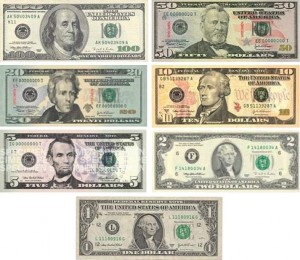
Money in the US has the picture of famous Americans on it (usually a president, but not always).  You need to know this to understand this headline.  For example, the $10 bill has a picture of Alexander Hamilton, our first Secretary of the Treasury.  So (informally) $10 bills are sometimes called “Hamiltons.”  Similarly, the $20 has a picture of President Andrew Jackson, a famous 19th century president and general – hence (for that reason), they are sometimes called “Jacksons.”

Here are the rest of the people who appear on US banknotes:

$1 – George Washington, first US president
$2 – Thomas Jefferson, 3rd president*
$5 – Abraham Lincoln, 16th president
$10 – Alexander Hamilton, first Treasury Secretary
$20 – Andrew Jackson, 7th president and general
$50 – Ulyssus Grant, 18th president and general
$100 – Benjamin Franklin, founding father and diplomat
* = Not commonly used

Although you will hear and read these terms, they are I think less popular now than they were 50 years ago, even though the pictures haven’t changed.  It is also not common to refer, for example, to the $1 bill as a “Washington,” although I suppose you could.  The $100 bill can be called either a Franklin or a Benjamin (or even “Benjie”).  It can also be called a C-note (C is the Roman numeral for 100).

The US no longer prints bills higher than $100.  They were last printed back in 1934, and are now rarely seen.

~Jeff

Posted in Life in the United States | 16 Comments

Drug Money

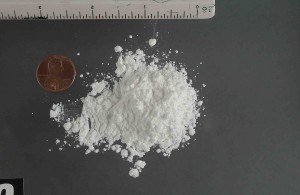
cocainehydrochloridepowderCocaine is a very addictive (something that you can’t stop doing or consuming once you start because it is so pleasurable) drug that became popular in the 1970s and 1980s and still is used by many today (I am told).  It is usually ingested (taken into the body) via (through) the nose in an action called snorting.  Sometimes (I’ve seen in the movies, at least) people take dollar bills (US paper money) and roll them up into a small circle, then place one end of the roll in their nose and the other to snort up (to draw into your nose by breathing in) the cocaine, much like a vacuum cleaner.   (A type of cocaine, called crack cocaine, or simply “crack,” is smoked instead of snorted.  Cocaine can also be injected with a needle, like other drugs, directly into your blood.)

The US is a major importer (a country that buys a product from another country) of this illegal drug, which has been the cause of so many problems in Latin American and the US.  A recent study reported in the New York Times found that 90% of all US banknotes (paper money) contains small amounts of cocaine.   The amount is very small, which we would call trace amounts.   Two years ago, a study found that 67% of banknotes in the US had traces of cocaine, so the amount has increased.

The researchers collected 230 bills from 17 different cities.  Washington, D.C. had the highest percentage of bills with cocaine among the cities surveyed.  For some reason, $5, $10, and $50 bills had more cocaine on average than $1 and $100 bills.

The US is not unique when it comes to (concerning) cocaine on banknotes.  Eighty percent of Brazilian bills have traces of cocaine, and about 20% of Chinese bills.

The researchers noted that there was not enough cocaine to cause any health concerns, and certainly not enough to get high (intoxicated, affected by the drug).   Nor does it mean that 9 out of every 10 bills in the US is being used to snort cocaine!  Cocaine is snorted as a fine powder (very small particles or pieces, like flour), and spreads easily from bill to bill in bill counting machines (machines banks used to count the number of bills quickly).

The New York Times headline for the article online was “Those Hamiltons and Jacksons Carry Some Cocaine.”   What is this all about?  More on that in my next blog post.

~Jeff

Posted in News and Current Events | 24 Comments

“As Time Goes By” from Casablanca

In this week’s English Cafe 203, Jeff talked about the classic movie Casablanca. The main hit (very popular) song from this movie was “As Time Goes By.”

The video below has a montage (collection of short videos edited together) from the movie.  There are spoilers (information that will tell you what happens in the story), so if you haven’t seen the movie yet and want to see it, you may only want to listen, and not watch the montage.

~ Lucy


“As Time Goes By”

(music and words by Herman Hupfeld; sung by Frank Sinatra)

You must remember this
A kiss is still a kiss, a sigh is just a sigh.
The fundamental (basic) things apply (is applicable; is relevant),
As time goes by.

And when two lovers woo (try to gain each others’ love)
They still say, “I love you.”
On that you can rely (depend)
No matter what the future brings,
As time goes by.

Moonlight and love songs
Never out of date (old-fashioned).
Hearts full of passion (strong emotion of love)
Jealousy (the emotion of wanting what others have) and hate.
Woman needs man
And man must have his mate (partner; lover; wife),
That no one can deny.

It’s still the same old story
A fight for love and glory (recognition for achieving something great)
A case of do or die (something that must be done, even though it is difficult and/or dangerous)
The world will always welcome lovers,
As time goes by.

It’s still the same old story
A fight for love and glory
A case of do or die
The world will always welcome lovers,
As time goes by.

Posted in Karaoke English | 27 Comments

Giving In to Guilty Pleasures

Guilty pleasures are things that we enjoy, but that we are embarrassed or ashamed that we like.  There can be guilty pleasures in all categories: food, TV shows, music, sports, and more.

In terms of food, one of my guilty pleasures is cake.  Other people like ice cream, chocolate, or candy.  I like cake–not the fancy kind at fancy bakeries, though I don’t mind those either.  I am perfectly happy with a plain white (vanilla) cake with frosting (a layer of sweet icing used to decorate the top and sides of cakes).  Chocolate cake is fine, too, but I don’t need fancy fruit, cream, or other fillings (food put inside of other food).  My favorite part of birthday parties, mine and other people’s, is having cake.  It’s something that I can never turn down (refuse), and I give in to (allow myself to do something I shouldn’t) my cravings (the wanting something very badly) all too often.

In terms of movies, I have a lot of guilty pleasures.  My guilty pleasures fall into two categories:
1) movies that I can watch over and over again (no, I won’t admit how many times I’ve seen them), and
2) bad movies that I enjoy.

Movies like “The Fugitive,” “Shawshank Redemption,” and “Roman Holiday” are ones I can watch time and time again (many times).  I usually catch them on lazy weekend afternoons, surfing the channels (using the remote control to move quickly through many TV channels).

Then, there are the bad movies.  There was a movie I saw on television when I was young called “Sooner or Later” about a teenage girl who falls for a handsome 17-year-old guy.  He is (of course!) the leader of a rock band, and she lies to him about her age so he’ll be interested in her.  Okay, everything about this movie is cheesy (embarrassingly bad and of poor quality)–the acting, the script, the music, the premise (basic idea).  Still, I can’t help enjoying myself when I watch the film now.  I’m sure it’s nostalgia (warm feelings for the past), but I’m not joking when I say it’s bad.

All right, now that I’ve confessed (admitted to something I’m not proud of or to something bad I’ve done) some of my guilty pleasures, will you confess some of yours?

~ Lucy

Posted in Life in the United States, Television and Movies | 25 Comments