What Can You Believe?

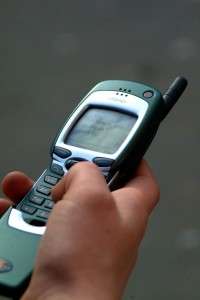
It happened again yesterday. My wife received an email with a subject line that shouted (said loudly), “Do NOT press 90# on your phone!”

Briefly, here’s what the email said: If someone calls you and asks you to enter 90#, don’t do it! If you do, the other person can use your phone account to make long distance calls – and you pay the bill! According to the email, people who claimed (say it’s true) to represent AT&T and other telephone service providers have been doing this.

As evidence (proof) that this is true, the email made several statements:

  • “I dialed ‘0’ to check this out, asked the operator, who confirmed that this was correct.”
  • “I also checked Snopes.Com [more about them later]. This is true, and also applies to cell phones!”
  • “The GTE Security Department requested that I share this information with EVERYONE I KNOW.”
  • “After checking with Verizon they also said it was true, so do Not dial 90# for anyone !!!!!”

Well, I tend to be a little skeptical (questioning) – some might even say cynical (suspicious; not believing) – when I see things like this. So I went to work. And I quickly discovered that almost everything in the email is false! The only phone equipment that might be vulnerable (easily attacked) to this scam (a dishonest plan; fraud) is an old kind of business phone system – called a PBX.

This email is a good example of what we call an urban legend. An urban legend is a story that is told to many people as if it were true, but it isn’t. Unfortunately, the people who repeat urban legends believe they are true and take them very seriously – the lady who sent the email to my wife also sent it to about 60 other people! Urban legends are spread (distributed) by word of mouth (one person telling another), and emails are a popular way to do that today.

Once urban legends get established (are accepted and shared by many) – today we might say “go viral” (spread quickly using technology) – it’s very difficult to stop them. This one has been making the rounds (going from person to person) for more than 10 years! I know of a few urban legends that have been around even longer than that.

I found most of my information at a website called Snopes.com – a good place to go if you suspect (feel; think) that something you hear is an urban legend. In fact, I discovered that the #-9-0 phone scam is on their Hottest Urban Legend list – the list of urban legends that people talk about and spread most often.

~ Warren Ediger – creator of Successful English, where you can learn more about how to improve your English!

Photo from FreeFoto used under Creative Commons license.

Posted in Life in the United States | 13 Comments

Is ESL Podcast Out-of-Date?

Hi Lucy,

I have a special question for you. I have been listening to your podcasts for almost six months. They’re all great. I think they improve my listening and vocabulary knowledge. But are your podcast scripts popular or out-of-date?

I ask because I listen to the news about how to speak English automatically and easily. It says to me that phrases or idioms which are not used in real conversation are being used in textbooks and grammar books in schools by teachers. We need the casual speech, informal idioms and phrases which are used in real conversation and daily common speaking. So what about this?

Thanks a lot for your great job always.
Miigaa
……

Dear Miigaa,

Thanks for your email and I understand your concern.  I try very hard to put into scripts only those terms that I think are commonly used in the U.S. today.  When I write a script, I often think to myself, “Would I say this?” or “Would I hear people on the street or in a supermarket use this expression?”  The nice thing about producing a podcast, rather than a textbook, is that we can change with the times (change according to current conditions).  At the same time, we don’t want our podcasts to be out-of-date or dated (seem old-fashioned) in just a few years, so the terms and expressions you hear are those that we think are commonly-used and that will not change significantly in the short term (in the immediate future).  So while I think our scripts reflect (represent) how people speak today, we try to avoid fleeting (not staying long) slang and fads, or things that are popular for only a short time. We may talk more about those terms in the blog, but they usually don’t make it into (are not included in) the scripts.

Here’s an example:  Right now, I hear people — especially young people on TV — using the word “sick,” which traditionally means being physically ill or in poor health, as an adjective to mean “great,” “fantastic,” or “incredible.”  Here are a couple of examples:
– “That new song is sick!”
– “You didn’t like that movie?  I thought it was sick!”
My guess is that in less than six to twelve months, we won’t hear this word used in this way anymore. It is for this reason that you won’t see it used in this way in a script.  “Sick” will remain, at ESL Podcast, what you pretend to be when you want to get out of (avoid) going to school or going to work.

I hope that answers your question and thanks for listening.

~ Lucy

Posted in Discussing the Episodes | 16 Comments

Podcasts This Week (August 2, 2010)

ON MONDAY
ESL Podcast 604 – Harming a Professional Reputation

In the Learning Guide: Get a full transcript (written version of every word you hear), vocabulary list and sample sentences, and comprehension questions.
In “What Else Does it Mean,” learn the other meanings of “to go under” and “retraction.”
In the “Culture Note,” learn about “Defenses Against Defamation Lawsuits.”
“In the United States, people can “sue” (take to court and ask to be paid money) for defamation, “claiming” (saying that something is true) that the “defendant” (the person who is brought to court and accused of a crime) “knowingly” (with full awareness and knowledge) lied…” – READ MORE in the Learning Guide

ON WEDNESDAY
English Cafe 253

Topics:  Chinatown; famous songs: Home on the Range; that way versus in that way versus in such a way; neither here nor there; suffer versus suffer from

In the Learning Guide:  Get a full transcript (written version of every word you hear).
In “What Insiders Know,” you will read about “Los Angeles Cultural Neighborhoods.”
“One of the benefits of visiting a large city like Los Angeles is its cultural “diversity” (having many kinds; having a lot of variety).  This diversity comes mainly from the immigrants who have come to “settle in” (come to live in) the Los Angeles area…” – READ MORE in the Learning Guide

ON FRIDAY
ESL Podcast 605 – Talking About Astronomy

In the Learning Guide: Get a full transcript (written version of every word you hear), vocabulary list and sample sentences, and comprehension questions.
In “What Else Does it Mean,” learn the other meanings of “space” and “star.”
In the “Culture Note,” learn about “The Most Notable Planetariums in the U.S.”
“A “planetarium” is a special theater with a “domed” (rounded) roof. Most planetariums are in museums and are used to present shows about astronomy, or just to teach people the names of objects in the “night sky” (the sky as it is seen at nighttime)…” – READ MORE in the Learning Guide

Please feel free to discuss this week’s episode by posting a comment.

Help us, help you (and others).  Please consider supporting ESL Podcast by becoming a Basic or Premium Member!

Posted in Announcements | 2 Comments

Summer Reading: What I’m Bringing to the Beach

In many countries, August is a popular time for vacations, and for me vacations have always meant (been associated with) reading lots of books. Here are some of the books that I have either read recently or plan on reading in the next few weeks.

These aren’t necessarily recommendations for your reading, since reading books in a second language depends on (is determined by) your general vocabulary, interests, and especially background knowledge (what you know already about a topic).  (Look here if you want to get some ideas on what to read in English.)  But I always enjoy hearing what other people are reading, so I thought I would share (tell you) some of my current “reads” (books).  (And, no, my list doesn’t include The Literacy Crisis: False Claims, Real Solutions, as featured in a recent Internet video.)

Some of the topics I’m interested in include economics, psychology, technology, productivity (how to use your time best in planning projects; how to get organized), Internet commerce (business), the art world, ancient Greek and Roman history, and financial planning (how to invest your money; practical advice on money matters).  Here’s my current list:

  • The Invisible Gorilla: and Other Ways Our Intuitions Deceive (trick; fool) Us by Christopher Chabris and Daniel Simons.  The authors of this book are psychology professors (I think at a little university called Harvard) who discuss recent research on the way we perceive (look at; see) and understand the world around us.  The book has a very broad range (covering many different topics), all of them related to the notion (idea) that the human mind isn’t always as powerful or as reliable (dependable) as we think.
  • 168 Hours: You Have More Time Than You Think by Laura Vanderkam.  This book falls into (is part of) the category of productivity, specifically time management.  There are 168 hours in every week, yet (however) many of us think that we don’t have time to do the things we want to do.  The author challenges (questions; criticizes) this idea by showing that people work less and waste more time than they realize.  (Note: Still reading this one — haven’t had time to finish it!)
  • Hamlet ‘s Blackberry: A Practical Philosophy for Building a Good Life in the Digital Age by William Powers.  Powers is a journalist who looks at how computers and the Internet have changed our lives and the way we relate and communicate with each other.  (Hamlet is a character from a play by Shakespeare of the same name, and a Blackberry is a kind of  “smartphone” that allows you to send email as well as make telephone calls.)  I just started reading this one, but it looks good.  (I should tell you that I typically read two or three books at a time (at the same time), which I probably shouldn’t do, but I get bored easily).
  • Why We Buy: the Science of Shopping by Paco Underhill.  This book, written about 10 years ago, uses what we may call an anthropological approach to understanding how people make their decisions when they go to a store to shop (to buy things).  Anthropologists observe how people act and react in a certain environment, and tries to describe and understand how and why they do what they do.  This book takes an experience common to all of us — shopping — and shows how the physical design of a store influences us in small but important ways.  Why We Buy is really a mix of economics, psychology, and anthropology, but written from the perspective (point of view) of a businessperson.  (It’s more interesting and less confusing than I’m making it sound (describing it).)

So, what are you reading, either in English or your own language?  Share with the rest of us your current reading list of either nonfiction (true events; not stories) or fiction (stories; novels) books.

~Jeff

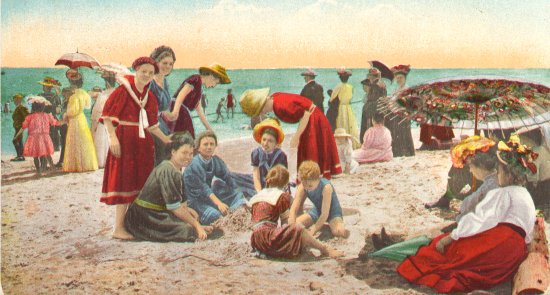
Illustration: “California Beach, 1905”  Wikipedia PD-US

Posted in Recommendations | 23 Comments

Podcasts This Week (July 26, 2010)

ON MONDAY
ESL Podcast 602 – Calling for an Ambulance

In the Learning Guide: Get a full transcript (written version of every word you hear), vocabulary list and sample sentences, and comprehension questions.
In “What Else Does it Mean,” learn the other meanings of “to black out” and “wound.”
In the “Culture Note,” learn about “Emergency Medical Technicians.”
“In the United States, “EMTs” (“emergency medical technicians”) are “healthcare providers” (people who provide medical care) who help sick and injured people before they can get to a hospital…” – READ MORE in the Learning Guide

ON WEDNESDAY
English Cafe 252

Topics:  Famous Authors: Raymond Chandler; the Pony Express; to be involved in versus to be involved with; to make sense; hard on its heels

In the Learning Guide:  Get a full transcript (written version of every word you hear).
In “What Insiders Know,” you will read about the “Pinkerton National Detective Agency.”
“In books and movies, the private investigator is often “portrayed as” (given the image of) a romantic character, involved in solving mysteries.  In real life, private investigators, or P.I.’s, are professionals who do a “wide array” (many different kinds) of work…” – READ MORE in the Learning Guide

ON FRIDAY
ESL Podcast 603 – Praising a Performance

In the Learning Guide: Get a full transcript (written version of every word you hear), vocabulary list and sample sentences, and comprehension questions.
In “What Else Does it Mean,” learn the other meanings of “number” and “lead.”
In the “Culture Note,” learn about “How Audiences Express Appreciation.”
“When an audience enjoys a performance, it has many ways to “express” (show) its appreciation. Depending on the type of performance, it can be “rude” (not polite) or inappropriate to show appreciation during the performance…” – READ MORE in the Learning Guide

Do you like listening to ESL Podcast?  Support us by becoming a Basic or Premium Member!

Posted in Announcements | 1 Comment

Obey the Sharrow!

As long as I can remember, I’ve had a bike (bicycle). I’ll never forget my first one, a Schwinn Phantom like the one in the photograph. My dad found it at an auction, a public meeting where items are sold to the person who offers the most money for them. It was in great shape (good condition) and we were able to get it (buy it) for only $15.00. They cost $85.00 in the bicycle shop!
We worked out an agreement: Dad would pay $7.50 and I would earn money to pay the other $7.50 by doing odd jobs (little regular jobs) around the house. At first, I was too short to sit on the saddle (seat). So until I became tall enough, I sat on a small pillow on the crossbar (the top tube of the bicycle frame.)

I rode that bike for many years until, finally, I gave it to my little brother. Later, I switched to a road bike, a bike with narrow (small) tires and designed for riding long-distances on smooth roads. Unfortunately, my bike-riding career came to an abrupt (sudden) end a few months ago when someone got into my garage and stole my nice road bike. Hopefully I’ll be able to replace it (get a new one) before too long (soon).

Two articles about bicycles grabbed (caught; got) my attention recently. The first was an article in the Los Angeles Times newspaper about the sharrows (see photo in article) that are being painted on streets used by both cars and bicycles in Santa Monica. Sharrows are a special kind of arrow, a symbol (a shape that has a meaning) painted on the street. Sharrows tell automobile drivers that they have to share the road with bicycle riders. I understand that sharrows are common in some European cities, but they are new in the United States.

Americans don’t use bicycles for commuting (riding to work) as much as people in other countries. But the number is growing, and many cities are creating bicycle lanes (a part of the road for only bicycles) or shared roads, like Santa Monica, to make bicycle commuting easier and safer. Irvine, a small city in southern California has almost 300 miles of bicycle lanes!

The second article, in the Economist, tells about the growing number of rent-a-bike services that are popping up (appearing) in cities around the world. In Mexico City, for example, the new Ecobici service provides about 1200 pay-as-you-go bicycles at 85 docking stations around the city.

A pay-as-you-go bicycle is a bicycle that you rent for each use, or trip, with cash or a credit card. A docking station is a machine that holds the bicycles and keeps them locked up until someone rents them. Perhaps you’ve seen docking stations at airports, where travelers use them to rent luggage carts. To rent a bicycle, you put your cash or credit card into the docking station, which then releases, or unlocks, one of the bicycles so you can use it. When you get to your destination (where you are going), you leave it at the nearest docking station so someone else can use it.

The London Transport Authority and Barclays Bank will introduce a new rent-a-bike program with 6,000 bicycles and 120 docking stations on July 30. The most successful program is the Velib in Paris, which has 20,000 bicycles. In some German cities you can even use your cell phone to rent a bike.

Who knows, if the bicycle commuting trend (the way a situation is changing or developing) continues to grow in Southern California, my next bike may be a commuter bike. In fact, I think I already know which one I want to get!

~ Warren Ediger – ESL tutor/coach and creator of Successful English, where you can learn how to acquire more English.

Photo by Wha’ppen used by permission under Creative Commons license.

Posted in Life in the United States | 8 Comments

Fifth Anniversary Video Podcast

Today is ESL Podcast’s five-year anniversary. It’s hard for us to believe that we have produced more than 600 ESL Podcast episodes and over 250 English Cafe episodes!

As always, we thank you, our wonderful listeners for sticking with (staying with; continuing with) us.  We would like to especially thank our donors and Learning Guide members, who are the true ESL Podcast heroes.  Without you, we could not do the work that we do.  Thank you for your continued support!

To celebrate our fifth anniversary, we have produced the Fifth Anniversary Video Podcast.  In it, you will see how Jeff spends his day. We hope you enjoy it!

~ Jeff, Lucy, and the entire ESL Podcast Team

Welcome to English as a Second Language Podcast’s Fifth Anniversary Video. You know, a lot of people ask me what I do for a living, and I tell them I’m a podcaster. And they say, “But, Jeff, what do you actually do all day?” This video will answer that question.

I’m up! I’m up! Time to work!

Well, I start my morning with my favorite drink, a good, hot tea at my favorite cafe, Starbucks. Here we go!

Oh, hi! I’m starting my day answering e-mail. Just let you finish this one e-mail.
?”Dear President Obama,
Thank you for your question.
If there is time I will explain the meaning of Mickey Mouse ears on our next English Café.” (He’s always writing me!)
“P.S. Please don’t write so often. I have a podcast to run.”

Well, that’s enough work for this morning. Let’s go get some lunch!

Well it’s lunchtime, and I’m hungry. You know, I always eat a healthy meal, nothing but the most healthy food for me. Here I go.

“Hello? Lucy! Oh, right…no, I’m working very hard. I’ve almost finished that podcast. Oh, absolutely! Oh, I’ll have it to you first thing in the morning. Okay, thanks for calling.” I can never get any sleep in this job.

Well, I’m done working now, and when I’m done working, I like to relax and watch my favorite baseball team, the Los Angeles Dodgers. I have my Los Angeles Dodgers cup, my hat, and of course my shirt. Baseball, as you know, is one of the great American sports, and I think, uh…goooooooooool!

Well, it’s evening time now and I try to relax a little by reading a good book. There are lots of good books out there. The one I’m reading is pretty interesting. It’s an excellent book and the author, I think, is, well, pretty smart.

Well it’s time for bed, but before I go, I want to thank all of you who listen to ESL Podcast. This is our fifth anniversary. I want to thank you for listening over the past year, and hope that you will continue listening for many more years to come. I especially want to thank our donors and our ESL Podcast Learning Guide members. These are the people who help make ESL podcast possible, so thank you especially to those of you who are members or donors.

I also want to thank Adriano, Jessica, Sue, Warren, and all the rest of our ESL Podcast team. A special thanks to our own Dr. Lucy Tse.

Well, it’s time for bed. We’ll see you next year!

Posted in Announcements | 33 Comments

The Dangers of Deforestation

Forests are large areas in nature with a lot of trees. When a lot of trees are removed from the forest, we call this deforestation.

Deforestation can occur for many reasons.  It may happen because of logging, the cutting down of trees so the wood can be used for building, for fuel (source of energy), and/or to make paper products. Deforestation may also occur when people want to use the land for other things, such as for homes or for pastures (land with green grass and plants) for livestock (animals raised for food or to work).

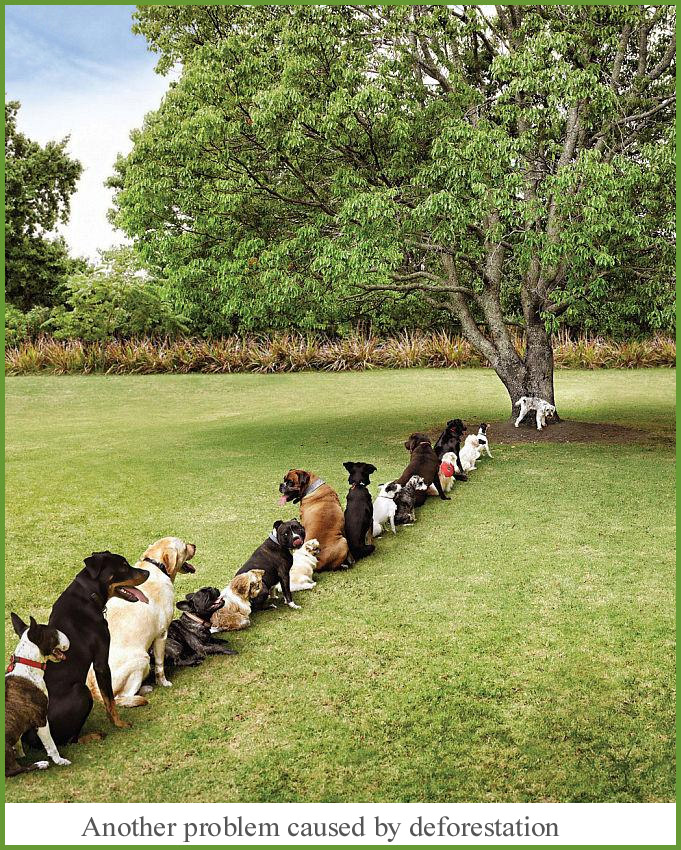
Environmentalists, people concerned with protecting nature and the environment, have long warned us about the negative effects of deforestation, including soil erosion, or the loss of soil (the layer of dirt where plants grow), and climate and air quality changes.

However, the follow photo shows another important negative effect of deforestation.  As the old saying goes:  “A picture is worth a thousand words.”

~ Lucy

*Thanks to Emiliano for the photo.

Posted in Jokes and Humor | 10 Comments

Podcasts This Week (July 19, 2010)

ON MONDAY
ESL Podcast 600 – Talking About Sight

In the Learning Guide: Get a full transcript (written version of every word you hear), vocabulary list and sample sentences, and comprehension questions.
In “What Else Does it Mean,” learn the other meanings of “sharp” and “to see double.”
In the “Culture Note,” learn about “The Use of Guide Dogs.”
“Many people who are blind or “visually impaired” (not able to see very well) use “guide dogs,” or dogs that have been “trained” (instructed; taught) to lead people around “obstacles”… – READ MORE in the Learning Guide

ON WEDNESDAY
English Cafe 251

Topics:  Ask an American: Obsolete; regarding versus concerning versus as for; can’t be bothered; How you doing?

In the Learning Guide:  Get a full transcript (written version of every word you hear).
In “What Insiders Know,” you will read about “Obsolete Audio and Video Formats.”
“As “audiovisual” (related to things that we watch and/or listen to) technology continues to change, many audio and video “formats” (the way something is packaged and used) are becoming “obsolete”…” – READ MORE in the Learning Guide

ON FRIDAY
ESL Podcast 601 – Paying an Unexpected Visit

In the Learning Guide: Get a full transcript (written version of every word you hear), vocabulary list and sample sentences, and comprehension questions.
In “What Else Does it Mean,” learn the other meanings of “to drop in” and “out with it.”
In the “Culture Note,” learn about high school graduates taking a “Gap Year” before continuing on to college.
“Traditionally, “college-bound” (planning to go to college) Americans “enroll” (begin a program) in a university in August or September, in the same year they graduate from high school. However, in recent years, more and more American teenagers are choosing to take a “gap year”… – READ MORE in the Learning Guide

Be an ESL Podcast hero!  Support us by becoming an ESL Podcast Basic or Premium Member!

Posted in Announcements | 1 Comment

Podcasts This Week (July 12, 2010)

ON MONDAY
ESL Podcast 598 – Suggesting a Nightcap

In the Learning Guide: Get a full transcript (written version of every word you hear), vocabulary list and sample sentences, and comprehension questions.
In “What Else Does it Mean,” learn the other meanings of “to slur” and “impression.”
In the “Culture Note,” learn about real “Nightcaps” worn by people in the old days.
“In this episode, a “nightcap” is an alcoholic drink drunken right before going to bed, usually to help one fall asleep. However, a “nightcap” is also a warm hat that used to be worn when people went to bed. Nightcaps were very common during the “Middle Ages”… – READ MORE in the Learning Guide

ON WEDNESDAY
English Cafe 250

Topics:  Comicon; Famous Americans:  Houdini; I just versus I have just; suit versus match versus fit; levity

In the Learning Guide:  Get a full transcript (written version of every word you hear).
In “What Insiders Know,” you will read about “The Magic Castle.”
“In Los Angeles, there are many “private clubs” that only allow certain people to become members and to participate in its activities.  One “unique” (special; unlike others) private club in Los Angeles that many people don’t know about is one for magicians…” – READ MORE in the Learning Guide

ON FRIDAY
ESL Podcast 599 – Shopping for Warm-Weather Clothes

In the Learning Guide: Get a full transcript (written version of every word you hear), vocabulary list and sample sentences, and comprehension questions.
In “What Else Does it Mean,” learn the other meanings of “skirt” and “figure.”
In the “Culture Note,” learn about “Dress Codes in American Schools.”
“Most American “public” (owned by the government, not by a private business) schools do not make students wear “uniforms” (a type and color of clothing worn by all people in a group). However, most schools do have “dress codes”… – READ MORE in the Learning Guide

If you enjoy our podcasts, please consider supporting ESL Podcast by becoming a Basic or Premium Member!

Posted in Announcements | 10 Comments