
Unwritten Rules

When I saw Angry Birds in the Field of Dreams, I chuckled (laughed quietly) to myself, thinking that Jeff had come up with a clever (unusual, interesting) title for something that had happened in a baseball game earlier that week. Well, it was a clever title, but about something else. That means I get to tell the “other” story about anger on the field of dreams (in baseball)!

Let me start with a little Sociology 101 (an introductory class in college often has the number 101). Beginning sociology students are usually introduced to norms – rules that identify behaviors (actions) that are acceptable or required in different situations. Norms tell us how to act when we’re together with other people. But norms are rarely written; they’re learned by experience and example as we live with a group of people. They’re what we call rules of thumb (general ideas from experience) for how to act with other people.

Let me give you a couple of (two) examples of norms. When you get into an elevator, you’re expected to turn around and face (look toward) the door, away from the other people in the elevator. If you walk into the elevator and face the people, we’d say that you had “violated (disobeyed) the norm.” You didn’t do what you were supposed to do in that situation. Here’s another example: in the U.S., you are expected to look at someone when you talk with them. If you look down or somewhere else, we’d consider you (think that you are) impolite.

Back to the field of dreams. You don’t need to know all about baseball to follow the story, but if you’d like to learn more about it, the Wikipedia baseball article is pretty good: read the first paragraph, then go down to the part called Rules and gameplay. And this article, What is Baseball, is helpful, too.

A couple of weeks ago the Anaheim Angels played the Detroit Tigers. The game featured (included as a special part) two of the best pitchers (players who throw the ball to players, called batters, who try to hit it) in baseball. Everyone expected the game to be a duel (contest or competition) between two pitchers who throw the ball so well that most batters have trouble hitting it. Many of us expected a low-scoring game, maybe even 1-0.

In baseball, one of the most exciting plays (actions) is the home run. A home run happens when a batter hits the ball so hard that it goes over the fence and out of the baseball park. When a batter hits a home run, he’s expected to drop his bat and run around the field, being sure to step on each of the four bases.

Near the beginning of the game, Magglio Ordonez from Detroit hit a home run. While he was running around the bases, Angel pitcher Jared Weaver shouted at him because he thought Ordonez wasn’t running fast enough. Bad mistake! Weaver broke (didn’t obey) the unwritten rule that says you have to show respect for the other teams’ players. He would argue (say), of course, that Ordonez’ slow running didn’t show him respect. If that’s true, Ordonez broke the same rule.

Weaver’s shouting at Ordonez angered Carlos Guillen, another Detroit player. So, when Guillen hit a home run later in the game, he stood and watched the ball for a while, then danced slowly for a few steps toward first base, looking at Weaver the entire time, before he ran around the bases. More disrespect! Another bad mistake!

One of the unwritten rules in baseball says that if a player does something bad to you, you have to retaliate, you have to do something bad to him or to one of his teammates, and that’s exactly what Weaver did: he threw the ball at the head of the next Detroit batter. Fortunately he missed, but he was ejected from (thrown out of) the game and has been suspended from (prohibited from playing in) six games. The suspension is bad news for the Angels, who are trying to get into the playoffs (the competition at the end of the regular season): Weaver is their best pitcher and they need him to play.

Every sport seems to have its unwritten rules. I’ve seen them in American football, soccer, baseball, and basketball. And it seems to me, unfortunately, that they often make young men act like little boys. What do you think?

~ Warren Ediger – creator of Successful English, where you can always find clear explanations and practical suggestions for better English.

Photo used courtesy of Wikipedia Commons.

Posted in Life in the United States | 19 Comments

Podcasts This Week (August 8, 2011)

Thank you to our members and donors!

We need your help to continue producing ESL Podcast. If you enjoy our podcasts, please consider supporting ESL Podcast by becoming a Basic or Premium Member!

…………

ON MONDAY
ESL Podcast 710 – Doubting One’s Language Use

In the Learning Guide: Get a full transcript (written version of every word you hear), vocabulary list and sample sentences, and comprehension questions.
In “What Else Does it Mean,” learn the other meanings of “to give (something) a shot” and “form.”
In the “Culture Note,” learn about “Idioms Related to Monkeys.”
“Modern American English has many idioms and sayings that seem to refer to monkeys. Today’s dialogue used, “monkeys will fly out of my butt,” but there are other monkey-related phrases that are even more common…” – READ MORE in the Learning Guide

ON WEDNESDAY
English Cafe 306

Topics: Ask an American: Health effects of city living; how do you say versus what do you call; résumé; to be over someone versus to be all over someone

In the Learning Guide:  Get a full transcript (written version of every word you hear).
In “What Insiders Know,” you will read about “Dystopian Films.”
“Many people “dream” (think hopefully; wish for) about “utopia,” or a society where everyone is happy and there is no war, fighting, or sadness. Other people focus on “dystopia”…” – READ MORE in the Learning Guide

ON FRIDAY
ESL Podcast 711 – A Difficult Place to Find

In the Learning Guide: Get a full transcript (written version of every word you hear), vocabulary list and sample sentences, and comprehension questions.
In “What Else Does it Mean,” learn the other meanings of “to make a pass” and “stretch.”
In the “Culture Note,” learn about “Hearst Castle.”
“Hearst Castle is a “mansion” (a large home for very rich people) on the California “coast” (land next to the ocean). Its construction began in 1919 and lasted almost 30 years. It was built for William Randolph Hearst…” – READ MORE in the Learning Guide

Posted in Announcements | 6 Comments

Angry Birds in the Field of Dreams

Baseball, as you probably know, is our national sport in the United States. Its influence can be seen in both popular culture (movies such as Kevin Costner’s Field of Dreams) and in the recreational (sporting; games) choices of Americans themselves. When I was growing up in Saint Paul, Minnesota, not only did children play baseball and softball (a type of baseball that uses a larger, softer ball), but adults did, too.  Nearly every large company or community organization had a softball team, and many had leagues (a group of teams that play each other frequently).  Team sports were part of adult culture, in the summertime especially.  Playing on a team was something you would do in your free time that connected you to your neighborhood and community.

Now, it seems, things have changed.  According to a recent article, the number of these amateur (not professional) sport teams has declined (decreased) dramatically (a large amount) in Minnesota and around the country (in the entire U.S.).  The number of adult softball teams is down (has declined) by more than 50% since the early 1990s.  Basketball teams are down 75%, and other team sports have experienced similar drops (declines).  What happened?

Some attribute (explain; give as the reason) the change to the way Americans are less “connected” to each other. Most people don’t know 15 other adults who’d want to form (start) a sports team together (I know I don’t).  For many, it’s just easier to jog or bike, activities that don’t require a group of people. People work more than the traditional 40 hours each week nowadays, some say, and so they don’t have time for playing on teams.

But part of the answer can also be found on your cellphone.  Video and cellphone games such as Angry Birds have started to replace physical sports as a relaxing pastime for younger adults. The amount of time adults spend on gaming (playing video games) has gone up at the same time team sports have gone down. It seems that many of us would rather kill imaginary birds than play in the real world.

~Jeff

Photo credit: Angry Birds Promotional Artwork, Wikipedia Fair Use

Posted in Life in the United States | 19 Comments

Google Doodles

File:Pacman10-hp.pngIf you’re a regular user of the search engine Google, you’re probably familiar with Google’s doodles. Normally, a doodle is a picture you draw or something you write when you’re not really paying attention, maybe while you’re bored in a class or a meeting, or talking to someone on the phone. Google’s doodles are a little different. They are creative versions of the Google logo (word and/or picture that represents a company).

The doodles began when the founders of Google, Sergey Brin and Larry Page, left the office in Northern California to attend the Burning Man festival in the state of Nevada.  (The Burning Man festival is one of the topics of this week’s English Cafe 305).  Before they left, they put up on the website a version of the Google logo with the symbol (picture representing something) of the festival behind it, with a note that said “Be back later.”  From that point on, someone going to the Google homepage on a holiday or a noteworthy (worth remembering) date might find a special version of the Google logo made for just that occasion. Last year, Google produced 271 doodles, often commemorating (remembering and showing respect for) the birthdays of important people, inventions (new things someone has created), movies, children’s shows, and of course, holidays.

Until recently, I didn’t know that many of the doodles were localized, intended just for a particular country or region.  Take a look at past doodles and you’ll see doodles created for many occasions and for many events and countries.  Some of them are quite amazingly creative (using original ideas; using the imagination), like the Pac-Man and Tetris doodles honoring the old video games that actually allowed you play.  If you like this type of creative design work, perhaps you could aspire to (wish for; hope one day to get) a job at Google.  There is now an entire branch (section; department) at the company with several full-time designers and engineers who create new doodles.

Looking at doodles past and present, do you have any favorites?

~ Lucy

Graphic Credit: “Pacman10-hp.png” from Wikipedia

Posted in Technology | 16 Comments

Podcasts This Week (August 1, 2011)

Get serious about improving your English. With the Learning Guide, you’ll get even more vocabulary, explanations, cultural information, and more.

Get the Learning Guide and support ESL Podcast by becoming a Basic or Premium Member today!

…………

ON MONDAY
ESL Podcast 708 – Trademarks and Logos

In the Learning Guide: Get a full transcript (written version of every word you hear), vocabulary list and sample sentences, and comprehension questions.
In “What Else Does it Mean,” learn the other meanings of “graphic” and “to associate.”
In the “Culture Note,” learn about “The U.S. Patent and Trademark Office.”
“The U.S. Patent and Trademark Office (USPTO) is the part of the U.S. government responsible for “granting” (issuing; making and giving out) “patents” and “registered trademarks”… – READ MORE in the Learning Guide

ON WEDNESDAY
English Cafe 305

Topics: Famous Songs: I’ve Been Working on the Railroad; Burning Man; irony versus sarcasm versus satire; agreement versus contract; to fall for (someone) versus to fall for (something)

In the Learning Guide:  Get a full transcript (written version of every word you hear).
In “What Insiders Know,” you will read about “Freighthopping.”
“Even with the “advent of” (invention of) airplanes, trains are still an important form of transportation across the United States.  One type of train is the freight train…” – READ MORE in the Learning Guide

ON FRIDAY
ESL Podcast 709 – Taking Someone for Granted

In the Learning Guide: Get a full transcript (written version of every word you hear), vocabulary list and sample sentences, and comprehension questions.
In “What Else Does it Mean,” learn the other meanings of “to leave” and “to please.”
In the “Culture Note,” learn about “Legal Separation.”
“Sometime married couples who are having “marital” (related to marriage) trouble choose to “file for” (legally request) “legal separation” before they “divorce” (officially end a marriage)…” – READ MORE in the Learning Guide

Posted in Announcements | 4 Comments

Let’s Go to the Mall!

Whether people intend (plan) to buy or only window-shop (look without buying), shopping malls have become popular destinations (places to go) around the world. “Let’s go to the mall,” is heard often in many households (people who live together, usually families) and many languages.


An article on The New Yorker web site tells the story of Victor Gruen, the man many people call the creator of the modern shopping mall. I was fascinated by his story and by the “science” of mall design.

Gruen grew up in Vienna. As a young man, he studied architecture (the design of buildings) during the day, and performed with his friends in cabarets (restaurants or clubs with live music and dance performances) in the evening. In 1938, he immigrated from Germany to the U.S. to escape Nazi persecution (cruel treatment) of the Jews. When he arrived in the U.S., he said he had “an architect’s degree, eight dollars, and no English.”

One day Gruen went for a walk in downtown New York and met a friend who wanted to open a leather-goods (products, like purses, made from leather) boutique (a small store selling fashionable products) on Fifth Avenue, a popular location for exclusive (fashionable and expensive) shops. Gruen agreed to design the shop and came up with a new idea that some called a “customer trap” – an area to attract customers and pull them into the store. Let me explain.

Up until this time, the fronts of most stores were flat. Gruen changed that. He created an open space outside at the front of the store – shaped like a “U” – with glass cases to display (show) the products. He also added special lighting and a special floor. Many customers who walked into this space – called an arcade – to look at the products continued into the store to buy something they first saw outside.

Gruen began his most famous project – Southdale in Edina, Minnesota – more than 50 years ago. It was the first of the modern malls. There were no windows on the outside; the fronts of all the stores faced (looked toward) the inside of the mall. The entire mall – with 72 stores – was under one roof and it was heated and air-conditioned. Gruen put the stores on two levels connected by escalators (moving stairs) and added two levels of parking outside the mall. In the middle of the mall he created a kind of town square with a fishpond, artificial (not live) trees, a cage of colorful birds, hanging plants, and a cafe. It was, according to news stories, a sensation (exciting, very interesting)!

I’m always fascinated by why things are done a certain way. The “science” of mall design used by Gruen – his reasons for doing things the way he did – has been borrowed and further developed (added to) by other mall designers. Here are some of the popular mall design ideas:

  • Always include two or more anchor stores – large, popular stores that will attract people to the mall. Put the anchor stores at opposite ends of the mall to create as much foot traffic (people walking) as possible for the smaller stores in between them.
  • Alfred Taubman, another mall designer, says malls should have two levels with escalators at each end. This allows a customer to come into the mall, walk along one level, take the escalator up or down, walk back along the other level, and easily return to his or her car.
  • Put the escalators at the end of the mall – near the anchor stores – so shoppers have to walk past more stores to get to them.
  • Taubman also puts more parking on the upper level than the lower level. “People flow like water,” he says. “They go down easier than they go up” and they’ll visit more of the mall if they start at the top level.
  • Make the handrails on the second level transparent (easy to see through) so shoppers can look through them and see all the stores.
  • Be sure the main corridors (where people walk) are no more than one-thousand feet (about 300 meters) long – if people have to walk farther than that, they lose interest in shopping.
  • Keep related stores near each other – for example, put a Johnson & Murphy shoe store near a Brooks Brothers clothing store where a man might buy a new suit so he can get everything he needs without walking far.

Modern designers have experimented with many new ideas. The next time you visit a mall, take time to look around. See if you can identify some of the things the designers have done to give you a good experience and, of course, to encourage you to buy … buy … buy …!

~ Warren Ediger – creator of Successful English, where you’ll always find clear explanations and practical suggestions for better English.

 Shopping mall photo by J. Franganillo used under Creative Commons license.

Posted in Life in the United States | 17 Comments

The 27 Club

This past Saturday, the singer Amy Winehouse was found dead in her apartment. Although the authorities (police and other government agencies) are still determining how she died, the singer had a long history with drug abuse (being addicted to or reliant on illegal drugs).  Amy Winehouse was 27 years old.

It’s tragic (very sad) that such a talented singer has died at this young age.  However, she’s not alone.  Also dying at 27 were  Janis Joplin, Jimi Hendrix, Jim Morrison, and Kurt Cobain.  This has been called “The 27 Club.”

Is there something about the magic number of 27?  Probably not, but one writer in the Washington Post suggested one reason we remember these singers:

“Their swirling mythologies congeal around a relatively small body of work. Many of these artists were young visionaries who left bold marks but didn’t live long enough to slide into mediocrity.”

Mythology is a set of stories about a person, place, or event that might explain why things are the way they are. For example, we all know about the Greek and Roman myths or mythology and in every culture there is a mythology about how the world was created.

To congeal means for a liquid to become more solid, often because the temperature has cooled.  This is what happens when I leave my dirty dishes in the sink overnight.  The next morning, the dishes have a congealed mess on them that I have to clean off.

A body of work is a collection of what an artist, musician, writer, or any person who does something creative produces over a period of time, often over one’s lifetime.  ESL Podcast’s body of work now includes over 1000 podcasts.

Many of those who died young and whom we still remember were considered visionaries, or people who have big and important ideas about what to do or what to create.  To leave a mark on something means to have a major influence on something or to affect something a lot.

Finally, to slide is to move smoothly over a surface, so to slide into mediocrity means to move without any difficulty or interruption over time into being average, or nothing special.

Amy Winehouse had produced only two albums (CD’s) before she died.  Her biggest hit was “Back in Black,” followed by a song called “Rehab,” which talked about her own troubles with drug use. When artists die young, we create our own mythology about who they were, what they represented, and why it happened.  Only time will tell (we’ll only know in the future) what type of mythology will develop about her.

Do you like or admire any other musicians, artists, actors, etc. for whom a mythology has developed?

~ Lucy

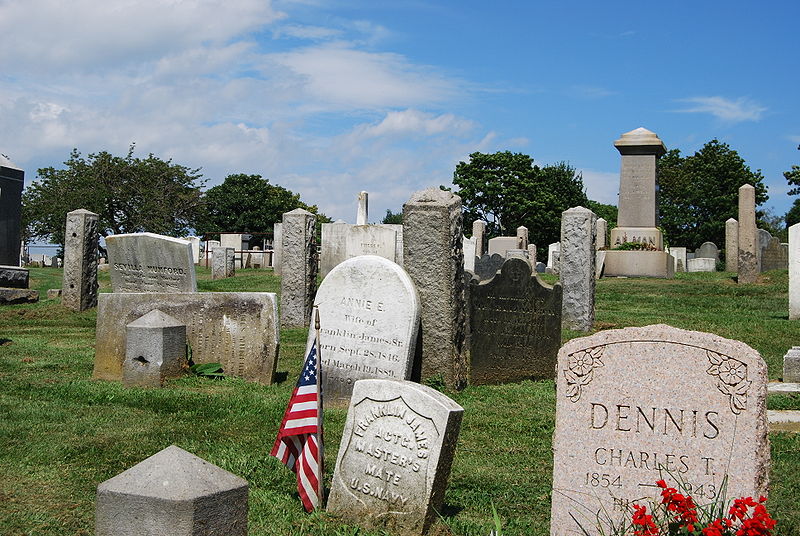
Photo Credit:  Newport Cemetery from Wikipedia


Posted in News and Current Events | 13 Comments

Podcasts This Week (July 25, 2011)

Get the most out of each podcast. Listening is helpful, but reading the Learning Guide as well will help you learn English even faster.

Get the Learning Guide and support ESL Podcast by becoming a Basic or Premium Member!
…………

ON MONDAY
ESL Podcast 706 – Feeling Ill from Food While Traveling

In the Learning Guide: Get a full transcript (written version of every word you hear), vocabulary list and sample sentences, and comprehension questions.
In “What Else Does it Mean,” learn the other meanings of “to guard against” and “some.”
In the “Culture Note,” learn about “Items Not Allowed to be Brought into the United States.”
“U.S. Customs and Border Protection (CBP) is the part of the U.S. government that “secures” (keeps safe) the nation’s “borders” (geographic lines between countries)…” – READ MORE in the Learning Guide

ON WEDNESDAY
English Cafe 304

Topics: American Presidents:  Bill Clinton; Louisiana Voodoo; articulation versus enunciation versus pronunciation; to start versus commence; I believe you versus I believe in you

In the Learning Guide:  Get a full transcript (written version of every word you hear).
In “What Insiders Know,” you will read about “Krispy Kreme Doughnuts.”
“While Bill Clinton was serving as the President of the United States, the “press” (news organizations) often mentioned his love of unhealthy foods, such as fried chicken.  The president “reportedly” (was said to) liked “doughnuts”… – READ MORE in the Learning Guide

ON FRIDAY
ESL Podcast 707 – Looking Back on One’s Life

In the Learning Guide: Get a full transcript (written version of every word you hear), vocabulary list and sample sentences, and comprehension questions.
In “What Else Does it Mean,” learn the other meanings of “to plan out” and “content.”
In the “Culture Note,” learn about “The Autobiography of Benjamin Franklin.”
“Benjamin Franklin was one of the “Founding Fathers” (one of the men who made important contribution to the country’s creation) of the United States. He made many important contributions to history, politics, science, and more…” – READ MORE in the Learning Guide

Posted in Announcements | 9 Comments

ESL Podcast’s Sixth Anniversary Video: The (Really) Serious Episode

Join us at English as a Second Language (ESL) Podcast in celebrating our sixth anniversary with our annual video episode! This one is called The (Really) Serious Episode, and when you watch it, you’ll see why.

Thanks to all of you who have listened to us the past year, and especially to those who have either donated money or become a member of ESL Podcast.  Your financial support is necessary for us to continue.  If you’re not a member, consider joining today.

Thank you again!

~Jeff, Lucy, and the ESL Podcast Team

P.S. The transcript for the video is below.


Video Transcript

Welcome to English as a Second Language Podcast’s Sixth Anniversary Video.  I’m your host, Dr. Jeff McQuillan, coming to you from the Center for Educational Development in beautiful Los Angeles, California.  We want to begin our episode by thanking you, our listeners.  We recently released our one-thousandth episode and we have thousands of you in almost every country around the world listening and improving your English.

Now, you may know that in the past, our anniversary videos have been funny, or tried to be funny.  But not this year.  This year, we’re going to do a serious anniversary video podcast.  It’s serious business learning English, and we thought that we should do a serious video podcast this year.

Now, before I do that, let me just say that some people have emailed us suggestions about things we should do.  People have emailed and said, “Oh, Jeff, you should wear a funny hat.  And you’re from Minnesota, maybe, maybe a Viking hat because the Minnesota Vikings are the Minnesota football team, a hat, something like this.  Well, I’m not going to do it.  I’m not going to wear a hat.  That’s just not serious.  It’s not dignified.

Where was I?  Oh, yes, I also to want to thank those who help us here at ESL Podcast:  Jessica, one of our writers and our customer service representative; Sue, our video editor and proofer; Warren Ediger of successfulenglish.com who writes blog posts for us; and Adriano, our wonderful webmaster.

Before I forget, some other people have emailed other suggestions, things they thought would be funny on our anniversary video podcast.  Some people said, “Oh, you should grow a mustache, you know, something, something maybe like this.  Oh, that would be funny.”  Well, it’s not funny.  As I said, this is a serious podcast episode and I’m not going to wear a mustache, mustache, just to be funny – not going to happen.

Our biggest thanks go to those of you who are members of ESL Podcast or who buy courses in our store.  Your financial support is absolutely necessary for us.  If you’re not a member, go to our website at eslpod.com and become a member and help us keep this podcast going.

Now, one more thing I got as a suggestion.  Someone who thought it would be funny if I sang on this video episode, as I have in some of our previous anniversary video podcasts.  They suggested I sing something by the Bee Gees, something like, you know, something like one of those horrible 70’s songs – [sings “How Deep is Your Love”]. No, that’s not going to happen.  I’m not going to sing the Bee Gees as part of this anniversary video podcast.

Finally, I want to thank Dr. Lucy Tse, our producer and scriptwriter, for her wonderful work this year.  Lucy also wanted to send a serious message as part of this episode. Lucy?

Thank you.  From Los Angeles, California, I’m Jeff McQuillan.  Thank you for listening.

Posted in About ESL Podcast | 42 Comments

Attention Nokia Owners: Get ESL Podcast on Your Phone!

If you own a Nokia phone, you can now download ESL Podcast audio files directly onto your phone with our new Ovi app. Go here for more information and to download the app onto your phone.  (If you like the app, please rate it five stars and write a good review for us!)

For iPhone users, you can simply access the podcast on iTunes.

For Android users, any program that can access an RSS file will work.  Try the Google Listen app.  You will need to enter our RSS feed address, which is:

http://feeds.feedburner.com/EnglishAsASecondLanguagePodcast

Happy listening!

~Jeff

Photo Credit: Nokia Store, Used with permission


Posted in About ESL Podcast | 7 Comments