Traveling California – Pacific Coast Highway

The Pacific Coast Highway (PCH) is certainly not the fastest way to travel from San Diego to San Francisco, but it is, without a doubt (certainly), the most scenic (with beautiful scenery, or views)! The PCH – California Highway 1 – is a narrow (small, not wide), two-lane highway that hugs (stays very close to) the coast (where the ocean touches the land) as it carries travelers 485 miles (780 km) from near San Diego, in southern California, almost all the way to San Francisco.

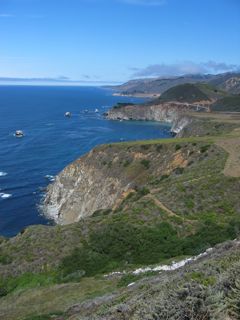
PCH is interrupted (stops for a short distance) occasionally as it winds (doesn’t travel in a straight line) its way up the coast. For the most part (usually), it treats (gives) patient (not in a hurry) travelers to beautiful views of the Pacific Ocean. It begins along the warm, sandy beaches of southern California and travels to Big Sur. There large waves crash (make a loud noise) on the rocks far below as the road hangs precariously (dangerously) from the cliffs (edge of mountain that goes straight down) near Ragged Point and crosses deep gorges (narrow valley with vertical sides) on bridges like the Bixby Creek Bridge.

In southern California, the views of the Pacific are punctuated (interrupted) by cities, like San Diego, Los Angeles, and Santa Barbara. As the PCH continues north, the cities and towns grow smaller. The view (what you see) is filled first with gentle hills and vineyards (where grapes grow) and, later, with rugged (rocky, rough) mountains and forests (place with many trees).

The PCH also carries the traveler through significant (important) moments (times) in California history. The California Missions Trail follows Highway 101, which runs parallel to (goes the same direction), and occasionally joins (comes together with) the PCH. Between 1769 and 1823, the Franciscans (followers of St. Francis of Assisi) established 21 Roman Catholic Missions (churches) beginning near San Diego and extending (continuing) all the way to Sonoma, north of San Francisco. Most of the missions have been preserved (saved; protected) and some, like Mission San Juan Capistrano, between San Diego and Los Angeles, give tourists a very real taste (experience) of what life was like in California more than 200 years ago.

If you’d like to begin to explore the PCH for yourself, start with this short video, then check out (look at) Driving California’s coast in 10 days from the Los Angeles Times or Pacific Coast Highway California from the National Geographic Traveler.

To really experience the PCH, however, you have to come to California, rent a car, and try it for yourself!

~ Warren Ediger – ESL tutor and coach, creator of Successful English, where you can learn more about how to improve your English.

photo of California coast near Ragged Point by W. Ediger

Posted in Life in the United States | 12 Comments

Queen – “We Are The Champions”

As Jeff has mentioned before, the sport of soccer is not as popular in the United States as other sports.  (The sport is, of course, called “football” in British English.)  The most popular professsional sports here are football (American), basketball, and baseball.  However, the U.S. has many residents (people who live in a place) who are from other countries and many people in countries around the world are very excited about the FIFA World Cup, the most important international soccer tournament (a competition which begins with many teams and ends with one team as the winner) in the world.  And if you are a soccer fan then you know that the 2010 World Cup begins June 11 and ends July 11, when we’ll know which team is the champion (winning) team.

If the winner is the United States — yes, I know that’s a long shot (a small possibility, a very, very, very, very, very small possibility!!) — the players may sing “We Are The Champions” by Queen.  This is a very popular song played or sung in the U.S. when people celebrate a victory (win), especially in sports.  If you know the lyrics (words), you probably know why.  If you don’t, take a look at them below.  If you’re not already in the mood (state of mind or feeling) to cheer on (send encouragement to) your favorite team, then maybe this song will help.  I know that those of you who are rabid (extreme; crazy about something) soccer fans don’t need anything more to help get you in the mood for the World Cup.

But who will win?  Which team will be able to say, “We are the champions?”

~ Lucy

We Are The Champions
by Queen

I’ve paid my dues (earned something through hard work or suffering)
Time after time (again and again)
I’ve done my sentence (completed my period of punishment)
But committed no crime
And bad mistakes
I’ve made a few
I’ve had my share of sand (very small bits of rock found at the beach) kicked in my face (“sand kicked in my face” = had obstacles; met people who did not respect me)
But I’ve come through (passed through or survived a period of difficulty)

We are the champions, my friends
And we’ll keep on fighting ’til the end
We are the champions
No time for losers
‘Cause we are the champions, of the world

I’ve taken my bows (bent at the waist, leaning forward, after a performance to acknowledge people’s applause and cheers)
And my curtain calls (after a performance, for the audience to continue clapping to encourage the performers to come back on stage to receive the audience’s appreciation)
You brought me fame (being known to a lot of people; being famous) and fortune (money) and everything that goes with it
I thank you all

But it’s been no bed of roses (easy thing)
No pleasure cruise (vacation on a large ship)
I consider it a challenge before the whole human race (all the living people in the world)
And I ain’t gonna lose

We are the champions, my friends
And we’ll keep on fighting ’til the end
We are the champions
No time for losers
‘Cause we are the champions, of the world

Posted in Karaoke English | 27 Comments

Podcasts This Week (June 7, 2010)

ON MONDAY
ESL Podcast 588 – Hiring Business Consultants

In the Learning Guide: Get a full transcript (written version of every word you hear), vocabulary list and sample sentences, and comprehension questions.
In “What Else Does it Mean,” learn the other meanings of “to call the shots” and “to contract.”
In the “Culture Note,” read about “Advice for Hiring Consultants.”
“Companies can “benefit” (receive advantages) in many ways when they hire consultants, but they have to make sure they hire consultants in the right way…” – READ MORE in the Learning Guide

ON WEDNESDAY
English Cafe 245

The Grand Canyon; Famous Americans: Georgia O’Keefe; shanty versus apartment versus tenement; alert the media; now what?

In the Learning Guide:  Get a full transcript (written version of every word you hear).
In “What Insiders Know,” you will read about “Sedona, Arizona.”
“After visiting the Grand Canyon, many visitors choose to visit other interesting places nearby.  Some choose to drive about six hours west to the exciting city of Las Vegas, Nevada, for some “gambling”…”
– READ MORE in the Learning Guide

ON FRIDAY
ESL Podcast 589 – Having Skin Problems

In the Learning Guide: Get a full transcript (written version of every word you hear), vocabulary list and sample sentences, and comprehension questions.
In “What Else Does it Mean,” learn the other meanings of “to start out” and “mole.”
In the “Culture Note,” learn about “Common Types of Skin Products.”
“People use many different “beauty products” (products designed to make one more beautiful) to treat skin “blemishes” (unwanted, unattractive marks) and improve the “condition” (state; health) of their skin…”- READ MORE in the Learning Guide

If you enjoy our podcasts, please consider supporting ESL Podcast by becoming a Basic or Premium Member!

Posted in Announcements | 1 Comment

Podcasts This Week (May 31, 2010)

ON MONDAY
ESL Podcast 586 – Getting a Girlfriend/Boyfriend Back

In the Learning Guide: Get a full transcript (written version of every word you hear), vocabulary list and sample sentences, and comprehension questions.
In “What Else Does it Mean,” learn the other meanings of “cause” and “within reason.”
In the “Culture Note,” learn about “How Americans Parents Select a Child’s First Name.”
When Americans are “expecting a child” (pregnant and waiting for the birth), they spend a lot of time “picking” (choosing) names. Some people pick “family names” (names of relatives); others use “baby name books”…” – READ MORE in the Learning Guide

ON WEDNESDAY
English Cafe 244

Topics: Ellis Island; The Rat Pack; lots of versus a lot of; sleep versus asleep, wake versus awake, rise versus arise; alpha male

In the Learning Guide:  Get a full transcript (written version of every word you hear).
In “What Insiders Know,” you will read about “Angel Island.”
“Ellis Island is the most well known location for “incoming” (entering) immigrants to the United States, but it was not the only place where immigrants legally entered the country.  A “lesser-known” (less well known) “entry point” (place where people enter a place) for immigrants is an island in San Francisco called…” – READ MORE in the Learning Guide

ON FRIDAY
ESL Podcast 587 – Feeling Disillusioned

In the Learning Guide: Get a full transcript (written version of every word you hear), vocabulary list and sample sentences, and comprehension questions.
In “What Else Does it Mean,” learn the other meanings of “to shatter” and “to picture.”
In the “Culture Note,” learn about “Ways that Fans Show Their Admiration.”
“Fans” (people who like, love, and admire someone or something very much) can “show” (demonstrate) their admiration in many ways. In the past, fans “were limited to” (had no options other than) sending “fan mail,” or letters written to their idols…” – READ MORE in the Learning Guide

If you enjoy our podcasts, please consider supporting ESL Podcast by becoming a Basic or Premium Member!

Posted in Announcements | 5 Comments

Who’s Talking About What, and Where are They?

If you enjoy words and have some time, you might want to hang out (spend time) at www.lexicalist.com for a while.
Lexicalist calls itself a “demographic dictionary of modern American English.” You won’t learn much about the meanings of words there, but you will find out who’s talking about what and where they’re doing the talking. It’s a lot of fun!

Demographics refers to groups of people that are a part of the total population. One common demographic would be gender – men and women. Age group would be another demographic – people from 12-17, 18-24, 25-34, etc. Geography is another demographic – people who live in California, Kansas, or Kentucky, for example.

According to Lexicalist, their computers read “through millions of words of chatter (talk, often about unimportant things) on the Internet to analyze how certain demographics talk and what kinds of things they talk about.” Currently (at this time) they break this information down (divide the information) into three kinds of demographics: gender, age, and geography.

Let’s try a Lexicalist search and see what happens. Jeff and I have been talking about the Apple iPad recently. Let’s see if he and I are the only ones.

I typed “apple ipad” into the search window, clicked on “Search Keyword,” and found … some surprises! Here’s what I found:

  • People are talking about Apple iPads 55% less today than they were a month ago. This is what we call a trend (the direction something is changing). Lexicalist tells you if people are talking about something more, less, or the same as they were one month ago.
  • A map of the United States that shows where people are talking about Apple iPads. If a state is light blue, more people are talking about something. Dark blue is less, and black is even less. If I click on the map, I see a table (rows and columns of names and numbers, like a spreadsheet) that shows me how many people in each state are talking about the iPad. I was surprised that more people are talking about the iPad in Oregon than in California. Obviously, they didn’t count Jeff or me!
  • A pie chart (information arranged like a picture) that compares the number of men and women talking about the iPad. A pie chart looks like it sounds and is a good way to compare parts of the whole (the total is always 100%). Is it really possible that more women are talking about the iPad than men? I’m not sure about that!
  • A bar chart that compares the number of people in each age group that are talking about the iPad. The length of each bar (a colored rectangle) shows how many people in one age group are talking about the iPad compared to people in other age groups. It looks like people from 45-64 are talking about the iPad more than anyone else. Once again, if you click on the chart, you’ll see a table with the numbers that were used to make the bar chart.

Take a minute to check out (look at) Lexicalist. Try comparing the three slang expressions they have on the home page – omg (oh my gosh or oh my god), bruh (brother or friend), and groovy (cool). I smiled when I saw the ages of people using “omg” and “groovy,” and where they use “bruh.”

What words did you try? Did you discover anything interesting or surprising?

~ Warren Ediger – ESL tutor and coach, creator of www.successfulenglish.com where you can learn more about how to improve your English.

Posted in Language & Terms | 10 Comments

Podcasts This Week (May 24, 2010)

ON MONDAY
ESL Podcast 584 – Calling in Sick to Work

In the Learning Guide: Get a full transcript (written version of every word you hear), vocabulary list and sample sentences, and comprehension questions.
In “What Else Does it Mean,” learn the other meanings of “to come down with (something)” and “row.”
In the “Culture Note,” learn about “How Sick Leave Works in the U.S.”
“Many American workers are “entitled to” (allowed to have) sick “leave” (absence from work for a short period of time), also known as medical leave…” – READ MORE in the Learning Guide

ON WEDNESDAY
English Cafe 243

Famous TV Animals; Niagara Falls; closed caption versus subtitle; meanwhile versus meantime; using the colon (:)

In the Learning Guide:  Get a full transcript (written version of every word you hear).
In “What Insiders Know,” you will read about “Top U.S. Honeymoon Destinations.”
“In this episode, we talked about Niagara Falls as a favorite “destination” (place to go) for honeymooners.  Other top honeymoon destinations…” – READ MORE in the Learning Guide

ON FRIDAY
ESL Podcast 585 – Being Clear or Confusing

In the Learning Guide: Get a full transcript (written version of every word you hear), vocabulary list and sample sentences, and comprehension questions.
In “What Else Does it Mean,” learn the other meanings of “for once” and “detail.”
In the “Culture Note,” learn about “Storytelling Festivals.”
“In the United States, there are many “storytelling” (the art of sharing stories orally, without using written information) “festivals” (fairs; celebrations and competitions).” – READ MORE in the Learning Guide

If you enjoy our podcasts, please consider supporting us by becoming a Basic or Premium Member!

Posted in Announcements | 1 Comment

How Children Get Their Last Name

In a recent post, I talked about women’s last names and what happens when they marry or divorce.  In this post, I’ll talk about how children get their last names.

There are no laws governing (controlling) how parents can and should name their children.  However, the social convention (what is generally done in society) is for the children to be given the last name of the father.  If the wife also changes her name to the husband’s after they marry, then every member of the nuclear family (parents and children) has the same last name.  In the U.S., many American men grow up feeling a strong cultural pressure to pass their last names on to their children.

That is the traditional way children get their last name.  However, these days (now), many people choose to name their children in non-traditional ways for a variety of reasons.

First, some people now feel the old naming traditions are sexist (biased against women).  If a woman does not change her name after marriage, the couple may decide to put their last names together in naming their child, with or without a hyphen (dash; “- “). For example:
Mother:  Marlena Ono
Father:  Curt Smith
Child:  Raymond Ono-Smith/Smith-Ono or Smith Ono/Ono Smith

When an unmarried woman has a child, the child is often given the mother’s last name.  It’s the parents’ choice, of course, but when the mother is unmarried she sometimes makes the choice with less (or no) influence from the father.  In the past, there was a strong social stigma (shame; dishonor) involved with having a baby without first getting married, but today, there is far less stigma or no stigma at all.  In this case, Marlena Ono’s child would be named Raymond Ono.

In the United States, gay couples are almost always legally unmarried because gay marriage is legal in only a few states.  Gay couples often give their children both of their last names, with or without a hyphen.  A few gay couples may give one parent’s name to the first child, and the other parent’s name to the second, but this is not common.

When parents get divorced, there are many options and it is up to (decided by) the child’s parents.  If the mother changed her name when she married, she may change it back to her maiden name (woman’s last name before marriage) after a divorce.  The parents sometimes choose to have the children keep the father’s name, even if the children live with the mother.  If the mother remarries, she may or may not change her name again, and her children may or may not take the name of their stepfather (the man who is not their biological father, but who marries their mother).  It is more likely that the children will change their name to the stepfather’s if the stepfather adopts the children, making the child legally his son or daughter.

As you can see, naming a child is not a cut-and-dried (completely clear and decided) matter. However, a majority (most) of people have their father’s last name, so that’s what most people assume is the case (is the situation; to be this).

~ Lucy

Posted in Life in the United States | 14 Comments

Podcasts This Week (May 17, 2010)

ON MONDAY
ESL Podcast 582 – A Parent-Teacher Conference

In the Learning Guide: Get a full transcript (written version of every word you hear), vocabulary list and sample sentences, and comprehension questions.
In “What Else Does it Mean,” learn the other meanings of “to work on” and “subject.”
In the “Culture Note,” learn about “How to Prepare for a Parent-Teacher Conference.”
“A parent-teacher conference is a great opportunity for parents to have a “one-on-one” (personal; individual) discussion with their child’s teacher…” – READ MORE in the Learning Guide

ON WEDNESDAY
English Cafe 242

Preventing Violence in Schools Post Columbine; American Territories: U.S. Virgin Islands; although versus even though; lite; rate versus rank

In the Learning Guide: Get a full transcript (written version of every word you hear).
In “What Insiders Know,” you will read about “The Television Show: Jackass.”
“American parents have many things to worry about, including violence in schools.  Many are also concerned about violence in the “media””…- READ MORE in the Learning Guide

ON FRIDAY
ESL Podcast 583 – Going to a Spa

In the Learning Guide: Get a full transcript (written version of every word you hear), vocabulary list and sample sentences, and comprehension questions.
In “What Else Does it Mean,” learn the other meanings of “wrap” and “to calm (one’s) nerves.”
In the “Culture Note,” learn about the different types of “Workers at a Spa.”
“A “typical” (common; normal) spa has many different types of employees who work together to create a “luxurious” (beautiful, comfortable, relaxing) pampering experience…” – READ MORE in the Learning Guide

If you enjoy our podcasts, please consider supporting us by becoming a Basic or Premium Member!

Posted in Announcements | 3 Comments

Politics as Usual?

Maybe you haven’t noticed, but Americans are often very idealistic. What I mean is this: many Americans, maybe most Americans, believe that you should try to live according to high principles (beliefs about what is right and wrong) even if it’s not always possible or practical (realistic).

If you are familiar with American history, this shouldn’t be a surprise. The first official document, The Declaration of Independence, is very idealistic. Before the writers of the Declaration listed their grievances (complaints) against the king of England, they made these idealistic statements:

  • Everyone is equal (no one is better, or should be treated differently, than anyone else).
  • Everyone has certain rights (something you are morally, legally, or officially allowed to have or do) that can’t be taken or given away – the right to life, the right to liberty or freedom, and the right to pursue (find and work for) happiness.
  • The purpose of government is to guarantee and protect these rights.

If you listened to the first speech Barak Obama gave after he became president, you might remember that he was very idealistic. He called for an end to the politics of “petty grievances” and “worn-out dogmas.” A petty grievance is something small and unimportant that upsets you and a worn-out dogma is a strong belief that is too old to be used any more. Clearly, he hoped that the Republicans and Democrats would stop quarreling (arguing) and begin to work together.

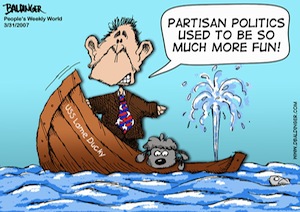
It didn’t take long for the idealism to disappear! For example, the new health care law was passed only after a lot of disagreement and argument. There was very little real discussion and cooperation. The law passed because the Democrats, President Obama’s party, had enough votes to win without help from the Republicans. It was a partisan decision (supported by only one political party), not bi-partisan (supported by both parties).

Many Americans were upset and disappointed because the two parties weren’t able to work together. In some countries, this would be politics as usual (the way politics is always done).

Should Americans have been surprised? What does history tell us? I found two interesting articles, one from a web site called History Now and the other from the Richmond (Virginia) Times-Dispatch (newspaper) web site. After reading the two articles, I don’t think Americans should have been surprised, even if they were disappointed. Partisan politics may be bad now, but it’s not new, and in the past it might have even been worse.

In the history of the U.S., there are many examples of partisan politics. In the early years, the 1800s for example, there was even occasional physical violence (fighting and hurting each other’s body) among the politicians. According to the Times-Dispatch article, the only time we have enjoyed bi-partisan politics was during World War II and the Cold War (between the Soviet Union and western countries, especially the United States).

Like President Obama, George Washington, our first president, called for the political parties to work together. He warned that there would be extremely negative results if they didn’t. The American political system may not be as ideal as Presidents Washington and Obama and many Americans would like it to be. Partisan politics may be politics as usual, even in the U.S.

~ Warren Ediger – ESL tutor/English language coach and creator of successfulenglish.com, where you can learn more about how to improve your English.

Cartoon by dbaldinger used with permission.

Posted in Life in the United States | 8 Comments

Podcasts This Week (May 10, 2010)

ON MONDAY
ESL Podcast 580 – Retiring From a Job

In the Learning Guide: Get a full transcript (written version of every word you hear), vocabulary list and sample sentences, and comprehension questions.
In “What Else Does it Mean,” learn the other meanings of “package” and “after.”
In the “Culture Note,” learn about what “What Americans Do After Retirement” that may be surprising to you.
“Americans can choose to do many things after they retire. Some workers imagine a retirement filled with “sleeping in” (sleeping until late in the morning), reading, and resting, but most of them soon “tire” (get tired) of the “monotony” (the same things happening the same way over and over again)… – READ MORE in the Learning Guide

ON WEDNESDAY
English Cafe 241

Ask an American: The Princess and the Frog; pronouncing “address;” to cut the bull/ bullsh*t; outspoken versus vocal

In the Learning Guide:  Get a full transcript (written version of every word you hear).
In “What Insiders Know,” you will read about “Lesser-known Fairytale Princesses.”
“Sleeping Beauty, Snow White, and Cinderella are all well-known fairy tale princesses, but others are “lesser-known” (not as well known), and you may not even have heard their stories.  In The Princes and the Pea, for example, a prince wants to marry, but cannot find a “suitable” (appropriate) “bride” (wife)… – READ MORE in the Learning Guide

ON FRIDAY
ESL Podcast 581 – Reading a World Map

In the Learning Guide: Get a full transcript (written version of every word you hear), vocabulary list and sample sentences, and comprehension questions.
In “What Else Does it Mean,” learn the other meanings of “map” and “to scale.”
In the “Culture Note,” learn about the controversy over “Google’s Street View” feature.
“Google has an “impressive” (surprising in a good way) map service called Street View. It lets Internet users type in an address and see photographs taken from the street. This can be helpful when people want to know what a neighborhood looks like, but it has also “raised” (caused; brought up) “concerns” (worries) about “privacy””…- READ MORE in the Learning Guide

If you enjoy our podcasts, please consider supporting ESL Podcast by becoming a Basic or Premium Member!

Posted in Announcements | 3 Comments