In today’s podcast, ESL Podcast 320 – Micromanaging the Staff, we talk about the verb “to butt in.” Butt is what we informally call the part of the body that we sit on, so it’s important to use phrases with butt in it carefully. In the “What Else Does it Mean?” section of today’s Learning Guide, we talk about other meanings of “to butt in,” and also “to butt out” and “to butt heads.” Jeff and I never butt heads while working on the podcast. If you believe that, I have some magic beans I would like to sell you.
Another phrase that uses the word “butt” is: to be the butt of a joke. To be the butt of a joke means that someone else told a joke that makes you look bad or silly, and the joke is on you. Nobody likes being the butt of a joke, especially if they’re just minding their own business (not concerning themselves with other people’s business).
If you own a Nokia cell phone, you can now listen to ESL Podcast right on (directly on) your phone! Nokia has a piece of podcasting software that allows you to listen to various podcasts on your phone.
To get the software, simply go to this page and click on the Download Nokia Podcasting button and install on your phone.
In today’s Cafe, I talk about how to become a teacher in the U.S. One of the problems I didn’t talk about is attrition (the loss of something, sometimes slowly). Teacher attrition happens when teachers quit their jobs and start a new career. This is a huge problem in the U.S., since as many as 50% of all teachers leave teaching in their first five years. Some leave because the pay is not very high, but many leave due to the stress involved in being a teacher nowadays.
An article earlier this week in the New York Times discusses this problem and some possible solutions for it. One solution is to start teacher education students in front of the classroom (teaching) right away, instead of waiting until the end of their training.
Today’s podcast, ESL Podcast 318, is about writing a love song. If you’re like me, you don’t know how to write a love song, but maybe you’re in the mood for (have a feeling of wanting)for love. If so, here’s some Frank Sinatra to make your Monday go by a little easier.
~ Lucy
Fly Me to the Moon
Fly me to the moon
And let me play among the stars.
Let me see what spring is like
On Jupiter and Mars.
In other words, hold my hand
In other words, baby, kiss me.
Fill my life with song
And let me sing forevermore.
You are all I long for
All I worship and adore.
In other words, please be true
In other words, I love you.
_____________
forevermore = forever; always to long for (something) = to have a strong wish or desire for something to worship = to love and deeply respect, usually a god to be true = to be faithful; to love only me
In Wednesday’s English Cafe 109, Jeff invited me to talk about Tucson, Arizona, where I grew up. Although I moved away many years ago, I still miss many things about Tucson.
The one thing I miss the most is the beautiful, breathtaking (amazing quality) sunsets. The blue skies of the day turn into paintings of yellows, oranges, reds, and purples. No picture I can find can do justice to them to show what they really look like, but some evenings can look like this:
In the Cafe, I also mentioned the rodeo. Here is what a rodeo in Tucson looks like:
As you can see, people sit in the grandstand, the seating area around the field, to watch the horse and other animal demonstrations and competitions. Here, two riders are trying to rope or to capture with a rope, a wild cow.
Other competitions include trying to ride a wild bull (male cow) or a wild horse, called a bronco. So if you’re a good horse rider, you may want to give next year’s rodeo a try!
Today is Halloween, which most American children celebrate each year. If you aren’t sure about Halloween and how it is celebrated in the U.S., listen to ESL Podcast 73, where I talk about how kids celebrate Halloween. Halloween isn’t an official holiday, but it is very popular.
If you want to scare someone, you can use the expression “Boo!” today (it’s pronounced like “do”). Or, you can just show them my picture.
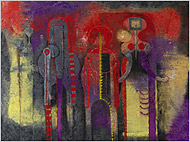
I read a fascinating (very interesting) story in the New York Times last week. A woman who lives in New York City was walking down the street one day when she saw a painting among some garbage bags on the sidewalk in front of a upscale (high class; wealthy) apartment building. It was a very large painting and she lived in a small apartment, but she really liked it and decided to take it home. She didn’t think the painting was worth any money and she kept it for three years before she found out that it was valuable, very valuable.
The painting had been stolen from a family in Houston, Texas, who had bought it for $55,000. For 20 years, no one knew where the painting was and it was considered a missing masterpiece (great piece of art). It is called “Tres Personajes” by famous Mexican artist Rufino Tamayo. The woman who found the painting only discovered it was famous when she did some research about the painter, whose name is on the painting.
The painting is now estimated or valued at $1 million. It was returned to the widow (woman whose husband died) from whom it was stolen and will be auctioned off next month at a public sale where the person who gives the highest price will get it. The woman who found it got a reward from the family and a small fee from the auction company that will be auctioning it off.
So the next time you see a painting in the garbage, think twice before you pass it by. Who knows? It may be another missing masterpiece.
In today’s podcast, we talk about going to the park and finding a nice spot, or small place, to enjoy the scenery and nature. We mention in the “What Else Does it Mean?” section of the Learning Guide that “spot” can have a lot of different meanings, both as a noun and a verb, and in idioms like “to put (someone) on the spot.”
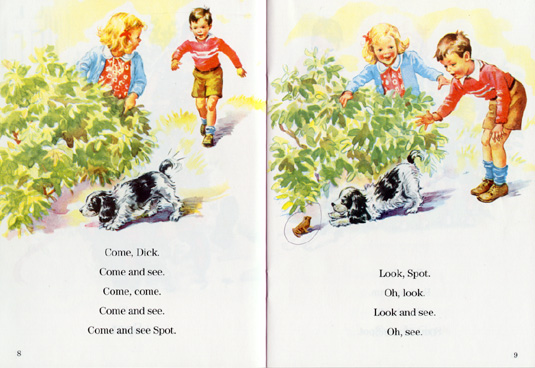
If you ask an average American what they think of when they hear the word “spot,” you may get a surprising answer: a dog. That’s because “Spot” is the name of a dog in a series of readers or short books used in schools with a boy and girl named Dick and Jane. They had a dog named Spot. These readers were used in schools mainly from the 1930s to the 1970s. These books were well known for their repetition, like this:
These books have been criticized over the years for being too focused on language skills and not on helping children learn to enjoy reading. Teachers and other educators–including Jeff and me–also say that these readers have poor language and uninteresting stories. In fact, some of the language is nonsensical (does not make sense). We do not recommend these readers to people learning English at any level, but they are a part of popular culture in the U.S.
Now when you see a dog or other pet in American movies and TV shows named Spot, you’ll know why, and maybe wonder where Dick and Jane are.
ESL Podcast is among a select group of Featured Providers on the Podcast page of the U.S. verison of iTunes! Only 46 companies are listed as being the most popular providers of podcasts, including the BBC, CNN, and now, ESLPod. The Featured Providers are selected by iTunes to feature (to publicize, to let others know about, to highlight) the best podcasts available.
Each country’s iTunes has a different list of featured providers, so you may not see it on your country’s Podcast page.
English Cafe 108 talks about the famous Route 66, a highway that goes from Chicago to Los Angeles. In the Cafe, I mention a song called “Get Your Kicks on Route 66,” originally performed by Nat King Cole.
In searching YouTube, I found an original version (performance) by the great Nat King Cole himself. Cole had one of the most wonderful voices in American pop music of the 20th century. Listen and see if you don’t agree. I’ve put the lyrics below so you can understand him better.
Here are the lyrics:
If you ever plan to motor west,
Travel my way,
Take the highway that’s the best — Get your kicks on Route 66.It winds from Chicago to LA,
More than two thousand miles all the way.
Get your kicks on Route 66.Now you go through Saint Looey
Joplin, Missouri,
and Oklahoma City is mighty pretty.
You see Amarillo,
Gallup, New Mexico,
Flagstaff, Arizona.
Don’t forget Winona,
Kingman, Barstow, San Bernandino.
Won’t you get hip to this timely tip:
When you make that California trip
Get your kicks on Route 66.
Won’t you get hip to this timely tip:
When you make that California trip
Get your kicks on Route 66.
Come on in — get your kicks on Route 66.
Get your kicks on Route 66.
In the first stanza (section) of the song, it says “If you plan to motor west.” To motor is an older expression meaning to drive in a car, to take a trip in a car. The singer is recommending that you take Route 66. “To get your kicks” is explained more in the podcast. Next the song says, “It winds from Chicago to LA.” This is the verb to wind, meaning that that Route 66 isn’t a straight line, but curves as it moves across the country. To wind rhymes with “mind” and “kind.” Don’t confuse this verb with the noun, wind. Wind is what happens when the air blows in a certain direction, and the noun wind rhymes with “sinned” (the “i” short, like the “i” in him).
Saint Looey is slang for Saint Louis, a large city in the state of Missouri. The song mentions several of the cities, big and small, that are on Route 66. Then it says, “Won’t you get hip to this timely tip.” To get hip to is an old expression, popular in the 1940s and 1950s, meaning to become informed about something, to get information about something, to become aware of something. Timely means useful, coming right at the right time, not too late.
 In the “What Else Does it Mean?” section of today’s Learning Guide, we talk about other meanings of “to butt in,” and also “to butt out” and “to butt heads.” Jeff and I never butt heads while working on the podcast. If you believe that, I have some magic beans I would like to sell you.
 In today’s


 Today is Halloween, which most American children celebrate each year. If you aren’t sure about Halloween and how it is celebrated in the U.S., listen to