“Cry Me a River” by Diana Krall

Lucy’s maid: “I clean all day because Lucy is a slob (messy and dirty). ”
Lucy’s dog: “Cry me a river! I have to play with her and pretend I like her. Who has the harder job?”

I don’t have a maid to clean my house, and I don’t have a dog, but if I did, I can imagine conversations like this.

Cry me a river” is a phrase we use when someone complains (say they don’t like something) and we want to tell them to stop because we don’t care what he or she is saying. When one of our listeners recently asked a question about this phrase, it reminded me of one of my favorite songs, by one of my favorite singers.

The song is called “Cry Me a River” and it is sung by Diana Krall, a jazz singer who is originally from Canada and now lives in the U.S. This is actually an old song and Diana Krall is not the first to sing it, but I like her version (interpretation).

In this song, she is singing to a man who broke her heart (made her sad because he did not love her). And now, he wants to return to her. When he complains that he is lonely and sad, she says, “cry me a river,” meaning she doesn’t care because she had “cried a river” over him when he said he didn’t love her. Now, she says, he will need to cry a lot, enough to fill a river, for her to forgive him.

~ Lucy

“Cry Me a River”
by Diana Krall

Now you say you’re lonely
You cry the long night through (entirely; from beginning to end)
Well, you can cry me a river, cry me a river
I cried a river over you

Now you say you’re sorry
For being so untrue (unfaithful; being with other lovers)
Well, you can cry me a river, cry me a river
I cried a river over you

You drove me, nearly drove me, out of my head (made me go crazy)
While you never shed a tear (cried)
Remember, I remember, all that you said
You told me love was too plebeian (low class; common; vulgar)
Told me you were through with me (done with our relationship) and

Now you say you love me
Well, just to prove (to show without doubt) that you do
Come on and cry me a river
Cry me a river
I cried a river over you
I cried a river…over you…

Posted in Karaoke English | 16 Comments

An ESLPod Experiment

Shared CopyI just discovered this very cool web service called Shared Copy. It allows you to make notes on web pages and share them with others. I tried using it and I think it may be useful for what we do here at ESL Podcast.
I took a news article from today’s Voice of America website and highlighted (made a different color) in yellow certain difficult words. Then on the side I put the definitions of these words so you can get some help if there is a word you don’t understand. It is even possible for you to go on to the page and put your own comments or questions (although in this first experiment, I turned the comments option off).

The article is about the subject of yesterday’s post, the sex scandal involving Governor Eliot Spitzer of New York. Take a look at it here and tell me what you think.

~Jeff

Posted in About ESL Podcast, News and Current Events | 36 Comments

Caught With Your Pants Down

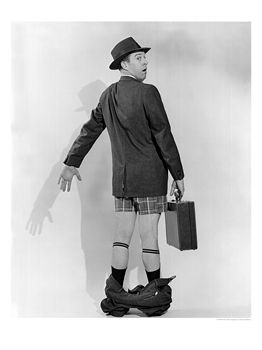
Pants DownA scandal is when someone does something wrong, usually a well-known person such as a politician or a movie star. There can be many different types of scandals, including scandals involving sex. In today’s U.S. papers, the American press is reporting on a story about the Governor of the State of New York, Eliot Spitzer. Governor Spitzer is accused (is said to be guilty of) visiting a prostitute (a man or woman who provides sex in exchange for money) while on a trip to Washington DC. The governor has admitted to doing something wrong, and will probably resign (give up his job) very soon.

Sex scandals are nothing new to American politics, or probably the politics of any country. One newspaper ran (published) an editorial cartoon (a visual joke usually involving politics) showing the governor in his underwear with his pants down on the ground. We have an expression, “to be caught with your pants down,” which means to be discovered doing something wrong, often while committing the act. Although the expression relates obviously to a sexual situation, it can also be applied to any situation where you are discovered by other people doing something wrong.

So whatever you do today, try not to get caught with your pants down.

~Jeff

Posted in News and Current Events | 11 Comments

Daylight Saving Time

Yesterday, Sunday, March 9, at 2:00 a.m. was the beginning of Daylight Saving Time in the U.S. Like many other countries, Daylight Saving is used to save energy (electricity, fuel) by adjusting (changing) the hours of the day to better match the hours when the sun is out. One way Americans know whether to turn the clocks ahead or set them back is to remember: We “spring” ahead in the spring, and we “fall” back in the fall. “Spring” is not just a season; it also means to jump. “Fall” isn’t just a season; it also means to move backwards. This is a very useful way for many people, including me, to remember.daylight-savings-time-disrupts-human-daily-rhythms-study-finds.jpg

In the U.S., Daylight Saving Time began during World War I. Since there are later hours of daylight between April and October, it made sense to take advantage of (to use for the best results) that daylight for war production (making things useful for the war). The same thing happened during World War II. The federal government again required the states to observe (to obey) Daylight Saving Time to save energy. After World War II, each states decided whether or not to observe Daylight Saving Time. In 1966, Congress passed the Uniform Time Act which standardized (make the same) the length of Daylight Saving Time.

However, not all states observe Daylight Saving Time. Arizona (except some Native American Reservations) and Hawaii are the two states that do not. (Puerto Rico, Guam, the U.S. Virgin Islands, and American Samoa also do not observe Daylight Saving Time.) This decision does make sense (have good reason) for the states and areas closer to the equator (the horizontal (side to side) line in the middle of the globe/Earth). The daylight hours there stay more consistent (the same) throughout the year.

Growing up in Arizona, it didn’t seem strange to me that half of the year, I shared the same time with family and friends in other states, and half of the year, I was an hour ahead or behind. In fact, to this day, I still find Daylight Saving Time strange. The worst parts? Losing an hour of sleep in the spring and changing all of the clocks around the house!

~ Lucy

Posted in Life in the United States | 9 Comments

TOEIC to TOEFL to IELTS: Comparing English Test Scores

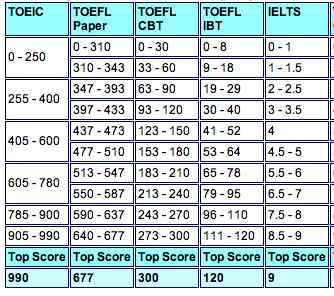
I got an interesting question recently from a listener, Mauricio, about how the different English proficiency tests compare to one another. Mauricio took the Test of English for International Communication (TOEIC), and wants to know what his approximate score would be on the International English Language Testing System (IELTS), another popular test of English skills. All these tests can be very confusing, since there is also a test for university students, the Test of English as a Foreign Language (TOEFL), which is the most popular of them all.

Unfortunately, these tests are different and cannot always be directly compared. In fact, the publisher of the TOEFL and the TOEIC says that you just can’t compare those two tests because they are so different. However, one Canadian language school published this comparison on their website:

TOEIC
Source: Vancouver English Centre

These comparisons are not official or taken from the companies that make these tests. They are what at least one school uses, so they may be helpful to you.

~Jeff

P.S Did you know that ESLPod.com has several lessons to prepare you for taking tests such as the TOEFL? You can find them on ESLPod.com’s Guide to the TOEFL Test page. This series also available to download for free on iTunes. We are not currently updating this podcast, but the older lessons will still be useful to you if you are studying for the exam.

Posted in Language & Terms | 10 Comments

Buyer’s Remorse and the American Elections

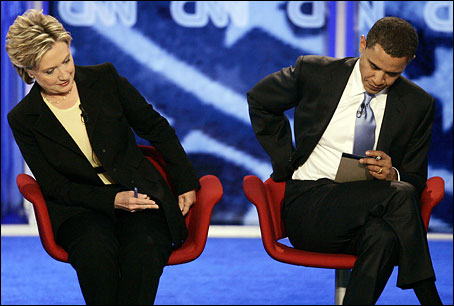
Barak and HillaryWell, the results are in (are available): Hillary Clinton won the elections in Texas and Ohio that I discussed in yesterday’s post, and so the fight for the presidential nomination in the Democratic Party will continue. The next big election will be in Pennsylvania, seven weeks from now.

So far (up to this point in time), neither Barak Obama nor Hillary Clinton has enough votes to win the nomination. For the Republicans, John McCain will be their nominee (the person who has been named or nominated as the candidate) for president. I talked about McCain a few years ago on English Cafe #40.

One expression that I heard watching the election coverage (news) last night was buyer’s remorse. A buyer is someone who buys or purchases something. Remorse is when you feel sorry for something you did, when you regret doing something. Buyer’s remorse is an expression we use when we buy something (a new car, a new house, a new MacBook Pro with a 15″ screen and 250 gigabyte hard drive!) and then later regret our purchase. We wish we had not bought it.

So how is this related to the election? Well, Hillary Clinton’s opponent, Barak Obama, has become very popular, very quickly in the past two months. He has become so popular that some people think that he has not been as carefully scrutinized (examined closely) as Senator Clinton. For this reason, some news commentators (people who give their opinion on the television and radio news shows) were suggesting that perhaps voters were sorry for supporting him earlier, that they changed their minds and instead are now supporting and voting for Hillary Clinton.

Of course, no one actually buys a political candidate. We should probably say “voter’s remorse.” We will have to see what happens in the upcoming (future) elections to know if the commentators are right.

~Jeff

Posted in News and Current Events | 5 Comments

Do or Die for Hillary Clinton

HillaryToday is a very important primary election in the states of Texas and Ohio (see my explanation of the U.S. election system here). One expression that you can read in the American newspapers today is “do or die.” People are saying that these elections today are do or die for one of the candidates, Hillary Clinton.

When something is do or die, we mean that if the person fails now, their chances of winning or succeeding are over, that they will not win in the future. This is often said of situations where the person has one last chance to try to win something. Clinton has lost 11 primaries in a row (one after the other) to her competitor, Barak Obama. If she loses in Texas and Ohio, it will be almost impossible for her to win the race (election) to be the nominee of the Democratic Party in the November elections.

We’ll know the answer to that question by tomorrow morning.

~Jeff

Posted in News and Current Events | 14 Comments

And The Winner Is…Not an American!

OscarsLast Sunday the annual awards for the best movies were given out (awarded, given to the winners) in Los Angeles. The awards are popularly called the Oscars, because the statue you win is called “Oscar.”  But no one is exactly sure why is it called Oscar.  (Why the Jeff or Lucy?)   The Oscars are presented by the Academy of Motion Arts and Sciences (hence (therefore), the ceremony is often called the Academy Awards). There is a separate category for the Best Foreign (non-American) Film, but actors and actresses from any movie, foreign or U.S.-made, can be nominated (named as a finalist) for the acting awards. The top or highest awards for acting are Best Actor (a man) and Best Actress (a woman). There are also awards for Best Supporting Actor and Actress, meaning the actors who weren’t the lead or most important actors in the movie, but were still important.

Many times in the past, actors from other countries have won acting Oscars, but this year, for the first time in more than 40 years, all of the top acting prizes – Best Actor, Best Actress, Best Supporting Actor, and Best Supporting Actress – were won by non-Americans.

Best Actor was given to an Irish actor, Daniel Day-Lewis, for the movie There Will Be Blood. Best Actress went to the young French actor, Marion Cotillard, for the movie La Vie en Rose. Best Supporting Actor went to the Spaniard, Javier Bardem, for the movie No Country for Old Men. Best Supporting Actress went to a British actress, Tilda Swinton, for her work in the movie Michael Clayton.

Movies are an international art form, so although Hollywood makes many of the most popular movies, I think it is a good thing that we recognize the great acting talents from all countries.

The Best Picture award went to No Country for Old Men, which was made by two people from my home state, Minnesota! So I guess Hollywood was the loser this year.

~Jeff

Posted in News and Current Events, Television and Movies | 9 Comments

Grandma Moses and Her Paintings (English Cafe 126)

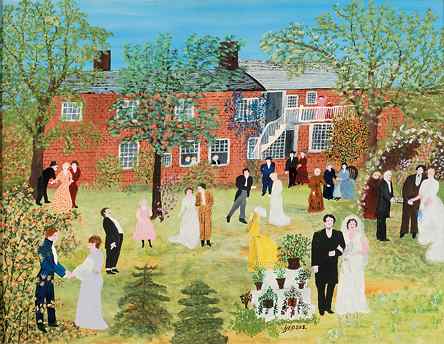
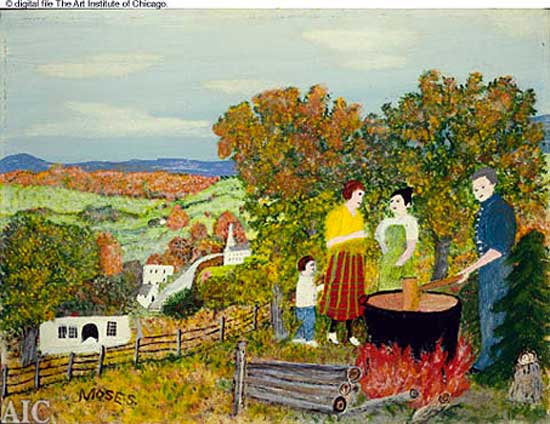
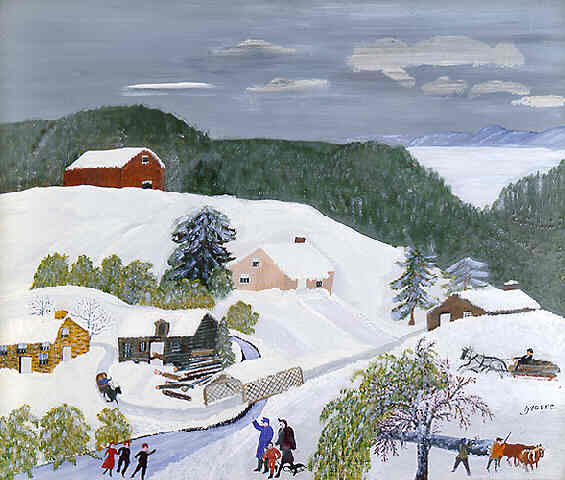
In today’s English Cafe 126, Jeff talked about the famous American painter Grandma Moses. Jeff talked about her style of “folk art” and it’s depiction (representation) of rural life, or life in the countryside. By looking at her paintings, we can get a sense (have an idea) of what life was like in rural American at the beginning of the 20th century.

These are pictures of Grandma Moses, who, as Jeff mentioned, began to paint in her 70’s and lived until the age of 101.

images2.jpegimages-7.jpeg

Here are a few of her paintings:

4cm650.jpg

image.jpeggmoldmill.jpg

Posted in Discussing the Episodes | 8 Comments

Theme from the TV Show “Friends”: “I’ll Be There For You”

From your blog comments, it looks like we have a lot of listeners/readers who are fans of the TV show Friends. We also recently had a question about some of the lyrics to the theme song (song that a show or person is known by), so I thought I would post them here with some explanations. For those of you who are not fans of the show, this is still a well-known song in the U.S. and I hope you enjoy it.

~ Lucy

“I’ll Be There For You”
by The Rembrandts

So no one told you life was gonna (going to) be this way
Your job’s a joke (not good; not adequate), you’re broke (have no money), your love life’s D.O.A (dead on arrival; not lively).

It’s like you’re always stuck in second gear (wheels in your car moving slowly)
And it hasn’t been your day, your week, your month,
or even your year
*, but…

I’ll be there for you (you can rely on me)
When the rain starts to pour (to fall heavily)
I’ll be there for you
Like I’ve been there before
I’ll be there for you
‘Cuz (because) you’re there for me too…

You’re still in bed at ten
And work began at eight
You’ve burned (cooked too long) your breakfast
So far…things are going great

Your mother warned (told you something would happen beforehand) you there’d be days like these
Oh, but she didn’t tell you when the world has brought
You down to your knees** that…

I’ll be there for you
When the rain starts to pour
I’ll be there for you
Like I’ve been there before
I’ll be there for you
‘Cuz you’re there for me too…

No one could ever know me
No one could ever see me
Seems you’re the only one who knows
What it’s like to be me
Someone to face the day with
Make it through (to successfully pass through an event although it is difficult) all the rest with
Someone I’ll always laugh with
Even at my worst I’m best with you, yeah

It’s like you’re always stuck in second gear
And it hasn’t been your day, your week, your month,
or even your year…

I’ll be there for you
When the rain starts to pour
I’ll be there for you
Like I’ve been there before
I’ll be there for you
‘Cuz you’re there for me too…

I’ll be there for you
‘Cuz you’re there for me too…

*to be (one’s) day = to have good things happen
**to be down to/on your knees = to feel hopeless or defeated

Posted in Karaoke English | 14 Comments