Podcasts This Week (April 11, 2011)

Thank you to all of you who are Premium or Basic Members, or who have donated to ESL Podcast.  You help keep the podcast going!

If you enjoy our podcasts and want to support us, please consider becoming a Basic or Premium Member!
…………

ON MONDAY
ESL Podcast 676 – Selecting a Health Insurance Plan

In the Learning Guide: Get a full transcript (written version of every word you hear), vocabulary list and sample sentences, and comprehension questions.
In “What Else Does it Mean,” learn the other meanings of “to switch” and “network.”
In the “Culture Note,” learn about “Types of Insurance Other than Basic Health Insurance.”
“Many health plans cover medical, dental, and vision care. But “disability insurance” and “long-term care plans” are other types of health plans that provide “financial assistance”… – READ MORE in the Learning Guide

ON WEDNESDAY
English Cafe 289

Topics: One Flew Over the Cuckoo’s Nest; Joshua Tree National Park; to the extent that versus in light of versus in the face of; I’m going versus I’m going to; adverb placement – accidentally

In the Learning Guide:  Get a full transcript (written version of every word you hear).
In “What Insiders Know,” you will read about the popular Internet movie rating website “Rotten Tomatoes.”
“In the old days, if members of an audience were unhappy with a “live” (not recorded) performance, they would throw “rotten” (not fresh; food that is bad and cannot be eaten) fruit, vegetables, or eggs at the performers on stage…” – READ MORE in the Learning Guide

ON FRIDAY
ESL Podcast 677 – Feeding a Picky Eater

In the Learning Guide: Get a full transcript (written version of every word you hear), vocabulary list and sample sentences, and comprehension questions.
In “What Else Does it Mean,” learn the other meanings of “course” and “to whip up.”
In the “Culture Note,” learn about “Ways that American Parents Get Children to Eat Health Foods.”
“Many “toddlers” (children ages 1-2) and “preschoolers” (children ages 3-4) are picky eaters. Some eat food only of a certain color, while others “refuse” (won’t do) to eat food that touches other types of food…” – READ MORE in the Learning Guide

Posted in Announcements | 4 Comments

Headline English: Going Hungry for the Hungry

Today I’m going to try another “Headline English” post. First I’ll give the background (the overall story or context of the headline), then we’ll talk about the specific words in the headline.

Headline: Anti-Hunger Advocates Fast to Protest U.S. Budget Cuts (from Voice of America).

Background:  The United States Congress (our elected national representatives; the House of Representatives and Senate) in Washington, D.C. has been trying to lower (make less) the amount the government spends each year, since the U.S. currently (now) has a very large budget deficit.  A budget is a description of how much you make (income) and how much you spend (expenses). A deficit is when you spend more than you make – usually not a good idea! But in order to reduce the deficit, Congress has to cut (eliminate) some popular programs.  Among the programs being considered for reduction or elimination are those that provide emergency food aid (help; assistance) for victims (people who are hurt by something or someone) of disasters (a bad event which affects many people, such as an earthquakes, floods, and hurricanes).  Some organizations want to stop Congress from making these cuts for people who are hungry.

Behind the Headline: The prefix “anti-” before a word means against or the opposite.  Anti-Hunger means you are against (don’t like, don’t want) hunger (the condition of being hungry, without enough food to eat).  An advocate is a person who is trying to defend some idea or organization, or who wants to change the political approach to an issue.  To fast means not to eat food on purpose (by choice; voluntarily).  This is sometimes done for religious reasons (Christians, Muslims, and Jews all fast for various occasions), sometimes for health reasons.  But it has also become a way of publicizing (making people know about) some political problem.  To protest means to fight against something in order to change it.  Budget cuts are reductions in the amount of money an organization (like the government) spends.

So anti-hunger groups are trying to stop Congress from reducing the amount the U.S. government spends on helping those who are in need of food during an emergency.

If you live outside the United States, is your government facing (having to deal with; take care of) similar problems of budget deficits?

~Jeff


Photo Credit: Voice of America (Public Domain)


Posted in News and Current Events | 16 Comments

Podcasts This Week (April 4, 2011)

Get the Learning Guide and help ESL Podcast continue producing podcasts by becoming a Basic or Premium Member.

Thank you for your support!
…………

ON MONDAY
ESL Podcast 674 – Threatening Other Countries

In the Learning Guide: Get a full transcript (written version of every word you hear), vocabulary list and sample sentences, and comprehension questions.
In “What Else Does it Mean,” learn the other meanings of “border” and “to strike.”
In the “Culture Note,” learn about “The Longest Border in the World.”
“The border between the United States and Canada is the longest border in the world. Including the part between Canada and Alaska, the “terrestrial” (land-based, not water-based) border…” – READ MORE in the Learning Guide

ON WEDNESDAY
English Cafe 288

Topics: Prohibition; Famous Americans: Oliver Wendell Holmes, Jr.; I’m sorry versus I apologize; green thumb; elbow grease; to be screwed

In the Learning Guide:  Get a full transcript (written version of every word you hear).
In “What Insiders Know,” you will read about “Famous Teetotaler President Robert B. Hayes.”
“There have been many famous teetotalers in American history.  One of the most famous is President Rutherford B. Hayes, who was the 19th American president, and who served from 1877 to 1881…” – READ MORE in the Learning Guide

ON FRIDAY
ESL Podcast 675 – Having Furniture Delivered

In the Learning Guide: Get a full transcript (written version of every word you hear), vocabulary list and sample sentences, and comprehension questions.
In “What Else Does it Mean,” learn the other meanings of “window” and “to be at (someone’s) mercy.”
In the “Culture Note,” learn about “Common Store Sales Policies.”
“Sellers in the United States often “stipulate” (say that something must happen; establish) “conditions of sale” (terms; things that the buyer and seller must agree to).  These conditions of sale can be very “lenient” (not tolerant) or very strict… – READ MORE in the Learning Guide

Posted in Announcements | 3 Comments

The Tire Iron and the Tamale

Sometimes help comes from an unexpected source (a thing or person you get something from). Sometimes it’s free, and sometimes it changes you forever. This story is adapted (changed to make it easier to read) and shortened from a true story by Justin Horner. You can read the complete, unadapted story in the New York Times Magazine. [Note: Since many of the sentences below are taken directly from the original article, we’ve put quotes around the entire selection so you know they are (mostly) from Horner’s story.]

Here is Justin’s story:

“During this past year, I’ve had car trouble three times, and they all happened while I was driving other people’s cars, which for some reason makes it worse.

“Each time, when these things happened, I was disgusted (very upset) with the way people didn’t stop to help. People at the gas stations where I asked for a gas can told me that they couldn’t loan them to me “for safety reasons,” but that I could buy a one-gallon can for $15. It was enough to make me say stuff like ‘this country is going to hell in a handbasket (getting worse).’

“But you know who came to my rescue all three times? Immigrants (someone who has moved from another country), Mexican immigrants, and none of them spoke any English.

“One of those guys (men) stopped to help me with a blow-out (when a tire suddenly bursts, like a balloon) even though he had his whole family with him. I was on the side of the road for almost three hours with my friend’s big Jeep (a kind of car for traveling over rough ground). I put signs in the windows, big signs that said, ‘NEED A JACK (tool to lift something heavy),’ and offered money. Nothing. Just as I was about to give up (stop trying to do something), a van pulled over, and a man jumped out.

“He sized up (looked at) the situation and called for his daughter who spoke English. He conveyed (communicated) through her that he had a jack but that it was too small for the Jeep, so we would need to put something under it. Then he got a saw (tool for cutting wood) from his van and cut a section (piece) out of a big log (large piece of wood from a tree) on the side of the road. We put his jack on top of it and we were in business (ready to begin).

“I started taking the wheel off, and then, if you can believe it, I broke his tire iron (tool used to remove a tire or wheel). Damn!

“No worries: he ran to the van and handed (gave) it to his wife. She was gone in a flash (immediately) down the road to buy a new tire iron. She was back in 15 minutes. We finished the job, and I was a very happy man.

“The two of us were filthy (very dirty) and sweaty (wet from working hard). His wife brought out a large water jug (container with small opening) for us to wash our hands. I tried to put a 20-dollar bill in the man’s hand, but he wouldn’t take it, so instead I went to the van and gave it to his wife as quietly as I could. I thanked them up one side and down the other (many times). I asked the little girl where they lived, thinking maybe I’d send them a gift for being so awesome (very good, impressive). She said they lived in Mexico. They were in Oregon so Mommy and Daddy could pick cherries for the next few weeks. Then they were going to pick peaches and, after that, go back home.

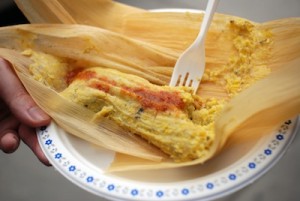
“After I said goodbye and started walking back to the Jeep, the girl called out and asked if I’d had lunch. When I told her no, she ran over and handed me a tamale (a traditional Mexican food; see the picture).

“This family, probably poorer than just about everyone else on that stretch (area) of highway, took a couple of hours out of their day to help a strange guy on the side of the road while people in tow trucks just drove by.

“But we weren’t done yet. I thanked them again, walked back to my car, and opened the foil (thin metal sheet for wrapping food) on the tamale. What did I find inside? My $20 bill! I whirled (turned quickly) around, ran to the van, and the guy rolled down his window. He saw the $20 in my hand and started shaking his head no. All I could think to say was, ‘Por favor (‘please’ in Spanish), por favor, por favor,‘ with my hands out. The guy just smiled and, with great difficulty, said in English: ‘Today you, tomorrow me.’ Then he rolled up his window and drove away with his daughter waving to me from the back.

“I sat in my car eating the best tamale I’ve ever had, and I just started to cry. It had been a rough (very difficult) year; nothing had seemed to go right for me. This was so out of left field (unexpected) I didn’t know what to do.

“In the several months since then, I’ve changed a couple of tires, given a few rides to gas stations, and once drove 50 miles out of my way to get a girl to an airport. I won’t accept money. But every time I’m able to help, I feel as if I’m putting something in the bank (collecting or saving something for the future).”

Have you ever had an experience like Justin’s? How did it affect you?

~ Warren Ediger – creator of Successful English where you can find clear explanations and practical suggestions for better English.

Photo of a tamale by Anita Sarkeesian used under Creative Commons license.

 

Posted in Life in the United States | 30 Comments

Podcasts This Week (March 28, 2011)

If you enjoy our podcasts, please consider supporting ESL Podcast by becoming a Basic or Premium Member!
…………

ON MONDAY
ESL Podcast 672 – Asking for More Time

In the Learning Guide: Get a full transcript (written version of every word you hear), vocabulary list and sample sentences, and comprehension questions.
In “What Else Does it Mean,” learn the other meanings of “slight” and “snag.”
In the “Culture Note,” learn about “Time Zones in the U.S.”
“Excluding “territories” (areas of land that are parts of the United States, but are not states), the United States has six “time zones” (vertical geographic areas that experience the same time)…” – READ MORE in the Learning Guide

ON WEDNESDAY
English Cafe 287

Topics:  Famous Authors – Edgar Allen Poe; women’s colleges; business versus commerce versus trade; thank goodness; to be keen on (something or something)

In the Learning Guide:  Get a full transcript (written version of every word you hear).
In “What Insiders Know,” you will read about the mysterious “Poe Toaster.”
“Every year on January 19, Edgar Allen Poe’s birthday, a “mysterious” (being secret or strange) person visits his “grave” (place in the ground where a dead person is buried).  This person is dressed in black with a “wide-brimmed hat”…” – READ MORE in the Learning Guide

ON FRIDAY
ESL Podcast 673 – Walking or Running as Exercise

In the Learning Guide: Get a full transcript (written version of every word you hear), vocabulary list and sample sentences, and comprehension questions.
In “What Else Does it Mean,” learn the other meanings of “to break (something) in” and “to stretch.”
In the “Culture Note,” learn about “Walkathons.”
“A “walkathon” is a “fundraiser” (an event designed to collect money for a particular organization or purpose) where many people walk along a certain “route” (path)…” – READ MORE in the Learning Guide

Posted in Announcements | 14 Comments

Podcasts This Week (March 21, 2011)

ESL Podcast is made possible through the support of our listeners. Get the Learning Guide and support ESL Podcast by becoming a Basic or Premium Member today!
…………

ON MONDAY
ESL Podcast 670 – To Forgive and Forget

In the Learning Guide: Get a full transcript (written version of every word you hear), vocabulary list and sample sentences, and comprehension questions.
In “What Else Does it Mean,” learn the other meanings of “much less” and “spat.”
In the “Culture Note,” learn about “Flowers With Special Meanings.”
“Some flowers have unusual names that “evoke” (make an image or idea come to one’s mind) certain images when people hear them. For example, there is a plant with “clusters” (groups) of small blue or “indigo” (dark blue) flowers called…” – READ MORE in the Learning Guide

ON WEDNESDAY
English Cafe 286

Topics: Ask an American – Louisville Slugger; globe versus sphere versus orb; on/by horseback; to hit one’s funny bone; to stub one’s toe

In the Learning Guide:  Get a full transcript (written version of every word you hear).
In “What Insiders Know,” you will read about the movie Field of Dreams.
“The 1989 movie Field of Dreams is about a farmer in Iowa who walks through his corn “fields” (areas of land where something is grown) and hears a voice “whispering” (talking very softly and quietly)…” – READ MORE in the Learning Guide

ON FRIDAY
ESL Podcast 671 – Vacationing on an Island

In the Learning Guide: Get a full transcript (written version of every word you hear), vocabulary list and sample sentences, and comprehension questions.
In “What Else Does it Mean,” learn the other meanings of “island” and “to be cut off from (someone/something)”
In the “Culture Note,” learn about “Island Vacation Locations in the Southern U.S.”
“…[T]here are also many island vacation spots in the southern United States, too, although they are less well known. Some are romantic, others are historical, and still others are simply fun to visit…” – READ MORE in the Learning Guide

Posted in Announcements | 4 Comments

Statue of Liberty, Eiffel Tower . . . and RoboCop

Some are very well known. In the U.S., the Statue of Liberty. In Rio de Janeiro, Christ the Redeemer. In Paris, the Eiffel Tower. In Kamakura, Japan, the Daibutsu, or Great Buddha.

Others are not so well known. For instance, the Little Mermaid in Copenhagen. Or Mannekin Pis in Brussels.

All of these statues or structures have one thing in common: they are icons. They are identified, or connected in our minds, with each of the cities or countries; when you see one of them, you think of the city, the country, or an idea, like freedom.

Today, the best-known icons are probably the ones you find on your computer screen – the small picture or sign that you click on to start a program – like the blue “W” for Microsoft Word.

When people who come from a Greek or Russian Orthodox or Catholic religious background hear the word “icon,” they may be reminded of a piece of religious art, often a painting of the Virgin Mary, Jesus’s mother.

Someone who is famous and admired by many people, someone who represents an important idea or art form may be called an icon. For me, B.B. King, and Buddy Guy are “blues icons”; they are famous blues musicians and represent an important part of the history and development of the blues. The blues are similar to jazz; the music is often slow and sad.

In general, you can see that an icon is something that is identified with something else: a statue with a city, a picture with a computer program, a painting with a kind of worship (religious practice or ceremony), a famous performer with a particular kind of music.

In the past two months, there’s been a lively (with a lot of energy) discussion about a new icon for the city of Detroit, Michigan, here in the U.S. Detroit is known as the home of (where it started) the American automobile industry and Motown Records, a popular music recording company famous for its black singers and groups, especially in the 1960’s.

A growing number of Detroit residents (people who live there) want RoboCop to become the new Detroit icon. Are you familiar with RoboCop? He was the star of RoboCop, the 1987 science-fiction movie, and became a pop culture icon. Pop, or popular, culture, is made up of music, movies, television programs, books, magazines, and other things in the culture that are popular with many people.

In the movie, futuristic (in the future) Detroit is filled with crime. A Detroit police officer who was killed by criminals is recreated (made again) as a super-human (more than human) cyborg (part human and part machine) called RoboCop. His life and work was guided by three principles, or values: serve (work for) the public trust (what people hired you to do), protect the innocent (people who can’t protect themselves), and uphold (defend or support) the law. In the movie, he helped clean up (restore law) the city and rid it (make it free of) of crime.

One supporter of the RoboCop statue says these are good values for Detroit to promote (encourage). And he adds, “A city needs to be fun, too. It can’t be all serious…. Showing people that we can have a sense of humor and encourage our citizens to have motivation and ideas is an important message….”

Question for discussion: If you were to choose an icon for the town or city you live in today, what would you choose? Why?

~ Warren Ediger – English tutor and creator of Successful English where you will find clear explanations and practical suggestions for better English.

Photo of the Eiffel Tower taken by W. Ediger


Posted in Life in the United States, News and Current Events | 24 Comments

The Earthquake and Tsunami in Japan

Like many people across the world, we at ESL Podcast were saddened to hear of the terrible earthquake (violent shaking of the ground) and tsunami (very high sea waves) in Japan last week. Our thoughts today are with the victims (those who are hurt by something) of this tragedy (terrible event).  There are many, many listeners of ESL Podcast in Japan, and we stand by them (support them) in their time of need.

As a rule (generally), we don’t comment or discuss events outside of the United States on our podcasts or on this blog.  However, we are making a one-time exception in this case due to the scale (size) of this disaster.

The situation is very dire (very serious and urgent) in parts of Japan.  If you would like to contribute (give) something to the Red Cross to help those in need there, please consider this or this website.

~ Jeff, Lucy, and the ESL Podcast Team

Posted in Announcements, News and Current Events | 38 Comments

Podcasts This Week (March 14, 2011)

Our ESL Podcast members make it possible for us to continue producing podcasts.

If you enjoy our podcasts, please consider supporting ESL Podcast by becoming a Basic or Premium Member!
…………

ON MONDAY
ESL Podcast 668 – Having Cash Flow Problems

In the Learning Guide: Get a full transcript (written version of every word you hear), vocabulary list and sample sentences, and comprehension questions.
In “What Else Does it Mean,” learn the other meanings of “to hedge” and “to hold off.”
In the “Culture Note,” learn about “Federal Government Grants.”
“Many Americans “mistakenly” (incorrectly) believe that the U.S. government “awards” (gives to the winner of a competition) “grants” (money that is given to a person or organization for a particular purpose)…” – READ MORE in the Learning Guide

ON WEDNESDAY
English Cafe 285

Topics: American Presidents: Thomas Jefferson; celebrity roasts; to splash versus to spray versus to sprinkle; hearing; to be of

In the Learning Guide:  Get a full transcript (written version of every word you hear).
In “What Insiders Know,” you will read about Thomas Jefferson’s slave “Sarah (Sally) Hemings.”
“Sarah Hemings was a mixed race slave owned by President Thomas Jefferson. While Jefferson was “in office” (serving as President) and for the years following, “journalists” (reporters) claimed that President Jefferson “fathered” (was the father of) seven children with Sally Hemings…” – READ MORE in the Learning Guide

ON FRIDAY
ESL Podcast 669 – Making Controversial Comments

In the Learning Guide: Get a full transcript (written version of every word you hear), vocabulary list and sample sentences, and comprehension questions.
In “What Else Does it Mean,” learn the other meanings of “offensive” and “to blow over.”
In the “Culture Note,” learn about “Sunday Morning News Programs.”
“Most Americans watch TV news programs on weekday mornings or evenings, but some prefer to watch Sunday morning news shows. Here are three of the most popular Sunday morning news shows…” – READ MORE in the Learning Guide

Posted in Announcements | 3 Comments

Podcasts This Week (March 7, 2011)

“What did you say?” 

“I didn’t understand that. Could you say that again?”

Does this sound familiar? Do you want to improve your English? Become a Basic or Premium Member and you’ll understand every word you hear on the podcast. Read the transcript as you listen to each podcast and you’ll improve your English even faster. Become a member today!
…………

ON MONDAY
ESL Podcast 666 – Traveling to Less Popular Sites

In the Learning Guide: Get a full transcript (written version of every word you hear), vocabulary list and sample sentences, and comprehension questions.
In “What Else Does it Mean,” learn the other meanings of “to plan out” and “to get lost.”
In the “Culture Note,” learn about “Travel Writers.”
“Each year, publisher Houghton Mifflin publishes an “anthology” (a collection of small pieces written by many different people) called “The Best American Travel Writing” and each year has a guest editor who writes the introduction…” – READ MORE in the Learning Guide

ON WEDNESDAY
English Cafe 284

Topics:  John Audubon and the Audubon Society; Famous Songs: “On Top of Old Smokey”; sign versus signal; figure out versus find out; to beat a dead horse

In the Learning Guide:  Get a full transcript (written version of every word you hear).
In “What Insiders Know,” you will read about the book and the film The Birds.
“The famous English film director Alfred Hitchcock (1899-1980) often directed films based on “novels” (long stories; a book not based on true events).  One of his most famous films, The Birds, was based on a “novelette” (short novel) by the English author Daphne du Maurier…” – READ MORE in the Learning Guide

ON FRIDAY
ESL Podcast 667 – Trying to Remember

In the Learning Guide: Get a full transcript (written version of every word you hear), vocabulary list and sample sentences, and comprehension questions.
In “What Else Does it Mean,” learn the other meanings of “combination” and “concentrate.”
In the “Culture Note,” learn about “Popular Mnemonics.”

“Americans use many mnemonics to remember lists of things that should be in a particular order. For example, some people remember the colors in the rainbow as: “Richard Of York “Gave Battle” (fought) “In Vain” (without success)…” – READ MORE in the Learning Guide

Posted in Announcements | 15 Comments