How Many Times Do You Need to Hear a Word to Learn It?
You need to see or hear a new word about 10 to 15 times before you can know it well enough to understand it when someone uses it (Pellicer-Sánchez & Schmitt, 2010). To be able to use that word yourself in speaking and writing usually requires encountering it many more times than that. That's why improving your language skills depends so much on the amount of input you get through reading and listening.
How is a word learned?
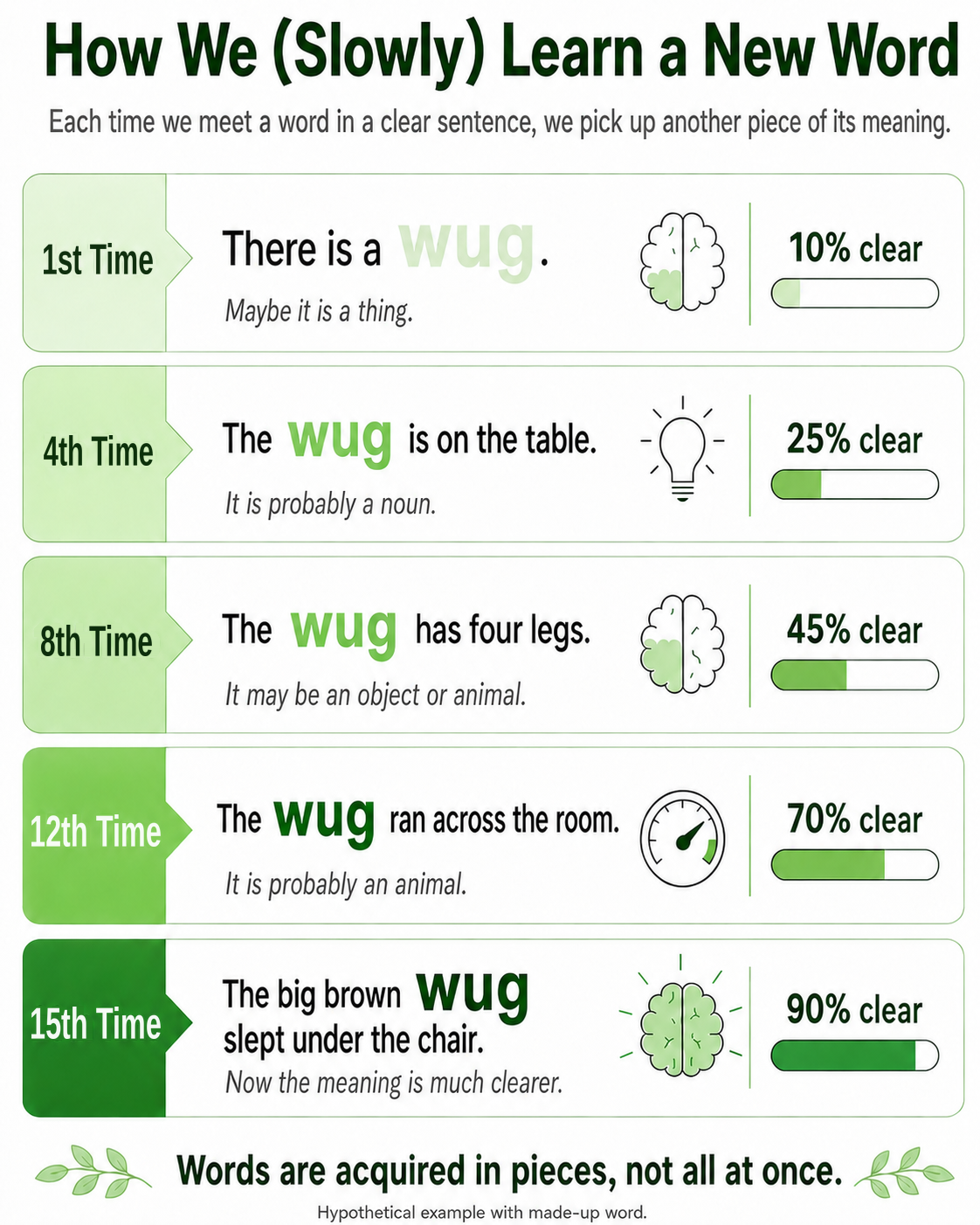
You learn words a little at a time after seeing or hearing them in different contexts. You almost never learn the full meaning of a word the first time you see it. Instead, you learn a small percentage of that word's meaning each time you encounter it (Frishkoff, Collins-Thompson, Perfetti, & Callan, 2008, and McQuillan & Ediger, 2018).
Take, for example, the invented word "wug." If you read the sentence "There is a wug," you don't really know very much about it. Next, you read the sentence "The wug is on the bed." Now you might guess that wug is a noun, something you would find in a house. Later, you see the sentence "The wug walked across the room." You then know the wug is probably a person or an animal.
As you continue to see "wug" in different sentences, you gain a little bit more of its meaning. After seeing "wug" used clearly in about 10 to 15 sentences, you will learn its meaning, probably without even realizing it.
How many encounters do you really need?
Ana Pellicer-Sánchez and Norbert Schmitt (2010) asked a group of learners to read an entire novel that contained words the learners didn't know. After that, the researchers tested the students on several of these new words to see how many they had learned. The more times they saw the word, the better their chances were of remembering it. They found that after 10 to 15 encounters, students knew the words well enough to recognize their meaning when reading or seeing them.
Just because you can recognize a word and know its meaning in a sentence as you read or listen does not mean you can use that same word yourself in speaking or writing. Stuart Webb (2007) gave a group of students a set of sentences in which they saw a word one, three, seven, or 10 times. He tested both their ability to recognize the meaning of the words and to use them. In all cases, students' recognition scores were higher than their "productive" or use scores. For example, learners could recognize the correct spelling of 88 percent of the words, but could supply the word itself for a given meaning only 29 percent of the time.
Webb concluded that while seeing a word 10 times produced large gains in recognizing words, it was not enough to learn the word well enough for a learner to use it. We don't have an exact number of how many times you need to see or hear a word to be able to use it, but it's clearly much higher than the number needed to be able to understand it in your reading and listening.
The context in which you see the new word matters. You will learn a word more quickly if the context gives you more information about the word. This explains why the number of encounters it takes to learn a word varies. Simply seeing the word 10 to 15 times without context doesn't work. Flashcards don't really help you improve in part for that reason.
Should you memorize word lists instead?
Many popular Internet "influencers," and even some language researchers, recommend that you use rote memorization to learn new words. But the scientific studies clearly show that the words you memorize using flashcards and lists don't actually improve your language comprehension (Tuinman & Brady, 1974, Pany & Jenkins, 1978, Hudson, 1982, Pany, Jenkins, & Schreck, 1982, and Jahangard, Moinzadeh, & Karimi, 2011). Rote memorization provides only a "shallow," surface-level knowledge of a word's meaning.
Language comprehension and production require "deep" knowledge of a word, which can only come from seeing and hearing words in different contexts. To increase your vocabulary, you must get "comprehensible input" that contains new words for you to learn (Krashen, 1985).
What can you do today?
Choose listening and reading you can mostly understand, on topics you enjoy, and get a lot of it. The 10 to 15 encounters happen on their own when you meet the same words again and again in material you understand.
Remember that even though you can understand the words you read, you may not have learned them well enough to use them in a conversation. That's why listening to and reading English that you understand almost completely is still very useful to you. Hearing those words over and over again in different contexts will allow you to start using them in your speaking and writing as well.
Don't think that just because the English is easy, it's not helping you. Unless you're already fluent in conversational English, easy English is actually getting you closer to your goal of speaking.
Dr. Lucy Tse and I designed Unlimited English around this research, with more than 1,800 audio lessons that repeat the most useful conversational words, each with a complete Learning Guide. The full science is on our research page.
~ Dr. Jeff McQuillan, from beautiful Los Angeles, California
Selected research
- Frishkoff, G. A., Collins-Thompson, K., Perfetti, C., & Callan, J. (2008). Measuring incremental changes in word knowledge: Experimental validation and implications for learning and assessment. Behavior Research Methods, 40(4), 907-925.
- Hudson, T. (1982). The effects of induced schemata on the "short circuit" in L2 reading: Non-decoding factors in L2 reading performance. Language Learning, 32(1), 1-31.
- Jahangard, A., Moinzadeh, A., & Karimi, A. (2011). The effect of grouping and presenting selected TOEFL words on the vocabulary learning of EFL learners. Iranian EFL Journal, 7(2), 220-235.
- Krashen, S. D. (1985). The input hypothesis: Issues and implications. Longman.
- McQuillan, J., & Ediger, W. (2018). The Markov Estimation of Semantic Association (MESA): Good for vocabulary measurement, ineffective for vocabulary teaching. The Reading Matrix, 18(1), 27-40.
- Pany, D., & Jenkins, J. R. (1978). Learning word meanings: A comparison of instructional procedures. Learning Disability Quarterly, 1(2), 21-32.
- Pany, D., Jenkins, J. R., & Schreck, J. (1982). Vocabulary instruction: Effects on word knowledge and reading comprehension. Learning Disability Quarterly, 5(3), 202-215.
- Pellicer-Sánchez, A., & Schmitt, N. (2010). Incidental vocabulary acquisition from an authentic novel: Do Things Fall Apart? Reading in a Foreign Language, 22(1), 31-55.
- Tuinman, J. J., & Brady, M. E. (1974). How does vocabulary account for variance on reading comprehension tests? A preliminary instructional analysis. In P. Nacke (Ed.), Interaction: Research and practice for college-adult reading (pp. 176-184). National Reading Conference.
- Webb, S. (2007). The effects of repetition on vocabulary knowledge. Applied Linguistics, 28(1), 46-65.