ESLPod
Home Unlimited English
A Note from Dr. McQuillan

Rich Comprehensible Input™: The Science of Language Learning

Why most second language adults don’t get past the intermediate level, and what to do about it

Most adults who study English get to a certain point and then stop. In fact, studies show that fewer than 1 out of every 4 students who make it to the intermediate level go on to an advanced level.1

Many intermediate speakers can read some English and understand it when it’s spoken slowly. They know and recognize a lot of English words and phrases.

But if they try to understand an American speaking fast on the telephone, or if you ask them to tell a story without stopping to think, they can’t do it.

They can’t speak.

They can’t understand real, “fast” conversations, movies, or videos.

This is not because they’re too old. It’s not because they haven’t “practiced” English enough. It isn’t a problem of “trying harder” or “not being good at languages.”

It is a very common stage or step in learning a language. Some frustrated learners have called it the Intermediate Plateau. Many students report that they often make quick progress at the beginning stage, but then their progress slows down when they get to the intermediate (B1/B2) stage.

Skill level Time spent learning → Beginner Intermediate (the plateau) Advanced most learners stop here
Figure 1. Skill growth in adult second-language learning, with slowing growth at the intermediate stage due to lack of continued comprehensible input.

Fortunately, the research now tells us how to get past this “stall” or plateau.

This page is meant to explain, in clear English, what the science says about how adults pick up a second language, where the plateau comes from, and why our method, Rich Comprehensible Input™, will finally make you fluent.

Studying about a language is not learning a language

More than 40 years ago, Dr. Stephen Krashen at the University of Southern California hypothesized that there are two ways your brain stores or “knows” a language.2

The first kind of knowledge you have is what we usually call studying or “learning ABOUT a language.” This includes, for example, conscious knowledge of grammar, spelling, pronunciation, or other “facts” about a language. It’s the sort of thing you study in school or in a textbook.

You can write what you learn about the language down. You can take a test on it. You can give the rule, for example, for the third-person singular -s and get it right 100% on a written exam.

The second kind of knowledge you have is learning the language itself, not just about the language. It’s the unconscious, automatic system you use to actually speak and understand.

When you listen to a friend tell a story, you are not stopping to ask yourself, “Was that the past tense?” You just understand.

That is your brain’s learning system at work, and it is doing 95 to 99% of the work whenever you use language in real life.

(Note that Krashen himself calls what I’m calling studying a language consciously “learning,” and what I’m calling learning a language unconsciously “acquisition.” I think the terms “studying” and “learning” are more straightforward, so that’s what I’ll use here.) 3

Studying, learning about a language, is conscious, hard, and often involves somewhat painful memorization.

Learning a language is unconscious, natural, and (when done correctly) easy. It doesn’t require any sort of memorization or writing down rules.

“Studying knowledge” does not become “learning knowledge”

An important finding in Krashen’s original research was that the knowledge we get from studying a language does not become learning.

You can study a rule consciously for ten years and still not learn it unconsciously.

You can learn a rule unconsciously and not be able to explain it.

The two “systems” or types of knowledge are separate. Studying rules will not make them “automatic” or part of your learned knowledge.

Consider this: There are people who have lived in the United States for forty years, who can recite English grammar rules from memory, but who still miss the third-person -s when they speak (e.g. “He go to the store”). That’s because studying about language and learning language are two different systems.

One does not magically “become” the other (although you can have both kinds!).

And, even more importantly, when we are communicating in the real world, it’s the “learning” system we use 95-99% of the time, not the “learning about” system.4

So how do we actually learn a language, rather than learn about a language?

Krashen’s answer is the Comprehension Hypothesis (or what he first called the “Input Hypothesis”): we learn a language by understanding messages, either by listening or by reading.

Krashen uses the term “comprehensible input,” where input is what goes INTO the brain through reading and listening, as compared to OUTPUT, which is what you take out of your brain by speaking or writing.
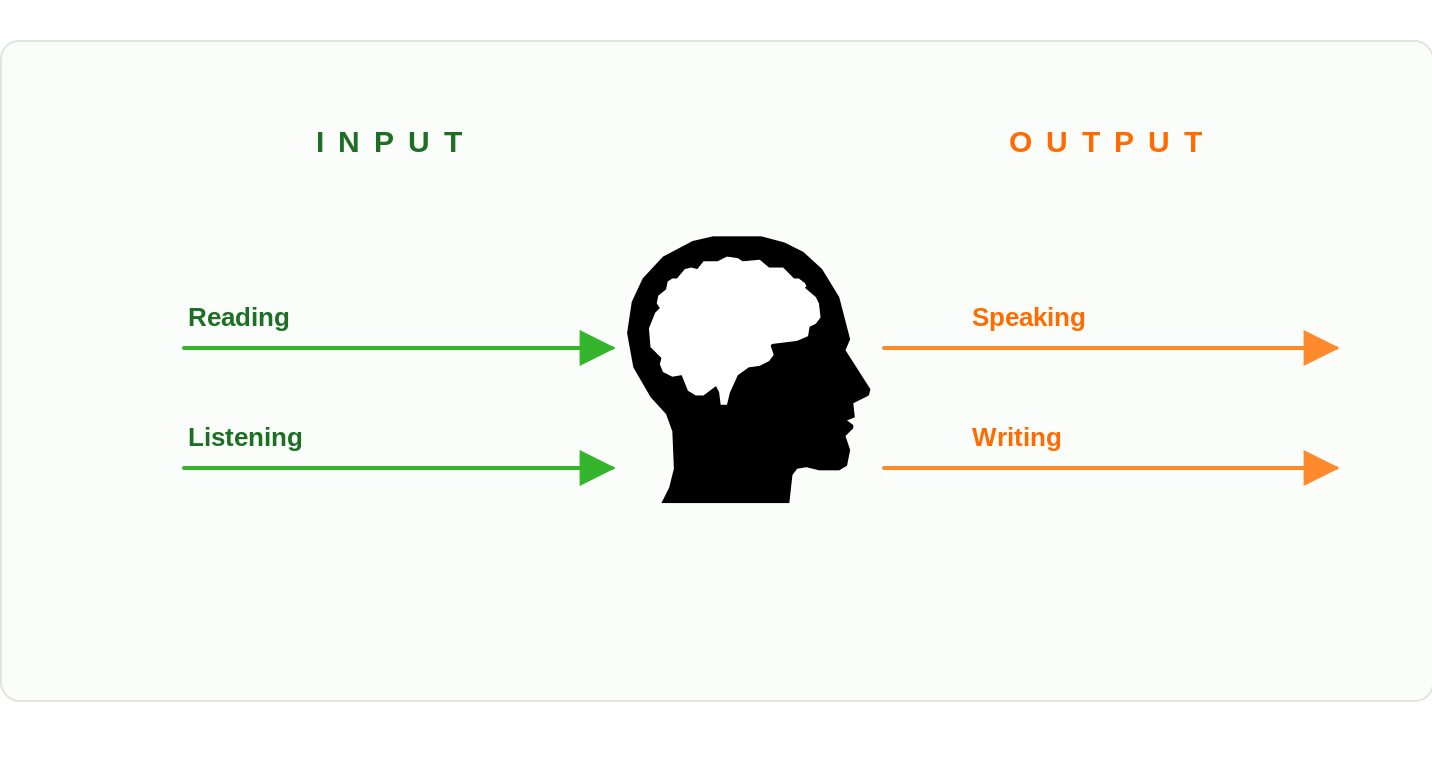
Language goes into the brain through reading and listening (input) and comes out of the brain through speaking and writing (output).
Figure 2. Language goes into the brain through reading and listening (input) and comes out of the brain through speaking and writing (output).

You learn language (your first language, your second language, your 10th language) one way and one way only: by getting lots and lots of comprehensible input.

The only way you can actually improve your language skills is by getting lots and lots of good comprehensible input.

But what’s “good input”?

Krashen says that input needs to contain something new for you to learn, but be familiar enough to you that you can still understand the message it communicates. This language that is just a bit above your current level (which he calls “i”) is referred to as “i + 1.”5

How do you know what your current level or “i” is?

It would require lots of testing to find that out for different parts of your language system, but the good thing is that if you focus on finding things you can mostly understand, you will probably be getting lots of “i + 1” input.

The real problem is that people often think they know more than they do!

This leads them to get frustrated at the fact that, for example, they can understand slow English but not fast English, or they can understand things but they can’t actually speak them.

The reason is explained by what linguists call the “receptive-productive gap.”

Why you can understand English but not speak it

If unconscious learning comes from input, you would expect adult learners to understand much more language than they can produce. That is exactly what we see.

Webb (2008) tested 83 Japanese university English as a Foreign Language learners on their receptive (“I know this when I see it”) and productive (“I can use this when I am asked to produce it”) knowledge of 180 words at three frequency levels. (Listening and reading, comprehending language, are receptive skills. Speaking and writing are productive skills.)6

Webb found that the more common a word is, the more likely the learner can both understand and speak it. The less common a word is, the wider the gap between recognition and use.

0 10 20 30 Score (out of 30) 28.4 25.1 Most frequent (ranks 701–1,900) 88% gap 26.1 19.2 Mid-frequency (ranks 1,901–3,400) 73% gap 18.7 12.1 Lower-frequency (ranks 3,401–6,600) 65% gap Receptive (recognize) Productive (recall)
Figure 3. Webb (2008): the receptive-productive gap widens as words become less frequent.

For very common words, the gap is small. For the words a learner needs to move from intermediate to advanced, the gap is much larger.

Roughly a third of the lower-frequency words a learner recognizes are not yet available for use.

Webb’s data show us, then, that you will usually understand more than you can speak.

A second study, Shin, Chon, and Kim (2011), tested 403 Korean high school learners across the first nine 1,000-word frequency bands of English.7 They found the same pattern Webb saw. Learners knew most of the very common words receptively, but their productive knowledge declined dramatically once they moved past the first 1,000 word families.

By the 5th 1,000 band, the average learner could recognize about 60% of the words but produce only about 16%. That is roughly a 4-to-1 gap. By the 9th 1,000 word band, the productive score was almost zero.

0 2 4 6 8 10 Score (out of 10) 9.35 8.04 1st 9.01 4.67 2nd 7.99 3.27 3rd 6.07 2.29 4th 6.14 1.63 5th 5.66 2.24 6th 4.09 0.69 7th 3.41 0.65 8th 4.01 0.55 9th Word frequency band (1,000-word ranges) Receptive (recognize) Productive (recall)
Figure 4. Shin, Chon, & Kim (2011): 403 Korean high school learners, scored out of 10 per band. Receptive knowledge drops gradually across frequency bands. Productive knowledge grows much more slowly, with the gap widening through the middle bands.

The conclusion here is that just because you know language enough to understand it does not mean you have completely learned it. In other words, your “i” or level of language may be lower than you think.

So when you say “I already know these words,” what is often the case is that “I know these words well enough to understand them when spoken slowly or by reading them, but I do not yet know them well enough to understand fast English or speak fluently.”

A word is learned in pieces, not all at once

You don’t learn 100% of the meaning of a word the first time you meet it. You pick up a small piece of its meaning. The next time you hear it or read it, you pick up a little more. Each time you encounter it, you get more and more of its meaning.8

Let’s take the example of a made-up word, wug.

The first time you read “There is a wug,” you know almost nothing. Maybe it is a thing. Maybe it is a person.

A few sentences later you read “The wug is on the table,” and now you know it is probably a noun. Read “The wug ran across the room,” and you know it is probably alive, an animal or a human being.

Each time the word comes back inside a clear sentence, you get another part of the word’s meaning.
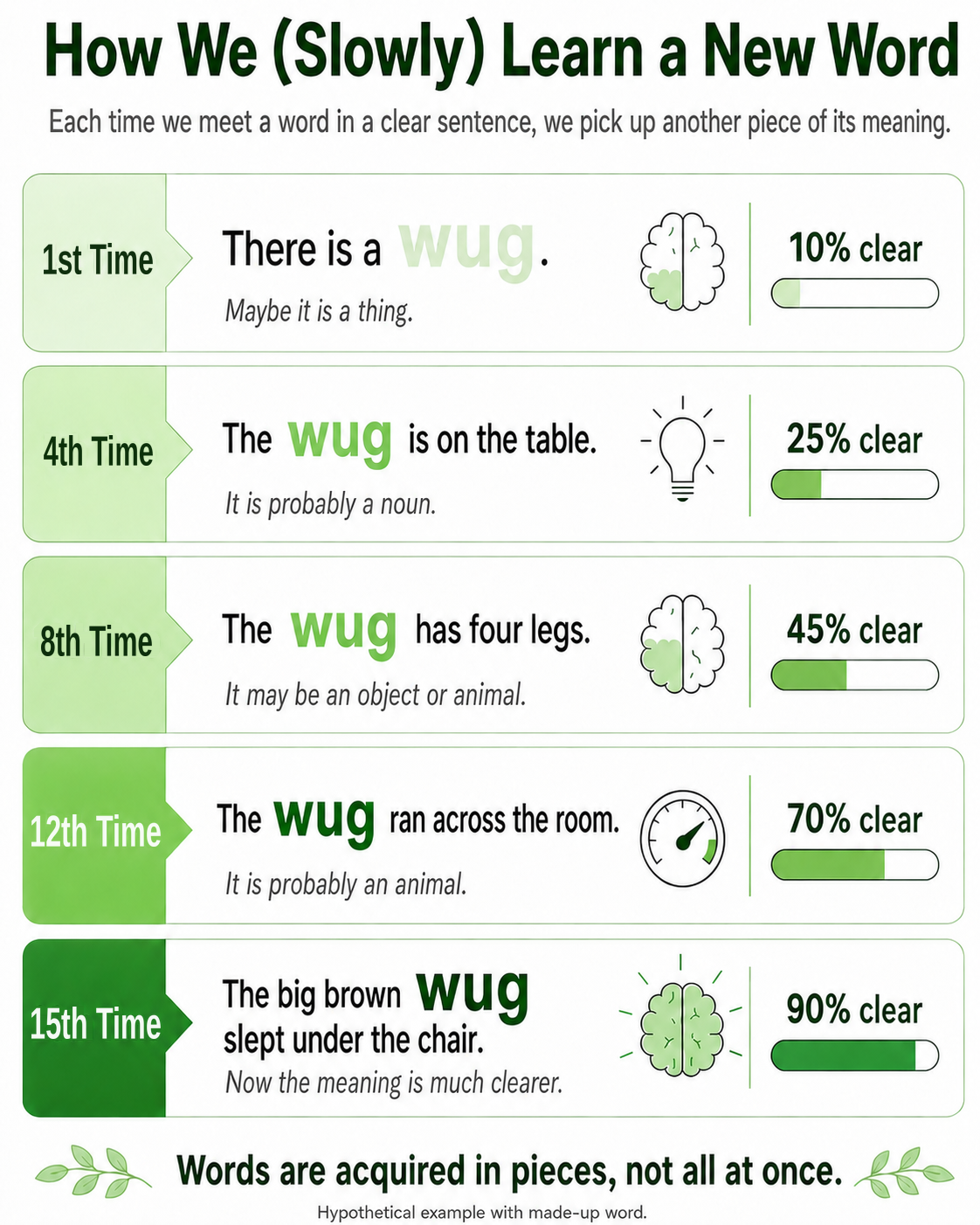
Across encounters with the made-up word 'wug,' the meaning becomes clearer in steps.
Figure 5. How we slowly learn a new word. Across repeated encounters with a made-up word (wug) in clear sentences, the meaning becomes clearer in steps. Words are acquired in pieces, not all at once. (Hypothetical example.)

This is how you learn almost all of the words you know, both in your first language and in your second. You learn them incrementally, piece by piece. No single encounter teaches you the entire meaning of the word. The meaning is put together slowly, across many meetings, from the sentences around it.

This is also why studying a word from a list or a flashcard is not very useful. A definition gives you one piece of the meaning, out of context, without the other pieces that real sentences give you. Your brain learns a word the way it learns everything else about language: by meeting it again and again in messages it understands.

And this is exactly why the next question is so important. If you only learn a small percentage of a word’s meaning each time you meet it, how many times do you need to see or hear it to learn it completely?

How much input is enough?

Researchers Pellicer-Sánchez and Schmitt (2010) carried out a study, one that has been repeated many times, to show the importance of getting LOTS of input, especially for intermediates.

They had readers go through one complete novel and tested how many of the new words in the book they remembered after reading it. The answer: students could recognize, as receptive vocabulary, many words as long as they were repeated enough times in the text.

Most words required about 10 to 15 repetitions in the book before they were reliably “learned” well enough to understand them (“I know what that word means.”).8

But when it came time to produce the word, to recall it (productive vocabulary), 10 to 15 times was not enough.

In fact, students were unable to produce most of the words they saw (“recall” them).

We don’t have an exact estimate of the number of times you may need to see a word, but it may be two or three times the number needed to simply understand it.

0% 25% 50% 75% 100% % of words known Number of times the word appeared in the book Once 2–4 times 5–8 times 10–17 times 28+ times Meaning recognition: 87% Recall: 61% Recognition (receptive) Recall (productive)
Figure 6. Pellicer-Sánchez & Schmitt (2010), post-reading test. As a word appears more times in an authentic novel, meaning recognition climbs sharply and reaches 87%. Meaning recall lags far behind, and it passes half only after 28 or more exposures.

Now, the wrong conclusion is that they just need to “study” more words!

Attempting to study the words one by one is, in fact, a very inefficient way of learning them. And we know from several studies that “memorizing” words doesn’t actually help even reading or listening comprehension (receptive tasks).9

The fastest, most effective way to learn words unconsciously is through hearing and reading them in context, in real English stories and conversations.

In other words, the fastest way to improve your vocabulary, to really learn the language, is by getting comprehensible input.

How to end the intermediate stall

You have heard enough English to understand a careful, clear speaker. But you have not heard enough English to:

  1. Understand a fast, native-paced speaker without effort.
  2. Pull words out of your own mouth in real time.

Both of those problems are the same problem in two different forms. They are an input problem.

Amount of Input Input needed for speaking & fast understanding You are here the intermediate plateau Enough input to understand slow English what you already have
Figure 7. The intermediate plateau is an input gap. You have enough input to understand slow English. You do not yet have enough to understand fast English or speak it. Progress requires getting more comprehensible input to reach fluency and fast understanding.

Your brain does not yet have enough examples of the language used at speed. Your productive vocabulary, by Webb’s numbers, is roughly half your receptive vocabulary, which means most of the words you “know” are not yet automatic enough to use.

And research in the past 10 years tells us that this productive vocabulary is strongly correlated to your speaking fluency. Until you improve your productive vocabulary, your speaking will not get better.10

Most schools, apps, and tutors will tell you, at this point, that the answer is to speak more. Get a conversation partner. Force yourself to produce. Practice, practice, practice.

The research says this is backwards, the exact opposite of what you should be doing.

Remember, output (speaking) is a result of learning, not a cause of it.11

Asking an intermediate learner to speak their way to fluency is like asking a poor man to give you more money. You can’t take out what isn’t there yet.

The intermediate plateau, then, is not a “speaking” problem or a “pronunciation” problem or a “practice” problem. It is an input problem.

Why Rich Comprehensible Input™ is the (only) way to get to fluency

This is the “gap” our method is designed to fill.

Rich Comprehensible Input™ is comprehensible input designed for adults who have “stalled” or slowed down in their progress in exactly the place I have just described.

Three principles run through every Unlimited English lesson Dr. Tse and I have created:

  1. The level is right. Lessons are pitched at i + 1. Slightly above where you are, but still understandable. It isn’t “authentic” content given to you with no help, which is often just noise. It’s also not beginner content, which is too low. In terms of vocabulary levels, we use primarily the first 3,000 to 4,000 of the most commonly used English word families, which are exactly the ones that are used in daily conversation. The reason this is important is that these are often the ones you “know” partially (you can understand many of them) but you have not yet fully learned well enough to understand them in fast English and in speaking.12
  2. The explanations stay in English. Hard words are explained with simpler English words (again, using those commonly spoken words), in context, in real sentences. There is no translation. This is what gets the new vocabulary into your brain unconsciously. The explanations are actually the most important part of the lesson, much more so than the “key terms” we discuss! You’re not expected to remember the key terms at the end of the lesson. The crucial thing is hearing and understanding the explanations themselves, which give you deeper exposure to the most commonly used word families.13
  3. The volume is high, and the repetition is built in. Words in that “conversation range” of up to 4,000 words come back across different lessons. By Pellicer-Sánchez and Schmitt’s numbers, that is what “deep” learning for speaking and understanding fast English actually requires.14

This is also why our method does not ask you to speak before your brain is ready. It does not pretend that “drilling” output will somehow create input you never had.

The learners we see break through the intermediate plateau are not the ones who forced themselves to speak earlier. They are the ones who got hundreds of hours of language they could understand.

The speaking comes on its own. That is what forty years of research predicts, and it is what we see in our students.

Things that won’t help you

You should know enough about the science of language learning to understand why most of the things being sold as “language courses” are a complete waste of time.

They are not based on the scientific research at all, but on 19th century ideas (really!) of what learning a language requires.

You know now, for example, that you do not learn a language by speaking. Speaking is output, not input. It’s true that if you speak to someone, they might speak back to you and give you input. But it’s the input that matters, not the output.

Language tutors are not very helpful if you spend most of your time talking. You talking won’t directly improve your language. Again, that’s output, not input.

Studying grammar or morphology or pronunciation rules will not help you learn a language, either.

Why?

Because they are all examples of learning ABOUT a language, using conscious knowledge. And since conscious knowledge does not become unconscious learning, it won’t help you.

Also, there’s no time to use your conscious learning in real life, so “practicing” doesn’t help much. Conversations happen too quickly to stop and think about rules or memorized phrases.

Below is what you typically find in the language learning apps and courses on the internet, what each product is actually doing, and why each one fails to get you past the intermediate plateau.

Popular methodWhat it really isWhy it fails
Duolingo, Babbel, and other “gamified” appsShort, conscious drills on grammar and vocabulary, with points and “streaks.”There is almost no real comprehensible input. You are studying about English, not learning it.
Rosetta Stone, Tell Me More, and similar softwarePicture-to-word matching with a few short phrases.There is very little real actual input. In one study, 99 per cent of users did not even reach the 10-hour mark of a 200-hour course of this type.15
Pimsleur and other audio “repeat-after-me” coursesA small amount input, then a lot of “now you say it,” with over-use of concurrent translation.Too much output is called for before the brain has heard enough input. The repetition drills are fake practice for your brain that is not yet ready to produce.
Conversation tutors (iTalki, Cambly, 1:1 language exchanges)You speak. The tutor or partner corrects what comes out.You cannot produce what you have not yet fully learned. The tutor becomes an audience for your gaps, not a source of input.
Vocabulary flashcards (Anki, Quizlet, paper cards)Memorizing isolated word-translation pairs.This is pure conscious study. The research shows this kind of memorization does not improve language comprehension.16
Grammar workbooks and rule drillsMemorizing rules, then testing yourself on the rules.This is learning about language, not learning a language. Conscious knowledge does not become unconscious learning.
Watching movies, news, or YouTube without helpInput that is usually not comprehensible.If you understand less than 95 per cent of what is said, your brain has nothing to work with. The exposure is not input. It is noise.

Each of these popular approaches ignores input entirely, supplies input you cannot understand, or asks you to produce language you have not yet acquired.

None of them is designed in the way the brain actually learns a language.

The reason Rich Comprehensible Input™ works is that it does the one thing the research says you must do: get understandable English, in volume, on topics you care about, with the harder words explained in simpler English so the message gets through. That is the only way to reach advanced fluency in a language.

— Dr. Jeff McQuillan, Center for Educational Development, Los Angeles, California

Footnotes

  1. For the dropout figure across language study, see Dupuy, B., & Krashen, S. D. (1998). Survival of the fittest: ‘Surviving’ post-secondary foreign language programs. Mosaic, 5(2), 19–22; Furman, N., Goldberg, D., & Lusin, N. (2007). Enrollments in languages other than English in United States institutions of higher education, fall 2006. Modern Language Association; Draper, J. B., & Hicks, J. H. (2002). Foreign language enrollments in public secondary schools, fall 2000. American Council on the Teaching of Foreign Languages. For the commercial-software dropout figure cited in the table, see Nielson, K. B. (2011). Self-study with language learning software in the workplace: What happens? Language Learning & Technology, 15(3), 110–129; and McQuillan, J. (2019). And then there were none? Measuring the success of commercial language courses. International Journal of Foreign Language Teaching, 8(1), 2–5. See also Tse, L. (2000). Student perceptions of foreign language study: A qualitative analysis of foreign language autobiographies. Modern Language Journal, 84(1), 69–84. ↑ Back to text
  2. Krashen, S. D. (1982). Principles and practice in second language acquisition. Pergamon. See also Krashen, S. D. (2004). Applying the comprehension hypothesis: Some suggestions. Paper presented at the 13th International Symposium and Book Fair on Language Teaching, Taipei. ↑ Back to text
  3. Krashen, S. D. (1982). Principles and practice in second language acquisition. Pergamon. See also Krashen, S. D. (2004). Applying the comprehension hypothesis: Some suggestions. Paper presented at the 13th International Symposium and Book Fair on Language Teaching, Taipei. ↑ Back to text
  4. Krashen, S. D. (1982). Principles and practice in second language acquisition. Pergamon. See also Krashen, S. D. (2004). Applying the comprehension hypothesis: Some suggestions. Paper presented at the 13th International Symposium and Book Fair on Language Teaching, Taipei. ↑ Back to text
  5. Krashen, S. D. (1985). The input hypothesis: Issues and implications. Longman. ↑ Back to text
  6. Webb, S. (2008). Receptive and productive vocabulary sizes of L2 learners. Studies in Second Language Acquisition, 30(1), 79–95. ↑ Back to text
  7. Shin, D., Chon, Y. V., & Kim, H. (2011). Receptive and productive vocabulary sizes of high school learners: What next for the basic word list? English Teaching, 66(3), 123–148. ↑ Back to text
  8. Frishkoff, G. A., Collins-Thompson, K., Perfetti, C., & Callan, J. (2008). Measuring incremental changes in word knowledge: Experimental validation and implications for learning and assessment. Behavior Research Methods, 40(4), 907–925. See also McQuillan, J., & Ediger, W. (2018). The Markov Estimation of Semantic Association (MESA): Good for vocabulary measurement, ineffective for vocabulary teaching. The Reading Matrix, 18(1), 27–40. ↑ Back to text
  9. Pellicer-Sánchez, A., & Schmitt, N. (2010). Incidental vocabulary acquisition from an authentic novel: Do Things Fall Apart? Reading in a Foreign Language, 22(1), 31–55. ↑ Back to text
  10. See Tuinman, J. J., & Brady, M. E. (1974). How does vocabulary account for variance on reading comprehension tests? A preliminary instructional analysis. In P. Nacke (Ed.), Interaction: Research and practice for college-adult reading (pp. 176–184). National Reading Conference; Pany, D., & Jenkins, J. R. (1978). Learning word meanings: A comparison of instructional procedures. Learning Disability Quarterly, 1(2), 21–32; Hudson, T. (1981). The effects of induced schemata on the “short circuit” in L2 reading: Non-decoding factors in L2 reading performance. Language Learning, 32(1), 1–31; Pany, D., Jenkins, J. R., & Schreck, J. (1982). Vocabulary instruction: Effects on word knowledge and reading comprehension. Learning Disability Quarterly, 5(3), 202–215; Jahangard, A., Moinzadeh, A., & Karimi, A. (2011). The effect of grouping and presenting selected TOEFL words on the vocabulary learning of EFL learners. Iranian EFL Journal, 7(2), 220–235. ↑ Back to text
  11. Uchihara, T., & Saito, K. (2019). Exploring the relationship between productive vocabulary knowledge and second language oral ability. The Language Learning Journal, 47(1), 64–75. See also Tong, Y., Hasim, Z., & Abdul Halim, H. (2022). The impact of L2 vocabulary knowledge on language fluency. Pertanika Journal of Social Sciences & Humanities, 30(4), 1723–1751. ↑ Back to text
  12. Krashen, S. D. (1998). Comprehensible output? System, 26(2), 175–182. See also McQuillan, J. (1997). The literacy crisis: False claims, real solutions. Heinemann; Tse, L. (2001). Why don’t they speak English? Separating fact from fallacy in the U.S. language debate. Teachers College Press; Krashen, S., Tse, L., & McQuillan, J. (Eds.). (1998). Heritage language development. Language Education Associates; Tse, L. (2001). Resisting and reversing language shift: Heritage language resilience among U.S. native biliterates. Harvard Educational Review, 71(4), 676–708. ↑ Back to text
  13. Krashen, S. D. (1985). The input hypothesis: Issues and implications. Longman. ↑ Back to text
  14. Krashen, S. D. (1982). Principles and practice in second language acquisition. Pergamon. See also Krashen, S. D. (2004). Applying the comprehension hypothesis: Some suggestions. Paper presented at the 13th International Symposium and Book Fair on Language Teaching, Taipei. ↑ Back to text
  15. Pellicer-Sánchez, A., & Schmitt, N. (2010). Incidental vocabulary acquisition from an authentic novel: Do Things Fall Apart? Reading in a Foreign Language, 22(1), 31–55. See also McQuillan, J. (2016). Time, texts, and teaching in vocabulary acquisition: A rebuttal to Cobb (2016). Reading in a Foreign Language, 28(2), 307–318; McQuillan, J. (2019a). Where do we get our academic vocabulary? Comparing the efficiency of direct instruction and free voluntary reading. The Reading Matrix: An International Online Journal, 19(1), 129–138. See also Tse, L. (1996). When an ESL adult becomes a reader. Reading Horizons, 31(1), 16–29. ↑ Back to text
  16. For the dropout figure across language study, see Dupuy, B., & Krashen, S. D. (1998). Survival of the fittest: ‘Surviving’ post-secondary foreign language programs. Mosaic, 5(2), 19–22; Furman, N., Goldberg, D., & Lusin, N. (2007). Enrollments in languages other than English in United States institutions of higher education, fall 2006. Modern Language Association; Draper, J. B., & Hicks, J. H. (2002). Foreign language enrollments in public secondary schools, fall 2000. American Council on the Teaching of Foreign Languages. For the commercial-software dropout figure cited in the table, see Nielson, K. B. (2011). Self-study with language learning software in the workplace: What happens? Language Learning & Technology, 15(3), 110–129; and McQuillan, J. (2019). And then there were none? Measuring the success of commercial language courses. International Journal of Foreign Language Teaching, 8(1), 2–5. ↑ Back to text
  17. See Tuinman, J. J., & Brady, M. E. (1974). How does vocabulary account for variance on reading comprehension tests? A preliminary instructional analysis. In P. Nacke (Ed.), Interaction: Research and practice for college-adult reading (pp. 176–184). National Reading Conference; Pany, D., & Jenkins, J. R. (1978). Learning word meanings: A comparison of instructional procedures. Learning Disability Quarterly, 1(2), 21–32; Hudson, T. (1981). The effects of induced schemata on the “short circuit” in L2 reading: Non-decoding factors in L2 reading performance. Language Learning, 32(1), 1–31; Pany, D., Jenkins, J. R., & Schreck, J. (1982). Vocabulary instruction: Effects on word knowledge and reading comprehension. Learning Disability Quarterly, 5(3), 202–215; Jahangard, A., Moinzadeh, A., & Karimi, A. (2011). The effect of grouping and presenting selected TOEFL words on the vocabulary learning of EFL learners. Iranian EFL Journal, 7(2), 220–235. ↑ Back to text

References

Draper, J. B., & Hicks, J. H. (2002). Foreign language enrollments in public secondary schools, fall 2000. American Council on the Teaching of Foreign Languages.

Dupuy, B., & Krashen, S. D. (1998). Survival of the fittest: ‘Surviving’ post-secondary foreign language programs. Mosaic, 5(2), 19–22.

Frishkoff, G. A., Collins-Thompson, K., Perfetti, C., & Callan, J. (2008). Measuring incremental changes in word knowledge: Experimental validation and implications for learning and assessment. Behavior Research Methods, 40(4), 907–925.

Furman, N., Goldberg, D., & Lusin, N. (2007). Enrollments in languages other than English in United States institutions of higher education, fall 2006. Modern Language Association.

Hudson, T. (1981). The effects of induced schemata on the “short circuit” in L2 reading: Non-decoding factors in L2 reading performance. Language Learning, 32(1), 1–31.

Jahangard, A., Moinzadeh, A., & Karimi, A. (2011). The effect of grouping and presenting selected TOEFL words on the vocabulary learning of EFL learners. Iranian EFL Journal, 7(2), 220–235.

Krashen, S. D. (1982). Principles and practice in second language acquisition. Pergamon.

Krashen, S. D. (1985). The input hypothesis: Issues and implications. Longman.

Krashen, S. D. (1998). Comprehensible output? System, 26(2), 175–182.

Krashen, S. D. (2004). Applying the comprehension hypothesis: Some suggestions [Paper presentation]. 13th International Symposium and Book Fair on Language Teaching, Taipei, Taiwan.

Krashen, S., Tse, L., & McQuillan, J. (Eds.). (1998). Heritage language development. Language Education Associates.

McQuillan, J. (1997). The literacy crisis: False claims, real solutions. Heinemann.

McQuillan, J. (2016). Time, texts, and teaching in vocabulary acquisition: A rebuttal to Cobb (2016). Reading in a Foreign Language, 28(2), 307–318.

McQuillan, J., & Ediger, W. (2018). The Markov Estimation of Semantic Association (MESA): Good for vocabulary measurement, ineffective for vocabulary teaching. The Reading Matrix, 18(1), 27–40.

McQuillan, J. (2019). And then there were none? Measuring the success of commercial language courses. International Journal of Foreign Language Teaching, 8(1), 2–5.

McQuillan, J. (2019a). Where do we get our academic vocabulary? Comparing the efficiency of direct instruction and free voluntary reading. The Reading Matrix: An International Online Journal, 19(1), 129–138.

Nielson, K. B. (2011). Self-study with language learning software in the workplace: What happens? Language Learning & Technology, 15(3), 110–129.

Pany, D., & Jenkins, J. R. (1978). Learning word meanings: A comparison of instructional procedures. Learning Disability Quarterly, 1(2), 21–32.

Pany, D., Jenkins, J. R., & Schreck, J. (1982). Vocabulary instruction: Effects on word knowledge and reading comprehension. Learning Disability Quarterly, 5(3), 202–215.

Pellicer-Sánchez, A., & Schmitt, N. (2010). Incidental vocabulary acquisition from an authentic novel: Do Things Fall Apart? Reading in a Foreign Language, 22(1), 31–55.

Shin, D., Chon, Y. V., & Kim, H. (2011). Receptive and productive vocabulary sizes of high school learners: What next for the basic word list? English Teaching, 66(3), 123–148.

Tong, Y., Hasim, Z., & Abdul Halim, H. (2022). The impact of L2 vocabulary knowledge on language fluency. Pertanika Journal of Social Sciences & Humanities, 30(4), 1723–1751.

Tse, L. (1996). When an ESL adult becomes a reader. Reading Horizons, 31(1), 16–29.

Tse, L. (2000). Student perceptions of foreign language study: A qualitative analysis of foreign language autobiographies. Modern Language Journal, 84(1), 69–84.

Tse, L. (2001). Resisting and reversing language shift: Heritage language resilience among U.S. native biliterates. Harvard Educational Review, 71(4), 676–708.

Tse, L. (2001). Why don’t they speak English? Separating fact from fallacy in the U.S. language debate. Teachers College Press.

Tuinman, J. J., & Brady, M. E. (1974). How does vocabulary account for variance on reading comprehension tests? A preliminary instructional analysis. In P. Nacke (Ed.), Interaction: Research and practice for college-adult reading (pp. 176–184). National Reading Conference.

Uchihara, T., & Saito, K. (2019). Exploring the relationship between productive vocabulary knowledge and second language oral ability. The Language Learning Journal, 47(1), 64–75.

Webb, S. (2008). Receptive and productive vocabulary sizes of L2 learners. Studies in Second Language Acquisition, 30(1), 79–95.

كلمة من Dr. McQuillan

Rich Comprehensible Input™: علم تعلّم اللغة

لماذا لا يتجاوز معظم البالغين الذين يتعلّمون لغةً ثانية المستوى المتوسط، وما الذي يمكن فعله حيال ذلك

معظم البالغين الذين يدرسون الإنجليزية يصلون إلى نقطة معيّنة ثم يتوقفون. بل إن الدراسات تُظهر أن أقل من طالب واحد من كل 4 طلاب يبلغون المستوى المتوسط ينتقلون إلى المستوى المتقدم.1

كثير من المتحدثين في المستوى المتوسط يقرؤون بعض الإنجليزية ويفهمونها حين تُنطق ببطء. وهم يعرفون كثيرًا من الكلمات والعبارات الإنجليزية ويميّزونها.

لكنهم إن حاولوا فهم أمريكيّ يتحدث بسرعة على الهاتف، أو إن طلبتم منهم أن يرووا قصة دون أن يتوقفوا للتفكير، فلن يقدروا على ذلك.

لا يستطيعون التحدث.

لا يستطيعون فهم المحادثات “السريعة” الحقيقية، ولا الأفلام، ولا مقاطع الفيديو.

وهذا ليس لأنهم كبروا في السنّ. وليس لأنهم لم “يتمرّنوا” على الإنجليزية بما يكفي. وليست مشكلة “بذل جهد أكبر” أو “عدم الموهبة في اللغات”.

إنها مرحلة أو خطوة شائعة جدًا في تعلّم اللغة. وقد سمّاها بعض المتعلّمين المُحبَطين الهضبة المتوسطة. ويقول كثير من الطلاب إنهم كثيرًا ما يتقدمون بسرعة في المرحلة الأولى، ثم يتباطأ تقدّمهم حين يبلغون المرحلة المتوسطة (B1/B2).

مستوى المهارة الوقت المُنفَق في التعلّم → مبتدئ متوسط (الهضبة) متقدم هنا يتوقف معظم المتعلّمين
الشكل 1. نموّ المهارة في تعلّم البالغين لغةً ثانية، مع تباطؤ النموّ في المرحلة المتوسطة بسبب انقطاع المدخلات المفهومة المستمرة.

لحسن الحظ، تخبرنا الأبحاث الآن كيف نتجاوز هذا “التوقف” أو هذه الهضبة.

الغرض من هذه الصفحة أن نشرح، بإنجليزية واضحة، ما يقوله العلم عن كيفية اكتساب البالغين لغةً ثانية، ومن أين تأتي الهضبة، ولماذا ستجعلكم طريقتنا، Rich Comprehensible Input™، تتقنون اللغة أخيرًا.

الدراسة عن لغة ليست تعلّمًا للغة

قبل أكثر من 40 عامًا، افترض Dr. Stephen Krashen في University of Southern California أن لدماغكم طريقتين لتخزين اللغة أو “معرفتها”.2

النوع الأول من المعرفة هو ما نسمّيه عادةً الدراسة أو “التعلّم عن لغة”. ويشمل ذلك، مثلًا، المعرفة الواعية بالقواعد والإملاء والنطق أو غيرها من “الحقائق” عن اللغة. وهو نوع ما تدرسونه في المدرسة أو في كتاب مدرسي.

يمكنكم أن تكتبوا ما تتعلّمونه عن اللغة. ويمكنكم أن تخضعوا لاختبار فيه. ويمكنكم أن تذكروا القاعدة، مثلًا قاعدة المفرد الغائب -s، وتصيبوها 100% في امتحان كتابي.

النوع الثاني من المعرفة هو تعلّم اللغة نفسها، لا مجرد التعلّم عنها. وهو النظام اللاواعي التلقائي الذي تستعملونه فعلًا للتحدث والفهم.

حين تستمعون إلى صديق يروي قصة، لا تتوقفون لتسألوا أنفسكم: “هل كان ذلك زمن الماضي؟” بل تفهمون فحسب.

ذلك هو نظام التعلّم في دماغكم وهو يعمل، وهو يؤدّي 95 إلى 99% من العمل كلما استعملتم اللغة في الحياة الواقعية.

(لاحظوا أن Krashen نفسه يسمّي ما أسمّيه أنا دراسة اللغة بوعي “learning”، ويسمّي ما أسمّيه أنا تعلّم اللغة دون وعي “acquisition”. وأرى أن مصطلحي “الدراسة” و“التعلّم” أوضح، فهما ما سأستعمله هنا.) 3

الدراسة، أي التعلّم عن اللغة، واعية وشاقّة، وكثيرًا ما تتطلّب حفظًا مؤلمًا بعض الشيء.

أما تعلّم اللغة فلا واعٍ وطبيعيّ، وسهلٌ (إذا تمّ على الوجه الصحيح). ولا يتطلّب أيّ حفظ أو تدوين للقواعد.

“معرفة الدراسة” لا تتحوّل إلى “معرفة التعلّم”

من النتائج المهمّة في بحث Krashen الأصلي أن المعرفة التي نكتسبها من دراسة لغة لا تتحوّل إلى تعلّم.

يمكنكم أن تدرسوا قاعدةً بوعي عشر سنين ومع ذلك لا تتعلّمونها لا واعيًا.

ويمكنكم أن تتعلّموا قاعدةً لا واعيًا ولا تقدروا على شرحها.

“النظامان” أو نوعا المعرفة منفصلان. ودراسة القواعد لن تجعلها “تلقائية” أو جزءًا من معرفتكم المتعلَّمة.

تأمّلوا هذا: هناك أناس عاشوا في الولايات المتحدة أربعين عامًا، ويستطيعون استظهار قواعد الإنجليزية عن ظهر قلب، لكنهم ما زالوا يُسقطون -s المفرد الغائب حين يتحدثون (مثل: “He go to the store”). وذلك لأن الدراسة عن اللغة وتعلّم اللغة نظامان مختلفان.

ولا يتحوّل أحدهما إلى الآخر بطريقة سحرية (وإن كان بإمكانكم امتلاك النوعين معًا!).

والأهمّ من ذلك أننا حين نتواصل في العالم الواقعي، نستعمل نظام “التعلّم” 95-99% من الوقت، لا نظام “التعلّم عن” اللغة.4

فكيف نتعلّم لغةً فعلًا، بدلًا من أن نتعلّم عن لغة؟

جواب Krashen هو فرضية الفهم (أو ما سمّاه أول الأمر “فرضية المدخلات”): نتعلّم اللغة بفهم الرسائل، إما بالاستماع وإما بالقراءة.

يستعمل Krashen مصطلح “Comprehensible Input (المدخلات المفهومة)”، حيث Input (المدخلات) هو ما يدخل إلى الدماغ عبر القراءة والاستماع، مقابل OUTPUT (المخرجات) وهو ما تُخرجونه من دماغكم بالتحدث أو الكتابة.

Language goes into the brain through reading and listening (input) and comes out of the brain through speaking and writing (output).
الشكل 2. تدخل اللغة إلى الدماغ عبر القراءة والاستماع (input) وتخرج من الدماغ عبر التحدث والكتابة (output).

تتعلّمون اللغة (لغتكم الأولى، ولغتكم الثانية، ولغتكم العاشرة) بطريقة واحدة لا غير: بالحصول على كميات كبيرة جدًا من المدخلات المفهومة.

الطريقة الوحيدة لتحسين مهاراتكم اللغوية فعلًا هي الحصول على كميات كبيرة جدًا من المدخلات المفهومة الجيّدة.

لكن ما هي “المدخلات الجيّدة”؟

يقول Krashen إن المدخلات يجب أن تتضمّن شيئًا جديدًا لتتعلّموه، لكن مألوفًا لكم بما يكفي لتفهموا الرسالة التي تنقلها. وهذه اللغة التي تعلو قليلًا على مستواكم الحالي (الذي يسمّيه “i”) يُشار إليها بـ “i + 1”.5

كيف تعرفون ما هو مستواكم الحالي أو “i”؟

سيتطلّب ذلك اختبارات كثيرة لمعرفته في أجزاء مختلفة من نظامكم اللغوي، لكن الجميل أنكم إن ركّزتم على إيجاد أشياء تفهمونها في معظمها، فستحصلون على الأرجح على كميات كبيرة من مدخلات “i + 1”.

المشكلة الحقيقية أن الناس كثيرًا ما يظنون أنهم يعرفون أكثر مما يعرفون فعلًا!

وهذا يقودهم إلى الإحباط من أنهم، مثلًا، يفهمون الإنجليزية البطيئة لا السريعة، أو يفهمون أشياء لكنهم لا يقدرون على التحدث بها.

والسبب يفسّره ما يسمّيه اللغويون “الفجوة بين الاستقبال والإنتاج”.

لماذا تفهمون الإنجليزية لكنكم لا تتحدثون بها

إذا كان التعلّم اللاواعي يأتي من المدخلات، فإنكم تتوقّعون أن يفهم المتعلّمون البالغون لغةً أكثر بكثير مما يستطيعون إنتاجه. وهذا بالضبط ما نراه.

اختبر Webb (2008) 83 متعلّمًا جامعيًا يابانيًا للإنجليزية كلغة أجنبية في معرفتهم الاستقبالية (“أعرف هذا حين أراه”) والإنتاجية (“أستطيع استعمال هذا حين يُطلب مني إنتاجه”) لـ 180 كلمة عند ثلاثة مستويات تردّد. (الاستماع والقراءة وفهم اللغة مهارات استقبالية. أما التحدث والكتابة فمهارات إنتاجية.)6

وجد Webb أنه كلما كانت الكلمة أكثر شيوعًا، زاد احتمال أن يفهمها المتعلّم ويتحدّث بها معًا. وكلما قلّ شيوع الكلمة، اتّسعت الفجوة بين التمييز والاستعمال.

0 10 20 30 الدرجة (من 30) 28.4 25.1 الأكثر تردّدًا (الرتب 701–1,900) فجوة 88% 26.1 19.2 متوسطة التردّد (الرتب 1,901–3,400) فجوة 73% 18.7 12.1 أقل تردّدًا (الرتب 3,401–6,600) فجوة 65% استقبالية (تمييز) إنتاجية (استرجاع)
الشكل 3. Webb (2008): تتّسع الفجوة بين الاستقبال والإنتاج كلما قلّ تردّد الكلمات.

في الكلمات الشائعة جدًا تكون الفجوة صغيرة. أما الكلمات التي يحتاجها المتعلّم للانتقال من المتوسط إلى المتقدم فالفجوة فيها أكبر بكثير.

نحو ثُلث الكلمات الأقل تردّدًا التي يميّزها المتعلّم ليست متاحة بعد لـ الاستعمال.

تُرينا بيانات Webb إذن أنكم في العادة تفهمون أكثر مما تستطيعون التحدث به.

دراسة ثانية، Shin, Chon, and Kim (2011)، اختبرت 403 متعلّمين كوريين في المرحلة الثانوية عبر أوّل تسع شرائح تردّدية من 1,000 كلمة في الإنجليزية.7 ووجدوا النمط نفسه الذي رآه Webb. فقد عرف المتعلّمون معظم الكلمات الشائعة جدًا استقبالًا، لكن معرفتهم الإنتاجية انخفضت انخفاضًا حادًا بمجرد تجاوزهم أوّل 1,000 عائلة كلمات.

وعند الشريحة الخامسة من 1,000 كلمة، كان المتعلّم المتوسّط يميّز نحو 60% من الكلمات لكنه يُنتج نحو 16% فقط. أي فجوة بنسبة 4 إلى 1 تقريبًا. وعند الشريحة التاسعة من 1,000 كلمة، كانت الدرجة الإنتاجية تقترب من الصفر.

0 2 4 6 8 10 الدرجة (من 10) 9.35 8.04 الأولى 9.01 4.67 الثانية 7.99 3.27 الثالثة 6.07 2.29 الرابعة 6.14 1.63 الخامسة 5.66 2.24 السادسة 4.09 0.69 السابعة 3.41 0.65 الثامنة 4.01 0.55 التاسعة شريحة تردّد الكلمات (نطاقات الـ 1,000 كلمة) استقبالية (تمييز) إنتاجية (استرجاع)
الشكل 4. Shin, Chon, & Kim (2011): 403 متعلّمين كوريين في المرحلة الثانوية، مع تقييم من 10 لكل شريحة. تنخفض المعرفة الاستقبالية تدريجيًا عبر الشرائح التردّدية. أما المعرفة الإنتاجية فتنمو ببطء أشدّ، مع اتّساع الفجوة خلال الشرائح الوسطى.

والخلاصة هنا أن مجرد معرفتكم لغةً بما يكفي لفهمها لا يعني أنكم تعلّمتموها تمامًا. بعبارة أخرى، قد يكون مستواكم أو “i” أدنى مما تظنون.

فحين تقولون “أنا أعرف هذه الكلمات أصلًا”، الواقع في الغالب هو “أنا أعرف هذه الكلمات بما يكفي لفهمها حين تُنطق ببطء أو حين أقرؤها، لكنني لا أعرفها بعد بما يكفي لفهم الإنجليزية السريعة أو للتحدث بطلاقة”.

الكلمة تُتعلَّم قطعةً قطعة، لا دفعةً واحدة

أنتم لا تتعلّمون 100% من معنى الكلمة أول مرة تصادفونها. بل تلتقطون قطعة صغيرة من معناها. وفي المرة التالية التي تسمعونها أو تقرؤونها فيها، تلتقطون قليلًا آخر. وفي كل مرة تصادفونها، تحصلون على مزيد فمزيد من معناها.8

لنأخذ مثال كلمة مُختلَقة، wug.

أول مرة تقرؤون فيها “There is a wug,” لا تعرفون شيئًا تقريبًا. قد تكون شيئًا. وقد تكون شخصًا.

وبعد بضع جمل تقرؤون “The wug is on the table,” فتعرفون الآن أنها على الأرجح اسم. واقرؤوا “The wug ran across the room,” فتعرفون أنها على الأرجح كائن حيّ، حيوان أو إنسان.

وفي كل مرة تعود فيها الكلمة داخل جملة واضحة، تحصلون على جزء آخر من معناها.

Across encounters with the made-up word 'wug,' the meaning becomes clearer in steps.
الشكل 5. كيف نتعلّم كلمة جديدة ببطء. عبر لقاءات متكرّرة بكلمة مُختلَقة (wug) في جمل واضحة، يتّضح المعنى خطوةً خطوة. فالكلمات تُكتسَب قطعةً قطعة، لا دفعةً واحدة. (مثال افتراضي.)

هكذا تتعلّمون جميع الكلمات التي تعرفونها تقريبًا، في لغتكم الأولى وفي لغتكم الثانية على السواء. تتعلّمونها تدريجيًا، قطعةً قطعة. ولا يعلّمكم أيّ لقاء واحد معنى الكلمة كاملًا. فالمعنى يُبنى ببطء، عبر لقاءات كثيرة، من الجمل المحيطة بها.

ولهذا أيضًا فإن دراسة كلمة من قائمة أو من بطاقة مفردات ليست مفيدة كثيرًا. فالتعريف يمنحكم قطعة واحدة من المعنى، خارج سياقها، دون القطع الأخرى التي تمنحها إياكم الجمل الحقيقية. ودماغكم يتعلّم الكلمة كما يتعلّم كل شيء آخر عن اللغة: بأن يصادفها مرة بعد مرة في رسائل يفهمها.

ولهذا بالضبط يكون السؤال التالي بالغ الأهمية. فإن كنتم لا تتعلّمون إلا نسبة صغيرة من معنى الكلمة في كل مرة تصادفونها، فكم مرة تحتاجون إلى رؤيتها أو سماعها كي تتعلّموها كاملةً؟

كم من المدخلات يكفي؟

أجرى الباحثان Pellicer-Sánchez and Schmitt (2010) دراسة، تكرّرت مرات كثيرة, لبيان أهمية الحصول على كميات كبيرة من المدخلات، خاصةً للمتعلّمين في المستوى المتوسط.

طلبا من القرّاء أن يقرؤوا روايةً كاملة، واختبرا كم من الكلمات الجديدة في الكتاب تذكّروها بعد قراءته. والجواب: استطاع الطلاب أن يميّزوا، كمفردات استقبالية، كلماتٍ كثيرة ما دامت قد تكرّرت بما يكفي في النص.

احتاجت معظم الكلمات إلى نحو 10 إلى 15 تكرارًا في الكتاب قبل أن “تُتعلَّم” على نحو موثوق بما يكفي لـ فهمها (“أعرف ماذا تعني تلك الكلمة”).8

لكن حين جاء وقت إنتاج الكلمة، أي استرجاعها (المفردات الإنتاجية)، لم تكفِ 10 إلى 15 مرة.

بل عجز الطلاب عن إنتاج معظم الكلمات التي رأوها (“استرجاعها”).

ليس لدينا تقدير دقيق لعدد المرات التي قد تحتاجون فيها إلى رؤية كلمة، لكنه قد يكون ضعفي أو ثلاثة أضعاف العدد اللازم لمجرد فهمها.

0% 25% 50% 75% 100% % من الكلمات المعروفة عدد مرات ظهور الكلمة في الكتاب مرة واحدة 2–4 مرات 5–8 مرات 10–17 مرة 28+ مرة تمييز المعنى: 87% الاسترجاع: 61% تمييز (استقبالي) استرجاع (إنتاجي)
الشكل 6. Pellicer-Sánchez & Schmitt (2010)، اختبار بعد القراءة. كلما ظهرت الكلمة مرات أكثر في رواية أصلية، ارتفع تمييز المعنى ارتفاعًا حادًا حتى بلغ 87%. أما استرجاع المعنى فيبقى متأخرًا كثيرًا، ولا يتجاوز النصف إلا بعد 28 ظهورًا أو أكثر.

أما الآن، فالاستنتاج الخاطئ هو أنهم يحتاجون فقط إلى “دراسة” مزيد من الكلمات!

محاولة دراسة الكلمات واحدةً واحدة هي في الواقع طريقة غير فعّالة جدًا لتعلّمها. ونعرف من عدة دراسات أن “حفظ” الكلمات لا يساعد فعلًا حتى على فهم القراءة أو الاستماع (المهام الاستقبالية).9

أسرع طريقة وأنجعها لتعلّم الكلمات لا واعيًا هي سماعها وقراءتها في سياقها، في قصص الإنجليزية ومحادثاتها الحقيقية.

بعبارة أخرى، أسرع طريقة لتحسين مفرداتكم، ولتعلّم اللغة حقًا، هي الحصول على المدخلات المفهومة.

كيف تنهون التوقف عند المستوى المتوسط

لقد سمعتم من الإنجليزية ما يكفي لفهم متحدث حريص وواضح. لكنكم لم تسمعوا ما يكفي من الإنجليزية كي:

  1. تفهموا متحدثًا سريعًا بإيقاع الناطقين الأصليين دون عناء.
  2. تُخرجوا الكلمات من فمكم في الوقت الفعلي.

كلتا المشكلتين هما المشكلة نفسها في صورتين مختلفتين. إنهما مشكلة مدخلات.

كمية المدخلات المدخلات اللازمة للتحدث & الفهم السريع أنتم هنا الهضبة المتوسطة مدخلات تكفي لفهم الإنجليزية البطيئة ما لديكم بالفعل
الشكل 7. الهضبة المتوسطة فجوة مدخلات. لديكم مدخلات تكفي لفهم الإنجليزية البطيئة. لكن ليس لديكم بعد ما يكفي لفهم الإنجليزية السريعة أو للتحدث بها. والتقدّم يتطلّب الحصول على مزيد من المدخلات المفهومة لبلوغ الطلاقة والفهم السريع.

دماغكم لا يملك بعد أمثلة كافية للّغة وهي تُستعمل بسرعة. ومفرداتكم الإنتاجية، بأرقام Webb، هي نحو نصف مفرداتكم الاستقبالية، ما يعني أن معظم الكلمات التي “تعرفونها” ليست تلقائية بما يكفي للاستعمال بعد.

وتخبرنا الأبحاث في السنوات العشر الأخيرة أن هذه المفردات الإنتاجية مرتبطة ارتباطًا وثيقًا بطلاقتكم في التحدث. فما لم تحسّنوا مفرداتكم الإنتاجية، لن يتحسّن تحدّثكم.10

معظم المدارس والتطبيقات والمدرّسين سيقولون لكم، عند هذه النقطة، إن الحلّ هو أن تتحدثوا أكثر. احصلوا على شريك محادثة. أرغموا أنفسكم على الإنتاج. تمرّنوا، تمرّنوا، تمرّنوا.

تقول الأبحاث إن هذا مقلوب، أي العكس تمامًا مما ينبغي أن تفعلوه.

تذكّروا أن المخرجات (التحدث) نتيجة للتعلّم لا سبب له.11

أن تطلبوا من متعلّم في المستوى المتوسط أن يتحدث طريقَه إلى الطلاقة أشبه بأن تطلبوا من رجل فقير أن يعطيكم مزيدًا من المال. لا تستطيعون أن تُخرجوا ما ليس موجودًا بعد.

الهضبة المتوسطة إذن ليست مشكلة “تحدّث” ولا مشكلة “نطق” ولا مشكلة “تمرين”. إنها مشكلة مدخلات.

لماذا Rich Comprehensible Input™ هو الطريق (الوحيد) إلى الطلاقة

هذه هي “الفجوة” التي صُمّمت طريقتنا لملئها.

Rich Comprehensible Input™ مدخلاتٌ مفهومة مصمّمة للبالغين الذين “توقّفوا” أو تباطأ تقدّمهم في المكان نفسه الذي وصفته للتوّ.

ثلاثة مبادئ تسري في كل درس من دروس Unlimited English التي أعددتها أنا وDr. Tse:

  1. المستوى صحيح. الدروس مضبوطة على i + 1. أعلى قليلًا مما أنتم عليه، لكنها لا تزال مفهومة. وليست محتوى “أصيلًا” يُعطى لكم بلا أي مساعدة، وهو ما يكون غالبًا مجرد ضوضاء. وليست أيضًا محتوى للمبتدئين، فهو أدنى من اللازم. وعلى صعيد مستويات المفردات، نستعمل بالأساس أوّل 3,000 إلى 4,000 من عائلات الكلمات الإنجليزية الأكثر استعمالًا، وهي بالضبط المستعملة في المحادثة اليومية. وأهمية ذلك أنها غالبًا الكلمات التي “تعرفونها” جزئيًا (تستطيعون فهم كثير منها) لكنكم لم تتعلّموها بعد تعلّمًا كاملًا بما يكفي لفهمها في الإنجليزية السريعة وفي التحدث.12
  2. الشروح تبقى بالإنجليزية. تُشرح الكلمات الصعبة بكلمات إنجليزية أبسط (مستعملين كذلك تلك الكلمات الشائعة في الكلام)، في سياقها، في جمل حقيقية. ولا توجد ترجمة. وهذا ما يُدخل المفردات الجديدة إلى دماغكم لا واعيًا. والشروح في الحقيقة هي أهمّ جزء في الدرس، أهمّ بكثير من “المصطلحات الأساسية” التي نناقشها! ولا يُنتظر منكم أن تتذكروا المصطلحات الأساسية في نهاية الدرس. فالأمر الجوهري هو سماع الشروح نفسها وفهمها، إذ تمنحكم تعرّضًا أعمق لعائلات الكلمات الأكثر استعمالًا.13
  3. الكمّ كبير، والتكرار مُدمَج. الكلمات في “نطاق المحادثة” حتى 4,000 كلمة تعود عبر دروس مختلفة. وبأرقام Pellicer-Sánchez and Schmitt، هذا هو ما يتطلّبه فعلًا التعلّم “العميق” للتحدث وفهم الإنجليزية السريعة.14

ولهذا أيضًا لا تطلب طريقتنا منكم أن تتحدثوا قبل أن يكون دماغكم جاهزًا. وهي لا تتظاهر بأن “تدريب” المخرجات سيخلق بطريقة ما مدخلات لم تحصلوا عليها قط.

المتعلّمون الذين نراهم يخترقون الهضبة المتوسطة ليسوا من أرغموا أنفسهم على التحدث مبكرًا. بل هم من حصلوا على مئات الساعات من اللغة التي يستطيعون فهمها.

والتحدث يأتي من تلقاء نفسه. هذا ما تتنبّأ به أربعون عامًا من البحث، وهذا ما نراه في طلابنا.

أشياء لن تساعدكم

ينبغي أن تعرفوا من علم تعلّم اللغة ما يكفي لتفهموا لماذا معظم ما يُباع باسم “دورات لغة” مضيعة كاملة للوقت.

فهي ليست قائمة على البحث العلمي إطلاقًا، بل على أفكار من القرن التاسع عشر (حقًا!) عمّا يتطلّبه تعلّم لغة.

تعرفون الآن، مثلًا، أنكم لا تتعلّمون لغةً بالتحدث. فالتحدث مخرجات لا مدخلات. صحيح أنكم إن تحدثتم إلى أحد فقد يردّ عليكم بالكلام ويمنحكم مدخلات. لكن المهمّ هو المدخلات لا المخرجات.

مدرّسو اللغة لا ينفعون كثيرًا إن قضيتم معظم وقتكم في الكلام. فكلامكم لن يُحسّن لغتكم مباشرةً. وهذا أيضًا مخرجات لا مدخلات.

ودراسة القواعد أو الصرف أو قواعد النطق لن تساعدكم على تعلّم لغة كذلك.

لماذا؟

لأنها كلها أمثلة على التعلّم عن لغة باستعمال المعرفة الواعية. وبما أن المعرفة الواعية لا تتحوّل إلى تعلّم لا واعٍ، فلن تساعدكم.

كذلك لا وقت لاستعمال تعلّمكم الواعي في الحياة الواقعية، فـ“التمرّن” لا يفيد كثيرًا. فالمحادثات تجري بسرعة أكبر من أن تتوقفوا لتفكروا في قواعد أو عبارات محفوظة.

في ما يلي ما تجدونه عادةً في تطبيقات تعلّم اللغة ودوراتها على الإنترنت، وما يفعله كل منتج فعلًا، ولماذا يخفق كل واحد في إيصالكم إلى ما بعد الهضبة المتوسطة.

الطريقة الشائعةما هي حقًالماذا تخفق
Duolingo وBabbel وغيرهما من التطبيقات “المُلعّبة”تدريبات واعية قصيرة على القواعد والمفردات، مع نقاط و“سلاسل أيام”.لا توجد فيها تقريبًا أي مدخلات مفهومة حقيقية. أنتم تدرسون عن الإنجليزية، لا تتعلّمونها.
Rosetta Stone وTell Me More وبرمجيات مشابهةمطابقة صورة بكلمة مع بضع عبارات قصيرة.لا توجد فيها إلا مدخلات حقيقية فعلية قليلة جدًا. في إحدى الدراسات، 99 في المئة من المستخدمين لم يبلغوا حتى علامة الساعات العشر من دورة بطول 200 ساعة من هذا النوع.15
Pimsleur وغيرها من الدورات الصوتية القائمة على “كرّر بعدي”قدر قليل من المدخلات، ثم كثير من “الآن قُلها أنت”، مع إفراط في الترجمة المتزامنة.يُطلب الكثير من المخرجات قبل أن يسمع الدماغ ما يكفي من المدخلات. وتدريبات التكرار تمرين زائف لدماغكم الذي لم يصبح بعد جاهزًا للإنتاج.
مدرّسو المحادثة (iTalki وCambly وتبادلات لغوية فردية)أنتم تتحدثون. والمدرّس أو الشريك يصحّح ما يخرج منكم.لا تستطيعون إنتاج ما لم تتعلّموه بعد تعلّمًا كاملًا. والمدرّس يصير جمهورًا لثغراتكم، لا مصدرًا للمدخلات.
بطاقات المفردات (Anki وQuizlet والبطاقات الورقية)حفظ أزواج كلمة-ترجمة معزولة.هذا دراسة واعية محضة. وتُظهر الأبحاث أن هذا النوع من الحفظ لا يُحسّن فهم اللغة.16
كرّاسات القواعد وتدريبات القواعدحفظ القواعد، ثم اختبار النفس على القواعد.هذا تعلّم عن اللغة، لا تعلّم للغة. والمعرفة الواعية لا تتحوّل إلى تعلّم لا واعٍ.
مشاهدة الأفلام أو الأخبار أو YouTube بلا مساعدةمدخلات غير مفهومة في العادة.إن كنتم تفهمون أقل من 95 في المئة مما يُقال، فلا شيء لدى دماغكم ليعمل به. هذا التعرّض ليس مدخلات. إنه ضوضاء.

كل واحد من هذه المقاربات الشائعة إما يتجاهل المدخلات كليًا، أو يقدّم لكم مدخلات لا تستطيعون فهمها، أو يطلب منكم إنتاج لغة لم تكتسبوها بعد.

ولا واحد منها مصمَّم بالطريقة التي يتعلّم بها الدماغ لغةً فعلًا.

والسبب في نجاح Rich Comprehensible Input™ أنه يفعل الشيء الوحيد الذي تقول الأبحاث إنكم يجب أن تفعلوه: الحصول على إنجليزية مفهومة، بكميات كبيرة، في موضوعات تهمّكم، مع شرح الكلمات الأصعب بإنجليزية أبسط كي تصل الرسالة. وهذه هي الطريقة الوحيدة لبلوغ الطلاقة المتقدمة في لغة.

— Dr. Jeff McQuillan, Center for Educational Development, Los Angeles, California

الحواشي

  1. For the dropout figure across language study, see Dupuy, B., & Krashen, S. D. (1998). Survival of the fittest: ‘Surviving’ post-secondary foreign language programs. Mosaic, 5(2), 19–22; Furman, N., Goldberg, D., & Lusin, N. (2007). Enrollments in languages other than English in United States institutions of higher education, fall 2006. Modern Language Association; Draper, J. B., & Hicks, J. H. (2002). Foreign language enrollments in public secondary schools, fall 2000. American Council on the Teaching of Foreign Languages. For the commercial-software dropout figure cited in the table, see Nielson, K. B. (2011). Self-study with language learning software in the workplace: What happens? Language Learning & Technology, 15(3), 110–129; and McQuillan, J. (2019). And then there were none? Measuring the success of commercial language courses. International Journal of Foreign Language Teaching, 8(1), 2–5. See also Tse, L. (2000). Student perceptions of foreign language study: A qualitative analysis of foreign language autobiographies. Modern Language Journal, 84(1), 69–84. ↑ العودة إلى النص
  2. Krashen, S. D. (1982). Principles and practice in second language acquisition. Pergamon. See also Krashen, S. D. (2004). Applying the comprehension hypothesis: Some suggestions. Paper presented at the 13th International Symposium and Book Fair on Language Teaching, Taipei. ↑ العودة إلى النص
  3. Krashen, S. D. (1982). Principles and practice in second language acquisition. Pergamon. See also Krashen, S. D. (2004). Applying the comprehension hypothesis: Some suggestions. Paper presented at the 13th International Symposium and Book Fair on Language Teaching, Taipei. ↑ العودة إلى النص
  4. Krashen, S. D. (1982). Principles and practice in second language acquisition. Pergamon. See also Krashen, S. D. (2004). Applying the comprehension hypothesis: Some suggestions. Paper presented at the 13th International Symposium and Book Fair on Language Teaching, Taipei. ↑ العودة إلى النص
  5. Krashen, S. D. (1985). The input hypothesis: Issues and implications. Longman. ↑ العودة إلى النص
  6. Webb, S. (2008). Receptive and productive vocabulary sizes of L2 learners. Studies in Second Language Acquisition, 30(1), 79–95. ↑ العودة إلى النص
  7. Shin, D., Chon, Y. V., & Kim, H. (2011). Receptive and productive vocabulary sizes of high school learners: What next for the basic word list? English Teaching, 66(3), 123–148. ↑ العودة إلى النص
  8. Frishkoff, G. A., Collins-Thompson, K., Perfetti, C., & Callan, J. (2008). Measuring incremental changes in word knowledge: Experimental validation and implications for learning and assessment. Behavior Research Methods, 40(4), 907–925. See also McQuillan, J., & Ediger, W. (2018). The Markov Estimation of Semantic Association (MESA): Good for vocabulary measurement, ineffective for vocabulary teaching. The Reading Matrix, 18(1), 27–40. ↑ العودة إلى النص
  9. Pellicer-Sánchez, A., & Schmitt, N. (2010). Incidental vocabulary acquisition from an authentic novel: Do Things Fall Apart? Reading in a Foreign Language, 22(1), 31–55. ↑ العودة إلى النص
  10. See Tuinman, J. J., & Brady, M. E. (1974). How does vocabulary account for variance on reading comprehension tests? A preliminary instructional analysis. In P. Nacke (Ed.), Interaction: Research and practice for college-adult reading (pp. 176–184). National Reading Conference; Pany, D., & Jenkins, J. R. (1978). Learning word meanings: A comparison of instructional procedures. Learning Disability Quarterly, 1(2), 21–32; Hudson, T. (1981). The effects of induced schemata on the “short circuit” in L2 reading: Non-decoding factors in L2 reading performance. Language Learning, 32(1), 1–31; Pany, D., Jenkins, J. R., & Schreck, J. (1982). Vocabulary instruction: Effects on word knowledge and reading comprehension. Learning Disability Quarterly, 5(3), 202–215; Jahangard, A., Moinzadeh, A., & Karimi, A. (2011). The effect of grouping and presenting selected TOEFL words on the vocabulary learning of EFL learners. Iranian EFL Journal, 7(2), 220–235. ↑ العودة إلى النص
  11. Uchihara, T., & Saito, K. (2019). Exploring the relationship between productive vocabulary knowledge and second language oral ability. The Language Learning Journal, 47(1), 64–75. See also Tong, Y., Hasim, Z., & Abdul Halim, H. (2022). The impact of L2 vocabulary knowledge on language fluency. Pertanika Journal of Social Sciences & Humanities, 30(4), 1723–1751. ↑ العودة إلى النص
  12. Krashen, S. D. (1998). Comprehensible output? System, 26(2), 175–182. See also McQuillan, J. (1997). The literacy crisis: False claims, real solutions. Heinemann; Tse, L. (2001). Why don’t they speak English? Separating fact from fallacy in the U.S. language debate. Teachers College Press; Krashen, S., Tse, L., & McQuillan, J. (Eds.). (1998). Heritage language development. Language Education Associates; Tse, L. (2001). Resisting and reversing language shift: Heritage language resilience among U.S. native biliterates. Harvard Educational Review, 71(4), 676–708. ↑ العودة إلى النص
  13. Krashen, S. D. (1985). The input hypothesis: Issues and implications. Longman. ↑ العودة إلى النص
  14. Krashen, S. D. (1982). Principles and practice in second language acquisition. Pergamon. See also Krashen, S. D. (2004). Applying the comprehension hypothesis: Some suggestions. Paper presented at the 13th International Symposium and Book Fair on Language Teaching, Taipei. ↑ العودة إلى النص
  15. Pellicer-Sánchez, A., & Schmitt, N. (2010). Incidental vocabulary acquisition from an authentic novel: Do Things Fall Apart? Reading in a Foreign Language, 22(1), 31–55. See also McQuillan, J. (2016). Time, texts, and teaching in vocabulary acquisition: A rebuttal to Cobb (2016). Reading in a Foreign Language, 28(2), 307–318; McQuillan, J. (2019a). Where do we get our academic vocabulary? Comparing the efficiency of direct instruction and free voluntary reading. The Reading Matrix: An International Online Journal, 19(1), 129–138. See also Tse, L. (1996). When an ESL adult becomes a reader. Reading Horizons, 31(1), 16–29. ↑ العودة إلى النص
  16. For the dropout figure across language study, see Dupuy, B., & Krashen, S. D. (1998). Survival of the fittest: ‘Surviving’ post-secondary foreign language programs. Mosaic, 5(2), 19–22; Furman, N., Goldberg, D., & Lusin, N. (2007). Enrollments in languages other than English in United States institutions of higher education, fall 2006. Modern Language Association; Draper, J. B., & Hicks, J. H. (2002). Foreign language enrollments in public secondary schools, fall 2000. American Council on the Teaching of Foreign Languages. For the commercial-software dropout figure cited in the table, see Nielson, K. B. (2011). Self-study with language learning software in the workplace: What happens? Language Learning & Technology, 15(3), 110–129; and McQuillan, J. (2019). And then there were none? Measuring the success of commercial language courses. International Journal of Foreign Language Teaching, 8(1), 2–5. ↑ العودة إلى النص
  17. See Tuinman, J. J., & Brady, M. E. (1974). How does vocabulary account for variance on reading comprehension tests? A preliminary instructional analysis. In P. Nacke (Ed.), Interaction: Research and practice for college-adult reading (pp. 176–184). National Reading Conference; Pany, D., & Jenkins, J. R. (1978). Learning word meanings: A comparison of instructional procedures. Learning Disability Quarterly, 1(2), 21–32; Hudson, T. (1981). The effects of induced schemata on the “short circuit” in L2 reading: Non-decoding factors in L2 reading performance. Language Learning, 32(1), 1–31; Pany, D., Jenkins, J. R., & Schreck, J. (1982). Vocabulary instruction: Effects on word knowledge and reading comprehension. Learning Disability Quarterly, 5(3), 202–215; Jahangard, A., Moinzadeh, A., & Karimi, A. (2011). The effect of grouping and presenting selected TOEFL words on the vocabulary learning of EFL learners. Iranian EFL Journal, 7(2), 220–235. ↑ العودة إلى النص

المراجع

Draper, J. B., & Hicks, J. H. (2002). Foreign language enrollments in public secondary schools, fall 2000. American Council on the Teaching of Foreign Languages.

Dupuy, B., & Krashen, S. D. (1998). Survival of the fittest: ‘Surviving’ post-secondary foreign language programs. Mosaic, 5(2), 19–22.

Frishkoff, G. A., Collins-Thompson, K., Perfetti, C., & Callan, J. (2008). Measuring incremental changes in word knowledge: Experimental validation and implications for learning and assessment. Behavior Research Methods, 40(4), 907–925.

Furman, N., Goldberg, D., & Lusin, N. (2007). Enrollments in languages other than English in United States institutions of higher education, fall 2006. Modern Language Association.

Hudson, T. (1981). The effects of induced schemata on the “short circuit” in L2 reading: Non-decoding factors in L2 reading performance. Language Learning, 32(1), 1–31.

Jahangard, A., Moinzadeh, A., & Karimi, A. (2011). The effect of grouping and presenting selected TOEFL words on the vocabulary learning of EFL learners. Iranian EFL Journal, 7(2), 220–235.

Krashen, S. D. (1982). Principles and practice in second language acquisition. Pergamon.

Krashen, S. D. (1985). The input hypothesis: Issues and implications. Longman.

Krashen, S. D. (1998). Comprehensible output? System, 26(2), 175–182.

Krashen, S. D. (2004). Applying the comprehension hypothesis: Some suggestions [Paper presentation]. 13th International Symposium and Book Fair on Language Teaching, Taipei, Taiwan.

Krashen, S., Tse, L., & McQuillan, J. (Eds.). (1998). Heritage language development. Language Education Associates.

McQuillan, J. (1997). The literacy crisis: False claims, real solutions. Heinemann.

McQuillan, J. (2016). Time, texts, and teaching in vocabulary acquisition: A rebuttal to Cobb (2016). Reading in a Foreign Language, 28(2), 307–318.

McQuillan, J., & Ediger, W. (2018). The Markov Estimation of Semantic Association (MESA): Good for vocabulary measurement, ineffective for vocabulary teaching. The Reading Matrix, 18(1), 27–40.

McQuillan, J. (2019). And then there were none? Measuring the success of commercial language courses. International Journal of Foreign Language Teaching, 8(1), 2–5.

McQuillan, J. (2019a). Where do we get our academic vocabulary? Comparing the efficiency of direct instruction and free voluntary reading. The Reading Matrix: An International Online Journal, 19(1), 129–138.

Nielson, K. B. (2011). Self-study with language learning software in the workplace: What happens? Language Learning & Technology, 15(3), 110–129.

Pany, D., & Jenkins, J. R. (1978). Learning word meanings: A comparison of instructional procedures. Learning Disability Quarterly, 1(2), 21–32.

Pany, D., Jenkins, J. R., & Schreck, J. (1982). Vocabulary instruction: Effects on word knowledge and reading comprehension. Learning Disability Quarterly, 5(3), 202–215.

Pellicer-Sánchez, A., & Schmitt, N. (2010). Incidental vocabulary acquisition from an authentic novel: Do Things Fall Apart? Reading in a Foreign Language, 22(1), 31–55.

Shin, D., Chon, Y. V., & Kim, H. (2011). Receptive and productive vocabulary sizes of high school learners: What next for the basic word list? English Teaching, 66(3), 123–148.

Tong, Y., Hasim, Z., & Abdul Halim, H. (2022). The impact of L2 vocabulary knowledge on language fluency. Pertanika Journal of Social Sciences & Humanities, 30(4), 1723–1751.

Tse, L. (1996). When an ESL adult becomes a reader. Reading Horizons, 31(1), 16–29.

Tse, L. (2000). Student perceptions of foreign language study: A qualitative analysis of foreign language autobiographies. Modern Language Journal, 84(1), 69–84.

Tse, L. (2001). Resisting and reversing language shift: Heritage language resilience among U.S. native biliterates. Harvard Educational Review, 71(4), 676–708.

Tse, L. (2001). Why don’t they speak English? Separating fact from fallacy in the U.S. language debate. Teachers College Press.

Tuinman, J. J., & Brady, M. E. (1974). How does vocabulary account for variance on reading comprehension tests? A preliminary instructional analysis. In P. Nacke (Ed.), Interaction: Research and practice for college-adult reading (pp. 176–184). National Reading Conference.

Uchihara, T., & Saito, K. (2019). Exploring the relationship between productive vocabulary knowledge and second language oral ability. The Language Learning Journal, 47(1), 64–75.

Webb, S. (2008). Receptive and productive vocabulary sizes of L2 learners. Studies in Second Language Acquisition, 30(1), 79–95.

Dr. McQuillan 的一封信

Rich Comprehensible Input™:语言学习的科学

为什么大多数学第二语言的成年人过不了中级,又该怎么办

大多数学英语的成年人学到某个程度就停了下来。事实上,研究显示,在到达中级的学员里,每 4 个人中走到高级的不到 1 个。1

很多中级水平的人能读懂一些英语,别人说得慢时也能听懂。他们认识不少英语单词和短语。

但如果让他们听一个美国人在电话里飞快地说话,或者让他们不假思索地讲一个故事,他们就做不到了。

他们说不出口。

他们听不懂真实、“快速”的对话、电影或视频。

这不是因为他们年纪太大,不是因为他们“练”得不够,也不是“不够努力”或者“没有语言天赋”的问题。

这是学一门语言时非常常见的一个阶段或步骤。一些感到沮丧的学习者把它叫做中级高原期。很多学员说,他们在初级阶段常常进步很快,但一到中级(B1/B2)阶段,进步就慢了下来。

技能水平 学习所花的时间 → 初级 中级(高原期) 高级 大多数学习者停在这里
图 1。成年人学习第二语言时的技能增长。由于缺少持续的可理解性输入,到中级阶段增长就放缓了。

好在,现在的研究已经告诉我们怎样越过这个“停滞”或高原期。

这个页面要用清楚的英语解释:科学是怎么说成年人学第二语言的,高原期从哪里来,以及为什么我们的方法 Rich Comprehensible Input™ 最终能让你真正说一口流利的英语。

学习关于一门语言的知识,不等于学会这门语言

40 多年前,University of Southern California 的 Dr. Stephen Krashen 提出了一个假设:你的大脑储存或“知道”一门语言有两种方式。2

你拥有的第一种知识,就是我们通常说的学习,也就是“学习关于一门语言的知识”。比如,对语法、拼写、发音或其他关于语言的“事实”的有意识的知识。这是你在学校或课本里学的那种东西。

你能把学到的关于语言的知识写下来,能就此参加考试。比如第三人称单数 -s 的规则,你能说出来,并在笔试里 100% 答对。

你拥有的第二种知识,是习得语言本身,而不只是关于语言的知识。这是你真正用来说话和听懂的那套无意识、自动的系统。

当你听一个朋友讲故事时,你不会停下来问自己:“刚才那是过去时吗?”你就是直接听懂了。

那就是你大脑里习得系统在工作。每当你在真实生活中使用语言时,它都在完成 95% 到 99% 的工作。

(注意,我所说的学习一门语言,Krashen 本人称之为有意识的“learning”;我所说的习得一门语言,他称之为无意识的“acquisition”。我觉得“学习”和“习得”这两个说法更直白,所以这里我就这么用。)3

学习,也就是学关于一门语言的知识,是有意识的、辛苦的,往往还要做一些挺痛苦的死记硬背。

习得一门语言则是无意识的、自然的,而且(在做对的时候)很轻松。它不需要任何死记硬背,也不用把规则写下来。

“学习得来的知识”不会变成“习得来的知识”

Krashen 早期研究的一个重要发现是:我们学习一门语言得来的知识,不会变成习得的知识。

你可以有意识地学一条规则学十年,却仍然没有无意识地习得它。

你也可以无意识地习得一条规则,却说不出它是什么。

这两套“系统”或者说两类知识,是分开的。学习规则不会让它们变得“自动”,也不会让它们成为你习得知识的一部分。

想想看:有些人在美国住了四十年,能凭记忆背出英语语法规则,但说话时还是会漏掉第三人称的 -s(比如“He go to the store”)。这是因为学习关于语言的知识和习得语言,是两套不同的系统。

一套不会神奇地“变成”另一套(不过你可以两种都有!)。

更重要的是,当我们在真实世界里交流时,我们用的是“习得”系统,占了95-99% 的时间,而不是“学习关于语言”的那套系统。4

那么,我们到底怎样才能习得一门语言,而不只是学习关于这门语言的知识呢?

Krashen 的答案是理解假说(也就是他最初称为“输入假说”的东西):我们通过理解信息来习得语言,要么靠听,要么靠读。

Krashen 用了“comprehensible input(可理解性输入)”这个说法。这里 input(输入)是通过读和听进入大脑的东西,而 OUTPUT(输出)则是你通过说和写从大脑里拿出来的东西。

Language goes into the brain through reading and listening (input) and comes out of the brain through speaking and writing (output).
图 2。语言通过读和听进入大脑(输入),又通过说和写从大脑里出来(输出)。

你习得一门语言(你的第一语言、第二语言、第十语言)只有一种方式,唯一一种:获得大量大量的可理解性输入。

你真正提高语言能力的唯一方式,就是获得大量大量优质的可理解性输入。

可什么才算“优质的输入”?

Krashen 说,输入里要含有一些对你来说新的东西,让你能学到;但又要足够熟悉,让你仍然能听懂它要传达的信息。这种刚好比你当前水平(他称之为“i”)高出一点的语言,就叫做“i + 1”。5

你怎么知道自己当前的水平、也就是“i”是多少呢?

要弄清楚语言系统各个部分的水平,得做大量测试。但好处是,只要你专注于找那些你大体能听懂的内容,你多半就在获得大量的“i + 1”输入。

真正的问题在于,人们常常以为自己懂得比实际多!

这就让他们感到沮丧:比如,他们能听懂慢速英语,却听不懂快速英语;又或者他们能听懂,却真的说不出来。

原因可以用语言学家所说的“理解—产出差距”来解释。

为什么你能听懂英语,却说不出来

如果无意识的习得来自输入,那么你应该预料到:成年学习者能听懂的语言,会远多于他们能说出来的语言。我们看到的正是这样。

Webb(2008)测试了 83 名把英语作为外语来学的日本大学生,考察他们对三个频率层级共 180 个词的理解性(“我看到就认得”)和产出性(“需要我说出来时我能用”)知识。(听和读,也就是理解语言,属于理解性技能;说和写属于产出性技能。)6

Webb 发现,一个词越常见,学习者就越可能既能听懂、又能说出来。一个词越不常见,认得和会用之间的差距就越大。

0 10 20 30 得分(满分 30) 28.4 25.1 最高频 (排名 701–1,900) 88% 差距 26.1 19.2 中频 (排名 1,901–3,400) 73% 差距 18.7 12.1 较低频 (排名 3,401–6,600) 65% 差距 理解性(认得) 产出性(回想)
图 3。Webb(2008):随着词频降低,理解—产出差距越来越大。

对很常见的词,差距很小。对那些学习者从中级走向高级所需要的词,差距就大得多。

在学习者认得的较低频词里,大约有三分之一还无法使用。

那么 Webb 的数据告诉我们:你通常会听懂的比能说出来的多。

第二项研究,Shin、Chon 和 Kim(2011),测试了 403 名韩国高中生,覆盖英语前九个 1,000 词的频率段。7他们发现了和 Webb 一样的规律。学习者在理解层面认得大部分很常见的词,但一旦超过前 1,000 个词族,他们的产出性知识就急剧下降。

到了第 5 个 1,000 词段,平均每个学习者能认出约 60% 的词,却只能说出约 16%。这大致是 4 比 1 的差距。到了第 9 个 1,000 词段,产出得分几乎为零。

0 2 4 6 8 10 得分(满分 10) 9.35 8.04 第 1 9.01 4.67 第 2 7.99 3.27 第 3 6.07 2.29 第 4 6.14 1.63 第 5 5.66 2.24 第 6 4.09 0.69 第 7 3.41 0.65 第 8 4.01 0.55 第 9 词频段(每 1,000 词为一段) 理解性(认得) 产出性(回想)
图 4。Shin、Chon 和 Kim(2011):403 名韩国高中生,每个词段满分 10 分计分。理解性知识随频率段逐步下降。产出性知识增长慢得多,在中间几个词段差距越拉越大。

这里的结论是:你认识一个词、懂到能听懂它,并不意味着你已经完全习得它了。换句话说,你的“i”、也就是你的语言水平,可能比你以为的要低。

所以当你说“这些词我早就会了”,实际情况往往是:“这些词我懂得足够多,慢速听或者读的时候能听懂、看懂,但我还没掌握到能听懂快速英语、或者能流利说出来的程度。”

一个词是一点一点学会的,不是一次学完的

你第一次遇到一个词时,并不会学到它 100% 的意思。你只学到它意思的一小部分。下一次你听到或读到它,又多学到一点点。每遇到一次,你就掌握它意思的更多一部分。8

我们拿一个造出来的词 wug 来举例。

你第一次读到 “There is a wug,” 时,几乎什么都不知道。它也许是一个东西,也许是一个人。

几句话之后,你读到 “The wug is on the table,”,这时你知道它多半是个名词。再读到 “The wug ran across the room,”,你就知道它多半是活的,是一只动物或一个人。

这个词每一次回到一个清楚的句子里,你就掌握它意思的又一部分。

Across encounters with the made-up word 'wug,' the meaning becomes clearer in steps.
图 5。我们如何慢慢学会一个新词。在清楚的句子里反复遇到一个造出来的词(wug),它的意思就一步一步变得清晰。词是一点一点习得的,不是一次学完的。(假设性的例子。)

你认识的几乎所有词,无论是第一语言还是第二语言里的,都是这样学会的。你是逐步地、一点一点学会它们的。没有哪一次遇到,能教会你这个词的全部意思。它的意思是慢慢拼起来的,经过许多次遇到,从它周围的句子里拼出来。

这也是为什么从词表或闪卡上去学一个词,作用不大。一条释义只给你意思的一部分,脱离了语境,缺少真实句子能给你的那些其他部分。你的大脑学一个词的方式,和它学语言里其他一切的方式一样:在它听懂的信息里,一次又一次地遇到这个词。

而这正是为什么下一个问题如此重要。如果你每次遇到一个词,都只学到它意思的一小部分,那你要看到或听到它多少次,才能把它完全学会呢?

多少输入才算够?

研究者 Pellicer-Sánchez 和 Schmitt(2010)做过一项研究,后来被重复了很多次,用来说明获得大量输入的重要性,尤其是对中级学习者而言。

他们让读者读完一整本小说,然后测试他们在读完之后还记得书里多少生词。结果是:只要一个词在文本里重复的次数足够多,学生就能把它作为接收性词汇认出来。

大多数词需要在书里出现大约 10 到 15 次,才能可靠地被“学会”到足以听懂它们的程度(“我知道那个词是什么意思。”)。8

但轮到要说出这个词、把它回想起来(产出性词汇)时,10 到 15 次就不够了。

事实上,学生对自己见过的大多数词都说不出来(“回想”不起来)。

我们没有一个确切的估算,说你可能需要见到一个词多少次,但这个数字也许是单纯听懂它所需次数的两到三倍。

0% 25% 50% 75% 100% 已掌握词的百分比 该词在书中出现的次数 1 次 2–4 次 5–8 次 10–17 次 28 次以上 意义辨识:87% 回想:61% 认识(理解性) 回想(产出性)
图 6。Pellicer-Sánchez 和 Schmitt(2010),阅读后测试。随着一个词在一本真实小说里出现的次数增多,意义辨识迅速上升,最高达到 87%。意义回想则远远落后,只有在接触 28 次以上之后才超过一半。

那么,错误的结论是:他们只要再多“学”一些词就行了!

其实,一个词一个词地去学,是一种非常低效的学词方式。而且我们从好几项研究中知道,“背”单词连阅读或听力理解(理解性任务)都帮不上忙。9

无意识地习得词汇,最快、最有效的方式,是在真实的英语故事和对话里结合语境去听、去读这些词。

换句话说,提高词汇量、真正习得这门语言最快的方式,就是获得可理解性输入。

如何结束中级停滞

你听过的英语,已经足够听懂一个说得仔细、清楚的人。但你听过的英语还不够,做不到:

  1. 毫不费力地听懂一个以母语者语速快速说话的人。
  2. 实时地把词从自己嘴里说出来。

这两个问题,其实是同一个问题的两种表现。它们都是输入的问题。

输入量 说话所需的输入 & 快速理解 你在这里 中级高原期 足以听懂慢速英语的输入 你已经拥有的
图 7。中级高原期是一个输入缺口。你的输入已经足够听懂慢速英语,却还不足以听懂快速英语或把它说出来。要继续进步,就需要获得更多可理解性输入,才能达到流利和快速理解。

你的大脑还没有足够多的、语言被快速使用的例子。按 Webb 的数字,你的产出性词汇大约只有理解性词汇的一半,这意味着你“会”的词里,大多数还没有自动到能拿来用的程度。

而过去 10 年的研究告诉我们,这种产出性词汇和你的口语流利度密切相关。在你提高产出性词汇之前,你的口语不会变好。10

走到这一步,大多数学校、应用和老师会告诉你,答案是多说。找个对话伙伴。逼自己说出来。练,练,练。

研究说,这恰恰反了,跟你该做的正好相反。

记住,output(输出,也就是说话)是习得的结果,不是它的原因。11

让一个中级学习者靠多说话来变流利,就像让一个穷人给你更多钱。还不存在的东西,你拿不出来。

所以,中级高原期不是“说”的问题,不是“发音”的问题,也不是“练习”的问题。它是输入的问题。

为什么 Rich Comprehensible Input™ 是通往流利的(唯一)路

这就是我们的方法要填补的那个“缺口”。

Rich Comprehensible Input™ 是一种可理解性输入,专为那些恰好在我刚才描述的地方“卡住”、进步放缓的成年人设计。

Dr. Tse 和我创作的每一节 Unlimited English 课程,都贯穿三条原则:

  1. 难度刚好。课程定在 i + 1。比你现在的水平略高一点,但仍然能听懂。它不是那种不加任何帮助就丢给你的“原汁原味”内容,那往往只是噪音。它也不是初级内容,那又太低了。在词汇层级上,我们主要用英语最常用的前 3,000 到 4,000 个词族,这些恰恰就是日常对话里用到的词。这之所以重要,是因为这些词往往是你“部分会”的(很多你都能听懂),却还没有完全掌握到能在快速英语和说话中用上的程度。12
  2. 解释全程用英语。难词用更简单的英语词来解释(同样,用那些常说的词),结合语境,放在真实的句子里。没有翻译。这就是把新词汇无意识地装进你大脑的办法。这些解释才是一节课里最重要的部分,比我们讨论的那些“关键词”重要得多!我们并不指望你在课程结束时记住那些关键词。关键是要听到并听懂这些解释本身,它们让你更深入地接触到最常用的词族。13
  3. 量很大,重复也内置其中。那个“对话范围”内、最多到 4,000 个词的词汇,会在不同课程里反复出现。按 Pellicer-Sánchez 和 Schmitt 的数字,这正是为了说出口、听懂快速英语而进行的“深度”习得真正需要的。14

这也是为什么我们的方法不会要求你在大脑还没准备好时就开口。它不会假装靠“操练”输出,就能凭空造出你从未有过的输入。

我们见到那些突破中级高原期的学习者,并不是那些逼着自己早早开口说话的人。他们是那些获得了好几百个小时、能听懂的语言的人。

说,会自己来。这正是四十年研究所预测的,也是我们在学员身上看到的。

帮不上你的那些东西

你应该足够了解语言学习的科学,从而明白为什么市面上大多数打着“语言课程”旗号卖的东西,完全是在浪费时间。

它们根本不是基于科学研究,而是基于 19 世纪的观念(真的!)——以为学一门语言需要的是那些东西。

比如,你现在知道,你不是靠说来习得一门语言的。说是输出,不是输入。确实,如果你跟别人说话,对方可能会回话,给你输入。但起作用的是输入,不是输出。

如果你大部分时间都在讲,那么语言老师帮助不大。你讲,并不会直接提高你的语言。再说一遍,那是输出,不是输入。

学语法、词法或发音规则,也帮不了你习得一门语言。

为什么?

因为它们都是学习关于一门语言的知识的例子,用的是有意识的知识。而既然有意识的知识不会变成无意识的习得,它就帮不了你。

还有,在真实生活里根本没有时间去用你那些有意识学来的知识,所以“练习”也帮不上多少忙。对话发生得太快,来不及停下来想规则或背过的短语。

下面列出的是你在网上的语言学习应用和课程里常见到的东西、每种产品实际在做什么,以及为什么每一种都没法帮你越过中级高原期。

流行方法它真正是什么为什么没用
Duolingo、Babbel 以及其他“游戏化”应用围绕语法和词汇的、短小的有意识操练,配上积分和“连胜天数”。几乎没有真正的可理解性输入。你是在学习关于英语的知识,而不是在习得它。
Rosetta Stone、Tell Me More 以及类似软件图片与单词的配对,再加几个短短的短语。真正实际的输入非常少。在一项研究中,这类 200 小时课程的用户里,99% 的人连 10 小时都没学到。15
Pimsleur 以及其他“跟我读”式音频课程先给一点点输入,然后大量“现在你来说”,并过度使用同步翻译。在大脑还没听够输入之前,就要求太多输出。这些重复操练,对你那还没准备好产出的大脑来说,是假的练习。
对话导师(iTalki、Cambly、一对一语言交换)你说。老师或伙伴纠正你说出来的东西。你还没完全习得的东西,是说不出来的。老师成了你那些短板的观众,而不是输入的来源。
词汇闪卡(Anki、Quizlet、纸质卡片)背诵孤立的“单词—译文”配对。这是纯粹的有意识学习。研究显示,这种死记硬背并不能提高语言理解。16
语法练习册和规则操练背规则,然后就规则考自己。这是在学习关于语言的知识,而不是在习得一门语言。有意识的知识不会变成无意识的习得。
不加任何帮助地看电影、新闻或 YouTube通常不可理解的输入。如果你听懂的内容不到 95%,你的大脑就没什么可用来加工的。这种接触不是输入,是噪音。

这些流行做法,每一种要么完全忽略输入,要么给你看不懂的输入,要么要求你说出你还没习得的语言。

它们没有一种,是按照大脑真正习得一门语言的方式来设计的。

Rich Comprehensible Input™ 之所以管用,是因为它做了研究说你必须做的那一件事:在你关心的话题上,大量获得能听懂的英语,把较难的词用更简单的英语解释清楚,让信息传达进去。这是达到一门语言高级流利水平的唯一途径。

—— Dr. Jeff McQuillan,Center for Educational Development,Los Angeles, California

脚注

  1. For the dropout figure across language study, see Dupuy, B., & Krashen, S. D. (1998). Survival of the fittest: ‘Surviving’ post-secondary foreign language programs. Mosaic, 5(2), 19–22; Furman, N., Goldberg, D., & Lusin, N. (2007). Enrollments in languages other than English in United States institutions of higher education, fall 2006. Modern Language Association; Draper, J. B., & Hicks, J. H. (2002). Foreign language enrollments in public secondary schools, fall 2000. American Council on the Teaching of Foreign Languages. For the commercial-software dropout figure cited in the table, see Nielson, K. B. (2011). Self-study with language learning software in the workplace: What happens? Language Learning & Technology, 15(3), 110–129; and McQuillan, J. (2019). And then there were none? Measuring the success of commercial language courses. International Journal of Foreign Language Teaching, 8(1), 2–5. See also Tse, L. (2000). Student perceptions of foreign language study: A qualitative analysis of foreign language autobiographies. Modern Language Journal, 84(1), 69–84. ↑ 返回正文
  2. Krashen, S. D. (1982). Principles and practice in second language acquisition. Pergamon. See also Krashen, S. D. (2004). Applying the comprehension hypothesis: Some suggestions. Paper presented at the 13th International Symposium and Book Fair on Language Teaching, Taipei. ↑ 返回正文
  3. Krashen, S. D. (1982). Principles and practice in second language acquisition. Pergamon. See also Krashen, S. D. (2004). Applying the comprehension hypothesis: Some suggestions. Paper presented at the 13th International Symposium and Book Fair on Language Teaching, Taipei. ↑ 返回正文
  4. Krashen, S. D. (1982). Principles and practice in second language acquisition. Pergamon. See also Krashen, S. D. (2004). Applying the comprehension hypothesis: Some suggestions. Paper presented at the 13th International Symposium and Book Fair on Language Teaching, Taipei. ↑ 返回正文
  5. Krashen, S. D. (1985). The input hypothesis: Issues and implications. Longman. ↑ 返回正文
  6. Webb, S. (2008). Receptive and productive vocabulary sizes of L2 learners. Studies in Second Language Acquisition, 30(1), 79–95. ↑ 返回正文
  7. Shin, D., Chon, Y. V., & Kim, H. (2011). Receptive and productive vocabulary sizes of high school learners: What next for the basic word list? English Teaching, 66(3), 123–148. ↑ 返回正文
  8. Frishkoff, G. A., Collins-Thompson, K., Perfetti, C., & Callan, J. (2008). Measuring incremental changes in word knowledge: Experimental validation and implications for learning and assessment. Behavior Research Methods, 40(4), 907–925. See also McQuillan, J., & Ediger, W. (2018). The Markov Estimation of Semantic Association (MESA): Good for vocabulary measurement, ineffective for vocabulary teaching. The Reading Matrix, 18(1), 27–40. ↑ 返回正文
  9. Pellicer-Sánchez, A., & Schmitt, N. (2010). Incidental vocabulary acquisition from an authentic novel: Do Things Fall Apart? Reading in a Foreign Language, 22(1), 31–55. ↑ 返回正文
  10. See Tuinman, J. J., & Brady, M. E. (1974). How does vocabulary account for variance on reading comprehension tests? A preliminary instructional analysis. In P. Nacke (Ed.), Interaction: Research and practice for college-adult reading (pp. 176–184). National Reading Conference; Pany, D., & Jenkins, J. R. (1978). Learning word meanings: A comparison of instructional procedures. Learning Disability Quarterly, 1(2), 21–32; Hudson, T. (1981). The effects of induced schemata on the “short circuit” in L2 reading: Non-decoding factors in L2 reading performance. Language Learning, 32(1), 1–31; Pany, D., Jenkins, J. R., & Schreck, J. (1982). Vocabulary instruction: Effects on word knowledge and reading comprehension. Learning Disability Quarterly, 5(3), 202–215; Jahangard, A., Moinzadeh, A., & Karimi, A. (2011). The effect of grouping and presenting selected TOEFL words on the vocabulary learning of EFL learners. Iranian EFL Journal, 7(2), 220–235. ↑ 返回正文
  11. Uchihara, T., & Saito, K. (2019). Exploring the relationship between productive vocabulary knowledge and second language oral ability. The Language Learning Journal, 47(1), 64–75. See also Tong, Y., Hasim, Z., & Abdul Halim, H. (2022). The impact of L2 vocabulary knowledge on language fluency. Pertanika Journal of Social Sciences & Humanities, 30(4), 1723–1751. ↑ 返回正文
  12. Krashen, S. D. (1998). Comprehensible output? System, 26(2), 175–182. See also McQuillan, J. (1997). The literacy crisis: False claims, real solutions. Heinemann; Tse, L. (2001). Why don’t they speak English? Separating fact from fallacy in the U.S. language debate. Teachers College Press; Krashen, S., Tse, L., & McQuillan, J. (Eds.). (1998). Heritage language development. Language Education Associates; Tse, L. (2001). Resisting and reversing language shift: Heritage language resilience among U.S. native biliterates. Harvard Educational Review, 71(4), 676–708. ↑ 返回正文
  13. Krashen, S. D. (1985). The input hypothesis: Issues and implications. Longman. ↑ 返回正文
  14. Krashen, S. D. (1982). Principles and practice in second language acquisition. Pergamon. See also Krashen, S. D. (2004). Applying the comprehension hypothesis: Some suggestions. Paper presented at the 13th International Symposium and Book Fair on Language Teaching, Taipei. ↑ 返回正文
  15. Pellicer-Sánchez, A., & Schmitt, N. (2010). Incidental vocabulary acquisition from an authentic novel: Do Things Fall Apart? Reading in a Foreign Language, 22(1), 31–55. See also McQuillan, J. (2016). Time, texts, and teaching in vocabulary acquisition: A rebuttal to Cobb (2016). Reading in a Foreign Language, 28(2), 307–318; McQuillan, J. (2019a). Where do we get our academic vocabulary? Comparing the efficiency of direct instruction and free voluntary reading. The Reading Matrix: An International Online Journal, 19(1), 129–138. See also Tse, L. (1996). When an ESL adult becomes a reader. Reading Horizons, 31(1), 16–29. ↑ 返回正文
  16. For the dropout figure across language study, see Dupuy, B., & Krashen, S. D. (1998). Survival of the fittest: ‘Surviving’ post-secondary foreign language programs. Mosaic, 5(2), 19–22; Furman, N., Goldberg, D., & Lusin, N. (2007). Enrollments in languages other than English in United States institutions of higher education, fall 2006. Modern Language Association; Draper, J. B., & Hicks, J. H. (2002). Foreign language enrollments in public secondary schools, fall 2000. American Council on the Teaching of Foreign Languages. For the commercial-software dropout figure cited in the table, see Nielson, K. B. (2011). Self-study with language learning software in the workplace: What happens? Language Learning & Technology, 15(3), 110–129; and McQuillan, J. (2019). And then there were none? Measuring the success of commercial language courses. International Journal of Foreign Language Teaching, 8(1), 2–5. ↑ 返回正文
  17. See Tuinman, J. J., & Brady, M. E. (1974). How does vocabulary account for variance on reading comprehension tests? A preliminary instructional analysis. In P. Nacke (Ed.), Interaction: Research and practice for college-adult reading (pp. 176–184). National Reading Conference; Pany, D., & Jenkins, J. R. (1978). Learning word meanings: A comparison of instructional procedures. Learning Disability Quarterly, 1(2), 21–32; Hudson, T. (1981). The effects of induced schemata on the “short circuit” in L2 reading: Non-decoding factors in L2 reading performance. Language Learning, 32(1), 1–31; Pany, D., Jenkins, J. R., & Schreck, J. (1982). Vocabulary instruction: Effects on word knowledge and reading comprehension. Learning Disability Quarterly, 5(3), 202–215; Jahangard, A., Moinzadeh, A., & Karimi, A. (2011). The effect of grouping and presenting selected TOEFL words on the vocabulary learning of EFL learners. Iranian EFL Journal, 7(2), 220–235. ↑ 返回正文

参考文献

Draper, J. B., & Hicks, J. H. (2002). Foreign language enrollments in public secondary schools, fall 2000. American Council on the Teaching of Foreign Languages.

Dupuy, B., & Krashen, S. D. (1998). Survival of the fittest: ‘Surviving’ post-secondary foreign language programs. Mosaic, 5(2), 19–22.

Frishkoff, G. A., Collins-Thompson, K., Perfetti, C., & Callan, J. (2008). Measuring incremental changes in word knowledge: Experimental validation and implications for learning and assessment. Behavior Research Methods, 40(4), 907–925.

Furman, N., Goldberg, D., & Lusin, N. (2007). Enrollments in languages other than English in United States institutions of higher education, fall 2006. Modern Language Association.

Hudson, T. (1981). The effects of induced schemata on the “short circuit” in L2 reading: Non-decoding factors in L2 reading performance. Language Learning, 32(1), 1–31.

Jahangard, A., Moinzadeh, A., & Karimi, A. (2011). The effect of grouping and presenting selected TOEFL words on the vocabulary learning of EFL learners. Iranian EFL Journal, 7(2), 220–235.

Krashen, S. D. (1982). Principles and practice in second language acquisition. Pergamon.

Krashen, S. D. (1985). The input hypothesis: Issues and implications. Longman.

Krashen, S. D. (1998). Comprehensible output? System, 26(2), 175–182.

Krashen, S. D. (2004). Applying the comprehension hypothesis: Some suggestions [Paper presentation]. 13th International Symposium and Book Fair on Language Teaching, Taipei, Taiwan.

Krashen, S., Tse, L., & McQuillan, J. (Eds.). (1998). Heritage language development. Language Education Associates.

McQuillan, J. (1997). The literacy crisis: False claims, real solutions. Heinemann.

McQuillan, J. (2016). Time, texts, and teaching in vocabulary acquisition: A rebuttal to Cobb (2016). Reading in a Foreign Language, 28(2), 307–318.

McQuillan, J., & Ediger, W. (2018). The Markov Estimation of Semantic Association (MESA): Good for vocabulary measurement, ineffective for vocabulary teaching. The Reading Matrix, 18(1), 27–40.

McQuillan, J. (2019). And then there were none? Measuring the success of commercial language courses. International Journal of Foreign Language Teaching, 8(1), 2–5.

McQuillan, J. (2019a). Where do we get our academic vocabulary? Comparing the efficiency of direct instruction and free voluntary reading. The Reading Matrix: An International Online Journal, 19(1), 129–138.

Nielson, K. B. (2011). Self-study with language learning software in the workplace: What happens? Language Learning & Technology, 15(3), 110–129.

Pany, D., & Jenkins, J. R. (1978). Learning word meanings: A comparison of instructional procedures. Learning Disability Quarterly, 1(2), 21–32.

Pany, D., Jenkins, J. R., & Schreck, J. (1982). Vocabulary instruction: Effects on word knowledge and reading comprehension. Learning Disability Quarterly, 5(3), 202–215.

Pellicer-Sánchez, A., & Schmitt, N. (2010). Incidental vocabulary acquisition from an authentic novel: Do Things Fall Apart? Reading in a Foreign Language, 22(1), 31–55.

Shin, D., Chon, Y. V., & Kim, H. (2011). Receptive and productive vocabulary sizes of high school learners: What next for the basic word list? English Teaching, 66(3), 123–148.

Tong, Y., Hasim, Z., & Abdul Halim, H. (2022). The impact of L2 vocabulary knowledge on language fluency. Pertanika Journal of Social Sciences & Humanities, 30(4), 1723–1751.

Tse, L. (1996). When an ESL adult becomes a reader. Reading Horizons, 31(1), 16–29.

Tse, L. (2000). Student perceptions of foreign language study: A qualitative analysis of foreign language autobiographies. Modern Language Journal, 84(1), 69–84.

Tse, L. (2001). Resisting and reversing language shift: Heritage language resilience among U.S. native biliterates. Harvard Educational Review, 71(4), 676–708.

Tse, L. (2001). Why don’t they speak English? Separating fact from fallacy in the U.S. language debate. Teachers College Press.

Tuinman, J. J., & Brady, M. E. (1974). How does vocabulary account for variance on reading comprehension tests? A preliminary instructional analysis. In P. Nacke (Ed.), Interaction: Research and practice for college-adult reading (pp. 176–184). National Reading Conference.

Uchihara, T., & Saito, K. (2019). Exploring the relationship between productive vocabulary knowledge and second language oral ability. The Language Learning Journal, 47(1), 64–75.

Webb, S. (2008). Receptive and productive vocabulary sizes of L2 learners. Studies in Second Language Acquisition, 30(1), 79–95.

來自 Dr. McQuillan 的話

Rich Comprehensible Input™:語言學習的科學

為什麼大多數成人第二語言學習者過不了中級這一關,又該怎麼辦

大多數學英文的成人,學到某個程度就停下來了。事實上,研究顯示,在到達中級的學生裡,後來能進到高級的不到 4 個人裡的 1 個。1

許多中級程度的人能讀懂一些英文,在別人講得慢的時候也聽得懂。他們認得很多英文單字和片語。

但如果要他們聽懂一個美國人在電話裡講得飛快的英文,或者請他們不停下來思考就把一個故事說完,他們就做不到了。

他們講不出來。

他們聽不懂真實、「快速」的對話、電影或影片。

這不是因為他們年紀太大。也不是因為英文「練習」得不夠。這跟「不夠努力」或「沒有語言天分」都沒有關係。

這是學一種語言時非常常見的一個階段或步驟。一些感到挫折的學習者把它叫做中級高原期。許多學生都說,他們在初級階段常常進步得很快,但一到中級(B1/B2)階段,進步就慢了下來。

能力程度 學習所花的時間 → 初級 中級(高原期) 高級 多數學習者在這裡停下
圖 1。成人第二語言學習的能力成長曲線;由於缺少持續的可理解輸入,成長在中級階段慢了下來。

好消息是,研究現在已經告訴我們,該怎麼突破這個「卡關」或高原期。

這個頁面要用清楚的英文說明:科學對成人如何習得第二語言怎麼說、這個高原期是從哪裡來的,以及為什麼我們的方法Rich Comprehensible Input™,終於能讓你說得流利。

學習關於語言的知識,不等於學會這個語言

40 多年前,University of Southern California 的 Dr. Stephen Krashen 提出一個假設:你的大腦儲存或「知道」一種語言,有兩種方式。2

你擁有的第一種知識,就是我們通常說的學習,也就是「學習關於一種語言的知識」。舉例來說,這包括對文法、拼字、發音,或其他關於這個語言的「事實」的有意識知識。這是你在學校或課本裡學的那種東西。

你可以把學到的這些語言知識寫下來。你可以拿它來考試。舉例來說,你可以說出第三人稱單數 -s 的規則,在筆試裡拿到 100% 的正確率。

你擁有的第二種知識,是學會這個語言本身,而不只是學會關於這個語言的知識。這是你真正用來說話和理解的那套無意識、自動的系統。

當你聽一個朋友講故事時,你不會停下來問自己:「那是過去式嗎?」你就是聽懂了。

那就是你大腦的學會系統在運作,而且每當你在現實生活中使用語言時,它都在做 95 到 99% 的工作。

(請注意,我所說的學習一種語言,Krashen 本人把它有意識的那一面稱為「learning」;我所說的學會一種語言,他把它無意識的那一面稱為「acquisition」。我覺得「學習」和「學會」這兩個說法比較直接,所以這裡就用這兩個詞。) 3

學習,也就是學習關於一種語言的知識,是有意識的、辛苦的,而且常常牽涉到有點痛苦的死背。

學會一種語言則是無意識的、自然的,而且(做對的話)很輕鬆。它不需要任何死背,也不必把規則寫下來。

「學習得來的知識」不會變成「學會得來的知識」

Krashen 最初的研究有一個重要發現:我們從學習一種語言得到的知識,不會變成學會。

你可以有意識地學一條規則學十年,還是沒辦法無意識地學會它。

你也可以無意識地學會一條規則,卻沒辦法把它解釋出來。

這兩個「系統」或兩種知識是分開的。學習規則不會讓它們變得「自動」,也不會讓它們變成你學會得來的知識。

想想看:有些人在美國住了四十年,能憑記憶背出英文文法規則,可是一開口還是會漏掉第三人稱的 -s(例如「He go to the store」)。那是因為學習關於語言的知識,和學會語言,是兩套不同的系統。

其中一套不會神奇地「變成」另一套(雖然你兩種都可以擁有!)。

而且更重要的是,當我們在現實世界裡溝通時,我們用的是「學會」這套系統,佔了95-99% 的時間,而不是「學習關於語言」那套系統。4

那麼,我們到底要怎麼學會一種語言,而不只是學習關於這個語言的知識呢?

Krashen 的答案是理解假說(也就是他一開始稱為「輸入假說」的東西):我們是靠理解訊息來學會一種語言的,可以透過聽,也可以透過讀。

Krashen 用了「comprehensible input(可理解輸入)」這個說法,其中 Input(輸入)是透過閱讀和聆聽進入大腦的東西,相對於 Output(輸出),也就是你透過說話或書寫從大腦裡拿出來的東西。

Language goes into the brain through reading and listening (input) and comes out of the brain through speaking and writing (output).
圖 2。語言透過閱讀和聆聽進入大腦(輸入),再透過說話和書寫從大腦出來(輸出)。

你學會一種語言(你的母語、你的第二語言、你的第 10 種語言)的方式只有一種:就是大量、大量地獲得 comprehensible input。

你真正提升語言能力的唯一辦法,就是大量、大量地獲得好的 comprehensible input。

可是什麼叫「好的輸入」呢?

Krashen 說,輸入裡要有一些新的東西讓你去學,但又要夠熟悉,讓你還是能聽懂它要傳達的訊息。這種剛好比你目前程度(他把它稱為「i」)高一點點的語言,就叫做「i + 1」。5

你怎麼知道自己目前的程度,也就是「i」是多少呢?

要針對你語言系統的不同部分一一測出來,會需要做很多測驗,但好處是,只要你專心去找那些你大致能聽懂的東西,你大概就會獲得很多「i + 1」的輸入。

真正的問題是,人們常常以為自己懂的比實際上多!

這會讓他們感到挫折。舉例來說,他們聽得懂慢的英文,卻聽不懂快的英文;或者他們能聽懂一些東西,卻沒辦法真的把它們講出來。

原因可以用語言學家所說的「接收—產出落差」來解釋。

為什麼你聽得懂英文,卻講不出來

如果無意識的學會是來自輸入,那你應該會料到,成人學習者聽得懂的語言,遠多於他們能產出的語言。而我們看到的正是這樣。

Webb(2008)測試了 83 位以英文為外語的日本大學生,看他們對三個頻率層級、共 180 個單字的接收(「看到就認得」)和產出(「被要求講出來時用得出來」)知識。(聆聽和閱讀,也就是理解語言,屬於接收技能。說話和書寫則屬於產出技能。)6

Webb 發現,一個字越常用,學習者就越可能既聽得懂它、又講得出它。一個字越不常用,認得它和用得出它之間的落差就越大。

0 10 20 30 分數(滿分 30) 28.4 25.1 最常用 (第 701–1,900 名) 88% 落差 26.1 19.2 中頻 (第 1,901–3,400 名) 73% 落差 18.7 12.1 較低頻 (第 3,401–6,600 名) 65% 落差 接收(認得) 產出(回想)
圖 3。Webb(2008):字越不常用,接收—產出落差就越大。

對非常常用的字來說,落差很小。對於學習者要從中級邁向高級所需要的那些字來說,落差就大得多。

在學習者認得的低頻字裡,大約有三分之一還沒辦法拿來使用。

因此,Webb 的數據告訴我們,你通常會聽得懂的比講得出來的多。

第二項研究,Shin、Chon 和 Kim(2011),測試了 403 位韓國高中生,範圍涵蓋英文最前面九個 1,000 字的頻率區間。7他們發現了和 Webb 一樣的模式。學習者在接收層面認得大多數非常常用的字,但只要超過最前面 1,000 個詞族,他們的產出知識就大幅下降。

到了第 5 個 1,000 區間,一般學習者大約能認得 60% 的字,卻只產出得出大約 16%。那大概是 4 比 1 的落差。到了第 9 個 1,000 字的區間,產出分數幾乎是零。

0 2 4 6 8 10 分數(滿分 10) 9.35 8.04 第 1 9.01 4.67 第 2 7.99 3.27 第 3 6.07 2.29 第 4 6.14 1.63 第 5 5.66 2.24 第 6 4.09 0.69 第 7 3.41 0.65 第 8 4.01 0.55 第 9 詞頻區間(每 1,000 字的範圍) 接收(認得) 產出(回想)
圖 4。Shin、Chon & Kim(2011):403 位韓國高中生,每個區間以 10 分計。接收知識在各頻率區間逐漸下降。產出知識成長得慢得多,落差在中段各區間越拉越大。

這裡的結論是:光是你的語言程度足以聽懂某個東西,並不代表你已經完全學會它。換句話說,你的「i」,也就是你的語言程度,可能比你以為的還要低。

所以當你說「這些字我早就會了」的時候,真實情況往往是:「這些字我懂得夠多,在講得慢或我用讀的時候聽得懂、看得懂,但我還沒學得夠熟,還不足以聽懂快的英文或流利地把它們說出來。」

一個字是一片一片學會的,不是一次學會的

你第一次遇到一個字的時候,不會一下子就懂它 100% 的意思。你只接收到它意思的一小片。下一次你聽到或讀到它時,又多接收到一點。每一次遇到它,你就掌握了更多它的意思。8

我們拿一個虛構的字 wug 來當例子。

你第一次讀到「There is a wug,」的時候,幾乎什麼都不知道。它也許是個東西,也許是個人。

再過幾句,你讀到「The wug is on the table,」現在你知道它大概是個名詞了。再讀到「The wug ran across the room,」你就知道它大概是活的,是某種動物或某個人。

這個字每次回到一個清楚的句子裡,你就多掌握到它意思的一個部分。

Across encounters with the made-up word 'wug,' the meaning becomes clearer in steps.
圖 5。我們如何慢慢學會一個新字。在清楚的句子裡反覆遇到一個虛構的字(wug),它的意思一步一步地變得更清楚。字是一片一片習得的,不是一次學會的。(假設性的例子。)

你認得的字,幾乎全部都是這樣學會的,母語和第二語言都一樣。你是逐步學會它們的,一片接一片。沒有任何一次遇到,能教會你這個字的全部意思。它的意思是慢慢拼湊起來的,跨越許多次相遇,從它周圍的句子裡拼出來。

這也是為什麼從清單或字卡上學一個字,用處不大。一條定義只給你意思的一片,脫離了語境,缺了真實句子會給你的其他那些片。你的大腦學一個字的方式,和它學語言其他一切的方式一樣:在它聽得懂的訊息裡,一次又一次地遇到它。

而這正是為什麼下一個問題這麼重要。如果你每次遇到一個字,只學到它意思的一小部分,那你到底要看到或聽到它幾次,才能完全學會它呢?

多少輸入才夠?

研究者 Pellicer-Sánchez 和 Schmitt(2010)做了一項研究,這項研究後來被重複了很多次,用來說明獲得大量輸入有多重要,對中級學習者尤其如此。

他們讓讀者讀完一整本小說,然後測試他們讀完之後還記得書裡多少生字。結果是:只要一個字在文本裡重複的次數夠多,學生就能把它當作接收性詞彙辨認出來。

大多數字在書裡需要重複大約 10 到 15 次,才能可靠地「學會」到足以聽懂、看懂它們的程度(「我知道那個字是什麼意思。」)。8

但是,等到要產出那個字、要把它回想起來(產出詞彙)的時候,10 到 15 次就不夠了。

事實上,學生沒辦法產出他們看過的大多數字(把它們「回想」出來)。

我們沒有一個確切的數字,說你可能需要看到一個字多少次,但這個次數可能是單純聽懂、看懂它所需次數的兩、三倍。

0% 25% 50% 75% 100% 認得的字所佔 % 該字在書中出現的次數 1 次 2–4 次 5–8 次 10–17 次 28 次以上 意義辨識:87% 回想:61% 辨識(接收) 回想(產出)
圖 6。Pellicer-Sánchez 和 Schmitt(2010),閱讀後測驗。當一個字在一本真實小說裡出現的次數越多,意義辨識就急速上升,最高達到 87%。意義回想則遠遠落後,要接觸 28 次以上才超過一半。

現在,錯誤的結論會是:他們只要再多「學習」一些字就好了!

想要一個字一個字地去學,事實上是非常沒有效率的學字方式。而且我們從好幾項研究知道,「死背」單字其實連閱讀或聆聽理解(接收任務)都幫不上忙。9

最快、最有效的無意識學字方式,是在語境裡聽到和讀到這些字,在真實的英文故事和對話裡接觸它們。

換句話說,提升詞彙量、真正學會這個語言最快的方式,就是獲得 comprehensible input。

如何結束中級的卡關

你聽過的英文已經夠多,足以聽懂一個講得仔細、清楚的人。但你聽過的英文還不夠多,還不足以:

  1. 毫不費力地聽懂一個用母語者速度講話的人。
  2. 在即時的當下把字從自己嘴裡說出來。

這兩個問題其實是同一個問題的兩種不同形式。它們都是輸入問題。

輸入的分量 說話所需的輸入 & 快速理解 你在這裡 中級高原期 足以聽懂慢英文的輸入 你已經擁有的
圖 7。中級高原期是一道輸入落差。你的輸入已經足以聽懂慢的英文,卻還不足以聽懂快的英文或把它說出來。要繼續進步,就得獲得更多 comprehensible input,才能達到流利和快速理解。

你的大腦還沒有足夠多的、語言以正常語速使用的例子。按 Webb 的數據,你的產出詞彙大約只有接收詞彙的一半,這代表你「會」的字裡,大多數還不夠自動化,沒辦法真的拿來用。

而過去 10 年的研究告訴我們,這個產出詞彙和你的口說流利度有很強的關聯。在你提升產出詞彙之前,你的口說不會變好。10

大多數學校、應用程式和家教到了這個階段,都會告訴你,答案是多開口說。找個對話夥伴。逼自己產出。練習、練習、再練習。

研究說,這完全搞反了,正好和你應該做的相反。

記住,輸出(說話)是學會的結果,不是它的原因。11

要一個中級學習者靠多說來變流利,就像要一個窮人多給你一些錢。你沒辦法把還不存在的東西拿出來。

所以,中級高原期既不是「說話」的問題,也不是「發音」的問題,更不是「練習」的問題。它是一個輸入問題。

為什麼 Rich Comprehensible Input™ 是達到流利的(唯一)途徑

這正是我們的方法要填補的那道「落差」。

Rich Comprehensible Input™ 是一種 comprehensible input,專門為那些在我剛剛描述的位置上「卡住」或進度慢下來的成人設計。

Dr. Tse 和我做的每一堂 Unlimited English 課程,都貫穿著三項原則:

  1. 程度要對。每一課都設定在 i + 1。比你現在的程度高一點,但仍然聽得懂。它不是那種沒有任何輔助就丟給你的「原汁原味」內容,那種內容往往只是噪音。它也不是初級內容,那又太低了。在詞彙層級上,我們主要用最常用的英文詞族裡的前 3,000 到 4,000 個,而這些正是日常對話裡會用到的字。這之所以重要,是因為這些字往往就是你「半懂」的那些(很多你聽得懂),卻還沒有完全學熟到能在快的英文和說話時用出來。12
  2. 解說全用英文。難的字會用比較簡單的英文字來解釋(同樣使用那些常被講到的字),放在語境裡、放在真實的句子裡。完全沒有翻譯。這就是把新詞彙無意識地放進你大腦的方式。其實解說才是一課裡最重要的部分,比我們討論的那些「關鍵詞」重要得多!我們並不要求你在課程結束時記得那些關鍵詞。真正關鍵的是聽到並聽懂解說本身,因為解說讓你更深入地接觸到那些最常用的詞族。13
  3. 分量大,而且重複是設計好的。那個「對話範圍」裡、最多 4,000 個字之內的詞,會在不同課程之間反覆出現。按 Pellicer-Sánchez 和 Schmitt 的數據,要把字學到能用來說話、能聽懂快的英文這種「深層」程度,需要的正是這樣的重複。14

這也是為什麼我們的方法不會要你在大腦還沒準備好之前就開口說。它不會假裝靠「操練」輸出,就能憑空生出你從來不曾擁有過的輸入。

我們看到那些突破中級高原期的學習者,並不是那些逼自己提早開口說的人。他們是那些獲得了好幾百個小時、自己聽得懂的語言的人。

說話會自己到來。這正是四十年的研究所預測的,也正是我們在學生身上看到的。

那些幫不了你的東西

你對語言學習科學的了解,應該足以讓你明白:為什麼市面上大多數被當成「語言課程」在賣的東西,完全是在浪費時間。

它們根本不是建立在科學研究上,而是建立在 19 世紀(真的!)對學一種語言需要什麼的看法上。

舉例來說,你現在知道了,你並不是靠說話來學會一種語言的。說話是輸出,不是輸入。沒錯,你如果對某人說話,對方可能會回話給你,給你輸入。但重要的是輸入,不是輸出。

如果你大部分時間都在講話,語言家教其實幫不上太多忙。你講話並不會直接提升你的語言。再說一次,那是輸出,不是輸入。

學文法、學構詞,或學發音規則,同樣也幫不了你學會一種語言。

為什麼?

因為它們全都是學習關於一種語言的知識的例子,用的是有意識的知識。而既然有意識的知識不會變成無意識的學會,它就幫不了你。

再者,在現實生活裡沒有時間讓你動用有意識的學習,所以「練習」幫助不大。對話發生得太快,來不及停下來想規則或想死背的句子。

下面列出的,是你在網路上的語言學習應用程式和課程裡通常會看到的東西、每樣產品實際上在做什麼,以及為什麼每樣都沒辦法帶你越過中級高原期。

熱門方法它實際上是什麼它為什麼會失敗
Duolingo、Babbel,以及其他「遊戲化」的應用程式針對文法和詞彙的簡短有意識操練,搭配積分和「連續天數」。幾乎沒有任何真正的 comprehensible input。你是在學習關於英文的知識,而不是在學會它。
Rosetta Stone、Tell Me More 等類似軟體圖片配單字,搭配少數幾個短片語。真正、實際的輸入非常少。在一項研究裡,99% 的使用者連這類 200 小時課程的 10 小時門檻都沒到。15
Pimsleur 等「跟我念」的音訊課程少量的輸入,接著大量的「現在換你說」,並過度使用同步翻譯。在大腦聽到足夠輸入之前,就要求太多輸出。這些重複操練,對還沒準備好產出的大腦來說,是假的練習。
對話家教(iTalki、Cambly、一對一語言交換)你說話。家教或夥伴糾正你講出來的東西。你沒辦法產出你還沒完全學會的東西。家教變成了你那些缺口的觀眾,而不是輸入的來源。
詞彙字卡(Anki、Quizlet、紙卡)死背孤立的單字—翻譯配對。這純粹是有意識的學習。研究顯示,這種死背並不會提升語言理解。16
文法練習本和規則操練死背規則,然後就那些規則考自己。這是學習關於語言的知識,不是學會一種語言。有意識的知識不會變成無意識的學會。
沒有輔助就看電影、新聞或 YouTube通常並不可理解的輸入。如果你聽懂的不到所說內容的 95%,你的大腦就沒有東西可以拿來運作。這種接觸不是輸入。它是噪音。

這些熱門做法,每一種要不是完全忽略輸入,就是提供你聽不懂的輸入,或者要你產出你還沒習得的語言。

它們沒有一種,是按照大腦真正學會一種語言的方式設計的。

Rich Comprehensible Input™ 之所以有效,是因為它做了研究所說你必須做的那一件事:獲得聽得懂的英文,而且分量大、主題是你在乎的、難的字用比較簡單的英文解釋,好讓訊息真正傳進來。那是把一種語言練到高級流利的唯一途徑。

— Dr. Jeff McQuillan,Center for Educational Development,Los Angeles, California

註腳

  1. For the dropout figure across language study, see Dupuy, B., & Krashen, S. D. (1998). Survival of the fittest: ‘Surviving’ post-secondary foreign language programs. Mosaic, 5(2), 19–22; Furman, N., Goldberg, D., & Lusin, N. (2007). Enrollments in languages other than English in United States institutions of higher education, fall 2006. Modern Language Association; Draper, J. B., & Hicks, J. H. (2002). Foreign language enrollments in public secondary schools, fall 2000. American Council on the Teaching of Foreign Languages. For the commercial-software dropout figure cited in the table, see Nielson, K. B. (2011). Self-study with language learning software in the workplace: What happens? Language Learning & Technology, 15(3), 110–129; and McQuillan, J. (2019). And then there were none? Measuring the success of commercial language courses. International Journal of Foreign Language Teaching, 8(1), 2–5. See also Tse, L. (2000). Student perceptions of foreign language study: A qualitative analysis of foreign language autobiographies. Modern Language Journal, 84(1), 69–84. ↑ 返回內文
  2. Krashen, S. D. (1982). Principles and practice in second language acquisition. Pergamon. See also Krashen, S. D. (2004). Applying the comprehension hypothesis: Some suggestions. Paper presented at the 13th International Symposium and Book Fair on Language Teaching, Taipei. ↑ 返回內文
  3. Krashen, S. D. (1982). Principles and practice in second language acquisition. Pergamon. See also Krashen, S. D. (2004). Applying the comprehension hypothesis: Some suggestions. Paper presented at the 13th International Symposium and Book Fair on Language Teaching, Taipei. ↑ 返回內文
  4. Krashen, S. D. (1982). Principles and practice in second language acquisition. Pergamon. See also Krashen, S. D. (2004). Applying the comprehension hypothesis: Some suggestions. Paper presented at the 13th International Symposium and Book Fair on Language Teaching, Taipei. ↑ 返回內文
  5. Krashen, S. D. (1985). The input hypothesis: Issues and implications. Longman. ↑ 返回內文
  6. Webb, S. (2008). Receptive and productive vocabulary sizes of L2 learners. Studies in Second Language Acquisition, 30(1), 79–95. ↑ 返回內文
  7. Shin, D., Chon, Y. V., & Kim, H. (2011). Receptive and productive vocabulary sizes of high school learners: What next for the basic word list? English Teaching, 66(3), 123–148. ↑ 返回內文
  8. Frishkoff, G. A., Collins-Thompson, K., Perfetti, C., & Callan, J. (2008). Measuring incremental changes in word knowledge: Experimental validation and implications for learning and assessment. Behavior Research Methods, 40(4), 907–925. See also McQuillan, J., & Ediger, W. (2018). The Markov Estimation of Semantic Association (MESA): Good for vocabulary measurement, ineffective for vocabulary teaching. The Reading Matrix, 18(1), 27–40. ↑ 返回內文
  9. Pellicer-Sánchez, A., & Schmitt, N. (2010). Incidental vocabulary acquisition from an authentic novel: Do Things Fall Apart? Reading in a Foreign Language, 22(1), 31–55. ↑ 返回內文
  10. See Tuinman, J. J., & Brady, M. E. (1974). How does vocabulary account for variance on reading comprehension tests? A preliminary instructional analysis. In P. Nacke (Ed.), Interaction: Research and practice for college-adult reading (pp. 176–184). National Reading Conference; Pany, D., & Jenkins, J. R. (1978). Learning word meanings: A comparison of instructional procedures. Learning Disability Quarterly, 1(2), 21–32; Hudson, T. (1981). The effects of induced schemata on the “short circuit” in L2 reading: Non-decoding factors in L2 reading performance. Language Learning, 32(1), 1–31; Pany, D., Jenkins, J. R., & Schreck, J. (1982). Vocabulary instruction: Effects on word knowledge and reading comprehension. Learning Disability Quarterly, 5(3), 202–215; Jahangard, A., Moinzadeh, A., & Karimi, A. (2011). The effect of grouping and presenting selected TOEFL words on the vocabulary learning of EFL learners. Iranian EFL Journal, 7(2), 220–235. ↑ 返回內文
  11. Uchihara, T., & Saito, K. (2019). Exploring the relationship between productive vocabulary knowledge and second language oral ability. The Language Learning Journal, 47(1), 64–75. See also Tong, Y., Hasim, Z., & Abdul Halim, H. (2022). The impact of L2 vocabulary knowledge on language fluency. Pertanika Journal of Social Sciences & Humanities, 30(4), 1723–1751. ↑ 返回內文
  12. Krashen, S. D. (1998). Comprehensible output? System, 26(2), 175–182. See also McQuillan, J. (1997). The literacy crisis: False claims, real solutions. Heinemann; Tse, L. (2001). Why don’t they speak English? Separating fact from fallacy in the U.S. language debate. Teachers College Press; Krashen, S., Tse, L., & McQuillan, J. (Eds.). (1998). Heritage language development. Language Education Associates; Tse, L. (2001). Resisting and reversing language shift: Heritage language resilience among U.S. native biliterates. Harvard Educational Review, 71(4), 676–708. ↑ 返回內文
  13. Krashen, S. D. (1985). The input hypothesis: Issues and implications. Longman. ↑ 返回內文
  14. Krashen, S. D. (1982). Principles and practice in second language acquisition. Pergamon. See also Krashen, S. D. (2004). Applying the comprehension hypothesis: Some suggestions. Paper presented at the 13th International Symposium and Book Fair on Language Teaching, Taipei. ↑ 返回內文
  15. Pellicer-Sánchez, A., & Schmitt, N. (2010). Incidental vocabulary acquisition from an authentic novel: Do Things Fall Apart? Reading in a Foreign Language, 22(1), 31–55. See also McQuillan, J. (2016). Time, texts, and teaching in vocabulary acquisition: A rebuttal to Cobb (2016). Reading in a Foreign Language, 28(2), 307–318; McQuillan, J. (2019a). Where do we get our academic vocabulary? Comparing the efficiency of direct instruction and free voluntary reading. The Reading Matrix: An International Online Journal, 19(1), 129–138. See also Tse, L. (1996). When an ESL adult becomes a reader. Reading Horizons, 31(1), 16–29. ↑ 返回內文
  16. For the dropout figure across language study, see Dupuy, B., & Krashen, S. D. (1998). Survival of the fittest: ‘Surviving’ post-secondary foreign language programs. Mosaic, 5(2), 19–22; Furman, N., Goldberg, D., & Lusin, N. (2007). Enrollments in languages other than English in United States institutions of higher education, fall 2006. Modern Language Association; Draper, J. B., & Hicks, J. H. (2002). Foreign language enrollments in public secondary schools, fall 2000. American Council on the Teaching of Foreign Languages. For the commercial-software dropout figure cited in the table, see Nielson, K. B. (2011). Self-study with language learning software in the workplace: What happens? Language Learning & Technology, 15(3), 110–129; and McQuillan, J. (2019). And then there were none? Measuring the success of commercial language courses. International Journal of Foreign Language Teaching, 8(1), 2–5. ↑ 返回內文
  17. See Tuinman, J. J., & Brady, M. E. (1974). How does vocabulary account for variance on reading comprehension tests? A preliminary instructional analysis. In P. Nacke (Ed.), Interaction: Research and practice for college-adult reading (pp. 176–184). National Reading Conference; Pany, D., & Jenkins, J. R. (1978). Learning word meanings: A comparison of instructional procedures. Learning Disability Quarterly, 1(2), 21–32; Hudson, T. (1981). The effects of induced schemata on the “short circuit” in L2 reading: Non-decoding factors in L2 reading performance. Language Learning, 32(1), 1–31; Pany, D., Jenkins, J. R., & Schreck, J. (1982). Vocabulary instruction: Effects on word knowledge and reading comprehension. Learning Disability Quarterly, 5(3), 202–215; Jahangard, A., Moinzadeh, A., & Karimi, A. (2011). The effect of grouping and presenting selected TOEFL words on the vocabulary learning of EFL learners. Iranian EFL Journal, 7(2), 220–235. ↑ 返回內文

參考文獻

Draper, J. B., & Hicks, J. H. (2002). Foreign language enrollments in public secondary schools, fall 2000. American Council on the Teaching of Foreign Languages.

Dupuy, B., & Krashen, S. D. (1998). Survival of the fittest: ‘Surviving’ post-secondary foreign language programs. Mosaic, 5(2), 19–22.

Frishkoff, G. A., Collins-Thompson, K., Perfetti, C., & Callan, J. (2008). Measuring incremental changes in word knowledge: Experimental validation and implications for learning and assessment. Behavior Research Methods, 40(4), 907–925.

Furman, N., Goldberg, D., & Lusin, N. (2007). Enrollments in languages other than English in United States institutions of higher education, fall 2006. Modern Language Association.

Hudson, T. (1981). The effects of induced schemata on the “short circuit” in L2 reading: Non-decoding factors in L2 reading performance. Language Learning, 32(1), 1–31.

Jahangard, A., Moinzadeh, A., & Karimi, A. (2011). The effect of grouping and presenting selected TOEFL words on the vocabulary learning of EFL learners. Iranian EFL Journal, 7(2), 220–235.

Krashen, S. D. (1982). Principles and practice in second language acquisition. Pergamon.

Krashen, S. D. (1985). The input hypothesis: Issues and implications. Longman.

Krashen, S. D. (1998). Comprehensible output? System, 26(2), 175–182.

Krashen, S. D. (2004). Applying the comprehension hypothesis: Some suggestions [Paper presentation]. 13th International Symposium and Book Fair on Language Teaching, Taipei, Taiwan.

Krashen, S., Tse, L., & McQuillan, J. (Eds.). (1998). Heritage language development. Language Education Associates.

McQuillan, J. (1997). The literacy crisis: False claims, real solutions. Heinemann.

McQuillan, J. (2016). Time, texts, and teaching in vocabulary acquisition: A rebuttal to Cobb (2016). Reading in a Foreign Language, 28(2), 307–318.

McQuillan, J., & Ediger, W. (2018). The Markov Estimation of Semantic Association (MESA): Good for vocabulary measurement, ineffective for vocabulary teaching. The Reading Matrix, 18(1), 27–40.

McQuillan, J. (2019). And then there were none? Measuring the success of commercial language courses. International Journal of Foreign Language Teaching, 8(1), 2–5.

McQuillan, J. (2019a). Where do we get our academic vocabulary? Comparing the efficiency of direct instruction and free voluntary reading. The Reading Matrix: An International Online Journal, 19(1), 129–138.

Nielson, K. B. (2011). Self-study with language learning software in the workplace: What happens? Language Learning & Technology, 15(3), 110–129.

Pany, D., & Jenkins, J. R. (1978). Learning word meanings: A comparison of instructional procedures. Learning Disability Quarterly, 1(2), 21–32.

Pany, D., Jenkins, J. R., & Schreck, J. (1982). Vocabulary instruction: Effects on word knowledge and reading comprehension. Learning Disability Quarterly, 5(3), 202–215.

Pellicer-Sánchez, A., & Schmitt, N. (2010). Incidental vocabulary acquisition from an authentic novel: Do Things Fall Apart? Reading in a Foreign Language, 22(1), 31–55.

Shin, D., Chon, Y. V., & Kim, H. (2011). Receptive and productive vocabulary sizes of high school learners: What next for the basic word list? English Teaching, 66(3), 123–148.

Tong, Y., Hasim, Z., & Abdul Halim, H. (2022). The impact of L2 vocabulary knowledge on language fluency. Pertanika Journal of Social Sciences & Humanities, 30(4), 1723–1751.

Tse, L. (1996). When an ESL adult becomes a reader. Reading Horizons, 31(1), 16–29.

Tse, L. (2000). Student perceptions of foreign language study: A qualitative analysis of foreign language autobiographies. Modern Language Journal, 84(1), 69–84.

Tse, L. (2001). Resisting and reversing language shift: Heritage language resilience among U.S. native biliterates. Harvard Educational Review, 71(4), 676–708.

Tse, L. (2001). Why don’t they speak English? Separating fact from fallacy in the U.S. language debate. Teachers College Press.

Tuinman, J. J., & Brady, M. E. (1974). How does vocabulary account for variance on reading comprehension tests? A preliminary instructional analysis. In P. Nacke (Ed.), Interaction: Research and practice for college-adult reading (pp. 176–184). National Reading Conference.

Uchihara, T., & Saito, K. (2019). Exploring the relationship between productive vocabulary knowledge and second language oral ability. The Language Learning Journal, 47(1), 64–75.

Webb, S. (2008). Receptive and productive vocabulary sizes of L2 learners. Studies in Second Language Acquisition, 30(1), 79–95.

Un mot du Dr. McQuillan

Rich Comprehensible Input™ : la science de l’apprentissage des langues

Pourquoi la plupart des adultes qui apprennent une deuxième langue ne dépassent pas le niveau intermédiaire, et comment y remédier

La plupart des adultes qui étudient l’anglais arrivent à un certain point, puis s’arrêtent. En fait, les études montrent que moins d’un étudiant sur 4 qui atteint le niveau intermédiaire passe ensuite à un niveau avancé.1

Beaucoup de personnes de niveau intermédiaire peuvent lire un peu d’anglais et le comprendre quand on le parle lentement. Elles connaissent et reconnaissent de nombreux mots et expressions en anglais.

Mais si elles essaient de comprendre un Américain qui parle vite au téléphone, ou si vous leur demandez de raconter une histoire sans s’arrêter pour réfléchir, elles en sont incapables.

Elles ne peuvent pas parler.

Elles ne peuvent pas comprendre les vraies conversations « rapides », les films ou les vidéos.

Ce n’est pas parce qu’elles sont trop âgées. Ce n’est pas parce qu’elles n’ont pas assez « pratiqué » leur anglais. Ce n’est pas un problème d’« effort supplémentaire » ni de « doué ou non pour les langues ».

C’est une étape très courante de l’apprentissage d’une langue. Certains apprenants frustrés l’ont appelée le plateau intermédiaire. Beaucoup d’étudiants disent qu’ils progressent souvent vite au début, mais que leurs progrès ralentissent quand ils arrivent au niveau intermédiaire (B1/B2).

Niveau de compétence Temps consacré à l’apprentissage → Débutant Intermédiaire (le plateau) Avancé la plupart des apprenants s’arrêtent ici
Figure 1. Progression des compétences chez l’adulte qui apprend une deuxième langue, avec un ralentissement au stade intermédiaire par manque d’apport continu d’input compréhensible.

Heureusement, la recherche nous dit maintenant comment dépasser ce « blocage » ou ce plateau.

Cette page a pour but d’expliquer, dans un anglais clair, ce que dit la science sur la façon dont les adultes acquièrent une deuxième langue, d’où vient le plateau, et pourquoi notre méthode, Rich Comprehensible Input™, vous rendra enfin fluide.

Étudier une langue n’est pas l’apprendre

Il y a plus de 40 ans, le Dr. Stephen Krashen, à la University of Southern California, a émis l’hypothèse qu’il existe deux façons pour votre cerveau de stocker une langue ou de la « connaître ».2

Le premier type de connaissance est ce qu’on appelle d’habitude « étudier » ou « apprendre AU SUJET d’une langue ». Cela comprend, par exemple, la connaissance consciente de la grammaire, de l’orthographe, de la prononciation ou d’autres « faits » sur une langue. C’est le genre de chose qu’on étudie à l’école ou dans un manuel.

Vous pouvez écrire ce que vous apprenez sur la langue. Vous pouvez passer un examen dessus. Vous pouvez donner la règle, par exemple, du -s de la troisième personne du singulier et l’écrire correctement à 100 % à un examen écrit.

Le deuxième type de connaissance est apprendre la langue elle-même, et pas seulement au sujet de la langue. C’est le système inconscient et automatique que vous utilisez pour parler et comprendre vraiment.

Quand vous écoutez un ami raconter une histoire, vous ne vous arrêtez pas pour vous demander : « Était-ce du passé ? » Vous comprenez, tout simplement.

C’est le système d’apprentissage de votre cerveau à l’œuvre, et il fait 95 à 99 % du travail chaque fois que vous utilisez la langue dans la vie réelle.

(Notez que Krashen lui-même appelle « apprentissage » ce que j’appelle étudier une langue consciemment, et « acquisition » ce que j’appelle apprendre une langue inconsciemment. Je trouve les termes « étudier » et « apprendre » plus simples, c’est donc ceux que j’emploierai ici.) 3

Étudier, apprendre au sujet d’une langue, est conscient, difficile, et passe souvent par une mémorisation un peu pénible.

Apprendre une langue est inconscient, naturel et (quand c’est bien fait) facile. Cela ne demande aucune mémorisation ni règle à noter.

La « connaissance étudiée » ne devient pas la « connaissance apprise »

Une découverte importante de la recherche initiale de Krashen est que la connaissance que nous tirons de l’étude d’une langue ne devient pas de l’apprentissage.

Vous pouvez étudier une règle consciemment pendant dix ans et ne toujours pas l’apprendre inconsciemment.

Vous pouvez apprendre une règle inconsciemment et être incapable de l’expliquer.

Les deux « systèmes » ou types de connaissance sont séparés. Étudier des règles ne les rendra pas « automatiques » ni partie de votre connaissance apprise.

Pensez-y : il existe des gens qui vivent aux États-Unis depuis quarante ans, qui peuvent réciter de mémoire des règles de grammaire anglaise, mais qui oublient encore le -s de la troisième personne quand ils parlent (par ex. « He go to the store »). C’est parce qu’étudier une langue et apprendre une langue sont deux systèmes différents.

L’un ne « devient » pas l’autre comme par magie (même si vous pouvez avoir les deux types !).

Et, plus important encore, quand nous communiquons dans le monde réel, c’est le système « apprendre » que nous utilisons 95-99 % du temps, pas le système « apprendre au sujet de ».4

Alors, comment apprend-on réellement une langue, plutôt que d’apprendre au sujet d’une langue ?

La réponse de Krashen est l’hypothèse de la compréhension (ou ce qu’il a d’abord appelé l’« hypothèse de l’input ») : nous apprenons une langue en comprenant des messages, soit en écoutant, soit en lisant.

Krashen emploie le terme « Comprehensible Input (input compréhensible) », où l’Input (input) est ce qui ENTRE dans le cerveau par la lecture et l’écoute, par opposition à l’Output (output), qui est ce que vous sortez de votre cerveau en parlant ou en écrivant.

Language goes into the brain through reading and listening (input) and comes out of the brain through speaking and writing (output).
Figure 2. La langue entre dans le cerveau par la lecture et l’écoute (input) et en ressort par la parole et l’écriture (output).

Vous apprenez une langue (votre première langue, votre deuxième langue, votre 10ᵉ langue) d’une seule et unique façon : en recevant beaucoup, beaucoup d’input compréhensible.

La seule façon d’améliorer réellement vos compétences linguistiques est de recevoir beaucoup, beaucoup de bon input compréhensible.

Mais qu’est-ce qu’un « bon input » ?

Krashen dit que l’input doit contenir quelque chose de nouveau à apprendre, mais rester assez familier pour que vous puissiez quand même comprendre le message qu’il transmet. Cette langue qui se situe juste un peu au-dessus de votre niveau actuel (qu’il appelle « i ») est appelée « i + 1 ».5

Comment savoir quel est votre niveau actuel, votre « i » ?

Il faudrait beaucoup de tests pour le découvrir pour les différentes parties de votre système linguistique, mais la bonne nouvelle, c’est que si vous cherchez des choses que vous pouvez comprendre en grande partie, vous recevrez probablement beaucoup d’input « i + 1 ».

Le vrai problème, c’est que les gens pensent souvent en savoir plus qu’ils n’en savent !

Cela les amène à se sentir frustrés parce que, par exemple, ils comprennent l’anglais lent mais pas l’anglais rapide, ou ils comprennent des choses mais ne savent pas vraiment les dire.

La raison est expliquée par ce que les linguistes appellent l’« écart entre la réception et la production ».

Pourquoi vous comprenez l’anglais sans pouvoir le parler

Si l’apprentissage inconscient vient de l’input, on s’attendrait à ce que les apprenants adultes comprennent bien plus de langue qu’ils ne peuvent en produire. C’est exactement ce que nous observons.

Webb (2008) a testé 83 étudiants universitaires japonais apprenant l’anglais comme langue étrangère sur leur connaissance réceptive (« je le reconnais quand je le vois ») et productive (« je peux l’utiliser quand on me demande de le produire ») de 180 mots à trois niveaux de fréquence. (Écouter et lire, comprendre la langue, sont des compétences réceptives. Parler et écrire sont des compétences productives.)6

Webb a constaté que plus un mot est courant, plus l’apprenant est susceptible à la fois de le comprendre et de le dire. Plus un mot est rare, plus l’écart entre la reconnaissance et l’usage est grand.

0 10 20 30 Score (sur 30) 28.4 25.1 Les plus fréquents (rangs 701–1,900) écart de 88 % 26.1 19.2 Fréquence moyenne (rangs 1,901–3,400) écart de 73 % 18.7 12.1 Moins fréquents (rangs 3,401–6,600) écart de 65 % Réceptif (reconnaître) Productif (retrouver)
Figure 3. Webb (2008) : l’écart entre réception et production se creuse à mesure que les mots deviennent moins fréquents.

Pour les mots très courants, l’écart est petit. Pour les mots dont un apprenant a besoin pour passer de l’intermédiaire à l’avancé, l’écart est bien plus grand.

Environ un tiers des mots les moins fréquents qu’un apprenant reconnaît ne sont pas encore disponibles pour l’usage.

Les données de Webb nous montrent donc que vous comprendrez généralement plus que vous ne pouvez dire.

Une deuxième étude, Shin, Chon et Kim (2011), a testé 403 lycéens coréens sur les neuf premières bandes de fréquence de 1,000 mots de l’anglais.7 Ils ont trouvé le même schéma que Webb. Les apprenants connaissaient de façon réceptive la plupart des mots très courants, mais leur connaissance productive chutait fortement dès qu’ils dépassaient les 1,000 premières familles de mots.

À la 5e bande de 1,000 mots, l’apprenant moyen pouvait reconnaître environ 60 % des mots mais n’en produire qu’environ 16 %. C’est un écart d’environ 4 contre 1. À la 9e bande de 1,000 mots, le score productif était presque nul.

0 2 4 6 8 10 Score (sur 10) 9.35 8.04 1re 9.01 4.67 2e 7.99 3.27 3e 6.07 2.29 4e 6.14 1.63 5e 5.66 2.24 6e 4.09 0.69 7e 3.41 0.65 8e 4.01 0.55 9e Bande de fréquence des mots (plages de 1,000 mots) Réceptif (reconnaître) Productif (retrouver)
Figure 4. Shin, Chon, & Kim (2011) : 403 lycéens coréens, notés sur 10 par bande. La connaissance réceptive baisse progressivement à travers les bandes de fréquence. La connaissance productive progresse bien plus lentement, l’écart se creusant dans les bandes intermédiaires.

La conclusion ici, c’est que connaître une langue assez pour la comprendre ne signifie pas que vous l’avez complètement apprise. Autrement dit, votre « i », ou niveau de langue, est peut-être plus bas que vous ne le pensez.

Alors quand vous dites « je connais déjà ces mots », ce qui est souvent vrai, c’est que « je connais ces mots assez bien pour les comprendre quand on les dit lentement ou quand je les lis, mais je ne les connais pas encore assez bien pour comprendre l’anglais rapide ou parler couramment ».

Un mot s’apprend par morceaux, pas d’un seul coup

Vous n’apprenez pas 100 % du sens d’un mot la première fois que vous le rencontrez. Vous en saisissez un petit morceau. La fois suivante où vous l’entendez ou le lisez, vous en saisissez un peu plus. À chaque rencontre, vous en captez de plus en plus le sens.8

Prenons l’exemple d’un mot inventé, wug.

La première fois que vous lisez « There is a wug, » vous ne savez presque rien. C’est peut-être une chose. C’est peut-être une personne.

Quelques phrases plus loin, vous lisez « The wug is on the table, » et vous savez maintenant que c’est probablement un nom. Lisez « The wug ran across the room, » et vous savez que c’est probablement vivant, un animal ou un être humain.

Chaque fois que le mot revient dans une phrase claire, vous obtenez une autre partie de son sens.

Across encounters with the made-up word 'wug,' the meaning becomes clearer in steps.
Figure 5. Comment nous apprenons lentement un mot nouveau. Au fil de rencontres répétées avec un mot inventé (wug) dans des phrases claires, le sens se précise par étapes. Les mots s’acquièrent par morceaux, pas d’un seul coup. (Exemple hypothétique.)

C’est ainsi que vous apprenez presque tous les mots que vous connaissez, dans votre première langue comme dans votre deuxième. Vous les apprenez petit à petit, morceau par morceau. Aucune rencontre isolée ne vous enseigne le sens complet du mot. Le sens se construit lentement, au fil de nombreuses rencontres, à partir des phrases qui l’entourent.

C’est aussi pourquoi étudier un mot à partir d’une liste ou d’une carte de vocabulaire n’est pas très utile. Une définition vous donne un morceau du sens, hors contexte, sans les autres morceaux qu’apportent les vraies phrases. Votre cerveau apprend un mot comme il apprend tout le reste d’une langue : en le rencontrant encore et encore dans des messages qu’il comprend.

Et c’est exactement pourquoi la question suivante est si importante. Si vous n’apprenez qu’un petit pourcentage du sens d’un mot à chaque rencontre, combien de fois devez-vous le voir ou l’entendre pour l’apprendre complètement ?

Combien d’input faut-il ?

Les chercheurs Pellicer-Sánchez et Schmitt (2010) ont mené une étude, qui a été reproduite de nombreuses fois, pour montrer l’importance de recevoir BEAUCOUP d’input, surtout pour les niveaux intermédiaires.

Ils ont fait lire un roman entier à des lecteurs et ont testé combien des mots nouveaux du livre ils retenaient après la lecture. La réponse : les étudiants pouvaient reconnaître, comme vocabulaire réceptif, beaucoup de mots, à condition qu’ils soient répétés assez souvent dans le texte.

La plupart des mots demandaient environ 10 à 15 répétitions dans le livre avant d’être « appris » de façon fiable, assez bien pour les comprendre (« je sais ce que ce mot veut dire »).8

Mais quand il s’agissait de produire le mot, de le retrouver de mémoire (vocabulaire productif), 10 à 15 fois ne suffisaient pas.

En fait, les étudiants étaient incapables de produire la plupart des mots qu’ils avaient vus (de les « retrouver »).

Nous n’avons pas d’estimation exacte du nombre de fois où vous devez voir un mot, mais c’est peut-être deux ou trois fois le nombre nécessaire pour simplement le comprendre.

0% 25% 50% 75% 100% % de mots connus Nombre de fois où le mot est apparu dans le livre Une fois 2–4 fois 5–8 fois 10–17 fois 28 fois et + Reconnaissance du sens : 87 % Rappel : 61 % Reconnaissance (réceptif) Rappel (productif)
Figure 6. Pellicer-Sánchez & Schmitt (2010), test après lecture. À mesure qu’un mot apparaît plus souvent dans un roman authentique, la reconnaissance du sens grimpe fortement et atteint 87 %. Le rappel du sens reste loin derrière, et il ne dépasse la moitié qu’après 28 rencontres ou plus.

Or, la mauvaise conclusion serait qu’il leur suffit d’« étudier » plus de mots !

Essayer d’étudier les mots un par un est en fait une façon très inefficace de les apprendre. Et nous savons, grâce à plusieurs études, que « mémoriser » des mots n’aide même pas la compréhension en lecture ou en écoute (les tâches réceptives).9

La façon la plus rapide et la plus efficace d’apprendre des mots inconsciemment est de les entendre et de les lire en contexte, dans de vraies histoires et conversations en anglais.

Autrement dit, la façon la plus rapide d’enrichir votre vocabulaire, d’apprendre vraiment la langue, est de recevoir de l’input compréhensible.

Comment sortir du blocage intermédiaire

Vous avez entendu assez d’anglais pour comprendre un locuteur soigné et clair. Mais vous n’avez pas entendu assez d’anglais pour :

  1. Comprendre sans effort un locuteur rapide, au rythme natif.
  2. Sortir les mots de votre propre bouche en temps réel.

Ces deux problèmes sont le même problème sous deux formes différentes. C’est un problème d’input.

Quantité d’input Input nécessaire pour parler & comprendre vite Vous êtes ici le plateau intermédiaire Assez d’input pour comprendre l’anglais lent ce que vous avez déjà
Figure 7. Le plateau intermédiaire est un déficit d’input. Vous avez assez d’input pour comprendre l’anglais lent. Vous n’en avez pas encore assez pour comprendre l’anglais rapide ni pour le parler. Progresser exige de recevoir plus d’input compréhensible pour atteindre la fluidité et la compréhension rapide.

Votre cerveau n’a pas encore assez d’exemples de la langue utilisée à vitesse réelle. Votre vocabulaire productif, d’après les chiffres de Webb, représente à peu près la moitié de votre vocabulaire réceptif, ce qui veut dire que la plupart des mots que vous « connaissez » ne sont pas encore assez automatiques pour être utilisés.

Et la recherche de ces 10 dernières années nous montre que ce vocabulaire productif est fortement corrélé à votre fluidité à l’oral. Tant que vous n’améliorez pas votre vocabulaire productif, votre expression orale ne progressera pas.10

La plupart des écoles, applications et tuteurs vous diront, à ce stade, que la solution est de parler plus. Trouvez un partenaire de conversation. Forcez-vous à produire. Pratiquez, pratiquez, pratiquez.

La recherche dit que c’est à l’envers, exactement le contraire de ce que vous devriez faire.

Rappelez-vous, l’output (parler) est un résultat de l’apprentissage, pas sa cause.11

Demander à un apprenant intermédiaire de parler pour atteindre la fluidité, c’est comme demander à un homme pauvre de vous donner plus d’argent. Vous ne pouvez pas sortir ce qui n’est pas encore là.

Le plateau intermédiaire n’est donc pas un problème de « parole », de « prononciation » ou de « pratique ». C’est un problème d’input.

Pourquoi Rich Comprehensible Input™ est le (seul) chemin vers la fluidité

C’est ce « déficit » que notre méthode est conçue pour combler.

Rich Comprehensible Input™ est un input compréhensible conçu pour les adultes qui ont « bloqué » ou ralenti dans leurs progrès, exactement à l’endroit que je viens de décrire.

Trois principes traversent chaque leçon Unlimited English que le Dr. Tse et moi avons créée :

  1. Le niveau est juste. Les leçons sont calées sur i + 1. Légèrement au-dessus de votre niveau, mais toujours compréhensibles. Ce n’est pas du contenu « authentique » donné sans aide, qui n’est souvent que du bruit. Ce n’est pas non plus du contenu pour débutants, qui est trop bas. En matière de niveaux de vocabulaire, nous utilisons surtout les 3,000 à 4,000 premières familles de mots anglais les plus courantes, celles-là mêmes qui servent dans la conversation quotidienne. C’est important parce que ce sont souvent les mots que vous « connaissez » en partie (vous en comprenez beaucoup) mais que vous n’avez pas encore pleinement appris, assez bien pour les comprendre en anglais rapide et pour les dire.12
  2. Les explications restent en anglais. Les mots difficiles sont expliqués avec des mots anglais plus simples (là encore, ces mots très courants), en contexte, dans de vraies phrases. Il n’y a pas de traduction. C’est ce qui fait entrer le nouveau vocabulaire dans votre cerveau, inconsciemment. Les explications sont en réalité la partie la plus importante de la leçon, bien plus que les « termes clés » que nous abordons ! On ne vous demande pas de retenir les termes clés à la fin de la leçon. L’essentiel est d’entendre et de comprendre les explications elles-mêmes, qui vous donnent une exposition plus profonde aux familles de mots les plus courantes.13
  3. Le volume est élevé, et la répétition est intégrée. Les mots de cette « plage de conversation » pouvant aller jusqu’à 4,000 mots reviennent d’une leçon à l’autre. D’après les chiffres de Pellicer-Sánchez et Schmitt, c’est exactement ce qu’exige un apprentissage « profond » pour parler et comprendre l’anglais rapide.14

C’est aussi pourquoi notre méthode ne vous demande pas de parler avant que votre cerveau ne soit prêt. Elle ne prétend pas que « marteler » l’output créera comme par magie l’input que vous n’avez jamais eu.

Les apprenants que nous voyons franchir le plateau intermédiaire ne sont pas ceux qui se sont forcés à parler plus tôt. Ce sont ceux qui ont reçu des centaines d’heures de langue qu’ils pouvaient comprendre.

La parole vient d’elle-même. C’est ce que prévoient quarante ans de recherche, et c’est ce que nous observons chez nos étudiants.

Les choses qui ne vous aideront pas

Vous devriez en savoir assez sur la science de l’apprentissage des langues pour comprendre pourquoi la plupart des choses vendues comme des « cours de langue » sont une perte de temps totale.

Elles ne reposent pas du tout sur la recherche scientifique, mais sur des idées du XIXe siècle (vraiment !) de ce que demande l’apprentissage d’une langue.

Vous savez maintenant, par exemple, qu’on n’apprend pas une langue en parlant. Parler, c’est de l’output, pas de l’input. Il est vrai que si vous parlez à quelqu’un, cette personne peut vous répondre et vous donner de l’input. Mais c’est l’input qui compte, pas l’output.

Les tuteurs de langue ne sont pas très utiles si vous passez l’essentiel de votre temps à parler. Le fait que vous parliez n’améliorera pas directement votre langue. Encore une fois, c’est de l’output, pas de l’input.

Étudier la grammaire, la morphologie ou les règles de prononciation ne vous aidera pas non plus à apprendre une langue.

Pourquoi ?

Parce que ce sont tous des exemples d’apprentissage AU SUJET d’une langue, à partir d’une connaissance consciente. Et comme la connaissance consciente ne devient pas un apprentissage inconscient, cela ne vous aidera pas.

De plus, il n’y a pas le temps d’utiliser votre connaissance consciente dans la vie réelle, donc « pratiquer » n’aide pas beaucoup. Les conversations vont trop vite pour s’arrêter et réfléchir à des règles ou à des phrases mémorisées.

Voici ci-dessous ce qu’on trouve généralement dans les applications et les cours de langue sur Internet, ce que chaque produit fait réellement, et pourquoi chacun échoue à vous faire dépasser le plateau intermédiaire.

Méthode populaireCe que c’est vraimentPourquoi ça échoue
Duolingo, Babbel et autres applications « gamifiées »De courts exercices conscients sur la grammaire et le vocabulaire, avec des points et des « séries ».Il n’y a presque aucun vrai input compréhensible. Vous étudiez au sujet de l’anglais, vous ne l’apprenez pas.
Rosetta Stone, Tell Me More et logiciels similairesDe l’association image-mot avec quelques courtes phrases.Il y a très peu de vrai input réel. Dans une étude, 99 pour cent des utilisateurs n’ont même pas atteint la barre des 10 heures d’un cours de 200 heures de ce type.15
Pimsleur et autres cours audio « répétez après moi »Un peu d’input, puis beaucoup de « maintenant, dites-le », avec un usage excessif de la traduction simultanée.On demande trop d’output avant que le cerveau ait entendu assez d’input. Les exercices de répétition sont une fausse pratique pour un cerveau qui n’est pas encore prêt à produire.
Tuteurs de conversation (iTalki, Cambly, échanges linguistiques en tête-à-tête)Vous parlez. Le tuteur ou le partenaire corrige ce qui sort.Vous ne pouvez pas produire ce que vous n’avez pas encore pleinement appris. Le tuteur devient un public pour vos lacunes, pas une source d’input.
Cartes de vocabulaire (Anki, Quizlet, cartes papier)Mémoriser des paires isolées mot-traduction.C’est de l’étude purement consciente. La recherche montre que ce type de mémorisation n’améliore pas la compréhension de la langue.16
Cahiers de grammaire et exercices de règlesMémoriser des règles, puis se tester sur les règles.C’est apprendre au sujet d’une langue, pas apprendre une langue. La connaissance consciente ne devient pas un apprentissage inconscient.
Regarder des films, des infos ou YouTube sans aideDe l’input qui n’est généralement pas compréhensible.Si vous comprenez moins de 95 pour cent de ce qui est dit, votre cerveau n’a rien sur quoi travailler. L’exposition n’est pas de l’input. C’est du bruit.

Chacune de ces approches populaires ignore totalement l’input, fournit un input que vous ne pouvez pas comprendre, ou vous demande de produire une langue que vous n’avez pas encore acquise.

Aucune n’est conçue selon la façon dont le cerveau apprend réellement une langue.

Si Rich Comprehensible Input™ fonctionne, c’est qu’il fait la seule chose que la recherche dit indispensable : recevoir un anglais compréhensible, en volume, sur des sujets qui vous intéressent, avec les mots les plus difficiles expliqués en anglais plus simple pour que le message passe. C’est la seule façon d’atteindre une fluidité avancée dans une langue.

— Dr. Jeff McQuillan, Center for Educational Development, Los Angeles, California

Notes

  1. For the dropout figure across language study, see Dupuy, B., & Krashen, S. D. (1998). Survival of the fittest: ‘Surviving’ post-secondary foreign language programs. Mosaic, 5(2), 19–22; Furman, N., Goldberg, D., & Lusin, N. (2007). Enrollments in languages other than English in United States institutions of higher education, fall 2006. Modern Language Association; Draper, J. B., & Hicks, J. H. (2002). Foreign language enrollments in public secondary schools, fall 2000. American Council on the Teaching of Foreign Languages. For the commercial-software dropout figure cited in the table, see Nielson, K. B. (2011). Self-study with language learning software in the workplace: What happens? Language Learning & Technology, 15(3), 110–129; and McQuillan, J. (2019). And then there were none? Measuring the success of commercial language courses. International Journal of Foreign Language Teaching, 8(1), 2–5. See also Tse, L. (2000). Student perceptions of foreign language study: A qualitative analysis of foreign language autobiographies. Modern Language Journal, 84(1), 69–84. ↑ Retour au texte
  2. Krashen, S. D. (1982). Principles and practice in second language acquisition. Pergamon. See also Krashen, S. D. (2004). Applying the comprehension hypothesis: Some suggestions. Paper presented at the 13th International Symposium and Book Fair on Language Teaching, Taipei. ↑ Retour au texte
  3. Krashen, S. D. (1982). Principles and practice in second language acquisition. Pergamon. See also Krashen, S. D. (2004). Applying the comprehension hypothesis: Some suggestions. Paper presented at the 13th International Symposium and Book Fair on Language Teaching, Taipei. ↑ Retour au texte
  4. Krashen, S. D. (1982). Principles and practice in second language acquisition. Pergamon. See also Krashen, S. D. (2004). Applying the comprehension hypothesis: Some suggestions. Paper presented at the 13th International Symposium and Book Fair on Language Teaching, Taipei. ↑ Retour au texte
  5. Krashen, S. D. (1985). The input hypothesis: Issues and implications. Longman. ↑ Retour au texte
  6. Webb, S. (2008). Receptive and productive vocabulary sizes of L2 learners. Studies in Second Language Acquisition, 30(1), 79–95. ↑ Retour au texte
  7. Shin, D., Chon, Y. V., & Kim, H. (2011). Receptive and productive vocabulary sizes of high school learners: What next for the basic word list? English Teaching, 66(3), 123–148. ↑ Retour au texte
  8. Frishkoff, G. A., Collins-Thompson, K., Perfetti, C., & Callan, J. (2008). Measuring incremental changes in word knowledge: Experimental validation and implications for learning and assessment. Behavior Research Methods, 40(4), 907–925. See also McQuillan, J., & Ediger, W. (2018). The Markov Estimation of Semantic Association (MESA): Good for vocabulary measurement, ineffective for vocabulary teaching. The Reading Matrix, 18(1), 27–40. ↑ Retour au texte
  9. Pellicer-Sánchez, A., & Schmitt, N. (2010). Incidental vocabulary acquisition from an authentic novel: Do Things Fall Apart? Reading in a Foreign Language, 22(1), 31–55. ↑ Retour au texte
  10. See Tuinman, J. J., & Brady, M. E. (1974). How does vocabulary account for variance on reading comprehension tests? A preliminary instructional analysis. In P. Nacke (Ed.), Interaction: Research and practice for college-adult reading (pp. 176–184). National Reading Conference; Pany, D., & Jenkins, J. R. (1978). Learning word meanings: A comparison of instructional procedures. Learning Disability Quarterly, 1(2), 21–32; Hudson, T. (1981). The effects of induced schemata on the “short circuit” in L2 reading: Non-decoding factors in L2 reading performance. Language Learning, 32(1), 1–31; Pany, D., Jenkins, J. R., & Schreck, J. (1982). Vocabulary instruction: Effects on word knowledge and reading comprehension. Learning Disability Quarterly, 5(3), 202–215; Jahangard, A., Moinzadeh, A., & Karimi, A. (2011). The effect of grouping and presenting selected TOEFL words on the vocabulary learning of EFL learners. Iranian EFL Journal, 7(2), 220–235. ↑ Retour au texte
  11. Uchihara, T., & Saito, K. (2019). Exploring the relationship between productive vocabulary knowledge and second language oral ability. The Language Learning Journal, 47(1), 64–75. See also Tong, Y., Hasim, Z., & Abdul Halim, H. (2022). The impact of L2 vocabulary knowledge on language fluency. Pertanika Journal of Social Sciences & Humanities, 30(4), 1723–1751. ↑ Retour au texte
  12. Krashen, S. D. (1998). Comprehensible output? System, 26(2), 175–182. See also McQuillan, J. (1997). The literacy crisis: False claims, real solutions. Heinemann; Tse, L. (2001). Why don’t they speak English? Separating fact from fallacy in the U.S. language debate. Teachers College Press; Krashen, S., Tse, L., & McQuillan, J. (Eds.). (1998). Heritage language development. Language Education Associates; Tse, L. (2001). Resisting and reversing language shift: Heritage language resilience among U.S. native biliterates. Harvard Educational Review, 71(4), 676–708. ↑ Retour au texte
  13. Krashen, S. D. (1985). The input hypothesis: Issues and implications. Longman. ↑ Retour au texte
  14. Krashen, S. D. (1982). Principles and practice in second language acquisition. Pergamon. See also Krashen, S. D. (2004). Applying the comprehension hypothesis: Some suggestions. Paper presented at the 13th International Symposium and Book Fair on Language Teaching, Taipei. ↑ Retour au texte
  15. Pellicer-Sánchez, A., & Schmitt, N. (2010). Incidental vocabulary acquisition from an authentic novel: Do Things Fall Apart? Reading in a Foreign Language, 22(1), 31–55. See also McQuillan, J. (2016). Time, texts, and teaching in vocabulary acquisition: A rebuttal to Cobb (2016). Reading in a Foreign Language, 28(2), 307–318; McQuillan, J. (2019a). Where do we get our academic vocabulary? Comparing the efficiency of direct instruction and free voluntary reading. The Reading Matrix: An International Online Journal, 19(1), 129–138. See also Tse, L. (1996). When an ESL adult becomes a reader. Reading Horizons, 31(1), 16–29. ↑ Retour au texte
  16. For the dropout figure across language study, see Dupuy, B., & Krashen, S. D. (1998). Survival of the fittest: ‘Surviving’ post-secondary foreign language programs. Mosaic, 5(2), 19–22; Furman, N., Goldberg, D., & Lusin, N. (2007). Enrollments in languages other than English in United States institutions of higher education, fall 2006. Modern Language Association; Draper, J. B., & Hicks, J. H. (2002). Foreign language enrollments in public secondary schools, fall 2000. American Council on the Teaching of Foreign Languages. For the commercial-software dropout figure cited in the table, see Nielson, K. B. (2011). Self-study with language learning software in the workplace: What happens? Language Learning & Technology, 15(3), 110–129; and McQuillan, J. (2019). And then there were none? Measuring the success of commercial language courses. International Journal of Foreign Language Teaching, 8(1), 2–5. ↑ Retour au texte
  17. See Tuinman, J. J., & Brady, M. E. (1974). How does vocabulary account for variance on reading comprehension tests? A preliminary instructional analysis. In P. Nacke (Ed.), Interaction: Research and practice for college-adult reading (pp. 176–184). National Reading Conference; Pany, D., & Jenkins, J. R. (1978). Learning word meanings: A comparison of instructional procedures. Learning Disability Quarterly, 1(2), 21–32; Hudson, T. (1981). The effects of induced schemata on the “short circuit” in L2 reading: Non-decoding factors in L2 reading performance. Language Learning, 32(1), 1–31; Pany, D., Jenkins, J. R., & Schreck, J. (1982). Vocabulary instruction: Effects on word knowledge and reading comprehension. Learning Disability Quarterly, 5(3), 202–215; Jahangard, A., Moinzadeh, A., & Karimi, A. (2011). The effect of grouping and presenting selected TOEFL words on the vocabulary learning of EFL learners. Iranian EFL Journal, 7(2), 220–235. ↑ Retour au texte

Références

Draper, J. B., & Hicks, J. H. (2002). Foreign language enrollments in public secondary schools, fall 2000. American Council on the Teaching of Foreign Languages.

Dupuy, B., & Krashen, S. D. (1998). Survival of the fittest: ‘Surviving’ post-secondary foreign language programs. Mosaic, 5(2), 19–22.

Frishkoff, G. A., Collins-Thompson, K., Perfetti, C., & Callan, J. (2008). Measuring incremental changes in word knowledge: Experimental validation and implications for learning and assessment. Behavior Research Methods, 40(4), 907–925.

Furman, N., Goldberg, D., & Lusin, N. (2007). Enrollments in languages other than English in United States institutions of higher education, fall 2006. Modern Language Association.

Hudson, T. (1981). The effects of induced schemata on the “short circuit” in L2 reading: Non-decoding factors in L2 reading performance. Language Learning, 32(1), 1–31.

Jahangard, A., Moinzadeh, A., & Karimi, A. (2011). The effect of grouping and presenting selected TOEFL words on the vocabulary learning of EFL learners. Iranian EFL Journal, 7(2), 220–235.

Krashen, S. D. (1982). Principles and practice in second language acquisition. Pergamon.

Krashen, S. D. (1985). The input hypothesis: Issues and implications. Longman.

Krashen, S. D. (1998). Comprehensible output? System, 26(2), 175–182.

Krashen, S. D. (2004). Applying the comprehension hypothesis: Some suggestions [Paper presentation]. 13th International Symposium and Book Fair on Language Teaching, Taipei, Taiwan.

Krashen, S., Tse, L., & McQuillan, J. (Eds.). (1998). Heritage language development. Language Education Associates.

McQuillan, J. (1997). The literacy crisis: False claims, real solutions. Heinemann.

McQuillan, J. (2016). Time, texts, and teaching in vocabulary acquisition: A rebuttal to Cobb (2016). Reading in a Foreign Language, 28(2), 307–318.

McQuillan, J., & Ediger, W. (2018). The Markov Estimation of Semantic Association (MESA): Good for vocabulary measurement, ineffective for vocabulary teaching. The Reading Matrix, 18(1), 27–40.

McQuillan, J. (2019). And then there were none? Measuring the success of commercial language courses. International Journal of Foreign Language Teaching, 8(1), 2–5.

McQuillan, J. (2019a). Where do we get our academic vocabulary? Comparing the efficiency of direct instruction and free voluntary reading. The Reading Matrix: An International Online Journal, 19(1), 129–138.

Nielson, K. B. (2011). Self-study with language learning software in the workplace: What happens? Language Learning & Technology, 15(3), 110–129.

Pany, D., & Jenkins, J. R. (1978). Learning word meanings: A comparison of instructional procedures. Learning Disability Quarterly, 1(2), 21–32.

Pany, D., Jenkins, J. R., & Schreck, J. (1982). Vocabulary instruction: Effects on word knowledge and reading comprehension. Learning Disability Quarterly, 5(3), 202–215.

Pellicer-Sánchez, A., & Schmitt, N. (2010). Incidental vocabulary acquisition from an authentic novel: Do Things Fall Apart? Reading in a Foreign Language, 22(1), 31–55.

Shin, D., Chon, Y. V., & Kim, H. (2011). Receptive and productive vocabulary sizes of high school learners: What next for the basic word list? English Teaching, 66(3), 123–148.

Tong, Y., Hasim, Z., & Abdul Halim, H. (2022). The impact of L2 vocabulary knowledge on language fluency. Pertanika Journal of Social Sciences & Humanities, 30(4), 1723–1751.

Tse, L. (1996). When an ESL adult becomes a reader. Reading Horizons, 31(1), 16–29.

Tse, L. (2000). Student perceptions of foreign language study: A qualitative analysis of foreign language autobiographies. Modern Language Journal, 84(1), 69–84.

Tse, L. (2001). Resisting and reversing language shift: Heritage language resilience among U.S. native biliterates. Harvard Educational Review, 71(4), 676–708.

Tse, L. (2001). Why don’t they speak English? Separating fact from fallacy in the U.S. language debate. Teachers College Press.

Tuinman, J. J., & Brady, M. E. (1974). How does vocabulary account for variance on reading comprehension tests? A preliminary instructional analysis. In P. Nacke (Ed.), Interaction: Research and practice for college-adult reading (pp. 176–184). National Reading Conference.

Uchihara, T., & Saito, K. (2019). Exploring the relationship between productive vocabulary knowledge and second language oral ability. The Language Learning Journal, 47(1), 64–75.

Webb, S. (2008). Receptive and productive vocabulary sizes of L2 learners. Studies in Second Language Acquisition, 30(1), 79–95.

Ein Wort von Dr. McQuillan

Rich Comprehensible Input™: Die Wissenschaft des Sprachenlernens

Warum die meisten Erwachsenen in der Zweitsprache nicht über das mittlere Niveau hinauskommen, und was Sie dagegen tun können

Die meisten Erwachsenen, die Englisch lernen, kommen bis zu einem bestimmten Punkt und hören dann auf. Tatsächlich zeigen Studien, dass weniger als 1 von 4 Lernenden, die das mittlere Niveau erreichen, weiter zu einem fortgeschrittenen Niveau gelangen.1

Viele Lernende auf mittlerem Niveau können etwas Englisch lesen und verstehen es, wenn man langsam spricht. Sie kennen und erkennen viele englische Wörter und Wendungen.

Aber wenn sie versuchen, einem Amerikaner zu folgen, der am Telefon schnell spricht, oder wenn man sie bittet, eine Geschichte zu erzählen, ohne zum Nachdenken anzuhalten, schaffen sie es nicht.

Sie können nicht sprechen.

Sie können echte, „schnelle“ Gespräche, Filme oder Videos nicht verstehen.

Das liegt nicht daran, dass sie zu alt sind. Es liegt nicht daran, dass sie nicht genug Englisch „geübt“ haben. Es ist kein Problem von „mehr Anstrengung“ oder „kein Talent für Sprachen“.

Es ist ein sehr häufiges Stadium oder ein Schritt beim Erlernen einer Sprache. Manche frustrierten Lernenden nennen es das mittlere Plateau. Viele Lernende berichten, dass sie am Anfang oft schnell Fortschritte machen, ihr Fortschritt dann aber langsamer wird, wenn sie das mittlere Niveau (B1/B2) erreichen.

Niveau der Fähigkeiten Aufgewendete Lernzeit → Anfänger Mittleres Niveau (das Plateau) Fortgeschritten die meisten Lernenden hören hier auf
Abbildung 1. Das Wachstum der Fähigkeiten beim Erlernen einer Zweitsprache im Erwachsenenalter, mit verlangsamtem Wachstum auf dem mittleren Niveau wegen fehlenden weiteren verständlichen Inputs.

Zum Glück sagt uns die Forschung heute, wie man über diesen „Stillstand“ oder dieses Plateau hinauskommt.

Diese Seite soll in klarem Englisch erklären, was die Wissenschaft darüber sagt, wie Erwachsene eine Zweitsprache aufnehmen, woher das Plateau kommt und warum Sie unsere Methode, Rich Comprehensible Input™, endlich fließend sprechen lässt.

Über eine Sprache zu lernen ist nicht dasselbe wie eine Sprache zu lernen

Vor mehr als 40 Jahren stellte Dr. Stephen Krashen an der University of Southern California die Hypothese auf, dass Ihr Gehirn eine Sprache auf zwei Arten speichert oder „kennt“.2

Die erste Art von Wissen, die Sie haben, nennen wir gewöhnlich Studieren oder „ÜBER eine Sprache lernen“. Dazu gehört zum Beispiel bewusstes Wissen über Grammatik, Rechtschreibung, Aussprache oder andere „Fakten“ über eine Sprache. Es ist die Art von Dingen, die Sie in der Schule oder in einem Lehrbuch lernen.

Sie können aufschreiben, was Sie über die Sprache lernen. Sie können einen Test darüber machen. Sie können zum Beispiel die Regel für das -s in der dritten Person Singular angeben und sie in einer schriftlichen Prüfung zu 100% richtig haben.

Die zweite Art von Wissen, die Sie haben, ist das Lernen der Sprache selbst, nicht nur über die Sprache. Es ist das unbewusste, automatische System, das Sie nutzen, um tatsächlich zu sprechen und zu verstehen.

Wenn Sie einem Freund zuhören, der eine Geschichte erzählt, halten Sie nicht inne und fragen sich: „War das die Vergangenheitsform?“ Sie verstehen einfach.

Das ist das Lernsystem Ihres Gehirns bei der Arbeit, und es leistet 95 bis 99% der Arbeit, wann immer Sie Sprache im echten Leben verwenden.

(Beachten Sie, dass Krashen selbst das, was ich Studieren einer Sprache nenne, bewusstes „learning“ nennt, und das, was ich unbewusstes Lernen einer Sprache nenne, „acquisition“. Ich finde die Begriffe „Studieren“ und „Lernen“ klarer, also verwende ich sie hier.) 3

Studieren, also über eine Sprache zu lernen, ist bewusst, mühsam und beinhaltet oft etwas schmerzhaftes Auswendiglernen.

Eine Sprache zu lernen ist unbewusst, natürlich und (wenn man es richtig macht) leicht. Es erfordert keinerlei Auswendiglernen oder Aufschreiben von Regeln.

„Studierwissen“ wird nicht zu „Lernwissen“

Ein wichtiges Ergebnis in Krashens ursprünglicher Forschung war, dass das Wissen, das wir durch das Studieren einer Sprache gewinnen, nicht zu Lernen wird.

Sie können eine Regel zehn Jahre lang bewusst studieren und sie trotzdem nicht unbewusst lernen.

Sie können eine Regel unbewusst lernen und sie trotzdem nicht erklären können.

Die beiden „Systeme“ oder Arten von Wissen sind getrennt. Regeln zu studieren macht sie nicht „automatisch“ oder zu einem Teil Ihres gelernten Wissens.

Denken Sie daran: Es gibt Menschen, die seit vierzig Jahren in den Vereinigten Staaten leben, die englische Grammatikregeln auswendig aufsagen können, aber beim Sprechen immer noch das -s in der dritten Person vergessen (z. B. „He go to the store“). Das liegt daran, dass über Sprache zu studieren und Sprache zu lernen zwei verschiedene Systeme sind.

Das eine wird nicht auf magische Weise zum anderen (obwohl Sie beide Arten haben können!).

Und, noch wichtiger: Wenn wir in der echten Welt kommunizieren, ist es das „Lern“-System, das wir 95-99% der Zeit nutzen, nicht das „Lernen-über“-System.4

Wie lernen wir also tatsächlich eine Sprache, statt nur über eine Sprache zu lernen?

Krashens Antwort ist die Comprehension Hypothesis (oder das, was er zuerst die „Input Hypothesis“ nannte): Wir lernen eine Sprache, indem wir Botschaften verstehen, entweder durch Hören oder durch Lesen.

Krashen verwendet den Begriff „Comprehensible Input (verständlicher Input)“, wobei Input (Input) das ist, was durch Lesen und Hören INS Gehirn hineingeht, im Gegensatz zu OUTPUT (Output), also dem, was Sie durch Sprechen oder Schreiben aus Ihrem Gehirn herausholen.

Language goes into the brain through reading and listening (input) and comes out of the brain through speaking and writing (output).
Abbildung 2. Sprache geht durch Lesen und Hören in das Gehirn hinein (Input) und kommt durch Sprechen und Schreiben aus dem Gehirn heraus (Output).

Sie lernen Sprache (Ihre erste Sprache, Ihre zweite Sprache, Ihre 10. Sprache) auf eine einzige Weise: indem Sie sehr, sehr viel verständlichen Input bekommen.

Die einzige Möglichkeit, Ihre Sprachfähigkeiten tatsächlich zu verbessern, besteht darin, sehr, sehr viel guten verständlichen Input zu bekommen.

Aber was ist „guter Input“?

Krashen sagt, dass Input etwas Neues enthalten muss, das Sie lernen können, Ihnen aber vertraut genug sein muss, damit Sie die Botschaft, die er vermittelt, trotzdem verstehen. Diese Sprache, die nur ein kleines Stück über Ihrem aktuellen Niveau liegt (das er „i“ nennt), wird als „i + 1“ bezeichnet.5

Woher wissen Sie, was Ihr aktuelles Niveau oder „i“ ist?

Es würde viele Tests erfordern, das für die verschiedenen Teile Ihres Sprachsystems herauszufinden, aber das Gute ist: Wenn Sie sich darauf konzentrieren, Dinge zu finden, die Sie größtenteils verstehen, bekommen Sie wahrscheinlich viel „i + 1“-Input.

Das eigentliche Problem ist, dass Menschen oft denken, sie wüssten mehr, als sie tatsächlich wissen!

Das führt dazu, dass sie sich darüber ärgern, dass sie zum Beispiel langsames Englisch verstehen, aber kein schnelles, oder dass sie Dinge verstehen, sie aber nicht tatsächlich sprechen können.

Den Grund erklärt das, was Linguisten die „rezeptiv-produktive Lücke“ nennen.

Warum Sie Englisch verstehen, aber nicht sprechen können

Wenn unbewusstes Lernen aus Input entsteht, würden Sie erwarten, dass erwachsene Lernende viel mehr Sprache verstehen, als sie produzieren können. Genau das sehen wir.

Webb (2008) testete 83 japanische Universitätslernende von Englisch als Fremdsprache auf ihr rezeptives („Ich kenne das, wenn ich es sehe“) und produktives („Ich kann das verwenden, wenn ich es produzieren soll“) Wissen über 180 Wörter auf drei Häufigkeitsstufen. (Hören und Lesen, das Verstehen von Sprache, sind rezeptive Fähigkeiten. Sprechen und Schreiben sind produktive Fähigkeiten.)6

Webb fand heraus: Je häufiger ein Wort ist, desto wahrscheinlicher kann der Lernende es sowohl verstehen als auch sprechen. Je seltener ein Wort ist, desto größer ist die Lücke zwischen Erkennen und Verwenden.

0 10 20 30 Punktzahl (von 30) 28.4 25.1 Am häufigsten (Ränge 701–1,900) 88% Lücke 26.1 19.2 Mittlere Häufigkeit (Ränge 1,901–3,400) 73% Lücke 18.7 12.1 Geringere Häufigkeit (Ränge 3,401–6,600) 65% Lücke Rezeptiv (erkennen) Produktiv (abrufen)
Abbildung 3. Webb (2008): Die rezeptiv-produktive Lücke wird größer, je seltener die Wörter werden.

Bei sehr häufigen Wörtern ist die Lücke klein. Bei den Wörtern, die ein Lernender braucht, um vom mittleren zum fortgeschrittenen Niveau zu kommen, ist die Lücke viel größer.

Etwa ein Drittel der selteneren Wörter, die ein Lernender erkennt, stehen noch nicht zur Verwendung bereit.

Webbs Daten zeigen uns also, dass Sie gewöhnlich mehr verstehen, als Sie sprechen können.

Eine zweite Studie, Shin, Chon und Kim (2011), testete 403 koreanische Oberschüler über die ersten neun 1,000-Wort-Häufigkeitsbänder des Englischen.7 Sie fanden dasselbe Muster, das Webb sah. Die Lernenden kannten die meisten der sehr häufigen Wörter rezeptiv, aber ihr produktives Wissen sank dramatisch, sobald sie über die ersten 1,000 Wortfamilien hinausgingen.

Beim 5. 1,000er-Band konnte der durchschnittliche Lernende etwa 60% der Wörter erkennen, aber nur etwa 16% produzieren. Das ist ungefähr eine Lücke von 4 zu 1. Beim 9. 1,000er-Band lag der produktive Wert nahezu bei null.

0 2 4 6 8 10 Punktzahl (von 10) 9.35 8.04 1. 9.01 4.67 2. 7.99 3.27 3. 6.07 2.29 4. 6.14 1.63 5. 5.66 2.24 6. 4.09 0.69 7. 3.41 0.65 8. 4.01 0.55 9. Wort-Häufigkeitsband (1,000-Wort-Bereiche) Rezeptiv (erkennen) Produktiv (abrufen)
Abbildung 4. Shin, Chon & Kim (2011): 403 koreanische Oberschüler, bewertet mit bis zu 10 Punkten pro Band. Das rezeptive Wissen sinkt allmählich über die Häufigkeitsbänder. Das produktive Wissen wächst viel langsamer, wobei die Lücke in den mittleren Bändern größer wird.

Die Schlussfolgerung hier ist: Nur weil Sie eine Sprache gut genug kennen, um sie zu verstehen, heißt das nicht, dass Sie sie vollständig gelernt haben. Mit anderen Worten: Ihr „i“ oder Sprachniveau ist vielleicht niedriger, als Sie denken.

Wenn Sie also sagen „Diese Wörter kenne ich schon“, ist oft der Fall: „Ich kenne diese Wörter gut genug, um sie zu verstehen, wenn man sie langsam spricht oder wenn ich sie lese, aber ich kenne sie noch nicht gut genug, um schnelles Englisch zu verstehen oder fließend zu sprechen.“

Ein Wort wird in Teilen gelernt, nicht auf einmal

Sie lernen nicht 100% der Bedeutung eines Wortes, wenn Sie ihm zum ersten Mal begegnen. Sie nehmen ein kleines Stück seiner Bedeutung auf. Wenn Sie es das nächste Mal hören oder lesen, nehmen Sie ein bisschen mehr auf. Jedes Mal, wenn Sie ihm begegnen, bekommen Sie mehr und mehr von seiner Bedeutung.8

Nehmen wir das Beispiel eines erfundenen Wortes, wug.

Wenn Sie zum ersten Mal “There is a wug,” lesen, wissen Sie fast nichts. Vielleicht ist es ein Ding. Vielleicht ist es eine Person.

Ein paar Sätze später lesen Sie “The wug is on the table,”, und jetzt wissen Sie, dass es wahrscheinlich ein Substantiv ist. Lesen Sie “The wug ran across the room,”, und Sie wissen, dass es wahrscheinlich lebendig ist, ein Tier oder ein Mensch.

Jedes Mal, wenn das Wort in einem klaren Satz wiederkommt, bekommen Sie einen weiteren Teil der Bedeutung des Wortes.

Across encounters with the made-up word 'wug,' the meaning becomes clearer in steps.
Abbildung 5. Wie wir ein neues Wort langsam lernen. Über wiederholte Begegnungen mit einem erfundenen Wort (wug) in klaren Sätzen wird die Bedeutung schrittweise klarer. Wörter werden in Teilen aufgenommen, nicht auf einmal. (Hypothetisches Beispiel.)

So lernen Sie fast alle Wörter, die Sie kennen, sowohl in Ihrer ersten als auch in Ihrer zweiten Sprache. Sie lernen sie schrittweise, Stück für Stück. Keine einzelne Begegnung lehrt Sie die gesamte Bedeutung des Wortes. Die Bedeutung wird langsam zusammengesetzt, über viele Begegnungen hinweg, aus den Sätzen darum herum.

Das ist auch der Grund, warum es nicht sehr nützlich ist, ein Wort aus einer Liste oder von einer Karteikarte zu studieren. Eine Definition gibt Ihnen ein Stück der Bedeutung, aus dem Zusammenhang gerissen, ohne die anderen Stücke, die echte Sätze Ihnen geben. Ihr Gehirn lernt ein Wort so, wie es alles andere über Sprache lernt: indem es ihm immer wieder in Botschaften begegnet, die es versteht.

Und genau deshalb ist die nächste Frage so wichtig. Wenn Sie jedes Mal, wenn Sie einem Wort begegnen, nur einen kleinen Prozentsatz seiner Bedeutung lernen, wie oft müssen Sie es sehen oder hören, um es vollständig zu lernen?

Wie viel Input ist genug?

Die Forscher Pellicer-Sánchez und Schmitt (2010) führten eine Studie durch, die viele Male wiederholt wurde, um zu zeigen, wie wichtig es ist, VIEL Input zu bekommen, besonders für Lernende auf mittlerem Niveau.

Sie ließen Leser einen ganzen Roman lesen und prüften, wie viele der neuen Wörter aus dem Buch sie danach behalten hatten. Die Antwort: Die Lernenden konnten viele Wörter als rezeptiven Wortschatz wiedererkennen, solange diese im Text oft genug wiederholt wurden.

Die meisten Wörter erforderten etwa 10 bis 15 Wiederholungen im Buch, bevor sie zuverlässig gut genug „gelernt“ waren, um sie zu verstehen („Ich weiß, was dieses Wort bedeutet.“).8

Aber wenn es darum ging, das Wort zu produzieren, es abzurufen (produktives Vokabular), reichten 10 bis 15 Mal nicht aus.

Tatsächlich waren die Lernenden nicht in der Lage, die meisten der Wörter zu produzieren, die sie gesehen hatten (sie „abzurufen“).

Wir haben keine genaue Schätzung, wie oft Sie ein Wort vielleicht sehen müssen, aber es könnte das Zwei- oder Dreifache der Anzahl sein, die nötig ist, um es einfach zu verstehen.

0% 25% 50% 75% 100% % der bekannten Wörter Anzahl der Male, die das Wort im Buch vorkam Einmal 2–4 Mal 5–8 Mal 10–17 Mal 28+ Mal Bedeutung erkennen: 87% Abruf: 61% Erkennen (rezeptiv) Abruf (produktiv)
Abbildung 6. Pellicer-Sánchez & Schmitt (2010), Test nach der Lektüre. Je öfter ein Wort in einem authentischen Roman vorkommt, desto steiler steigt das Erkennen der Bedeutung, und es erreicht 87%. Der Abruf der Bedeutung bleibt weit zurück und überschreitet die Hälfte erst nach 28 oder mehr Begegnungen.

Nun, die falsche Schlussfolgerung ist, dass sie einfach mehr Wörter „studieren“ müssen!

Wörter einzeln zu studieren ist tatsächlich eine sehr ineffiziente Art, sie zu lernen. Und wir wissen aus mehreren Studien, dass „Auswendiglernen“ von Wörtern nicht einmal dem Lese- oder Hörverstehen hilft (rezeptive Aufgaben).9

Der schnellste, wirksamste Weg, Wörter unbewusst zu lernen, ist, sie im Zusammenhang zu hören und zu lesen, in echten englischen Geschichten und Gesprächen.

Mit anderen Worten: Der schnellste Weg, Ihr Vokabular zu verbessern, die Sprache wirklich zu lernen, ist, verständlichen Input zu bekommen.

Wie Sie den Stillstand auf mittlerem Niveau beenden

Sie haben genug Englisch gehört, um einen sorgfältigen, klaren Sprecher zu verstehen. Aber Sie haben nicht genug Englisch gehört, um:

  1. Einen schnellen Sprecher im Tempo eines Muttersprachlers mühelos zu verstehen.
  2. In Echtzeit selbst Wörter über die Lippen zu bringen.

Diese beiden Probleme sind dasselbe Problem in zwei verschiedenen Formen. Sie sind ein Input-Problem.

Menge an Input Input, der zum Sprechen nötig ist & schnellen Verstehen Sie sind hier das mittlere Plateau Genug Input, um langsames Englisch zu verstehen was Sie bereits haben
Abbildung 7. Das mittlere Plateau ist eine Input-Lücke. Sie haben genug Input, um langsames Englisch zu verstehen. Sie haben noch nicht genug, um schnelles Englisch zu verstehen oder es zu sprechen. Fortschritt erfordert, mehr verständlichen Input zu bekommen, um zum Sprachfluss und schnellen Verstehen zu gelangen.

Ihr Gehirn hat noch nicht genug Beispiele für Sprache, die im Tempo verwendet wird. Ihr produktives Vokabular ist nach Webbs Zahlen ungefähr halb so groß wie Ihr rezeptives Vokabular, was bedeutet, dass die meisten Wörter, die Sie „kennen“, noch nicht automatisch genug sind, um sie zu verwenden.

Und die Forschung der letzten 10 Jahre sagt uns, dass dieses produktive Vokabular stark mit Ihrem Sprachfluss zusammenhängt. Solange Sie Ihr produktives Vokabular nicht verbessern, wird Ihr Sprechen nicht besser.10

Die meisten Schulen, Apps und Tutoren sagen Ihnen an diesem Punkt, die Antwort sei, mehr zu sprechen. Holen Sie sich einen Gesprächspartner. Zwingen Sie sich zu produzieren. Üben, üben, üben.

Die Forschung sagt, das ist verkehrt herum, das genaue Gegenteil von dem, was Sie tun sollten.

Denken Sie daran: Output (Sprechen) ist ein Ergebnis des Lernens, keine Ursache dafür.11

Einen Lernenden auf mittlerem Niveau zu bitten, sich zum Sprachfluss zu sprechen, ist, als würde man einen armen Mann bitten, einem mehr Geld zu geben. Sie können nicht herausnehmen, was noch nicht da ist.

Das mittlere Plateau ist also kein „Sprech“-Problem, kein „Aussprache“-Problem und kein „Übungs“-Problem. Es ist ein Input-Problem.

Warum Rich Comprehensible Input™ der (einzige) Weg zum Sprachfluss ist

Das ist die „Lücke“, die unsere Methode füllen soll.

Rich Comprehensible Input™ ist verständlicher Input, der für Erwachsene gestaltet ist, deren Fortschritt genau an der Stelle „ins Stocken“ geraten oder langsamer geworden ist, die ich gerade beschrieben habe.

Drei Prinzipien ziehen sich durch jede Unlimited English Lektion, die Dr. Tse und ich erstellt haben:

  1. Das Niveau stimmt. Die Lektionen sind auf i + 1 ausgerichtet. Etwas über dem, wo Sie sind, aber immer noch verständlich. Es sind keine „authentischen“ Inhalte, die Ihnen ohne Hilfe vorgesetzt werden, was oft nur Lärm ist. Es sind auch keine Anfängerinhalte, die zu niedrig sind. Beim Vokabular verwenden wir vor allem die ersten 3,000 bis 4,000 der am häufigsten verwendeten englischen Wortfamilien, also genau die, die in alltäglichen Gesprächen vorkommen. Wichtig ist das deshalb, weil das oft die Wörter sind, die Sie teilweise „kennen“ (Sie können viele davon verstehen), die Sie aber noch nicht vollständig gelernt haben, gut genug, um sie in schnellem Englisch und beim Sprechen zu verstehen.12
  2. Die Erklärungen bleiben auf Englisch. Schwierige Wörter werden mit einfacheren englischen Wörtern erklärt (wiederum mit jenen häufig gesprochenen Wörtern), im Zusammenhang, in echten Sätzen. Es gibt keine Übersetzung. Das ist es, was das neue Vokabular unbewusst in Ihr Gehirn bringt. Die Erklärungen sind tatsächlich der wichtigste Teil der Lektion, viel wichtiger als die „Schlüsselbegriffe“, die wir besprechen! Es wird nicht von Ihnen erwartet, dass Sie sich die Schlüsselbegriffe am Ende der Lektion merken. Entscheidend ist, die Erklärungen selbst zu hören und zu verstehen, die Ihnen tiefere Begegnung mit den am häufigsten verwendeten Wortfamilien geben.13
  3. Die Menge ist hoch, und die Wiederholung ist eingebaut. Wörter in diesem „Gesprächsbereich“ von bis zu 4,000 Wörtern kommen über verschiedene Lektionen hinweg wieder vor. Nach den Zahlen von Pellicer-Sánchez und Schmitt ist genau das es, was „tiefes“ Lernen zum Sprechen und Verstehen von schnellem Englisch tatsächlich erfordert.14

Das ist auch der Grund, warum unsere Methode Sie nicht auffordert, zu sprechen, bevor Ihr Gehirn bereit ist. Sie tut nicht so, als würde „Drillen“ von Output irgendwie Input erzeugen, den Sie nie hatten.

Die Lernenden, die wir das mittlere Plateau durchbrechen sehen, sind nicht die, die sich früher zum Sprechen gezwungen haben. Es sind die, die Hunderte Stunden Sprache bekommen haben, die sie verstehen konnten.

Das Sprechen kommt von allein. Das sagen vierzig Jahre Forschung voraus, und das sehen wir bei unseren Lernenden.

Dinge, die Ihnen nicht helfen

Sie sollten genug über die Wissenschaft des Sprachenlernens wissen, um zu verstehen, warum die meisten Dinge, die als „Sprachkurse“ verkauft werden, reine Zeitverschwendung sind.

Sie beruhen überhaupt nicht auf der wissenschaftlichen Forschung, sondern auf Vorstellungen aus dem 19. Jahrhundert (wirklich!) darüber, was das Erlernen einer Sprache erfordert.

Sie wissen jetzt zum Beispiel, dass Sie eine Sprache nicht durch Sprechen lernen. Sprechen ist Output, nicht Input. Es stimmt, dass jemand, mit dem Sie sprechen, vielleicht zurückspricht und Ihnen Input gibt. Aber es ist der Input, der zählt, nicht der Output.

Sprachtutoren sind nicht sehr hilfreich, wenn Sie die meiste Zeit damit verbringen zu reden. Ihr Reden verbessert Ihre Sprache nicht direkt. Auch das ist Output, nicht Input.

Grammatik oder Morphologie oder Ausspracheregeln zu studieren hilft Ihnen ebenfalls nicht, eine Sprache zu lernen.

Warum?

Weil das alles Beispiele dafür sind, ÜBER eine Sprache zu lernen, mit bewusstem Wissen. Und da bewusstes Wissen nicht zu unbewusstem Lernen wird, hilft es Ihnen nicht.

Außerdem gibt es keine Zeit, Ihr bewusstes Lernen im echten Leben einzusetzen, also hilft „Üben“ nicht viel. Gespräche laufen zu schnell ab, um anzuhalten und über Regeln oder auswendig gelernte Wendungen nachzudenken.

Unten steht, was Sie typischerweise in den Sprachlern-Apps und -Kursen im Internet finden, was jedes Produkt tatsächlich tut und warum jedes davon Sie nicht über das mittlere Plateau hinausbringt.

Beliebte MethodeWas sie wirklich istWarum sie scheitert
Duolingo, Babbel und andere „gamifizierte“ AppsKurze, bewusste Übungen zu Grammatik und Vokabular, mit Punkten und „Streaks“.Es gibt fast keinen echten verständlichen Input. Sie studieren über Englisch, statt es zu lernen.
Rosetta Stone, Tell Me More und ähnliche SoftwareBild-Wort-Zuordnung mit ein paar kurzen Wendungen.Es gibt sehr wenig echten tatsächlichen Input. In einer Studie erreichten 99 Prozent der Nutzer nicht einmal die 10-Stunden-Marke eines 200-Stunden-Kurses dieser Art.15
Pimsleur und andere Audio-Kurse nach dem Prinzip „Sprich mir nach“Eine kleine Menge Input, dann viel „Jetzt sagen Sie es“, mit übermäßiger Verwendung gleichzeitiger Übersetzung.Zu viel Output wird verlangt, bevor das Gehirn genug Input gehört hat. Die Wiederholungsübungen sind eine Scheinübung für Ihr Gehirn, das noch nicht bereit ist zu produzieren.
Gesprächstutoren (iTalki, Cambly, Sprachaustausch 1:1)Sie sprechen. Der Tutor oder Partner korrigiert, was herauskommt.Sie können nicht produzieren, was Sie noch nicht vollständig gelernt haben. Der Tutor wird zum Publikum für Ihre Lücken, nicht zu einer Input-Quelle.
Vokabel-Karteikarten (Anki, Quizlet, Papierkarten)Auswendiglernen isolierter Wort-Übersetzungs-Paare.Das ist reines bewusstes Studieren. Die Forschung zeigt, dass diese Art von Auswendiglernen das Sprachverständnis nicht verbessert.16
Grammatik-Arbeitshefte und RegelübungenRegeln auswendig lernen und sich dann selbst zu den Regeln abfragen.Das ist Lernen über Sprache, nicht das Lernen einer Sprache. Bewusstes Wissen wird nicht zu unbewusstem Lernen.
Filme, Nachrichten oder YouTube ohne Hilfe schauenInput, der gewöhnlich nicht verständlich ist.Wenn Sie weniger als 95 Prozent des Gesagten verstehen, hat Ihr Gehirn nichts, womit es arbeiten kann. Die Begegnung ist kein Input. Sie ist Lärm.

Jeder dieser beliebten Wege ignoriert Input vollständig, liefert Input, den Sie nicht verstehen können, oder verlangt von Ihnen, Sprache zu produzieren, die Sie noch nicht erworben haben.

Keiner davon ist so gestaltet, wie das Gehirn tatsächlich eine Sprache lernt.

Der Grund, warum Rich Comprehensible Input™ funktioniert, ist, dass es das Eine tut, was die Forschung als zwingend bezeichnet: verständliches Englisch in Menge zu geben, zu Themen, die Sie interessieren, mit den schwierigeren Wörtern in einfacherem Englisch erklärt, damit die Botschaft ankommt. Das ist der einzige Weg, in einer Sprache fortgeschrittenen Sprachfluss zu erreichen.

— Dr. Jeff McQuillan, Center for Educational Development, Los Angeles, California

Fußnoten

  1. For the dropout figure across language study, see Dupuy, B., & Krashen, S. D. (1998). Survival of the fittest: ‘Surviving’ post-secondary foreign language programs. Mosaic, 5(2), 19–22; Furman, N., Goldberg, D., & Lusin, N. (2007). Enrollments in languages other than English in United States institutions of higher education, fall 2006. Modern Language Association; Draper, J. B., & Hicks, J. H. (2002). Foreign language enrollments in public secondary schools, fall 2000. American Council on the Teaching of Foreign Languages. For the commercial-software dropout figure cited in the table, see Nielson, K. B. (2011). Self-study with language learning software in the workplace: What happens? Language Learning & Technology, 15(3), 110–129; and McQuillan, J. (2019). And then there were none? Measuring the success of commercial language courses. International Journal of Foreign Language Teaching, 8(1), 2–5. See also Tse, L. (2000). Student perceptions of foreign language study: A qualitative analysis of foreign language autobiographies. Modern Language Journal, 84(1), 69–84. ↑ Zurück zum Text
  2. Krashen, S. D. (1982). Principles and practice in second language acquisition. Pergamon. See also Krashen, S. D. (2004). Applying the comprehension hypothesis: Some suggestions. Paper presented at the 13th International Symposium and Book Fair on Language Teaching, Taipei. ↑ Zurück zum Text
  3. Krashen, S. D. (1982). Principles and practice in second language acquisition. Pergamon. See also Krashen, S. D. (2004). Applying the comprehension hypothesis: Some suggestions. Paper presented at the 13th International Symposium and Book Fair on Language Teaching, Taipei. ↑ Zurück zum Text
  4. Krashen, S. D. (1982). Principles and practice in second language acquisition. Pergamon. See also Krashen, S. D. (2004). Applying the comprehension hypothesis: Some suggestions. Paper presented at the 13th International Symposium and Book Fair on Language Teaching, Taipei. ↑ Zurück zum Text
  5. Krashen, S. D. (1985). The input hypothesis: Issues and implications. Longman. ↑ Zurück zum Text
  6. Webb, S. (2008). Receptive and productive vocabulary sizes of L2 learners. Studies in Second Language Acquisition, 30(1), 79–95. ↑ Zurück zum Text
  7. Shin, D., Chon, Y. V., & Kim, H. (2011). Receptive and productive vocabulary sizes of high school learners: What next for the basic word list? English Teaching, 66(3), 123–148. ↑ Zurück zum Text
  8. Frishkoff, G. A., Collins-Thompson, K., Perfetti, C., & Callan, J. (2008). Measuring incremental changes in word knowledge: Experimental validation and implications for learning and assessment. Behavior Research Methods, 40(4), 907–925. See also McQuillan, J., & Ediger, W. (2018). The Markov Estimation of Semantic Association (MESA): Good for vocabulary measurement, ineffective for vocabulary teaching. The Reading Matrix, 18(1), 27–40. ↑ Zurück zum Text
  9. Pellicer-Sánchez, A., & Schmitt, N. (2010). Incidental vocabulary acquisition from an authentic novel: Do Things Fall Apart? Reading in a Foreign Language, 22(1), 31–55. ↑ Zurück zum Text
  10. See Tuinman, J. J., & Brady, M. E. (1974). How does vocabulary account for variance on reading comprehension tests? A preliminary instructional analysis. In P. Nacke (Ed.), Interaction: Research and practice for college-adult reading (pp. 176–184). National Reading Conference; Pany, D., & Jenkins, J. R. (1978). Learning word meanings: A comparison of instructional procedures. Learning Disability Quarterly, 1(2), 21–32; Hudson, T. (1981). The effects of induced schemata on the “short circuit” in L2 reading: Non-decoding factors in L2 reading performance. Language Learning, 32(1), 1–31; Pany, D., Jenkins, J. R., & Schreck, J. (1982). Vocabulary instruction: Effects on word knowledge and reading comprehension. Learning Disability Quarterly, 5(3), 202–215; Jahangard, A., Moinzadeh, A., & Karimi, A. (2011). The effect of grouping and presenting selected TOEFL words on the vocabulary learning of EFL learners. Iranian EFL Journal, 7(2), 220–235. ↑ Zurück zum Text
  11. Uchihara, T., & Saito, K. (2019). Exploring the relationship between productive vocabulary knowledge and second language oral ability. The Language Learning Journal, 47(1), 64–75. See also Tong, Y., Hasim, Z., & Abdul Halim, H. (2022). The impact of L2 vocabulary knowledge on language fluency. Pertanika Journal of Social Sciences & Humanities, 30(4), 1723–1751. ↑ Zurück zum Text
  12. Krashen, S. D. (1998). Comprehensible output? System, 26(2), 175–182. See also McQuillan, J. (1997). The literacy crisis: False claims, real solutions. Heinemann; Tse, L. (2001). Why don’t they speak English? Separating fact from fallacy in the U.S. language debate. Teachers College Press; Krashen, S., Tse, L., & McQuillan, J. (Eds.). (1998). Heritage language development. Language Education Associates; Tse, L. (2001). Resisting and reversing language shift: Heritage language resilience among U.S. native biliterates. Harvard Educational Review, 71(4), 676–708. ↑ Zurück zum Text
  13. Krashen, S. D. (1985). The input hypothesis: Issues and implications. Longman. ↑ Zurück zum Text
  14. Krashen, S. D. (1982). Principles and practice in second language acquisition. Pergamon. See also Krashen, S. D. (2004). Applying the comprehension hypothesis: Some suggestions. Paper presented at the 13th International Symposium and Book Fair on Language Teaching, Taipei. ↑ Zurück zum Text
  15. Pellicer-Sánchez, A., & Schmitt, N. (2010). Incidental vocabulary acquisition from an authentic novel: Do Things Fall Apart? Reading in a Foreign Language, 22(1), 31–55. See also McQuillan, J. (2016). Time, texts, and teaching in vocabulary acquisition: A rebuttal to Cobb (2016). Reading in a Foreign Language, 28(2), 307–318; McQuillan, J. (2019a). Where do we get our academic vocabulary? Comparing the efficiency of direct instruction and free voluntary reading. The Reading Matrix: An International Online Journal, 19(1), 129–138. See also Tse, L. (1996). When an ESL adult becomes a reader. Reading Horizons, 31(1), 16–29. ↑ Zurück zum Text
  16. For the dropout figure across language study, see Dupuy, B., & Krashen, S. D. (1998). Survival of the fittest: ‘Surviving’ post-secondary foreign language programs. Mosaic, 5(2), 19–22; Furman, N., Goldberg, D., & Lusin, N. (2007). Enrollments in languages other than English in United States institutions of higher education, fall 2006. Modern Language Association; Draper, J. B., & Hicks, J. H. (2002). Foreign language enrollments in public secondary schools, fall 2000. American Council on the Teaching of Foreign Languages. For the commercial-software dropout figure cited in the table, see Nielson, K. B. (2011). Self-study with language learning software in the workplace: What happens? Language Learning & Technology, 15(3), 110–129; and McQuillan, J. (2019). And then there were none? Measuring the success of commercial language courses. International Journal of Foreign Language Teaching, 8(1), 2–5. ↑ Zurück zum Text
  17. See Tuinman, J. J., & Brady, M. E. (1974). How does vocabulary account for variance on reading comprehension tests? A preliminary instructional analysis. In P. Nacke (Ed.), Interaction: Research and practice for college-adult reading (pp. 176–184). National Reading Conference; Pany, D., & Jenkins, J. R. (1978). Learning word meanings: A comparison of instructional procedures. Learning Disability Quarterly, 1(2), 21–32; Hudson, T. (1981). The effects of induced schemata on the “short circuit” in L2 reading: Non-decoding factors in L2 reading performance. Language Learning, 32(1), 1–31; Pany, D., Jenkins, J. R., & Schreck, J. (1982). Vocabulary instruction: Effects on word knowledge and reading comprehension. Learning Disability Quarterly, 5(3), 202–215; Jahangard, A., Moinzadeh, A., & Karimi, A. (2011). The effect of grouping and presenting selected TOEFL words on the vocabulary learning of EFL learners. Iranian EFL Journal, 7(2), 220–235. ↑ Zurück zum Text

Quellen

Draper, J. B., & Hicks, J. H. (2002). Foreign language enrollments in public secondary schools, fall 2000. American Council on the Teaching of Foreign Languages.

Dupuy, B., & Krashen, S. D. (1998). Survival of the fittest: ‘Surviving’ post-secondary foreign language programs. Mosaic, 5(2), 19–22.

Frishkoff, G. A., Collins-Thompson, K., Perfetti, C., & Callan, J. (2008). Measuring incremental changes in word knowledge: Experimental validation and implications for learning and assessment. Behavior Research Methods, 40(4), 907–925.

Furman, N., Goldberg, D., & Lusin, N. (2007). Enrollments in languages other than English in United States institutions of higher education, fall 2006. Modern Language Association.

Hudson, T. (1981). The effects of induced schemata on the “short circuit” in L2 reading: Non-decoding factors in L2 reading performance. Language Learning, 32(1), 1–31.

Jahangard, A., Moinzadeh, A., & Karimi, A. (2011). The effect of grouping and presenting selected TOEFL words on the vocabulary learning of EFL learners. Iranian EFL Journal, 7(2), 220–235.

Krashen, S. D. (1982). Principles and practice in second language acquisition. Pergamon.

Krashen, S. D. (1985). The input hypothesis: Issues and implications. Longman.

Krashen, S. D. (1998). Comprehensible output? System, 26(2), 175–182.

Krashen, S. D. (2004). Applying the comprehension hypothesis: Some suggestions [Paper presentation]. 13th International Symposium and Book Fair on Language Teaching, Taipei, Taiwan.

Krashen, S., Tse, L., & McQuillan, J. (Eds.). (1998). Heritage language development. Language Education Associates.

McQuillan, J. (1997). The literacy crisis: False claims, real solutions. Heinemann.

McQuillan, J. (2016). Time, texts, and teaching in vocabulary acquisition: A rebuttal to Cobb (2016). Reading in a Foreign Language, 28(2), 307–318.

McQuillan, J., & Ediger, W. (2018). The Markov Estimation of Semantic Association (MESA): Good for vocabulary measurement, ineffective for vocabulary teaching. The Reading Matrix, 18(1), 27–40.

McQuillan, J. (2019). And then there were none? Measuring the success of commercial language courses. International Journal of Foreign Language Teaching, 8(1), 2–5.

McQuillan, J. (2019a). Where do we get our academic vocabulary? Comparing the efficiency of direct instruction and free voluntary reading. The Reading Matrix: An International Online Journal, 19(1), 129–138.

Nielson, K. B. (2011). Self-study with language learning software in the workplace: What happens? Language Learning & Technology, 15(3), 110–129.

Pany, D., & Jenkins, J. R. (1978). Learning word meanings: A comparison of instructional procedures. Learning Disability Quarterly, 1(2), 21–32.

Pany, D., Jenkins, J. R., & Schreck, J. (1982). Vocabulary instruction: Effects on word knowledge and reading comprehension. Learning Disability Quarterly, 5(3), 202–215.

Pellicer-Sánchez, A., & Schmitt, N. (2010). Incidental vocabulary acquisition from an authentic novel: Do Things Fall Apart? Reading in a Foreign Language, 22(1), 31–55.

Shin, D., Chon, Y. V., & Kim, H. (2011). Receptive and productive vocabulary sizes of high school learners: What next for the basic word list? English Teaching, 66(3), 123–148.

Tong, Y., Hasim, Z., & Abdul Halim, H. (2022). The impact of L2 vocabulary knowledge on language fluency. Pertanika Journal of Social Sciences & Humanities, 30(4), 1723–1751.

Tse, L. (1996). When an ESL adult becomes a reader. Reading Horizons, 31(1), 16–29.

Tse, L. (2000). Student perceptions of foreign language study: A qualitative analysis of foreign language autobiographies. Modern Language Journal, 84(1), 69–84.

Tse, L. (2001). Resisting and reversing language shift: Heritage language resilience among U.S. native biliterates. Harvard Educational Review, 71(4), 676–708.

Tse, L. (2001). Why don’t they speak English? Separating fact from fallacy in the U.S. language debate. Teachers College Press.

Tuinman, J. J., & Brady, M. E. (1974). How does vocabulary account for variance on reading comprehension tests? A preliminary instructional analysis. In P. Nacke (Ed.), Interaction: Research and practice for college-adult reading (pp. 176–184). National Reading Conference.

Uchihara, T., & Saito, K. (2019). Exploring the relationship between productive vocabulary knowledge and second language oral ability. The Language Learning Journal, 47(1), 64–75.

Webb, S. (2008). Receptive and productive vocabulary sizes of L2 learners. Studies in Second Language Acquisition, 30(1), 79–95.

Catatan dari Dr. McQuillan

Rich Comprehensible Input™: Ilmu di Balik Pembelajaran Bahasa

Mengapa sebagian besar orang dewasa yang belajar bahasa kedua tidak pernah melewati tingkat menengah, dan apa yang harus dilakukan

Sebagian besar orang dewasa yang belajar bahasa Inggris mencapai titik tertentu lalu berhenti. Bahkan, berbagai penelitian menunjukkan bahwa kurang dari 1 dari setiap 4 pelajar yang sampai ke tingkat menengah berlanjut ke tingkat lanjutan.1

Banyak penutur tingkat menengah bisa membaca sebagian bahasa Inggris dan memahaminya saat diucapkan perlahan. Mereka mengenal dan mengenali banyak kata serta frasa bahasa Inggris.

Namun jika mereka mencoba memahami orang Amerika yang berbicara cepat di telepon, atau jika Anda meminta mereka menceritakan sebuah kisah tanpa berhenti berpikir, mereka tidak bisa melakukannya.

Mereka tidak bisa berbicara.

Mereka tidak bisa memahami percakapan, film, atau video yang nyata dan “cepat”.

Ini bukan karena mereka terlalu tua. Bukan karena mereka belum cukup “berlatih” bahasa Inggris. Ini juga bukan soal “berusaha lebih keras” atau “tidak berbakat bahasa”.

Ini adalah tahap atau langkah yang sangat lazim dalam belajar bahasa. Sebagian pelajar yang frustrasi menyebutnya Dataran Tinggi Menengah. Banyak pelajar melaporkan bahwa mereka sering membuat kemajuan cepat pada tahap awal, tetapi kemajuan itu melambat begitu mereka mencapai tahap menengah (B1/B2).

Tingkat keterampilan Waktu yang dihabiskan untuk belajar → Pemula Menengah (dataran tinggi) Lanjutan sebagian besar pelajar berhenti di sini
Gambar 1. Pertumbuhan keterampilan dalam pembelajaran bahasa kedua oleh orang dewasa, dengan pertumbuhan yang melambat pada tahap menengah karena kurangnya comprehensible input yang berkelanjutan.

Untungnya, penelitian kini memberi tahu kita cara melewati “kemandekan” atau dataran tinggi ini.

Halaman ini bertujuan menjelaskan, dalam bahasa yang jelas, apa kata ilmu pengetahuan tentang cara orang dewasa menyerap bahasa kedua, dari mana dataran tinggi itu berasal, dan mengapa metode kami, Rich Comprehensible Input™, akhirnya akan membuat Anda fasih.

Belajar tentang sebuah bahasa bukanlah menguasai sebuah bahasa

Lebih dari 40 tahun yang lalu, Dr. Stephen Krashen di University of Southern California mengajukan hipotesis bahwa ada dua cara otak Anda menyimpan atau “mengetahui” sebuah bahasa.2

Jenis pengetahuan pertama yang Anda miliki adalah yang biasanya kita sebut belajar atau “mempelajari TENTANG sebuah bahasa.” Ini mencakup, misalnya, pengetahuan sadar tentang tata bahasa, ejaan, pelafalan, atau “fakta” lain tentang sebuah bahasa. Ini adalah hal yang Anda pelajari di sekolah atau di buku teks.

Anda bisa menuliskan apa yang Anda pelajari tentang bahasa itu. Anda bisa mengikuti ujian tentangnya. Anda bisa menyebutkan aturan, misalnya, untuk -s orang ketiga tunggal dan menjawabnya benar 100% pada ujian tertulis.

Jenis pengetahuan kedua yang Anda miliki adalah menguasai bahasa itu sendiri, bukan sekadar pengetahuan tentang bahasa itu. Ini adalah sistem tak sadar dan otomatis yang Anda gunakan untuk benar-benar berbicara dan memahami.

Ketika Anda mendengarkan seorang teman bercerita, Anda tidak berhenti untuk bertanya pada diri sendiri, “Tadi itu bentuk lampau, ya?” Anda langsung memahaminya.

Itulah sistem penguasaan otak Anda yang sedang bekerja, dan sistem itu mengerjakan 95 hingga 99% dari pekerjaan setiap kali Anda menggunakan bahasa dalam kehidupan nyata.

(Perhatikan bahwa Krashen sendiri menyebut apa yang saya sebut belajar sebuah bahasa secara sadar dengan istilah “learning,” dan apa yang saya sebut menguasai sebuah bahasa secara tak sadar dengan istilah “acquisition.” Menurut saya istilah “belajar” dan “menguasai” lebih lugas, jadi itulah yang akan saya gunakan di sini.) 3

Belajar, mempelajari tentang sebuah bahasa, bersifat sadar, sulit, dan sering melibatkan hafalan yang agak menyakitkan.

Menguasai sebuah bahasa bersifat tak sadar, alami, dan (jika dilakukan dengan benar) mudah. Ini tidak memerlukan hafalan apa pun atau menuliskan aturan.

“Pengetahuan dari belajar” tidak menjadi “pengetahuan dari penguasaan”

Temuan penting dalam penelitian asli Krashen adalah bahwa pengetahuan yang kita peroleh dari belajar sebuah bahasa tidak menjadi penguasaan.

Anda bisa mempelajari sebuah aturan secara sadar selama sepuluh tahun dan tetap tidak menguasainya secara tak sadar.

Anda bisa menguasai sebuah aturan secara tak sadar tetapi tidak mampu menjelaskannya.

Kedua “sistem” atau jenis pengetahuan ini terpisah. Mempelajari aturan tidak akan membuatnya “otomatis” atau menjadi bagian dari pengetahuan yang Anda kuasai.

Pertimbangkan ini: Ada orang yang telah tinggal di Amerika Serikat selama empat puluh tahun, yang bisa menghafal aturan tata bahasa Inggris dari ingatan, tetapi masih melewatkan -s orang ketiga saat mereka berbicara (mis. “He go to the store”). Itu karena belajar tentang bahasa dan menguasai bahasa adalah dua sistem yang berbeda.

Yang satu tidak secara ajaib “menjadi” yang lain (meskipun Anda bisa memiliki keduanya!).

Dan, yang lebih penting lagi, ketika kita berkomunikasi di dunia nyata, kita menggunakan sistem “penguasaan” itu 95-99% dari waktu kita, bukan sistem “belajar tentang” bahasa.4

Jadi bagaimana sebenarnya kita menguasai sebuah bahasa, alih-alih belajar tentang sebuah bahasa?

Jawaban Krashen adalah Hipotesis Pemahaman (atau yang pertama kali ia sebut “Hipotesis Input”): kita menguasai sebuah bahasa dengan memahami pesan, baik melalui menyimak maupun membaca.

Krashen menggunakan istilah “comprehensible input (masukan yang dapat dipahami),” di mana Input (input) adalah apa yang MASUK ke otak melalui membaca dan menyimak, dibandingkan dengan Output (output), yaitu apa yang Anda keluarkan dari otak Anda melalui berbicara atau menulis.

Language goes into the brain through reading and listening (input) and comes out of the brain through speaking and writing (output).
Gambar 2. Bahasa masuk ke dalam otak melalui membaca dan menyimak (input) dan keluar dari otak melalui berbicara dan menulis (output).

Anda menguasai bahasa (bahasa pertama Anda, bahasa kedua Anda, bahasa ke-10 Anda) dengan satu cara dan hanya satu cara: dengan memperoleh sangat banyak comprehensible input.

Satu-satunya cara Anda bisa benar-benar meningkatkan kemampuan bahasa Anda adalah dengan memperoleh sangat banyak comprehensible input yang baik.

Tetapi apa itu “input yang baik”?

Krashen mengatakan bahwa input perlu mengandung sesuatu yang baru untuk Anda pelajari, tetapi cukup familier bagi Anda sehingga Anda masih bisa memahami pesan yang disampaikannya. Bahasa yang sedikit di atas tingkat Anda saat ini (yang ia sebut “i”) disebut “i + 1.”5

Bagaimana Anda tahu berapa tingkat Anda saat ini atau “i” Anda?

Mencari tahu hal itu untuk berbagai bagian sistem bahasa Anda memerlukan banyak pengujian, tetapi kabar baiknya adalah jika Anda berfokus mencari hal-hal yang sebagian besar bisa Anda pahami, Anda kemungkinan besar akan memperoleh banyak input “i + 1.”

Masalah sebenarnya adalah orang sering mengira mereka tahu lebih banyak daripada yang sebenarnya mereka kuasai!

Ini membuat mereka frustrasi karena, misalnya, mereka bisa memahami bahasa Inggris yang lambat tetapi tidak yang cepat, atau mereka bisa memahami sesuatu tetapi tidak benar-benar bisa mengucapkannya.

Alasannya dijelaskan oleh apa yang para ahli bahasa sebut “kesenjangan reseptif-produktif.”

Mengapa Anda bisa memahami bahasa Inggris tetapi tidak bisa berbicara

Jika penguasaan tak sadar berasal dari input, Anda akan memperkirakan pelajar dewasa memahami bahasa jauh lebih banyak daripada yang bisa mereka hasilkan. Itulah persis yang kita lihat.

Webb (2008) menguji 83 pelajar bahasa Inggris sebagai Bahasa Asing di sebuah universitas Jepang atas pengetahuan reseptif (“Saya kenal ini saat melihatnya”) dan produktif (“Saya bisa menggunakannya saat diminta menghasilkannya”) mereka terhadap 180 kata pada tiga tingkat frekuensi. (Menyimak dan membaca, memahami bahasa, adalah keterampilan reseptif. Berbicara dan menulis adalah keterampilan produktif.)6

Webb menemukan bahwa semakin umum sebuah kata, semakin besar kemungkinan pelajar bisa sekaligus memahami dan mengucapkannya. Semakin jarang sebuah kata, semakin lebar kesenjangan antara mengenali dan menggunakan.

0 10 20 30 Skor (dari 30) 28.4 25.1 Paling sering (peringkat 701–1,900) kesenjangan 88% 26.1 19.2 Frekuensi menengah (peringkat 1,901–3,400) kesenjangan 73% 18.7 12.1 Frekuensi lebih rendah (peringkat 3,401–6,600) kesenjangan 65% Reseptif (mengenali) Produktif (mengingat kembali)
Gambar 3. Webb (2008): kesenjangan reseptif-produktif melebar seiring kata menjadi semakin jarang.

Untuk kata-kata yang sangat umum, kesenjangannya kecil. Untuk kata-kata yang dibutuhkan pelajar guna beranjak dari tingkat menengah ke lanjutan, kesenjangannya jauh lebih besar.

Kira-kira sepertiga dari kata-kata berfrekuensi rendah yang dikenali seorang pelajar belum tersedia untuk digunakan.

Data Webb menunjukkan kepada kita, kalau begitu, bahwa Anda biasanya akan memahami lebih banyak daripada yang bisa Anda ucapkan.

Sebuah studi kedua, Shin, Chon, dan Kim (2011), menguji 403 pelajar sekolah menengah atas Korea pada sembilan pita frekuensi 1,000-kata pertama bahasa Inggris.7 Mereka menemukan pola yang sama seperti yang dilihat Webb. Para pelajar mengenal sebagian besar kata yang sangat umum secara reseptif, tetapi pengetahuan produktif mereka menurun drastis begitu mereka melampaui 1,000 rumpun kata pertama.

Pada pita 1,000 ke-5, pelajar rata-rata bisa mengenali sekitar 60% kata tetapi hanya menghasilkan sekitar 16%. Itu kira-kira kesenjangan 4-to-1. Pada pita 1,000 kata ke-9, skor produktifnya nyaris nol.

0 2 4 6 8 10 Skor (dari 10) 9.35 8.04 ke-1 9.01 4.67 ke-2 7.99 3.27 ke-3 6.07 2.29 ke-4 6.14 1.63 ke-5 5.66 2.24 ke-6 4.09 0.69 ke-7 3.41 0.65 ke-8 4.01 0.55 ke-9 Pita frekuensi kata (rentang 1,000-kata) Reseptif (mengenali) Produktif (mengingat kembali)
Gambar 4. Shin, Chon, & Kim (2011): 403 pelajar sekolah menengah atas Korea, dinilai dari 10 per pita. Pengetahuan reseptif menurun bertahap di seluruh pita frekuensi. Pengetahuan produktif tumbuh jauh lebih lambat, dengan kesenjangan yang melebar pada pita-pita tengah.

Kesimpulannya di sini adalah bahwa hanya karena Anda mengenal bahasa cukup untuk memahaminya bukan berarti Anda telah sepenuhnya menguasainya. Dengan kata lain, “i” atau tingkat bahasa Anda mungkin lebih rendah daripada yang Anda kira.

Jadi ketika Anda berkata “Saya sudah tahu kata-kata ini,” yang sering terjadi sebenarnya adalah “Saya tahu kata-kata ini cukup baik untuk memahaminya saat diucapkan perlahan atau dengan membacanya, tetapi saya belum tahu kata-kata ini cukup baik untuk memahami bahasa Inggris cepat atau berbicara dengan fasih.”

Sebuah kata dikuasai sepotong demi sepotong, bukan sekaligus

Anda tidak menguasai 100% makna sebuah kata saat pertama kali bertemu dengannya. Anda menyerap sepotong kecil maknanya. Lain kali Anda mendengarnya atau membacanya, Anda menyerap sedikit lebih banyak. Setiap kali Anda menemuinya, Anda mendapatkan semakin banyak maknanya.8

Mari kita ambil contoh sebuah kata buatan, wug.

Saat pertama kali Anda membaca “There is a wug,” Anda hampir tidak tahu apa-apa. Mungkin itu sebuah benda. Mungkin itu seseorang.

Beberapa kalimat kemudian Anda membaca “The wug is on the table,” dan kini Anda tahu itu kemungkinan besar sebuah kata benda. Bacalah “The wug ran across the room,” dan Anda tahu itu kemungkinan besar makhluk hidup, seekor hewan atau seorang manusia.

Setiap kali kata itu muncul kembali di dalam sebuah kalimat yang jelas, Anda mendapatkan satu bagian lagi dari makna kata tersebut.

Across encounters with the made-up word 'wug,' the meaning becomes clearer in steps.
Gambar 5. Bagaimana kita perlahan menguasai sebuah kata baru. Melalui pertemuan berulang dengan sebuah kata buatan (wug) dalam kalimat-kalimat yang jelas, maknanya menjadi lebih jelas secara bertahap. Kata dikuasai sepotong demi sepotong, bukan sekaligus. (Contoh hipotetis.)

Beginilah cara Anda menguasai hampir semua kata yang Anda ketahui, baik dalam bahasa pertama maupun bahasa kedua Anda. Anda menguasainya secara bertahap, sepotong demi sepotong. Tidak ada satu pertemuan pun yang mengajarkan seluruh makna kata itu kepada Anda. Maknanya tersusun perlahan, melalui banyak pertemuan, dari kalimat-kalimat di sekitarnya.

Inilah juga mengapa mempelajari sebuah kata dari daftar atau kartu kosakata tidak terlalu berguna. Sebuah definisi memberi Anda satu potong makna, lepas dari konteks, tanpa potongan-potongan lain yang diberikan oleh kalimat nyata. Otak Anda menguasai sebuah kata dengan cara yang sama seperti ia menguasai segala hal lain tentang bahasa: dengan menemuinya berulang kali dalam pesan-pesan yang ia pahami.

Dan inilah persisnya mengapa pertanyaan berikutnya begitu penting. Jika Anda hanya menguasai sebagian kecil makna sebuah kata setiap kali Anda menemuinya, berapa kali Anda perlu melihat atau mendengarnya untuk menguasainya sepenuhnya?

Berapa banyak input yang cukup?

Para peneliti Pellicer-Sánchez dan Schmitt (2010) melakukan sebuah studi, yang telah diulang berkali-kali, untuk menunjukkan pentingnya memperoleh BANYAK input, terutama bagi pelajar tingkat menengah.

Mereka meminta pembaca membaca satu novel utuh dan menguji berapa banyak kata baru dalam buku itu yang mereka ingat setelah membacanya. Jawabannya: para pelajar dapat mengenali, sebagai kosakata reseptif, banyak kata selama kata itu cukup sering diulang dalam teks.

Sebagian besar kata memerlukan sekitar 10 hingga 15 pengulangan dalam buku itu sebelum kata-kata tersebut benar-benar “dikuasai” cukup baik untuk memahaminya (“Saya tahu arti kata itu.”).8

Tetapi ketika tiba waktunya untuk menghasilkan kata itu, untuk mengingatnya kembali (kosakata produktif), 10 hingga 15 kali tidak cukup.

Bahkan, para pelajar tidak mampu menghasilkan sebagian besar kata yang mereka lihat (“mengingatnya kembali”).

Kita tidak punya perkiraan pasti berapa kali Anda mungkin perlu melihat sebuah kata, tetapi jumlahnya mungkin dua atau tiga kali lipat dari jumlah yang diperlukan untuk sekadar memahaminya.

0% 25% 50% 75% 100% % kata yang dikuasai Berapa kali kata itu muncul dalam buku 1 kali 2–4 kali 5–8 kali 10–17 kali 28+ kali Pengenalan makna: 87% Pengingatan: 61% Pengenalan (reseptif) Pengingatan kembali (produktif)
Gambar 6. Pellicer-Sánchez & Schmitt (2010), tes setelah membaca. Seiring sebuah kata muncul lebih banyak kali dalam novel otentik, pengenalan makna meningkat tajam hingga mencapai 87%. Pengingatan makna tertinggal jauh, dan baru melewati separuh setelah 28 paparan atau lebih.

Nah, kesimpulan yang keliru adalah bahwa mereka hanya perlu “mempelajari” lebih banyak kata!

Mencoba mempelajari kata satu per satu sebenarnya merupakan cara yang sangat tidak efisien untuk menguasainya. Dan kita tahu dari beberapa studi bahwa “menghafal” kata sebenarnya tidak membantu, bahkan untuk pemahaman membaca atau menyimak (tugas reseptif).9

Cara tercepat dan paling efektif untuk menguasai kata secara tak sadar adalah dengan mendengar dan membacanya dalam konteks, dalam cerita dan percakapan bahasa Inggris yang nyata.

Dengan kata lain, cara tercepat untuk meningkatkan kosakata Anda, untuk benar-benar menguasai bahasa itu, adalah dengan memperoleh comprehensible input.

Cara mengakhiri kemandekan di tingkat menengah

Anda sudah cukup banyak mendengar bahasa Inggris untuk memahami penutur yang berhati-hati dan jelas. Tetapi Anda belum mendengar cukup bahasa Inggris untuk:

  1. Memahami penutur cepat berkecepatan penutur asli tanpa usaha keras.
  2. Mengeluarkan kata-kata dari mulut Anda sendiri secara langsung.

Kedua masalah itu adalah masalah yang sama dalam dua bentuk yang berbeda. Keduanya adalah masalah input.

Jumlah Input Input yang dibutuhkan untuk berbicara & pemahaman cepat Anda berada di sini dataran tinggi menengah Cukup input untuk memahami bahasa Inggris lambat yang sudah Anda miliki
Gambar 7. Dataran tinggi menengah adalah sebuah kesenjangan input. Anda punya cukup input untuk memahami bahasa Inggris yang lambat. Anda belum punya cukup untuk memahami bahasa Inggris yang cepat atau berbicara. Kemajuan menuntut perolehan lebih banyak comprehensible input untuk mencapai kefasihan dan pemahaman cepat.

Otak Anda belum punya cukup banyak contoh bahasa yang digunakan dengan kecepatan tinggi. Kosakata produktif Anda, menurut angka Webb, kira-kira separuh dari kosakata reseptif Anda, yang berarti sebagian besar kata yang Anda “tahu” belum cukup otomatis untuk digunakan.

Dan penelitian dalam 10 tahun terakhir memberi tahu kita bahwa kosakata produktif ini berkorelasi kuat dengan kefasihan berbicara Anda. Selama Anda belum meningkatkan kosakata produktif Anda, kemampuan berbicara Anda tidak akan membaik.10

Sebagian besar sekolah, aplikasi, dan tutor, pada titik ini, akan memberi tahu Anda bahwa jawabannya adalah berbicara lebih banyak. Cari teman percakapan. Paksa diri Anda untuk menghasilkan bahasa. Berlatih, berlatih, berlatih.

Penelitian mengatakan bahwa ini terbalik, justru kebalikan dari yang seharusnya Anda lakukan.

Ingat, output (berbicara) adalah hasil dari penguasaan, bukan penyebabnya.11

Meminta pelajar tingkat menengah berbicara hingga fasih sama saja dengan meminta orang miskin memberi Anda lebih banyak uang. Anda tidak bisa mengeluarkan apa yang belum ada.

Dataran tinggi menengah, kalau begitu, bukanlah masalah “berbicara” atau masalah “pelafalan” atau masalah “latihan.” Itu adalah masalah input.

Mengapa Rich Comprehensible Input™ adalah (satu-satunya) jalan menuju kefasihan

Inilah “kesenjangan” yang dirancang untuk diisi oleh metode kami.

Rich Comprehensible Input™ adalah comprehensible input yang dirancang bagi orang dewasa yang “mandek” atau melambat kemajuannya persis di tempat yang baru saja saya gambarkan.

Tiga prinsip mengalir di setiap pelajaran Unlimited English yang telah Dr. Tse dan saya buat:

  1. Tingkatnya tepat. Pelajaran disetel pada tingkat i + 1. Sedikit di atas posisi Anda sekarang, tetapi masih bisa dipahami. Ini bukan konten “otentik” yang diberikan kepada Anda tanpa bantuan, yang sering kali hanya menjadi kebisingan. Ini juga bukan konten pemula, yang terlalu rendah. Dalam hal tingkat kosakata, kami terutama menggunakan 3,000 hingga 4,000 rumpun kata bahasa Inggris yang paling sering digunakan, yang persis dipakai dalam percakapan sehari-hari. Alasan ini penting adalah karena kata-kata inilah yang sering Anda “tahu” sebagian (Anda bisa memahami banyak di antaranya) tetapi belum sepenuhnya Anda kuasai cukup baik untuk memahaminya dalam bahasa Inggris cepat dan dalam berbicara.12
  2. Penjelasannya tetap dalam bahasa Inggris. Kata-kata sulit dijelaskan dengan kata-kata bahasa Inggris yang lebih sederhana (sekali lagi, menggunakan kata-kata yang umum diucapkan itu), dalam konteks, dalam kalimat-kalimat nyata. Tidak ada terjemahan. Inilah yang memasukkan kosakata baru ke otak Anda secara tak sadar. Penjelasan sebenarnya adalah bagian terpenting dari pelajaran, jauh lebih penting daripada “istilah kunci” yang kami bahas! Anda tidak diharapkan mengingat istilah kunci di akhir pelajaran. Hal yang krusial adalah mendengar dan memahami penjelasan itu sendiri, yang memberi Anda paparan yang lebih mendalam terhadap rumpun kata yang paling sering digunakan.13
  3. Volumenya tinggi, dan pengulangannya sudah dirancang masuk ke dalamnya. Kata-kata dalam “rentang percakapan” hingga 4,000 kata itu muncul kembali di berbagai pelajaran. Menurut angka Pellicer-Sánchez dan Schmitt, itulah yang sebenarnya dituntut oleh penguasaan “mendalam” untuk berbicara dan memahami bahasa Inggris cepat.14

Inilah juga mengapa metode kami tidak meminta Anda berbicara sebelum otak Anda siap. Metode ini tidak berpura-pura bahwa “menggembleng” output entah bagaimana akan menciptakan input yang tidak pernah Anda miliki.

Para pelajar yang kami lihat menembus dataran tinggi menengah bukanlah mereka yang memaksa diri berbicara lebih dini. Mereka adalah orang-orang yang memperoleh ratusan jam bahasa yang bisa mereka pahami.

Kemampuan berbicara datang dengan sendirinya. Itulah yang diprediksi oleh penelitian selama empat puluh tahun, dan itulah yang kami lihat pada para pelajar kami.

Hal-hal yang tidak akan membantu Anda

Anda perlu cukup memahami ilmu pembelajaran bahasa untuk mengerti mengapa sebagian besar hal yang dijual sebagai “kursus bahasa” benar-benar membuang-buang waktu.

Hal-hal itu sama sekali tidak didasarkan pada penelitian ilmiah, melainkan pada gagasan abad ke-19 (sungguh!) tentang apa yang diperlukan untuk menguasai sebuah bahasa.

Sekarang Anda tahu, misalnya, bahwa Anda tidak menguasai bahasa dengan berbicara. Berbicara adalah output, bukan input. Memang benar bahwa jika Anda berbicara dengan seseorang, mereka mungkin menjawab Anda dan memberi Anda input. Tetapi yang penting adalah input itu, bukan output-nya.

Tutor bahasa tidak banyak membantu jika Anda menghabiskan sebagian besar waktu untuk berbicara. Anda berbicara tidak akan langsung meningkatkan bahasa Anda. Sekali lagi, itu output, bukan input.

Mempelajari aturan tata bahasa atau morfologi atau pelafalan juga tidak akan membantu Anda menguasai sebuah bahasa.

Mengapa?

Karena semuanya adalah contoh belajar TENTANG sebuah bahasa, menggunakan pengetahuan sadar. Dan karena pengetahuan sadar tidak menjadi penguasaan tak sadar, hal itu tidak akan membantu Anda.

Selain itu, tidak ada waktu untuk menggunakan pengetahuan sadar Anda dalam kehidupan nyata, sehingga “berlatih” tidak banyak membantu. Percakapan terjadi terlalu cepat untuk berhenti dan memikirkan aturan atau frasa hafalan.

Di bawah ini adalah apa yang biasanya Anda temukan dalam aplikasi dan kursus pembelajaran bahasa di internet, apa yang sebenarnya dilakukan masing-masing produk, dan mengapa masing-masing gagal membawa Anda melewati dataran tinggi menengah.

Metode populerApa sebenarnya ituMengapa gagal
Duolingo, Babbel, dan aplikasi “bergamifikasi” lainnyaLatihan singkat dan sadar tentang tata bahasa dan kosakata, dengan poin dan “rentetan”.Hampir tidak ada comprehensible input yang nyata. Anda sedang belajar tentang bahasa Inggris, bukan menguasainya.
Rosetta Stone, Tell Me More, dan perangkat lunak serupaMencocokkan gambar dengan kata disertai beberapa frasa pendek.Sangat sedikit input nyata yang sebenarnya. Dalam satu studi, 99 persen pengguna bahkan tidak mencapai batas 10 jam dari kursus jenis ini yang berdurasi 200 jam.15
Pimsleur dan kursus audio “ikuti-saya” lainnyaSedikit input, lalu banyak “sekarang Anda ucapkan,” dengan penggunaan terjemahan bersamaan yang berlebihan.Terlalu banyak output dituntut sebelum otak cukup banyak mendengar input. Latihan pengulangannya adalah latihan palsu bagi otak Anda yang belum siap menghasilkan bahasa.
Tutor percakapan (iTalki, Cambly, pertukaran bahasa 1:1)Anda berbicara. Tutor atau pasangan mengoreksi apa yang keluar.Anda tidak bisa menghasilkan apa yang belum sepenuhnya Anda kuasai. Tutor menjadi penonton bagi kekurangan Anda, bukan sumber input.
Kartu kosakata (Anki, Quizlet, kartu kertas)Menghafal pasangan kata-terjemahan yang terisolasi.Ini adalah belajar sadar murni. Penelitian menunjukkan jenis hafalan ini tidak meningkatkan pemahaman bahasa.16
Buku kerja tata bahasa dan latihan aturanMenghafal aturan, lalu menguji diri sendiri atas aturan itu.Ini adalah belajar tentang bahasa, bukan menguasai sebuah bahasa. Pengetahuan sadar tidak menjadi penguasaan tak sadar.
Menonton film, berita, atau YouTube tanpa bantuanInput yang biasanya tidak dapat dipahami.Jika Anda memahami kurang dari 95 persen dari apa yang diucapkan, otak Anda tidak punya bahan untuk diolah. Paparan itu bukan input. Itu kebisingan.

Masing-masing pendekatan populer ini sepenuhnya mengabaikan input, menyediakan input yang tidak bisa Anda pahami, atau meminta Anda menghasilkan bahasa yang belum Anda kuasai.

Tak satu pun dari pendekatan itu dirancang dengan cara otak benar-benar menguasai sebuah bahasa.

Alasan Rich Comprehensible Input™ berhasil adalah karena ia melakukan satu hal yang menurut penelitian harus Anda lakukan: memperoleh bahasa Inggris yang dapat dipahami, dalam volume besar, tentang topik yang Anda pedulikan, dengan kata-kata yang lebih sulit dijelaskan dalam bahasa Inggris yang lebih sederhana sehingga pesannya sampai. Itulah satu-satunya cara untuk mencapai kefasihan tingkat lanjut dalam sebuah bahasa.

— Dr. Jeff McQuillan, Center for Educational Development, Los Angeles, California

Catatan Kaki

  1. For the dropout figure across language study, see Dupuy, B., & Krashen, S. D. (1998). Survival of the fittest: ‘Surviving’ post-secondary foreign language programs. Mosaic, 5(2), 19–22; Furman, N., Goldberg, D., & Lusin, N. (2007). Enrollments in languages other than English in United States institutions of higher education, fall 2006. Modern Language Association; Draper, J. B., & Hicks, J. H. (2002). Foreign language enrollments in public secondary schools, fall 2000. American Council on the Teaching of Foreign Languages. For the commercial-software dropout figure cited in the table, see Nielson, K. B. (2011). Self-study with language learning software in the workplace: What happens? Language Learning & Technology, 15(3), 110–129; and McQuillan, J. (2019). And then there were none? Measuring the success of commercial language courses. International Journal of Foreign Language Teaching, 8(1), 2–5. See also Tse, L. (2000). Student perceptions of foreign language study: A qualitative analysis of foreign language autobiographies. Modern Language Journal, 84(1), 69–84. ↑ Kembali ke teks
  2. Krashen, S. D. (1982). Principles and practice in second language acquisition. Pergamon. See also Krashen, S. D. (2004). Applying the comprehension hypothesis: Some suggestions. Paper presented at the 13th International Symposium and Book Fair on Language Teaching, Taipei. ↑ Kembali ke teks
  3. Krashen, S. D. (1982). Principles and practice in second language acquisition. Pergamon. See also Krashen, S. D. (2004). Applying the comprehension hypothesis: Some suggestions. Paper presented at the 13th International Symposium and Book Fair on Language Teaching, Taipei. ↑ Kembali ke teks
  4. Krashen, S. D. (1982). Principles and practice in second language acquisition. Pergamon. See also Krashen, S. D. (2004). Applying the comprehension hypothesis: Some suggestions. Paper presented at the 13th International Symposium and Book Fair on Language Teaching, Taipei. ↑ Kembali ke teks
  5. Krashen, S. D. (1985). The input hypothesis: Issues and implications. Longman. ↑ Kembali ke teks
  6. Webb, S. (2008). Receptive and productive vocabulary sizes of L2 learners. Studies in Second Language Acquisition, 30(1), 79–95. ↑ Kembali ke teks
  7. Shin, D., Chon, Y. V., & Kim, H. (2011). Receptive and productive vocabulary sizes of high school learners: What next for the basic word list? English Teaching, 66(3), 123–148. ↑ Kembali ke teks
  8. Frishkoff, G. A., Collins-Thompson, K., Perfetti, C., & Callan, J. (2008). Measuring incremental changes in word knowledge: Experimental validation and implications for learning and assessment. Behavior Research Methods, 40(4), 907–925. See also McQuillan, J., & Ediger, W. (2018). The Markov Estimation of Semantic Association (MESA): Good for vocabulary measurement, ineffective for vocabulary teaching. The Reading Matrix, 18(1), 27–40. ↑ Kembali ke teks
  9. Pellicer-Sánchez, A., & Schmitt, N. (2010). Incidental vocabulary acquisition from an authentic novel: Do Things Fall Apart? Reading in a Foreign Language, 22(1), 31–55. ↑ Kembali ke teks
  10. See Tuinman, J. J., & Brady, M. E. (1974). How does vocabulary account for variance on reading comprehension tests? A preliminary instructional analysis. In P. Nacke (Ed.), Interaction: Research and practice for college-adult reading (pp. 176–184). National Reading Conference; Pany, D., & Jenkins, J. R. (1978). Learning word meanings: A comparison of instructional procedures. Learning Disability Quarterly, 1(2), 21–32; Hudson, T. (1981). The effects of induced schemata on the “short circuit” in L2 reading: Non-decoding factors in L2 reading performance. Language Learning, 32(1), 1–31; Pany, D., Jenkins, J. R., & Schreck, J. (1982). Vocabulary instruction: Effects on word knowledge and reading comprehension. Learning Disability Quarterly, 5(3), 202–215; Jahangard, A., Moinzadeh, A., & Karimi, A. (2011). The effect of grouping and presenting selected TOEFL words on the vocabulary learning of EFL learners. Iranian EFL Journal, 7(2), 220–235. ↑ Kembali ke teks
  11. Uchihara, T., & Saito, K. (2019). Exploring the relationship between productive vocabulary knowledge and second language oral ability. The Language Learning Journal, 47(1), 64–75. See also Tong, Y., Hasim, Z., & Abdul Halim, H. (2022). The impact of L2 vocabulary knowledge on language fluency. Pertanika Journal of Social Sciences & Humanities, 30(4), 1723–1751. ↑ Kembali ke teks
  12. Krashen, S. D. (1998). Comprehensible output? System, 26(2), 175–182. See also McQuillan, J. (1997). The literacy crisis: False claims, real solutions. Heinemann; Tse, L. (2001). Why don’t they speak English? Separating fact from fallacy in the U.S. language debate. Teachers College Press; Krashen, S., Tse, L., & McQuillan, J. (Eds.). (1998). Heritage language development. Language Education Associates; Tse, L. (2001). Resisting and reversing language shift: Heritage language resilience among U.S. native biliterates. Harvard Educational Review, 71(4), 676–708. ↑ Kembali ke teks
  13. Krashen, S. D. (1985). The input hypothesis: Issues and implications. Longman. ↑ Kembali ke teks
  14. Krashen, S. D. (1982). Principles and practice in second language acquisition. Pergamon. See also Krashen, S. D. (2004). Applying the comprehension hypothesis: Some suggestions. Paper presented at the 13th International Symposium and Book Fair on Language Teaching, Taipei. ↑ Kembali ke teks
  15. Pellicer-Sánchez, A., & Schmitt, N. (2010). Incidental vocabulary acquisition from an authentic novel: Do Things Fall Apart? Reading in a Foreign Language, 22(1), 31–55. See also McQuillan, J. (2016). Time, texts, and teaching in vocabulary acquisition: A rebuttal to Cobb (2016). Reading in a Foreign Language, 28(2), 307–318; McQuillan, J. (2019a). Where do we get our academic vocabulary? Comparing the efficiency of direct instruction and free voluntary reading. The Reading Matrix: An International Online Journal, 19(1), 129–138. See also Tse, L. (1996). When an ESL adult becomes a reader. Reading Horizons, 31(1), 16–29. ↑ Kembali ke teks
  16. For the dropout figure across language study, see Dupuy, B., & Krashen, S. D. (1998). Survival of the fittest: ‘Surviving’ post-secondary foreign language programs. Mosaic, 5(2), 19–22; Furman, N., Goldberg, D., & Lusin, N. (2007). Enrollments in languages other than English in United States institutions of higher education, fall 2006. Modern Language Association; Draper, J. B., & Hicks, J. H. (2002). Foreign language enrollments in public secondary schools, fall 2000. American Council on the Teaching of Foreign Languages. For the commercial-software dropout figure cited in the table, see Nielson, K. B. (2011). Self-study with language learning software in the workplace: What happens? Language Learning & Technology, 15(3), 110–129; and McQuillan, J. (2019). And then there were none? Measuring the success of commercial language courses. International Journal of Foreign Language Teaching, 8(1), 2–5. ↑ Kembali ke teks
  17. See Tuinman, J. J., & Brady, M. E. (1974). How does vocabulary account for variance on reading comprehension tests? A preliminary instructional analysis. In P. Nacke (Ed.), Interaction: Research and practice for college-adult reading (pp. 176–184). National Reading Conference; Pany, D., & Jenkins, J. R. (1978). Learning word meanings: A comparison of instructional procedures. Learning Disability Quarterly, 1(2), 21–32; Hudson, T. (1981). The effects of induced schemata on the “short circuit” in L2 reading: Non-decoding factors in L2 reading performance. Language Learning, 32(1), 1–31; Pany, D., Jenkins, J. R., & Schreck, J. (1982). Vocabulary instruction: Effects on word knowledge and reading comprehension. Learning Disability Quarterly, 5(3), 202–215; Jahangard, A., Moinzadeh, A., & Karimi, A. (2011). The effect of grouping and presenting selected TOEFL words on the vocabulary learning of EFL learners. Iranian EFL Journal, 7(2), 220–235. ↑ Kembali ke teks

Referensi

Draper, J. B., & Hicks, J. H. (2002). Foreign language enrollments in public secondary schools, fall 2000. American Council on the Teaching of Foreign Languages.

Dupuy, B., & Krashen, S. D. (1998). Survival of the fittest: ‘Surviving’ post-secondary foreign language programs. Mosaic, 5(2), 19–22.

Frishkoff, G. A., Collins-Thompson, K., Perfetti, C., & Callan, J. (2008). Measuring incremental changes in word knowledge: Experimental validation and implications for learning and assessment. Behavior Research Methods, 40(4), 907–925.

Furman, N., Goldberg, D., & Lusin, N. (2007). Enrollments in languages other than English in United States institutions of higher education, fall 2006. Modern Language Association.

Hudson, T. (1981). The effects of induced schemata on the “short circuit” in L2 reading: Non-decoding factors in L2 reading performance. Language Learning, 32(1), 1–31.

Jahangard, A., Moinzadeh, A., & Karimi, A. (2011). The effect of grouping and presenting selected TOEFL words on the vocabulary learning of EFL learners. Iranian EFL Journal, 7(2), 220–235.

Krashen, S. D. (1982). Principles and practice in second language acquisition. Pergamon.

Krashen, S. D. (1985). The input hypothesis: Issues and implications. Longman.

Krashen, S. D. (1998). Comprehensible output? System, 26(2), 175–182.

Krashen, S. D. (2004). Applying the comprehension hypothesis: Some suggestions [Paper presentation]. 13th International Symposium and Book Fair on Language Teaching, Taipei, Taiwan.

Krashen, S., Tse, L., & McQuillan, J. (Eds.). (1998). Heritage language development. Language Education Associates.

McQuillan, J. (1997). The literacy crisis: False claims, real solutions. Heinemann.

McQuillan, J. (2016). Time, texts, and teaching in vocabulary acquisition: A rebuttal to Cobb (2016). Reading in a Foreign Language, 28(2), 307–318.

McQuillan, J., & Ediger, W. (2018). The Markov Estimation of Semantic Association (MESA): Good for vocabulary measurement, ineffective for vocabulary teaching. The Reading Matrix, 18(1), 27–40.

McQuillan, J. (2019). And then there were none? Measuring the success of commercial language courses. International Journal of Foreign Language Teaching, 8(1), 2–5.

McQuillan, J. (2019a). Where do we get our academic vocabulary? Comparing the efficiency of direct instruction and free voluntary reading. The Reading Matrix: An International Online Journal, 19(1), 129–138.

Nielson, K. B. (2011). Self-study with language learning software in the workplace: What happens? Language Learning & Technology, 15(3), 110–129.

Pany, D., & Jenkins, J. R. (1978). Learning word meanings: A comparison of instructional procedures. Learning Disability Quarterly, 1(2), 21–32.

Pany, D., Jenkins, J. R., & Schreck, J. (1982). Vocabulary instruction: Effects on word knowledge and reading comprehension. Learning Disability Quarterly, 5(3), 202–215.

Pellicer-Sánchez, A., & Schmitt, N. (2010). Incidental vocabulary acquisition from an authentic novel: Do Things Fall Apart? Reading in a Foreign Language, 22(1), 31–55.

Shin, D., Chon, Y. V., & Kim, H. (2011). Receptive and productive vocabulary sizes of high school learners: What next for the basic word list? English Teaching, 66(3), 123–148.

Tong, Y., Hasim, Z., & Abdul Halim, H. (2022). The impact of L2 vocabulary knowledge on language fluency. Pertanika Journal of Social Sciences & Humanities, 30(4), 1723–1751.

Tse, L. (1996). When an ESL adult becomes a reader. Reading Horizons, 31(1), 16–29.

Tse, L. (2000). Student perceptions of foreign language study: A qualitative analysis of foreign language autobiographies. Modern Language Journal, 84(1), 69–84.

Tse, L. (2001). Resisting and reversing language shift: Heritage language resilience among U.S. native biliterates. Harvard Educational Review, 71(4), 676–708.

Tse, L. (2001). Why don’t they speak English? Separating fact from fallacy in the U.S. language debate. Teachers College Press.

Tuinman, J. J., & Brady, M. E. (1974). How does vocabulary account for variance on reading comprehension tests? A preliminary instructional analysis. In P. Nacke (Ed.), Interaction: Research and practice for college-adult reading (pp. 176–184). National Reading Conference.

Uchihara, T., & Saito, K. (2019). Exploring the relationship between productive vocabulary knowledge and second language oral ability. The Language Learning Journal, 47(1), 64–75.

Webb, S. (2008). Receptive and productive vocabulary sizes of L2 learners. Studies in Second Language Acquisition, 30(1), 79–95.

Una nota dal Dr. McQuillan

Rich Comprehensible Input™: la scienza dell’apprendimento linguistico

Perché la maggior parte degli adulti che studiano una seconda lingua non supera il livello intermedio, e cosa fare per riuscirci

La maggior parte degli adulti che studiano l’inglese arriva a un certo punto e poi si ferma. Anzi, gli studi mostrano che meno di 1 studente su 4 che raggiunge il livello intermedio prosegue fino al livello avanzato.1

Molti parlanti di livello intermedio riescono a leggere un po’ di inglese e a capirlo quando viene parlato lentamente. Conoscono e riconoscono moltissime parole ed espressioni inglesi.

Ma se provano a capire un americano che parla velocemente al telefono, oppure se Lei chiede loro di raccontare una storia senza fermarsi a pensare, non ci riescono.

Non riescono a parlare.

Non riescono a capire conversazioni reali e “veloci”, film o video.

Non è perché sono troppo grandi. Non è perché non hanno “fatto pratica” abbastanza con l’inglese. Non è un problema di “impegnarsi di più” o di “non essere portati per le lingue”.

È una fase, o uno scalino, molto comune nell’apprendimento di una lingua. Alcuni studenti frustrati l’hanno chiamata il plateau intermedio. Molti studenti raccontano di fare spesso progressi rapidi nella fase iniziale, ma poi i loro progressi rallentano quando arrivano alla fase intermedia (B1/B2).

Livello di competenza Tempo dedicato all’apprendimento → Principiante Intermedio (il plateau) Avanzato qui la maggior parte si ferma
Figura 1. Crescita delle competenze nell’apprendimento di una seconda lingua negli adulti, con un rallentamento della crescita alla fase intermedia dovuto alla mancanza di un input comprensibile continuo.

Per fortuna, oggi la ricerca ci dice come superare questo “blocco” o plateau.

Questa pagina vuole spiegare, in un inglese chiaro, cosa dice la scienza su come gli adulti imparano una seconda lingua, da dove nasce il plateau e perché il nostro metodo, Rich Comprehensible Input™, La renderà finalmente fluente.

Studiare una lingua non significa imparare una lingua

Più di 40 anni fa, il Dr. Stephen Krashen della University of Southern California ipotizzò che ci sono due modi in cui il Suo cervello immagazzina o “conosce” una lingua.2

Il primo tipo di conoscenza che possiede è ciò che di solito chiamiamo studiare o “imparare QUALCOSA SU una lingua”. Comprende, ad esempio, la conoscenza consapevole della grammatica, dell’ortografia, della pronuncia o di altri “fatti” su una lingua. È il genere di cose che si studia a scuola o su un libro di testo.

Ciò che impara sulla lingua lo può scrivere. Ci può fare un test. Può enunciare la regola, per esempio, della -s della terza persona singolare e azzeccarla al 100% in un esame scritto.

Il secondo tipo di conoscenza che possiede è imparare la lingua in sé, non solo qualcosa su di essa. È il sistema inconscio e automatico che usa per parlare e capire davvero.

Quando ascolta un amico che racconta una storia, non si ferma a chiedersi: “Era il passato?”. Capisce e basta.

È il sistema di apprendimento del Suo cervello che lavora, e fa il 95-99% del lavoro ogni volta che usa la lingua nella vita reale.

(Si noti che Krashen stesso chiama ciò che io chiamo studiare una lingua in modo consapevole “learning” (apprendimento), e ciò che io chiamo imparare una lingua in modo inconsapevole “acquisition” (acquisizione). Trovo i termini “studiare” e “imparare” più chiari, perciò qui userò questi.) 3

Studiare, imparare qualcosa su una lingua, è un’attività consapevole, faticosa, e spesso richiede una memorizzazione piuttosto penosa.

Imparare una lingua è inconsapevole, naturale e (se fatto bene) facile. Non richiede alcun tipo di memorizzazione né di scrivere regole.

La “conoscenza dello studio” non diventa “conoscenza dell’apprendimento”

Una scoperta importante nella ricerca originale di Krashen è che la conoscenza che otteniamo studiando una lingua non diventa apprendimento.

Può studiare una regola in modo consapevole per dieci anni e non averla comunque imparata in modo inconsapevole.

Può imparare una regola in modo inconsapevole e non saperla spiegare.

I due “sistemi”, o tipi di conoscenza, sono separati. Studiare le regole non le renderà “automatiche” né parte della Sua conoscenza appresa.

Pensi a questo: ci sono persone che vivono negli Stati Uniti da quarant’anni, che sanno recitare a memoria le regole della grammatica inglese, ma che continuano a dimenticare la -s della terza persona quando parlano (ad esempio “He go to the store”). Questo accade perché studiare una lingua e impararla sono due sistemi diversi.

Uno non “diventa” magicamente l’altro (anche se può avere entrambi i tipi di conoscenza!).

E, cosa ancora più importante, quando comunichiamo nel mondo reale è il sistema dell’“apprendimento” che usiamo 95-99% del tempo, non il sistema dello “studio”.4

Allora come impariamo davvero una lingua, invece di imparare qualcosa su una lingua?

La risposta di Krashen è la Comprehension Hypothesis (l’ipotesi della comprensione, che lui all’inizio chiamava “Input Hypothesis”): impariamo una lingua comprendendo messaggi, ascoltando oppure leggendo.

Krashen usa il termine “comprehensible input (input comprensibile)”, dove l’input è ciò che ENTRA nel cervello attraverso la lettura e l’ascolto, in contrapposizione all’OUTPUT, che è ciò che tira fuori dal cervello parlando o scrivendo.

Language goes into the brain through reading and listening (input) and comes out of the brain through speaking and writing (output).
Figura 2. La lingua entra nel cervello attraverso la lettura e l’ascolto (input) ed esce dal cervello attraverso il parlato e la scrittura (output).

Lei impara una lingua (la Sua prima lingua, la Sua seconda lingua, la Sua decima lingua) in un solo modo e in nessun altro: ottenendo tantissimo input comprensibile.

L’unico modo per migliorare davvero le Sue competenze linguistiche è ottenere tantissimo buon input comprensibile.

Ma cos’è un “buon input”?

Krashen dice che l’input deve contenere qualcosa di nuovo da imparare, ma essere abbastanza familiare da permetterle comunque di capire il messaggio che comunica. Questa lingua che è appena un po’ sopra il Suo livello attuale (che lui chiama “i”) viene indicata come “i + 1”.5

Come fa a sapere qual è il Suo livello attuale, ossia “i”?

Servirebbero molti test per scoprirlo per le diverse parti del Suo sistema linguistico, ma la cosa positiva è che, se si concentra sul trovare cose che riesce a capire per lo più, probabilmente otterrà tanto input “i + 1”.

Il vero problema è che spesso le persone pensano di sapere più di quanto sappiano davvero!

Questo le porta a frustrarsi del fatto che, ad esempio, capiscono l’inglese lento ma non l’inglese veloce, oppure capiscono le cose ma non riescono a dirle davvero.

Il motivo è spiegato da ciò che i linguisti chiamano il “divario ricettivo-produttivo”.

Perché riesce a capire l’inglese ma non a parlarlo

Se l’apprendimento inconsapevole nasce dall’input, ci si aspetterebbe che gli adulti che imparano capiscano molta più lingua di quanta ne sappiano produrre. Ed è proprio ciò che vediamo.

Webb (2008) ha testato 83 studenti universitari giapponesi di inglese come lingua straniera sulla loro conoscenza ricettiva (“lo riconosco quando lo vedo”) e produttiva (“lo so usare quando mi viene chiesto di produrlo”) di 180 parole a tre livelli di frequenza. (Ascoltare e leggere, comprendere la lingua, sono competenze ricettive. Parlare e scrivere sono competenze produttive.)6

Webb ha scoperto che più una parola è comune, più è probabile che chi impara riesca sia a capirla sia a usarla. Meno una parola è comune, più ampio è il divario tra il riconoscimento e l’uso.

0 10 20 30 Punteggio (su 30) 28.4 25.1 Più frequenti (ranghi 701–1,900) 88% di divario 26.1 19.2 Frequenza media (ranghi 1,901–3,400) 73% di divario 18.7 12.1 Frequenza più bassa (ranghi 3,401–6,600) 65% di divario Ricettiva (riconoscere) Produttiva (richiamare)
Figura 3. Webb (2008): il divario ricettivo-produttivo si allarga man mano che le parole diventano meno frequenti.

Per le parole molto comuni, il divario è piccolo. Per le parole di cui chi impara ha bisogno per passare dal livello intermedio a quello avanzato, il divario è molto più ampio.

Circa un terzo delle parole a bassa frequenza che chi impara riconosce non è ancora disponibile per l’uso.

I dati di Webb ci mostrano, quindi, che di solito capirà più di quanto riesca a dire.

Un secondo studio, Shin, Chon, and Kim (2011), ha testato 403 studenti coreani delle scuole superiori sulle prime nove fasce di frequenza da 1,000 parole dell’inglese.7 Hanno trovato lo stesso schema osservato da Webb. Gli studenti conoscevano in modo ricettivo la maggior parte delle parole molto comuni, ma la loro conoscenza produttiva calava drasticamente una volta superate le prime 1,000 famiglie di parole.

Alla 5ª fascia da 1,000, lo studente medio riconosceva circa il 60% delle parole ma ne produceva soltanto il 16% circa. È più o meno un divario di 4-to-1. Alla 9ª fascia da 1,000 parole, il punteggio produttivo era quasi zero.

0 2 4 6 8 10 Punteggio (su 10) 9.35 8.04 1ª 9.01 4.67 2ª 7.99 3.27 3ª 6.07 2.29 4ª 6.14 1.63 5ª 5.66 2.24 6ª 4.09 0.69 7ª 3.41 0.65 8ª 4.01 0.55 9ª Fascia di frequenza delle parole (intervalli da 1,000 parole) Ricettiva (riconoscere) Produttiva (richiamare)
Figura 4. Shin, Chon, & Kim (2011): 403 studenti coreani delle scuole superiori, con punteggio su 10 per ciascuna fascia. La conoscenza ricettiva cala gradualmente lungo le fasce di frequenza. La conoscenza produttiva cresce molto più lentamente, con il divario che si allarga nelle fasce centrali.

La conclusione qui è che il fatto di conoscere una lingua abbastanza da capirla non significa averla imparata del tutto. In altre parole, la Sua “i”, cioè il Suo livello di lingua, può essere più basso di quanto pensi.

Quindi, quando dice “conosco già queste parole”, spesso ciò che è vero è che “conosco queste parole abbastanza da capirle quando vengono parlate lentamente o leggendole, ma non le conosco ancora abbastanza da capire l’inglese veloce o da parlare in modo fluente”.

Una parola si impara a pezzi, non tutta in una volta

Non impara il 100% del significato di una parola la prima volta che la incontra. Ne coglie un piccolo pezzo. La volta dopo che la sente o la legge, ne coglie un po’ di più. Ogni volta che la incontra, ne afferra una parte sempre maggiore del significato.8

Prendiamo l’esempio di una parola inventata, wug.

La prima volta che legge “There is a wug,” non sa quasi nulla. Forse è una cosa. Forse è una persona.

Qualche frase dopo legge “The wug is on the table,” e ora sa che probabilmente è un sostantivo. Legge “The wug ran across the room,” e sa che probabilmente è un essere vivente, un animale o una persona.

Ogni volta che la parola ritorna dentro una frase chiara, afferra un’altra parte del suo significato.

Across encounters with the made-up word 'wug,' the meaning becomes clearer in steps.
Figura 5. Come impariamo lentamente una parola nuova. Attraverso incontri ripetuti con una parola inventata (wug) in frasi chiare, il significato diventa più chiaro a piccoli passi. Le parole si acquisiscono a pezzi, non tutte in una volta. (Esempio ipotetico.)

È così che impara quasi tutte le parole che conosce, sia nella Sua prima lingua sia nella seconda. Le impara in modo incrementale, pezzo per pezzo. Nessun singolo incontro Le insegna l’intero significato della parola. Il significato si costruisce lentamente, attraverso tanti incontri, a partire dalle frasi che la circondano.

Ed è anche per questo che studiare una parola da un elenco o da una flashcard non è molto utile. Una definizione Le dà un solo pezzo del significato, fuori contesto, senza gli altri pezzi che Le danno le frasi reali. Il Suo cervello impara una parola nello stesso modo in cui impara tutto il resto di una lingua: incontrandola di nuovo e di nuovo dentro messaggi che capisce.

Ed è proprio per questo che la prossima domanda è così importante. Se ogni volta che incontra una parola ne impara solo una piccola percentuale del significato, quante volte ha bisogno di vederla o sentirla per impararla del tutto?

Quanto input è sufficiente?

I ricercatori Pellicer-Sánchez and Schmitt (2010) hanno condotto uno studio, ripetuto poi molte volte, per mostrare l’importanza di ottenere TANTO input, soprattutto per chi è a livello intermedio.

Hanno fatto leggere un romanzo intero a dei lettori e hanno verificato quante delle parole nuove del libro ricordavano dopo la lettura. La risposta: gli studenti riuscivano a riconoscere, come vocabolario ricettivo, molte parole, purché fossero ripetute abbastanza volte nel testo.

La maggior parte delle parole richiedeva circa 10 a 15 ripetizioni nel libro prima di essere “imparata” in modo affidabile, abbastanza da capirla (“So cosa significa quella parola.”).8

Ma quando arrivava il momento di produrre la parola, di richiamarla alla memoria (vocaboli produttivi), 10 a 15 volte non bastavano.

Anzi, gli studenti non riuscivano a produrre la maggior parte delle parole che avevano visto (a “richiamarle”).

Non abbiamo una stima esatta del numero di volte in cui può aver bisogno di vedere una parola, ma potrebbe essere due o tre volte il numero necessario semplicemente per capirla.

0% 25% 50% 75% 100% % di parole conosciute Numero di volte in cui la parola è comparsa nel libro Una volta 2–4 volte 5–8 volte 10–17 volte 28+ volte Riconoscimento del significato: 87% Richiamo: 61% Riconoscimento (ricettivo) Richiamo (produttivo)
Figura 6. Pellicer-Sánchez & Schmitt (2010), test dopo la lettura. Man mano che una parola compare più volte in un romanzo autentico, il riconoscimento del significato sale rapidamente e arriva all’87%. Il richiamo del significato resta molto indietro e supera la metà solo dopo 28 incontri o più.

Ora, la conclusione sbagliata è pensare che basti “studiare” più parole!

Cercare di studiare le parole una per una è, in realtà, un modo molto inefficiente di impararle. E sappiamo da diversi studi che “memorizzare” le parole non aiuta nemmeno la comprensione in lettura o in ascolto (le attività ricettive).9

Il modo più rapido ed efficace per imparare le parole in modo inconsapevole è sentirle e leggerle in contesto, in vere storie e conversazioni in inglese.

In altre parole, il modo più rapido per migliorare il Suo lessico, per imparare davvero la lingua, è ottenere input comprensibile.

Come uscire dal blocco del livello intermedio

Ha sentito abbastanza inglese da capire un parlante attento e chiaro. Ma non ha sentito abbastanza inglese per:

  1. Capire senza sforzo un parlante veloce, al ritmo di un madrelingua.
  2. Tirare fuori le parole dalla Sua bocca in tempo reale.

Entrambi questi problemi sono lo stesso problema in due forme diverse. Sono un problema di input.

Quantità di input Input necessario per parlare & per la comprensione veloce Lei è qui il plateau intermedio Input sufficiente per capire l’inglese lento ciò che ha già
Figura 7. Il plateau intermedio è un divario di input. Ha abbastanza input per capire l’inglese lento. Non ne ha ancora abbastanza per capire l’inglese veloce o per parlarlo. Per progredire deve ottenere più input comprensibile, fino a raggiungere la fluenza e la comprensione veloce.

Il Suo cervello non ha ancora abbastanza esempi della lingua usata a velocità reale. I Suoi vocaboli produttivi, secondo i numeri di Webb, sono più o meno la metà dei Suoi vocaboli ricettivi, il che significa che la maggior parte delle parole che “conosce” non è ancora abbastanza automatica da poterla usare.

E la ricerca degli ultimi 10 anni ci dice che questi vocaboli produttivi sono fortemente correlati alla Sua fluenza nel parlato. Finché non migliora i Suoi vocaboli produttivi, il Suo parlato non migliorerà.10

A questo punto, la maggior parte delle scuole, delle app e dei tutor Le dirà che la soluzione è parlare di più. Trovare un partner di conversazione. Costringersi a produrre. Esercitarsi, esercitarsi, esercitarsi.

La ricerca dice che questo è al contrario, l’esatto opposto di ciò che dovrebbe fare.

Ricordi: l’output (il parlare) è un risultato dell’apprendimento, non una sua causa.11

Chiedere a uno studente di livello intermedio di parlare per arrivare alla fluenza è come chiedere a un povero di darle più soldi. Non può tirare fuori ciò che ancora non c’è.

Il plateau intermedio, quindi, non è un problema di “parlato” né di “pronuncia” né di “pratica”. È un problema di input.

Perché Rich Comprehensible Input™ è l’(unica) via per arrivare alla fluenza

È questo il “divario” che il nostro metodo è pensato per colmare.

Rich Comprehensible Input™ è input comprensibile pensato per gli adulti che si sono “bloccati” o hanno rallentato i loro progressi esattamente nel punto che ho appena descritto.

Tre principi attraversano ogni lezione di Unlimited English che il Dr. Tse e io abbiamo creato:

  1. Il livello è giusto. Le lezioni sono calibrate su i + 1. Appena sopra il punto in cui si trova, ma comunque comprensibili. Non sono contenuti “autentici” offerti senza alcun aiuto, che spesso sono solo rumore. E non sono nemmeno contenuti da principiante, che sono troppo bassi. In termini di livelli di vocaboli, usiamo soprattutto le prime 3,000 a 4,000 famiglie di parole inglesi più usate, che sono proprio quelle impiegate nella conversazione quotidiana. Il motivo per cui questo è importante è che spesso sono proprio le parole che “conosce” solo in parte (riesce a capirne molte) ma che non ha ancora imparato del tutto, abbastanza da capirle nell’inglese veloce e nel parlato.12
  2. Le spiegazioni restano in inglese. Le parole difficili vengono spiegate con parole inglesi più semplici (di nuovo, usando quelle parole di uso comune nel parlato), in contesto, in frasi reali. Non c’è traduzione. È questo che fa entrare i nuovi vocaboli nel Suo cervello in modo inconsapevole. Le spiegazioni sono in realtà la parte più importante della lezione, molto più dei “termini chiave” che trattiamo! Non ci si aspetta che ricordi i termini chiave alla fine della lezione. La cosa fondamentale è sentire e capire le spiegazioni stesse, che Le danno un’esposizione più profonda alle famiglie di parole più usate.13
  3. Il volume è alto e la ripetizione è integrata. Le parole di quella “fascia di conversazione”, fino a 4,000 parole, ritornano nelle diverse lezioni. Secondo i numeri di Pellicer-Sánchez and Schmitt, è proprio questo che richiede l’apprendimento “profondo” per parlare e capire l’inglese veloce.14

È anche per questo che il nostro metodo non Le chiede di parlare prima che il Suo cervello sia pronto. Non finge che “martellare” con l’output possa in qualche modo creare un input che non ha mai avuto.

Gli studenti che vediamo superare il plateau intermedio non sono quelli che si sono costretti a parlare prima del tempo. Sono quelli che hanno ottenuto centinaia di ore di lingua che riuscivano a capire.

Il parlare arriva da solo. È ciò che quarant’anni di ricerca prevedono, ed è ciò che vediamo nei nostri studenti.

Cose che non La aiuteranno

Dovrebbe sapere abbastanza sulla scienza dell’apprendimento linguistico da capire perché la maggior parte delle cose vendute come “corsi di lingua” è una completa perdita di tempo.

Non si basano affatto sulla ricerca scientifica, ma su idee del XIX secolo (davvero!) su ciò che serve per imparare una lingua.

Ora sa, per esempio, che non si impara una lingua parlando. Il parlare è output, non input. È vero che se parla con qualcuno, quella persona potrebbe risponderle e darle dell’input. Ma è l’input che conta, non l’output.

I tutor di lingua non sono molto utili se passa la maggior parte del tempo a parlare. Il Suo parlare non migliorerà direttamente la Sua lingua. Di nuovo, quello è output, non input.

Nemmeno studiare la grammatica, la morfologia o le regole di pronuncia La aiuterà a imparare una lingua.

Perché?

Perché sono tutti esempi dell’imparare qualcosa SU una lingua, usando la conoscenza consapevole. E poiché la conoscenza consapevole non diventa apprendimento inconsapevole, non La aiuterà.

C’è anche un altro motivo: non c’è tempo per usare il Suo apprendimento consapevole nella vita reale, perciò “esercitarsi” non aiuta molto. Le conversazioni accadono troppo in fretta per fermarsi a pensare alle regole o alle frasi memorizzate.

Qui sotto trova ciò che di solito si incontra nelle app e nei corsi di lingua su internet, ciò che ogni prodotto fa davvero e perché ciascuno non riesce a farLe superare il plateau intermedio.

Metodo popolareCos’è davveroPerché fallisce
Duolingo, Babbel e altre app “gamificate”Brevi esercizi consapevoli su grammatica e vocaboli, con punti e “streak”.Non c’è quasi nessun vero input comprensibile. Sta studiando qualcosa su l’inglese, non lo sta imparando.
Rosetta Stone, Tell Me More e software similiAbbinamento immagine-parola con qualche breve frase.C’è pochissimo input reale. In uno studio, il 99 per cento degli utenti non ha nemmeno raggiunto le 10 ore di un corso di questo tipo da 200 ore.15
Pimsleur e altri corsi audio “ripeti dopo di me”Una piccola quantità di input, poi tanto “adesso lo dice Lei”, con un uso eccessivo della traduzione simultanea.Si chiede troppo output prima che il cervello abbia sentito abbastanza input. Gli esercizi di ripetizione sono una finta pratica per un cervello che non è ancora pronto a produrre.
Tutor di conversazione (iTalki, Cambly, scambi linguistici 1:1)Lei parla. Il tutor o il partner corregge ciò che esce.Non può produrre ciò che non ha ancora imparato del tutto. Il tutor diventa il pubblico delle Sue lacune, non una fonte di input.
Flashcard di vocaboli (Anki, Quizlet, schede di carta)Memorizzare coppie isolate di parola e traduzione.Questo è puro studio consapevole. La ricerca mostra che questo tipo di memorizzazione non migliora la comprensione della lingua.16
Eserciziari di grammatica ed esercizi sulle regoleMemorizzare le regole, poi mettersi alla prova sulle regole.Questo è imparare qualcosa su una lingua, non imparare una lingua. La conoscenza consapevole non diventa apprendimento inconsapevole.
Guardare film, telegiornali o YouTube senza aiutoUn input che di solito non è comprensibile.Se capisce meno del 95 per cento di ciò che viene detto, il Suo cervello non ha nulla con cui lavorare. L’esposizione non è input. È rumore.

Ognuno di questi approcci popolari ignora del tutto l’input, fornisce un input che non riesce a capire, oppure Le chiede di produrre una lingua che non ha ancora acquisito.

Nessuno di essi è progettato nel modo in cui il cervello impara davvero una lingua.

Il motivo per cui Rich Comprehensible Input™ funziona è che fa l’unica cosa che la ricerca dice di dover fare: ottenere inglese comprensibile, in grande quantità, su argomenti che Le stanno a cuore, con le parole più difficili spiegate in un inglese più semplice così che il messaggio arrivi. È l’unico modo per raggiungere la fluenza avanzata in una lingua.

— Dr. Jeff McQuillan, Center for Educational Development, Los Angeles, California

Note

  1. For the dropout figure across language study, see Dupuy, B., & Krashen, S. D. (1998). Survival of the fittest: ‘Surviving’ post-secondary foreign language programs. Mosaic, 5(2), 19–22; Furman, N., Goldberg, D., & Lusin, N. (2007). Enrollments in languages other than English in United States institutions of higher education, fall 2006. Modern Language Association; Draper, J. B., & Hicks, J. H. (2002). Foreign language enrollments in public secondary schools, fall 2000. American Council on the Teaching of Foreign Languages. For the commercial-software dropout figure cited in the table, see Nielson, K. B. (2011). Self-study with language learning software in the workplace: What happens? Language Learning & Technology, 15(3), 110–129; and McQuillan, J. (2019). And then there were none? Measuring the success of commercial language courses. International Journal of Foreign Language Teaching, 8(1), 2–5. See also Tse, L. (2000). Student perceptions of foreign language study: A qualitative analysis of foreign language autobiographies. Modern Language Journal, 84(1), 69–84. ↑ Torna al testo
  2. Krashen, S. D. (1982). Principles and practice in second language acquisition. Pergamon. See also Krashen, S. D. (2004). Applying the comprehension hypothesis: Some suggestions. Paper presented at the 13th International Symposium and Book Fair on Language Teaching, Taipei. ↑ Torna al testo
  3. Krashen, S. D. (1982). Principles and practice in second language acquisition. Pergamon. See also Krashen, S. D. (2004). Applying the comprehension hypothesis: Some suggestions. Paper presented at the 13th International Symposium and Book Fair on Language Teaching, Taipei. ↑ Torna al testo
  4. Krashen, S. D. (1982). Principles and practice in second language acquisition. Pergamon. See also Krashen, S. D. (2004). Applying the comprehension hypothesis: Some suggestions. Paper presented at the 13th International Symposium and Book Fair on Language Teaching, Taipei. ↑ Torna al testo
  5. Krashen, S. D. (1985). The input hypothesis: Issues and implications. Longman. ↑ Torna al testo
  6. Webb, S. (2008). Receptive and productive vocabulary sizes of L2 learners. Studies in Second Language Acquisition, 30(1), 79–95. ↑ Torna al testo
  7. Shin, D., Chon, Y. V., & Kim, H. (2011). Receptive and productive vocabulary sizes of high school learners: What next for the basic word list? English Teaching, 66(3), 123–148. ↑ Torna al testo
  8. Frishkoff, G. A., Collins-Thompson, K., Perfetti, C., & Callan, J. (2008). Measuring incremental changes in word knowledge: Experimental validation and implications for learning and assessment. Behavior Research Methods, 40(4), 907–925. See also McQuillan, J., & Ediger, W. (2018). The Markov Estimation of Semantic Association (MESA): Good for vocabulary measurement, ineffective for vocabulary teaching. The Reading Matrix, 18(1), 27–40. ↑ Torna al testo
  9. Pellicer-Sánchez, A., & Schmitt, N. (2010). Incidental vocabulary acquisition from an authentic novel: Do Things Fall Apart? Reading in a Foreign Language, 22(1), 31–55. ↑ Torna al testo
  10. See Tuinman, J. J., & Brady, M. E. (1974). How does vocabulary account for variance on reading comprehension tests? A preliminary instructional analysis. In P. Nacke (Ed.), Interaction: Research and practice for college-adult reading (pp. 176–184). National Reading Conference; Pany, D., & Jenkins, J. R. (1978). Learning word meanings: A comparison of instructional procedures. Learning Disability Quarterly, 1(2), 21–32; Hudson, T. (1981). The effects of induced schemata on the “short circuit” in L2 reading: Non-decoding factors in L2 reading performance. Language Learning, 32(1), 1–31; Pany, D., Jenkins, J. R., & Schreck, J. (1982). Vocabulary instruction: Effects on word knowledge and reading comprehension. Learning Disability Quarterly, 5(3), 202–215; Jahangard, A., Moinzadeh, A., & Karimi, A. (2011). The effect of grouping and presenting selected TOEFL words on the vocabulary learning of EFL learners. Iranian EFL Journal, 7(2), 220–235. ↑ Torna al testo
  11. Uchihara, T., & Saito, K. (2019). Exploring the relationship between productive vocabulary knowledge and second language oral ability. The Language Learning Journal, 47(1), 64–75. See also Tong, Y., Hasim, Z., & Abdul Halim, H. (2022). The impact of L2 vocabulary knowledge on language fluency. Pertanika Journal of Social Sciences & Humanities, 30(4), 1723–1751. ↑ Torna al testo
  12. Krashen, S. D. (1998). Comprehensible output? System, 26(2), 175–182. See also McQuillan, J. (1997). The literacy crisis: False claims, real solutions. Heinemann; Tse, L. (2001). Why don’t they speak English? Separating fact from fallacy in the U.S. language debate. Teachers College Press; Krashen, S., Tse, L., & McQuillan, J. (Eds.). (1998). Heritage language development. Language Education Associates; Tse, L. (2001). Resisting and reversing language shift: Heritage language resilience among U.S. native biliterates. Harvard Educational Review, 71(4), 676–708. ↑ Torna al testo
  13. Krashen, S. D. (1985). The input hypothesis: Issues and implications. Longman. ↑ Torna al testo
  14. Krashen, S. D. (1982). Principles and practice in second language acquisition. Pergamon. See also Krashen, S. D. (2004). Applying the comprehension hypothesis: Some suggestions. Paper presented at the 13th International Symposium and Book Fair on Language Teaching, Taipei. ↑ Torna al testo
  15. Pellicer-Sánchez, A., & Schmitt, N. (2010). Incidental vocabulary acquisition from an authentic novel: Do Things Fall Apart? Reading in a Foreign Language, 22(1), 31–55. See also McQuillan, J. (2016). Time, texts, and teaching in vocabulary acquisition: A rebuttal to Cobb (2016). Reading in a Foreign Language, 28(2), 307–318; McQuillan, J. (2019a). Where do we get our academic vocabulary? Comparing the efficiency of direct instruction and free voluntary reading. The Reading Matrix: An International Online Journal, 19(1), 129–138. See also Tse, L. (1996). When an ESL adult becomes a reader. Reading Horizons, 31(1), 16–29. ↑ Torna al testo
  16. For the dropout figure across language study, see Dupuy, B., & Krashen, S. D. (1998). Survival of the fittest: ‘Surviving’ post-secondary foreign language programs. Mosaic, 5(2), 19–22; Furman, N., Goldberg, D., & Lusin, N. (2007). Enrollments in languages other than English in United States institutions of higher education, fall 2006. Modern Language Association; Draper, J. B., & Hicks, J. H. (2002). Foreign language enrollments in public secondary schools, fall 2000. American Council on the Teaching of Foreign Languages. For the commercial-software dropout figure cited in the table, see Nielson, K. B. (2011). Self-study with language learning software in the workplace: What happens? Language Learning & Technology, 15(3), 110–129; and McQuillan, J. (2019). And then there were none? Measuring the success of commercial language courses. International Journal of Foreign Language Teaching, 8(1), 2–5. ↑ Torna al testo
  17. See Tuinman, J. J., & Brady, M. E. (1974). How does vocabulary account for variance on reading comprehension tests? A preliminary instructional analysis. In P. Nacke (Ed.), Interaction: Research and practice for college-adult reading (pp. 176–184). National Reading Conference; Pany, D., & Jenkins, J. R. (1978). Learning word meanings: A comparison of instructional procedures. Learning Disability Quarterly, 1(2), 21–32; Hudson, T. (1981). The effects of induced schemata on the “short circuit” in L2 reading: Non-decoding factors in L2 reading performance. Language Learning, 32(1), 1–31; Pany, D., Jenkins, J. R., & Schreck, J. (1982). Vocabulary instruction: Effects on word knowledge and reading comprehension. Learning Disability Quarterly, 5(3), 202–215; Jahangard, A., Moinzadeh, A., & Karimi, A. (2011). The effect of grouping and presenting selected TOEFL words on the vocabulary learning of EFL learners. Iranian EFL Journal, 7(2), 220–235. ↑ Torna al testo

Riferimenti bibliografici

Draper, J. B., & Hicks, J. H. (2002). Foreign language enrollments in public secondary schools, fall 2000. American Council on the Teaching of Foreign Languages.

Dupuy, B., & Krashen, S. D. (1998). Survival of the fittest: ‘Surviving’ post-secondary foreign language programs. Mosaic, 5(2), 19–22.

Frishkoff, G. A., Collins-Thompson, K., Perfetti, C., & Callan, J. (2008). Measuring incremental changes in word knowledge: Experimental validation and implications for learning and assessment. Behavior Research Methods, 40(4), 907–925.

Furman, N., Goldberg, D., & Lusin, N. (2007). Enrollments in languages other than English in United States institutions of higher education, fall 2006. Modern Language Association.

Hudson, T. (1981). The effects of induced schemata on the “short circuit” in L2 reading: Non-decoding factors in L2 reading performance. Language Learning, 32(1), 1–31.

Jahangard, A., Moinzadeh, A., & Karimi, A. (2011). The effect of grouping and presenting selected TOEFL words on the vocabulary learning of EFL learners. Iranian EFL Journal, 7(2), 220–235.

Krashen, S. D. (1982). Principles and practice in second language acquisition. Pergamon.

Krashen, S. D. (1985). The input hypothesis: Issues and implications. Longman.

Krashen, S. D. (1998). Comprehensible output? System, 26(2), 175–182.

Krashen, S. D. (2004). Applying the comprehension hypothesis: Some suggestions [Paper presentation]. 13th International Symposium and Book Fair on Language Teaching, Taipei, Taiwan.

Krashen, S., Tse, L., & McQuillan, J. (Eds.). (1998). Heritage language development. Language Education Associates.

McQuillan, J. (1997). The literacy crisis: False claims, real solutions. Heinemann.

McQuillan, J. (2016). Time, texts, and teaching in vocabulary acquisition: A rebuttal to Cobb (2016). Reading in a Foreign Language, 28(2), 307–318.

McQuillan, J., & Ediger, W. (2018). The Markov Estimation of Semantic Association (MESA): Good for vocabulary measurement, ineffective for vocabulary teaching. The Reading Matrix, 18(1), 27–40.

McQuillan, J. (2019). And then there were none? Measuring the success of commercial language courses. International Journal of Foreign Language Teaching, 8(1), 2–5.

McQuillan, J. (2019a). Where do we get our academic vocabulary? Comparing the efficiency of direct instruction and free voluntary reading. The Reading Matrix: An International Online Journal, 19(1), 129–138.

Nielson, K. B. (2011). Self-study with language learning software in the workplace: What happens? Language Learning & Technology, 15(3), 110–129.

Pany, D., & Jenkins, J. R. (1978). Learning word meanings: A comparison of instructional procedures. Learning Disability Quarterly, 1(2), 21–32.

Pany, D., Jenkins, J. R., & Schreck, J. (1982). Vocabulary instruction: Effects on word knowledge and reading comprehension. Learning Disability Quarterly, 5(3), 202–215.

Pellicer-Sánchez, A., & Schmitt, N. (2010). Incidental vocabulary acquisition from an authentic novel: Do Things Fall Apart? Reading in a Foreign Language, 22(1), 31–55.

Shin, D., Chon, Y. V., & Kim, H. (2011). Receptive and productive vocabulary sizes of high school learners: What next for the basic word list? English Teaching, 66(3), 123–148.

Tong, Y., Hasim, Z., & Abdul Halim, H. (2022). The impact of L2 vocabulary knowledge on language fluency. Pertanika Journal of Social Sciences & Humanities, 30(4), 1723–1751.

Tse, L. (1996). When an ESL adult becomes a reader. Reading Horizons, 31(1), 16–29.

Tse, L. (2000). Student perceptions of foreign language study: A qualitative analysis of foreign language autobiographies. Modern Language Journal, 84(1), 69–84.

Tse, L. (2001). Resisting and reversing language shift: Heritage language resilience among U.S. native biliterates. Harvard Educational Review, 71(4), 676–708.

Tse, L. (2001). Why don’t they speak English? Separating fact from fallacy in the U.S. language debate. Teachers College Press.

Tuinman, J. J., & Brady, M. E. (1974). How does vocabulary account for variance on reading comprehension tests? A preliminary instructional analysis. In P. Nacke (Ed.), Interaction: Research and practice for college-adult reading (pp. 176–184). National Reading Conference.

Uchihara, T., & Saito, K. (2019). Exploring the relationship between productive vocabulary knowledge and second language oral ability. The Language Learning Journal, 47(1), 64–75.

Webb, S. (2008). Receptive and productive vocabulary sizes of L2 learners. Studies in Second Language Acquisition, 30(1), 79–95.

Dr. McQuillan からのメッセージ

Rich Comprehensible Input™:言語習得の科学

なぜ大人の第二言語学習者の多くは中級の壁を越えられないのか、そしてどうすればいいのか

英語を学ぶ大人の多くは、あるところまで来ると止まってしまいます。実際、中級にたどり着いた学習者のうち上級まで進む人は4人に1人もいない、という研究があります。1

中級の話者の多くは、ある程度の英語を読めますし、ゆっくり話してもらえれば聞き取れます。たくさんの英単語やフレーズを知っていて、見れば分かります。

ところが、アメリカ人が電話で早口で話すのを理解しようとしたり、考え込まずに話を一気に語ってみてくださいと頼まれたりすると、できないのです。

話せない。

本物の「速い」会話や、映画や、動画が理解できない。

これは、年を取りすぎたからではありません。英語を「練習」してこなかったからでもありません。「努力が足りない」とか「語学のセンスがない」といった問題でもないのです。

これは言語学習のなかでとてもよくある段階、つまり一つのステップです。一部の学習者は、もどかしさからこれを中級の停滞期(Intermediate Plateau)と呼んできました。多くの学習者が、最初のうちはぐんぐん上達するのに、中級(B1/B2)に入ると伸びが鈍る、と口をそろえます。

技能レベル 学習に費やした時間 → 初級 中級(停滞期) 上級 ここで止まる学習者が多い
図1。大人の第二言語学習における技能の伸び。理解可能なインプットを取り込み続けられないために、中級の段階で伸びが鈍っていく様子。

うれしいことに、この「行き詰まり」や停滞期をどう抜け出すか、研究はもう答えを教えてくれています。

このページでは、大人がどうやって第二言語を身につけるのか、停滞期はどこから来るのか、そしてなぜ私たちの学習法、Rich Comprehensible Input™があなたを最終的に流暢にするのかを、科学が語っている内容に沿って、分かりやすい英語で説明します。

言語について学ぶことは、言語を身につけることではない

40年以上前、University of Southern California の Dr. Stephen Krashen は、あなたの脳が言語を蓄える、つまり「知る」やり方には二つある、という仮説を立てました。2

一つめの知識は、ふだん私たちが勉強、つまり「言語について学ぶこと」と呼んでいるものです。たとえば、文法・つづり・発音といった「事実」や、言語に関するそのほかの「事実」を意識して知っている状態がこれにあたります。学校や教科書で勉強するたぐいのものです。

言語について学んだことは、書き出せます。テストにもできます。たとえば三人称単数の -s のルールを言えますし、筆記試験ならそれで100%正解できます。

二つめの知識は、言語についてではなく、言語そのものを身につけることです。これは、実際に話したり理解したりするときに使う、無意識で自動的なしくみです。

友だちが話をしているのを聞いているとき、あなたはいちいち「今のは過去形だったかな」と立ち止まって自問したりはしません。ただ分かるのです。

それが、あなたの脳の習得のしくみが働いている瞬間です。実生活で言語を使うときには、いつもこのしくみが仕事の95〜99%をこなしています。

(なお、私がここで勉強と呼んでいる意識的な学びを、Krashen 自身は「学習(learning)」と呼び、私が身につけることと呼んでいる無意識の学びを「習得(acquisition)」と呼んでいます。私には「勉強」と「身につけること」のほうが分かりやすいので、このページではそちらを使います。)3

勉強、つまり言語について学ぶことは、意識的で、骨が折れ、たいていは多少つらい暗記をともないます。

言語を身につけることは、無意識で、自然で、(正しくやれば)楽です。暗記もルールの書き出しも、まったく要りません。

「勉強した知識」は「身についた知識」にはならない

Krashen のもともとの研究で分かった大切なことの一つは、言語を勉強して得た知識は、身についた知識にはならない、ということでした。

あるルールを10年間ずっと意識的に勉強しても、無意識のレベルでは身につかないことがあります。

逆に、あるルールを無意識に身につけていても、それを説明できないこともあります。

この二つの「しくみ」、つまり知識の種類は別物です。ルールを勉強しても、それが「自動的」になったり、身についた知識の一部になったりすることはありません。

こう考えてみてください。アメリカに40年住んでいて、英語の文法ルールを暗唱できるのに、話すときには三人称の -s をいまだに落としてしまう人がいます(たとえば「He go to the store」のように)。これは、言語について勉強することと言語を身につけることが二つの別のしくみだからです。

片方が魔法のようにもう片方に「変わる」ことはありません(もちろん、両方を持つことはできます)。

そして、もっと大事なのはここです。現実の世界でやりとりしているとき、私たちが使っているのは「身についた」しくみのほうで、しかも使う時間の95-99%を占めます。「言語について知っている」しくみではありません。4

では、言語について学ぶのではなく、言語そのものを身につけるには、いったいどうすればいいのでしょうか。

Krashen の答えが理解仮説(Comprehension Hypothesis)です(彼が最初に「インプット仮説(Input Hypothesis)」と呼んだものです)。私たちは、聞くか読むかしてメッセージを理解することで、言語を身につけるのです。

Krashen は「comprehensible input」という言葉を使います。input(インプット)とは、読んだり聞いたりして脳の中に入っていくものです。それに対して OUTPUT(アウトプット)は、話したり書いたりして脳から取り出すものを指します。

Language goes into the brain through reading and listening (input) and comes out of the brain through speaking and writing (output).
図2。言語は、読むことと聞くことを通して脳の中へ入り(インプット)、話すことと書くことを通して脳の外へ出ていく(アウトプット)。

言語(あなたの第一言語も、第二言語も、10番目の言語も)を身につける道は、ただ一つしかありません。理解可能なインプットを、とにかくたくさん取り込むことです。

あなたの言語の力を実際に伸ばせる唯一の方法は、良い理解可能なインプットを、とにかくたくさん取り込むことなのです。

では、「良いインプット」とは何でしょうか。

Krashen によれば、インプットには、あなたが学ぶべき新しいものが含まれていなければなりませんが、同時に、伝えようとしているメッセージはまだ理解できるくらい、あなたにとってなじみのあるものでなければなりません。今のあなたのレベル(彼はこれを「i」と呼びます)より、ほんの少しだけ上のこの言語が、「i + 1」と呼ばれるものです。5

では、自分の今のレベル、つまり「i」がどこなのか、どうすれば分かるのでしょうか。

それを言語のいろいろな部分について正確に突き止めるには、たくさんのテストが必要になります。けれども、ありがたいことに、自分がだいたい理解できるものを探すことに集中すれば、おそらく「i + 1」のインプットをたっぷり取り込めているはずです。

本当の問題は、人は自分が思っているほど分かっていないことが多い、という点にあります。

このせいで、たとえば、ゆっくりの英語は分かるのに速い英語は分からない、あるいは、理解はできるのに実際には話せない、といったことにいら立ってしまうのです。

その理由は、言語学者が「受容と産出のギャップ(receptive-productive gap)」と呼ぶもので説明がつきます。

なぜ英語が分かるのに話せないのか

無意識の習得がインプットから生まれるのなら、大人の学習者は自分で口に出せる量よりもずっと多くの言語を理解できるはずだと予想できます。そして、実際にそのとおりのことが見られます。

Webb(2008)は、外国語として英語を学ぶ日本人大学生83人を対象に、3つの頻度レベルにわたる180語について、受容(「見れば分かる」)と産出(「求められれば使える」)の知識をテストしました。(聞くことと読むこと、つまり言語を理解することは、受容の技能です。話すことと書くことは、産出の技能です。)6

Webb が見つけたのは、ある単語がよく使われるものであるほど、学習者はそれを理解することも話すことも両方できる可能性が高い、ということでした。あまり使われない単語ほど、見分けることと使うことのあいだのギャップは広がります。

0 10 20 30 スコア(30点満点) 28.4 25.1 最も高頻度 (ランク 701–1,900) 88% のギャップ 26.1 19.2 中頻度 (ランク 1,901–3,400) 73% のギャップ 18.7 12.1 低頻度 (ランク 3,401–6,600) 65% のギャップ 受容(見分ける) 産出(思い出す)
図3。Webb(2008):単語の頻度が下がるほど、受容と産出のギャップが広がる。

とてもよく使う単語では、ギャップは小さいものです。けれども、学習者が中級から上級へ進むために必要な単語では、ギャップはずっと大きくなります。

学習者が見分けられる低頻度の単語のうち、おおよそ3分の1は、まだ使える状態にはなっていません。

つまり Webb のデータが示しているのは、あなたはたいてい話せる量より多くを理解できる、ということです。

2つめの研究、Shin, Chon, and Kim(2011)は、韓国の高校生403人を対象に、英語の最初の9つの1,000語頻度帯にわたってテストしました。7 その結果、Webb が見たのと同じパターンが見つかりました。学習者はとてもよく使う単語のほとんどを受容的には知っていましたが、最初の1,000語族を超えると、産出の知識は急激に落ち込んだのです。

5番目の1,000語帯になると、平均的な学習者は単語の約60%を見分けられたものの、産出できたのはわずか約16%でした。これはおおよそ4対1のギャップです。9番目の1,000語帯になると、産出のスコアはほぼゼロでした。

0 2 4 6 8 10 スコア(10点満点) 9.35 8.04 1番目 9.01 4.67 2番目 7.99 3.27 3番目 6.07 2.29 4番目 6.14 1.63 5番目 5.66 2.24 6番目 4.09 0.69 7番目 3.41 0.65 8番目 4.01 0.55 9番目 単語の頻度帯(1,000語ごとの区切り) 受容(見分ける) 産出(思い出す)
図4。Shin, Chon, & Kim(2011):韓国の高校生403人、各帯ごとに10点満点で採点。受容の知識は頻度帯を下るにつれて少しずつ下がる。産出の知識ははるかにゆっくりとしか伸びず、中ほどの帯でギャップが広がっていく。

ここでの結論はこうです。理解できるだけの言語を知っているからといって、それを完全に身につけたことにはなりません。言い換えれば、あなたの「i」、つまり言語のレベルは、自分が思っているより低いかもしれない、ということです。

ですから、あなたが「この単語はもう知っている」と言うとき、実際にはこういう場合が多いのです。「ゆっくり話してもらえれば、あるいは読めば、理解できるくらいにはこの単語を知っている。でも、速い英語を聞き取ったり、流暢に話したりできるほどには、まだこの単語を知らない」と。

単語は一度にではなく、少しずつ身につく

ある単語に初めて出会ったとき、あなたはその意味を100%覚えるわけではありません。意味のほんの一部だけを拾います。次にそれを聞いたり読んだりすると、もう少しだけ拾います。出会うたびに、あなたはその意味を少しずつ、もっと多く手に入れていくのです。8

ここで、作りものの単語 wug を例にとってみましょう。

“There is a wug,” と初めて読んだとき、あなたはほとんど何も分かりません。何かの「もの」かもしれない。あるいは「人」かもしれません。

数文あとに “The wug is on the table,” と読むと、今度はそれがおそらく名詞だと分かります。さらに “The wug ran across the room,” と読めば、それがたぶん生きもの、つまり動物か人間だと分かるのです。

その単語が分かりやすい文の中にもう一度出てくるたびに、あなたはその意味のまた別の一部を手に入れます。

Across encounters with the made-up word 'wug,' the meaning becomes clearer in steps.
図5。新しい単語をどうやって少しずつ覚えていくか。作りものの単語(wug)に分かりやすい文の中で何度もくり返し出会ううちに、その意味は段階を追ってはっきりしていく。単語は一度にではなく、少しずつ身についていく。(仮の例。)

あなたが知っている単語のほぼすべてを、第一言語でも第二言語でも、こうやって覚えているのです。一つひとつ、少しずつ身につけていきます。たった一度の出会いで単語の意味を丸ごと教えてくれるものはありません。意味は、何度もの出会いをまたいで、まわりの文の中から、ゆっくりと組み上がっていきます。

だからこそ、リストや暗記カードで単語を勉強しても、あまり役には立ちません。定義が与えてくれるのは、文脈から切り離された意味の一かけらだけで、本物の文がくれるほかの一かけらが抜け落ちています。あなたの脳は、言語のほかのすべてを学ぶのと同じやり方で単語を覚えるのです。つまり、理解できるメッセージの中でその単語に何度も何度も出会うことによって、です。

そして、まさにこのために、次の問いがとても大事になります。単語に出会うたびに、その意味のほんのわずかな割合しか覚えられないのなら、それを完全に覚えるには、いったい何回見たり聞いたりすればいいのでしょうか。

インプットはどれくらいあれば足りるのか

研究者の Pellicer-Sánchez and Schmitt(2010)は、ある研究を行いました。これは何度も追試されてきた研究で、たくさんのインプットを取り込むことが、とりわけ中級者にとってどれほど大切かを示しています。

研究者たちは読者に一冊の小説を最後まで読ませ、読み終えたあとで本の中の新しい単語をどれだけ覚えているかを調べました。答えはこうです。単語が本文の中で十分な回数くり返されていれば、学習者はそれを受容語彙として認識できました。

ほとんどの単語は、理解できるくらい(「あの単語の意味は分かる」というくらい)に確実に「身につく」までに、本の中でおよそ10〜15回くり返される必要がありました。8

ところが、いざその単語を産出する段になると、つまり思い出して使う(産出語彙)段になると、10〜15回では足りませんでした。

それどころか、学習者は目にした単語のほとんどを産出できなかったのです(つまり「思い出せ」なかった)。

ある単語を何回見れば足りるのか、正確な見積もりは私たちにはありません。けれども、ただ理解するために必要な回数の、2倍か3倍は要るかもしれません。

0% 25% 50% 75% 100% 知っている単語の割合 その単語が本の中に出てきた回数 1回 2–4回 5–8回 10–17回 28回以上 意味の認識:87% 想起:61% 見分け(受容) 思い出し(産出)
図6。Pellicer-Sánchez & Schmitt(2010)、読後テスト。本物の小説の中で単語が出てくる回数が増えるほど、意味の認識は急に上がり、87%に達します。意味の想起ははるかに遅れ、28回以上出会ってからようやく半分を超えます。

さて、ここでまちがった結論にとびつかないでください。だったらもっと単語を「勉強」すればいい、という結論です。

単語を一つずつ勉強しようとするのは、実のところ、とても効率の悪い覚え方です。しかも、いくつもの研究から分かっているのは、単語を「暗記」しても、読解や聴解(受容の作業)すら実際には伸びない、ということなのです。9

単語を無意識に身につける、いちばん速くていちばん効果のあるやり方は、本物の英語の物語や会話の中で、文脈のなかでその単語を聞き、読むことです。

言い換えれば、語彙を伸ばし、言語を本当に身につけるいちばん速い道は、理解可能なインプットを取り込むことなのです。

中級の行き詰まりを終わらせるには

あなたは、ていねいで明瞭な話し手を理解できるだけの英語は聞いてきました。けれども、次のことができるほど十分な英語は、まだ聞いていません。

  1. ネイティブの速さで話す相手を、力まずに理解すること。
  2. 自分の口から、その場で言葉を引き出すこと。

この二つの問題は、形こそ違いますが同じ問題です。どちらもインプットの問題なのです。

インプットの量 話すために必要なインプット & 速い理解のために あなたは今ここ 中級の停滞期 ゆっくりの英語を理解するのに足りるインプット あなたがすでに持っているもの
図7。中級の停滞期は、インプットのギャップです。あなたには、ゆっくりの英語を理解するのに足りるだけのインプットがあります。けれども、速い英語を理解したり話したりするには、まだ足りていません。前に進むには、流暢さと速い理解に届くまで、もっと多くの理解可能なインプットを取り込むことが必要です。

あなたの脳には、速さをともなって使われる言語の例が、まだ十分にたまっていません。Webb の数字で言えば、あなたの産出語彙はおおよそ受容語彙の半分です。つまり、あなたが「知っている」単語のほとんどは、使えるほど自動的にはまだなっていない、ということです。

そして、ここ10年の研究が私たちに教えてくれるのは、この産出語彙があなたの話す流暢さと強く結びついている、ということです。産出語彙を伸ばさないかぎり、あなたの話す力はよくなりません。10

ここで、たいていの学校もアプリも家庭教師も、答えはもっと話すことだ、と言うでしょう。会話の相手を見つけなさい。無理にでも口に出しなさい。練習、練習、また練習、と。

ところが研究によれば、これは逆さまです。あなたがやるべきことの、ちょうど正反対なのです。

思い出してください。アウトプット(話すこと)は習得の結果であって、原因ではありません。11

中級の学習者に、話すことで流暢になりなさいと求めるのは、貧しい人にもっとお金をくれと頼むようなものです。まだそこに無いものは、取り出せません。

だから、中級の停滞期は「話す」問題でも「発音」の問題でも「練習」の問題でもありません。インプットの問題なのです。

なぜ Rich Comprehensible Input™ が流暢さへの(唯一の)道なのか

これこそ、私たちの学習法が埋めるために作られた「ギャップ」です。

Rich Comprehensible Input™は、まさに今お話ししたところで進歩が「行き詰まった」、あるいは伸びが鈍ってしまった大人のために設計された、理解可能なインプットです。

Dr. Tse と私が作ってきた Unlimited English のレッスンには、すべてに3つの原則が通っています。

  1. レベルが合っている。 レッスンは i + 1 に合わせてあります。今のあなたより少しだけ上、それでもまだ理解できる、というところです。何の助けもなく与えられる「本物の」コンテンツではありません。それはたいていただの雑音です。かといって、低すぎる初級者向けのコンテンツでもありません。語彙のレベルで言えば、私たちが主に使うのは、いちばんよく使われる英語の語族の最初の3,000〜4,000語です。これらは、まさに日常の会話で使われる単語です。これが大事な理由は、こうした単語こそ、あなたが部分的に「知っている」(多くは理解できる)のに、速い英語の中で聞き取ったり話したりできるほどには、まだ完全に身につけていない単語であることが多いからです。12
  2. 解説は英語のまま。 難しい単語は、もっとやさしい英語の単語で(ここでもよく使われる単語で)、文脈のなかで、本物の文の中で説明します。翻訳はありません。これが、新しい語彙を無意識のうちにあなたの脳へ入れていくものです。実は、この解説こそレッスンでいちばん大切な部分で、私たちが扱う「キーワード」よりもずっと大事なのです。レッスンの終わりにキーワードを覚えていることは求めていません。肝心なのは、解説そのものを聞いて理解することです。それが、いちばんよく使われる語族に、より深く触れさせてくれます。13
  3. 量が多く、くり返しが組み込んである。 4,000語までの「会話の範囲」にある単語は、いくつものレッスンをまたいで何度も出てきます。Pellicer-Sánchez と Schmitt の数字で言えば、話すことと速い英語を理解することのための「深い」習得には、まさにこれが必要なのです。14

だからこそ私たちの学習法は、脳の準備が整う前に話すことを求めたりしません。アウトプットを「ドリル」すれば、これまで取り込んでこなかったインプットがどこからか生まれる、などというふりもしません。

中級の停滞期を突き抜けていく学習者は、早くから無理に話そうとした人ではありません。理解できる言語を、何百時間も取り込んだ人たちです。

話す力は、ひとりでにやってきます。40年の研究が予測しているのはそれであり、私たちが受講生のなかで実際に見ているのも、それなのです。

あなたの助けにならないもの

言語習得の科学を少し知っておけば、「語学コース」として売られているもののほとんどが、なぜ完全に時間のむだなのかが分かるはずです。

それらは科学的な研究にまったく基づいておらず、言語を身につけるには何が要るかについての、19世紀の考え(本当です)に基づいているのです。

たとえば、あなたはもう、言語は話すことでは身につかないと知っています。話すことはアウトプットであって、インプットではありません。たしかに、誰かに話しかければ、相手が話し返してくれて、インプットをくれることはあります。けれども大事なのはそのインプットであって、アウトプットではないのです。

語学の家庭教師も、時間のほとんどをあなたが話すことに使っているなら、あまり役に立ちません。あなたが話しても、言語が直接うまくなるわけではありません。くり返しますが、それはアウトプットであって、インプットではないからです。

文法や形態論、発音のルールを勉強しても、やはり言語は身につきません。

なぜでしょうか。

それらはどれも、意識的な知識を使って言語について学ぶ例だからです。そして、意識的な知識は無意識の習得にはならないので、あなたの助けにはならないのです。

さらに、実生活では意識的な学びを使う時間がありません。だから「練習」してもあまり役に立たないのです。会話はあまりに速く流れるので、立ち止まってルールや暗記したフレーズを考えている暇はありません。

以下に挙げるのは、ネット上の語学学習アプリやコースでよく見かけるもの、それぞれの製品が実際にやっていること、そしてなぜどれもあなたを中級の停滞期から抜け出させられないのか、という一覧です。

人気の学習法それが実際に何なのかなぜうまくいかないのか
Duolingo、Babbel、その他の「ゲーム化された」アプリ文法と語彙についての短い意識的なドリル。ポイントや「連続記録(streak)」つき。本物の理解可能なインプットはほとんどありません。あなたは英語について勉強しているだけで、英語を身につけてはいないのです。
Rosetta Stone、Tell Me More、似たようなソフト絵と単語のマッチング、それに短いフレーズが少々。本物のインプットはごくわずかしかありません。ある研究では、この種の200時間コースで、ユーザーの99パーセントが10時間の地点にすら到達しませんでした。15
Pimsleur など、音声の「私のあとにくり返して」型コース少しのインプット、そのあとに大量の「さあ、あなたが言ってみて」。同時通訳の使いすぎつき。脳がまだ十分なインプットを聞かないうちから、アウトプットを多く求めすぎています。くり返しのドリルは、まだ産出する準備のできていない脳にとっては、にせの練習にすぎません。
会話の家庭教師(iTalki、Cambly、1対1の言語交換)あなたが話す。出てきた言葉を家庭教師や相手が直す。まだ完全に身につけていないものは、産出できません。家庭教師は、インプットの源ではなく、あなたの穴を見せる相手になってしまいます。
単語の暗記カード(Anki、Quizlet、紙のカード)ばらばらの「単語と訳」のペアを暗記する。これは純粋に意識的な勉強です。研究によれば、この種の暗記は言語の理解力を伸ばしません。16
文法の問題集やルールのドリルルールを暗記し、そのルールで自分をテストする。これは言語について学ぶことであって、言語を身につけることではありません。意識的な知識は、無意識の習得にはなりません。
助けなしで映画やニュースや YouTube を見るたいていは理解できないインプット。話されていることの95パーセント未満しか理解できないなら、あなたの脳には手がかりがありません。その触れ合いはインプットではありません。雑音です。

こうした人気のやり方は、どれもインプットをまるごと無視するか、理解できないインプットを与えるか、まだ身につけていない言語を産出させようとするか、のどれかです。

どれ一つとして、脳が実際に言語を身につけるやり方に沿って設計されてはいないのです。

Rich Comprehensible Input™がうまくいくのは、研究が「これをやらなければならない」と言うただ一つのことをやるからです。理解できる英語を、たっぷりの量で、あなたが関心を持てる話題で、難しい単語はやさしい英語で説明してメッセージが届くように与える。これが、言語で上級の流暢さに届く唯一の道なのです。

— Dr. Jeff McQuillan、Center for Educational Development、Los Angeles, California

脚注

  1. For the dropout figure across language study, see Dupuy, B., & Krashen, S. D. (1998). Survival of the fittest: ‘Surviving’ post-secondary foreign language programs. Mosaic, 5(2), 19–22; Furman, N., Goldberg, D., & Lusin, N. (2007). Enrollments in languages other than English in United States institutions of higher education, fall 2006. Modern Language Association; Draper, J. B., & Hicks, J. H. (2002). Foreign language enrollments in public secondary schools, fall 2000. American Council on the Teaching of Foreign Languages. For the commercial-software dropout figure cited in the table, see Nielson, K. B. (2011). Self-study with language learning software in the workplace: What happens? Language Learning & Technology, 15(3), 110–129; and McQuillan, J. (2019). And then there were none? Measuring the success of commercial language courses. International Journal of Foreign Language Teaching, 8(1), 2–5. See also Tse, L. (2000). Student perceptions of foreign language study: A qualitative analysis of foreign language autobiographies. Modern Language Journal, 84(1), 69–84. ↑ 本文に戻る
  2. Krashen, S. D. (1982). Principles and practice in second language acquisition. Pergamon. See also Krashen, S. D. (2004). Applying the comprehension hypothesis: Some suggestions. Paper presented at the 13th International Symposium and Book Fair on Language Teaching, Taipei. ↑ 本文に戻る
  3. Krashen, S. D. (1982). Principles and practice in second language acquisition. Pergamon. See also Krashen, S. D. (2004). Applying the comprehension hypothesis: Some suggestions. Paper presented at the 13th International Symposium and Book Fair on Language Teaching, Taipei. ↑ 本文に戻る
  4. Krashen, S. D. (1982). Principles and practice in second language acquisition. Pergamon. See also Krashen, S. D. (2004). Applying the comprehension hypothesis: Some suggestions. Paper presented at the 13th International Symposium and Book Fair on Language Teaching, Taipei. ↑ 本文に戻る
  5. Krashen, S. D. (1985). The input hypothesis: Issues and implications. Longman. ↑ 本文に戻る
  6. Webb, S. (2008). Receptive and productive vocabulary sizes of L2 learners. Studies in Second Language Acquisition, 30(1), 79–95. ↑ 本文に戻る
  7. Shin, D., Chon, Y. V., & Kim, H. (2011). Receptive and productive vocabulary sizes of high school learners: What next for the basic word list? English Teaching, 66(3), 123–148. ↑ 本文に戻る
  8. Frishkoff, G. A., Collins-Thompson, K., Perfetti, C., & Callan, J. (2008). Measuring incremental changes in word knowledge: Experimental validation and implications for learning and assessment. Behavior Research Methods, 40(4), 907–925. See also McQuillan, J., & Ediger, W. (2018). The Markov Estimation of Semantic Association (MESA): Good for vocabulary measurement, ineffective for vocabulary teaching. The Reading Matrix, 18(1), 27–40. ↑ 本文に戻る
  9. Pellicer-Sánchez, A., & Schmitt, N. (2010). Incidental vocabulary acquisition from an authentic novel: Do Things Fall Apart? Reading in a Foreign Language, 22(1), 31–55. ↑ 本文に戻る
  10. See Tuinman, J. J., & Brady, M. E. (1974). How does vocabulary account for variance on reading comprehension tests? A preliminary instructional analysis. In P. Nacke (Ed.), Interaction: Research and practice for college-adult reading (pp. 176–184). National Reading Conference; Pany, D., & Jenkins, J. R. (1978). Learning word meanings: A comparison of instructional procedures. Learning Disability Quarterly, 1(2), 21–32; Hudson, T. (1981). The effects of induced schemata on the “short circuit” in L2 reading: Non-decoding factors in L2 reading performance. Language Learning, 32(1), 1–31; Pany, D., Jenkins, J. R., & Schreck, J. (1982). Vocabulary instruction: Effects on word knowledge and reading comprehension. Learning Disability Quarterly, 5(3), 202–215; Jahangard, A., Moinzadeh, A., & Karimi, A. (2011). The effect of grouping and presenting selected TOEFL words on the vocabulary learning of EFL learners. Iranian EFL Journal, 7(2), 220–235. ↑ 本文に戻る
  11. Uchihara, T., & Saito, K. (2019). Exploring the relationship between productive vocabulary knowledge and second language oral ability. The Language Learning Journal, 47(1), 64–75. See also Tong, Y., Hasim, Z., & Abdul Halim, H. (2022). The impact of L2 vocabulary knowledge on language fluency. Pertanika Journal of Social Sciences & Humanities, 30(4), 1723–1751. ↑ 本文に戻る
  12. Krashen, S. D. (1998). Comprehensible output? System, 26(2), 175–182. See also McQuillan, J. (1997). The literacy crisis: False claims, real solutions. Heinemann; Tse, L. (2001). Why don’t they speak English? Separating fact from fallacy in the U.S. language debate. Teachers College Press; Krashen, S., Tse, L., & McQuillan, J. (Eds.). (1998). Heritage language development. Language Education Associates; Tse, L. (2001). Resisting and reversing language shift: Heritage language resilience among U.S. native biliterates. Harvard Educational Review, 71(4), 676–708. ↑ 本文に戻る
  13. Krashen, S. D. (1985). The input hypothesis: Issues and implications. Longman. ↑ 本文に戻る
  14. Krashen, S. D. (1982). Principles and practice in second language acquisition. Pergamon. See also Krashen, S. D. (2004). Applying the comprehension hypothesis: Some suggestions. Paper presented at the 13th International Symposium and Book Fair on Language Teaching, Taipei. ↑ 本文に戻る
  15. Pellicer-Sánchez, A., & Schmitt, N. (2010). Incidental vocabulary acquisition from an authentic novel: Do Things Fall Apart? Reading in a Foreign Language, 22(1), 31–55. See also McQuillan, J. (2016). Time, texts, and teaching in vocabulary acquisition: A rebuttal to Cobb (2016). Reading in a Foreign Language, 28(2), 307–318; McQuillan, J. (2019a). Where do we get our academic vocabulary? Comparing the efficiency of direct instruction and free voluntary reading. The Reading Matrix: An International Online Journal, 19(1), 129–138. See also Tse, L. (1996). When an ESL adult becomes a reader. Reading Horizons, 31(1), 16–29. ↑ 本文に戻る
  16. For the dropout figure across language study, see Dupuy, B., & Krashen, S. D. (1998). Survival of the fittest: ‘Surviving’ post-secondary foreign language programs. Mosaic, 5(2), 19–22; Furman, N., Goldberg, D., & Lusin, N. (2007). Enrollments in languages other than English in United States institutions of higher education, fall 2006. Modern Language Association; Draper, J. B., & Hicks, J. H. (2002). Foreign language enrollments in public secondary schools, fall 2000. American Council on the Teaching of Foreign Languages. For the commercial-software dropout figure cited in the table, see Nielson, K. B. (2011). Self-study with language learning software in the workplace: What happens? Language Learning & Technology, 15(3), 110–129; and McQuillan, J. (2019). And then there were none? Measuring the success of commercial language courses. International Journal of Foreign Language Teaching, 8(1), 2–5. ↑ 本文に戻る
  17. See Tuinman, J. J., & Brady, M. E. (1974). How does vocabulary account for variance on reading comprehension tests? A preliminary instructional analysis. In P. Nacke (Ed.), Interaction: Research and practice for college-adult reading (pp. 176–184). National Reading Conference; Pany, D., & Jenkins, J. R. (1978). Learning word meanings: A comparison of instructional procedures. Learning Disability Quarterly, 1(2), 21–32; Hudson, T. (1981). The effects of induced schemata on the “short circuit” in L2 reading: Non-decoding factors in L2 reading performance. Language Learning, 32(1), 1–31; Pany, D., Jenkins, J. R., & Schreck, J. (1982). Vocabulary instruction: Effects on word knowledge and reading comprehension. Learning Disability Quarterly, 5(3), 202–215; Jahangard, A., Moinzadeh, A., & Karimi, A. (2011). The effect of grouping and presenting selected TOEFL words on the vocabulary learning of EFL learners. Iranian EFL Journal, 7(2), 220–235. ↑ 本文に戻る

参考文献

Draper, J. B., & Hicks, J. H. (2002). Foreign language enrollments in public secondary schools, fall 2000. American Council on the Teaching of Foreign Languages.

Dupuy, B., & Krashen, S. D. (1998). Survival of the fittest: ‘Surviving’ post-secondary foreign language programs. Mosaic, 5(2), 19–22.

Frishkoff, G. A., Collins-Thompson, K., Perfetti, C., & Callan, J. (2008). Measuring incremental changes in word knowledge: Experimental validation and implications for learning and assessment. Behavior Research Methods, 40(4), 907–925.

Furman, N., Goldberg, D., & Lusin, N. (2007). Enrollments in languages other than English in United States institutions of higher education, fall 2006. Modern Language Association.

Hudson, T. (1981). The effects of induced schemata on the “short circuit” in L2 reading: Non-decoding factors in L2 reading performance. Language Learning, 32(1), 1–31.

Jahangard, A., Moinzadeh, A., & Karimi, A. (2011). The effect of grouping and presenting selected TOEFL words on the vocabulary learning of EFL learners. Iranian EFL Journal, 7(2), 220–235.

Krashen, S. D. (1982). Principles and practice in second language acquisition. Pergamon.

Krashen, S. D. (1985). The input hypothesis: Issues and implications. Longman.

Krashen, S. D. (1998). Comprehensible output? System, 26(2), 175–182.

Krashen, S. D. (2004). Applying the comprehension hypothesis: Some suggestions [Paper presentation]. 13th International Symposium and Book Fair on Language Teaching, Taipei, Taiwan.

Krashen, S., Tse, L., & McQuillan, J. (Eds.). (1998). Heritage language development. Language Education Associates.

McQuillan, J. (1997). The literacy crisis: False claims, real solutions. Heinemann.

McQuillan, J. (2016). Time, texts, and teaching in vocabulary acquisition: A rebuttal to Cobb (2016). Reading in a Foreign Language, 28(2), 307–318.

McQuillan, J., & Ediger, W. (2018). The Markov Estimation of Semantic Association (MESA): Good for vocabulary measurement, ineffective for vocabulary teaching. The Reading Matrix, 18(1), 27–40.

McQuillan, J. (2019). And then there were none? Measuring the success of commercial language courses. International Journal of Foreign Language Teaching, 8(1), 2–5.

McQuillan, J. (2019a). Where do we get our academic vocabulary? Comparing the efficiency of direct instruction and free voluntary reading. The Reading Matrix: An International Online Journal, 19(1), 129–138.

Nielson, K. B. (2011). Self-study with language learning software in the workplace: What happens? Language Learning & Technology, 15(3), 110–129.

Pany, D., & Jenkins, J. R. (1978). Learning word meanings: A comparison of instructional procedures. Learning Disability Quarterly, 1(2), 21–32.

Pany, D., Jenkins, J. R., & Schreck, J. (1982). Vocabulary instruction: Effects on word knowledge and reading comprehension. Learning Disability Quarterly, 5(3), 202–215.

Pellicer-Sánchez, A., & Schmitt, N. (2010). Incidental vocabulary acquisition from an authentic novel: Do Things Fall Apart? Reading in a Foreign Language, 22(1), 31–55.

Shin, D., Chon, Y. V., & Kim, H. (2011). Receptive and productive vocabulary sizes of high school learners: What next for the basic word list? English Teaching, 66(3), 123–148.

Tong, Y., Hasim, Z., & Abdul Halim, H. (2022). The impact of L2 vocabulary knowledge on language fluency. Pertanika Journal of Social Sciences & Humanities, 30(4), 1723–1751.

Tse, L. (1996). When an ESL adult becomes a reader. Reading Horizons, 31(1), 16–29.

Tse, L. (2000). Student perceptions of foreign language study: A qualitative analysis of foreign language autobiographies. Modern Language Journal, 84(1), 69–84.

Tse, L. (2001). Resisting and reversing language shift: Heritage language resilience among U.S. native biliterates. Harvard Educational Review, 71(4), 676–708.

Tse, L. (2001). Why don’t they speak English? Separating fact from fallacy in the U.S. language debate. Teachers College Press.

Tuinman, J. J., & Brady, M. E. (1974). How does vocabulary account for variance on reading comprehension tests? A preliminary instructional analysis. In P. Nacke (Ed.), Interaction: Research and practice for college-adult reading (pp. 176–184). National Reading Conference.

Uchihara, T., & Saito, K. (2019). Exploring the relationship between productive vocabulary knowledge and second language oral ability. The Language Learning Journal, 47(1), 64–75.

Webb, S. (2008). Receptive and productive vocabulary sizes of L2 learners. Studies in Second Language Acquisition, 30(1), 79–95.

Dr. McQuillan의 글

Rich Comprehensible Input™: 언어 학습의 과학

대부분의 성인 제2언어 학습자가 중급을 넘지 못하는 이유, 그리고 어떻게 하면 넘어설 수 있는가

영어를 공부하는 성인 대부분은 어느 지점까지 가다가 멈춥니다. 실제로 여러 연구를 보면, 중급에 도달한 학습자 4명 중 1명도 채 안 되는 사람만 고급으로 올라갑니다.1

중급 학습자 중에는 영어를 어느 정도 읽고, 천천히 말해 주면 알아듣는 사람이 많습니다. 영어 단어와 표현도 꽤 많이 알고 알아봅니다.

하지만 빠르게 말하는 미국인의 전화 통화를 알아들으라고 하거나, 생각하느라 멈추지 않고 이야기를 풀어내 보라고 하면 그러지 못합니다.

말을 못 합니다.

진짜 “빠른” 대화나 영화, 영상을 알아듣지 못합니다.

나이가 너무 많아서가 아닙니다. 영어를 “연습”을 충분히 안 해서도 아닙니다. “더 열심히 안 해서”라거나 “언어에 소질이 없어서” 생기는 문제도 아닙니다.

이건 언어를 배우는 과정에서 아주 흔하게 나타나는 단계입니다. 답답해진 일부 학습자는 이것을 중급의 정체기(Intermediate Plateau)라고 부르기도 했습니다. 많은 학습자가 초급 단계에서는 빠르게 늘다가, 중급(B1/B2) 단계에 이르면 진도가 느려진다고 말합니다.

실력 수준 배우는 데 들인 시간 → 초급 중급(정체기) 고급 대부분의 학습자가 여기서 멈춥니다
그림 1. 성인 제2언어 학습에서 실력이 자라는 모습. 중급 단계에서는 이해 가능한 입력이 계속 들어오지 않아 성장이 느려집니다.

다행히도 이제 연구는 이 “멈춤”, 즉 정체기를 어떻게 넘는지 알려 줍니다.

이 글은 성인이 제2언어를 어떻게 익히는지, 정체기가 어디서 오는지, 그리고 저희의 방법인 Rich Comprehensible Input™이 어떻게 여러분을 마침내 유창하게 만들어 주는지를, 과학이 말하는 그대로 쉬운 영어로 설명하려고 합니다.

언어에 대해 공부하는 것은 언어를 배우는 것이 아닙니다

40년도 더 전에, University of Southern California의 Dr. Stephen Krashen은 우리 뇌가 언어를 저장하거나 “아는” 방식에 두 가지가 있다는 가설을 세웠습니다.2

여러분이 가진 첫 번째 종류의 지식은 보통 공부, 즉 “언어에 대해 배우는 것”이라고 부르는 것입니다. 예를 들어 문법, 철자, 발음, 그 밖에 언어에 관한 여러 “사실”을 의식적으로 아는 것이 여기에 들어갑니다. 학교나 교과서에서 공부하는 그런 종류죠.

언어에 대해 배운 내용은 글로 적을 수 있습니다. 그것으로 시험도 볼 수 있죠. 예를 들어 3인칭 단수 -s 규칙을 말해 보라고 하면 필기 시험에서 100% 맞힐 수 있습니다.

두 번째 종류의 지식은 언어에 대해 아는 것이 아니라 언어 그 자체를 배우는 것입니다. 실제로 말하고 알아들을 때 쓰는, 무의식적이고 자동으로 작동하는 체계죠.

친구가 이야기를 들려줄 때, 여러분은 “저게 과거형이었나?” 하고 멈춰서 자문하지 않습니다. 그냥 알아듣습니다.

그게 바로 여러분 뇌의 배움 체계가 작동하는 모습이고, 실생활에서 언어를 쓸 때마다 이 체계가 일의 95~99%를 해냅니다.

(참고로 Krashen 본인은 제가 공부라고 부르는 의식적 과정을 “learning”이라 부르고, 제가 배움이라 부르는 무의식적 과정을 “acquisition”이라고 부릅니다. 저는 “공부”와 “배움”이라는 말이 더 알기 쉽다고 생각해서 여기서는 그렇게 쓰겠습니다.) 3

공부, 즉 언어에 대해 배우는 것은 의식적이고 힘들며, 다소 괴로운 암기가 따르는 경우가 많습니다.

언어를 배우는 것은 무의식적이고 자연스러우며, (제대로만 하면) 쉽습니다. 암기하거나 규칙을 적어 둘 필요가 전혀 없습니다.

“공부로 얻은 지식”은 “배움으로 얻은 지식”이 되지 않습니다

Krashen의 초기 연구에서 나온 중요한 발견은, 언어를 공부해서 얻은 지식이 배움으로 바뀌지 않는다는 것입니다.

어떤 규칙을 10년 동안 의식적으로 공부해도 여전히 무의식적으로는 배우지 못할 수 있습니다.

반대로 어떤 규칙을 무의식적으로 배웠지만 그것을 설명하지는 못할 수도 있습니다.

두 “체계”, 즉 두 종류의 지식은 서로 별개입니다. 규칙을 공부한다고 해서 그것이 “자동으로” 나오거나 배운 지식의 일부가 되지는 않습니다.

이렇게 생각해 보세요. 미국에서 40년을 살면서 영어 문법 규칙을 외워서 줄줄 말할 수 있는데도, 막상 말할 때는 3인칭 -s를 빠뜨리는 사람들이 있습니다(예: “He go to the store”). 이건 언어에 대해 공부하는 것과 언어를 배우는 것이 서로 다른 두 체계이기 때문입니다.

하나가 마법처럼 다른 하나로 “바뀌지”는 않습니다(물론 두 가지를 다 가질 수는 있습니다!).

그리고 더 중요한 점은, 실제 세상에서 의사소통할 때 우리가 95-99% 쓰는 것은 “배움” 체계이지 “언어에 대해 아는” 체계가 아니라는 것입니다.4

그렇다면 언어에 대해 배우는 것이 아니라 언어를 실제로 배우려면 어떻게 해야 할까요?

Krashen의 답은 이해 가설(Comprehension Hypothesis)입니다(처음에는 “입력 가설(Input Hypothesis)”이라고 불렀습니다). 우리는 듣거나 읽어서 메시지를 이해함으로써 언어를 배운다는 것입니다.

Krashen은 “comprehensible input(이해 가능한 입력)”이라는 말을 씁니다. 여기서 Input(입력)은 읽기와 듣기를 통해 뇌 안으로 들어가는 것이고, 반대로 Output(출력)은 말하기나 쓰기를 통해 뇌 밖으로 꺼내는 것입니다.

Language goes into the brain through reading and listening (input) and comes out of the brain through speaking and writing (output).
그림 2. 언어는 읽기와 듣기를 통해 뇌 안으로 들어가고(input), 말하기와 쓰기를 통해 뇌 밖으로 나옵니다(output).

여러분이 언어(모국어든, 제2언어든, 열 번째 언어든)를 배우는 길은 단 하나뿐입니다. 이해 가능한 입력을 아주 많이, 아주 많이 받는 것입니다.

언어 실력을 실제로 늘릴 수 있는 유일한 방법은, 좋은 이해 가능한 입력을 아주 많이, 아주 많이 받는 것입니다.

그런데 “좋은 입력”이란 무엇일까요?

Krashen은 입력에 여러분이 배울 새로운 것이 들어 있어야 하지만, 동시에 그 메시지를 이해할 수 있을 만큼 익숙해야 한다고 말합니다. 여러분의 현재 수준(그는 이것을 “i”라고 부릅니다)보다 딱 한 단계 위인 이런 언어를 “i + 1”이라고 부릅니다.5

그런데 여러분의 현재 수준, 즉 “i”가 어디인지는 어떻게 알 수 있을까요?

언어 체계의 여러 부분마다 그것을 알아내려면 수많은 검사가 필요할 것입니다. 하지만 좋은 점은, 대부분 이해되는 자료를 찾는 데 집중하면 “i + 1” 입력을 아마 충분히 받게 된다는 것입니다.

진짜 문제는, 사람들이 자기가 아는 것보다 더 많이 안다고 착각할 때가 많다는 점입니다!

그래서 예를 들어 느린 영어는 알아듣는데 빠른 영어는 못 알아듣거나, 무언가를 이해는 하는데 막상 말로는 못 한다는 사실에 답답해합니다.

그 이유는 언어학자들이 “수용-산출 격차(receptive-productive gap)”라고 부르는 것으로 설명됩니다.

영어를 알아듣기는 하는데 말은 못 하는 이유

무의식적 배움이 입력에서 온다면, 성인 학습자는 자기가 만들어 낼 수 있는 것보다 훨씬 더 많은 언어를 알아들으리라고 예상하게 됩니다. 실제로도 바로 그렇습니다.

Webb(2008)는 일본 대학생 영어 학습자(English as a Foreign Language) 83명을 대상으로, 세 가지 빈도 수준의 단어 180개에 대한 수용(“보면 안다”) 지식과 산출(“만들어 내라고 하면 쓸 수 있다”) 지식을 검사했습니다. (듣기와 읽기, 즉 언어를 이해하는 것은 수용 기능입니다. 말하기와 쓰기는 산출 기능입니다.)6

Webb는 단어가 흔할수록 학습자가 그것을 이해하고 말하는 것을 둘 다 해낼 가능성이 높다는 사실을 발견했습니다. 단어가 덜 흔할수록, 알아보는 것과 실제로 쓰는 것 사이의 격차가 더 벌어졌습니다.

0 10 20 30 점수(30점 만점) 28.4 25.1 가장 흔한 단어 (701–1,900위) 88% 격차 26.1 19.2 중간 빈도 (1,901–3,400위) 73% 격차 18.7 12.1 저빈도 (3,401–6,600위) 65% 격차 수용(알아보기) 산출(떠올리기)
그림 3. Webb(2008): 단어가 덜 흔해질수록 수용-산출 격차가 더 벌어집니다.

아주 흔한 단어에서는 격차가 작습니다. 학습자가 중급에서 고급으로 넘어가는 데 필요한 단어에서는 격차가 훨씬 큽니다.

학습자가 알아보는 저빈도 단어 중 대략 3분의 1은 아직 실제로 쓸 수 있는 상태가 아닙니다.

그러니까 Webb의 데이터는 여러분이 보통 말할 수 있는 것보다 더 많이 이해한다는 것을 보여 줍니다.

두 번째 연구인 Shin, Chon, Kim(2011)은 한국 고등학생 학습자 403명을 대상으로 영어의 첫 아홉 개 1,000단어 빈도 구간을 검사했습니다.7 그 결과 Webb가 본 것과 똑같은 양상이 나타났습니다. 학습자들은 아주 흔한 단어 대부분을 수용 면에서는 알고 있었지만, 첫 1,000개 단어족을 넘어서자 산출 지식이 급격히 떨어졌습니다.

5번째 1,000단어 구간에 이르면 평균적인 학습자는 단어의 약 60%는 알아보았지만 산출은 약 16%밖에 못 했습니다. 대략 4 대 1의 격차죠. 9번째 1,000단어 구간에서는 산출 점수가 거의 0에 가까웠습니다.

0 2 4 6 8 10 점수(10점 만점) 9.35 8.04 1번째 9.01 4.67 2번째 7.99 3.27 3번째 6.07 2.29 4번째 6.14 1.63 5번째 5.66 2.24 6번째 4.09 0.69 7번째 3.41 0.65 8번째 4.01 0.55 9번째 단어 빈도 구간(1,000단어 범위) 수용(알아보기) 산출(떠올리기)
그림 4. Shin, Chon, & Kim(2011): 한국 고등학생 학습자 403명, 구간별 10점 만점으로 채점. 수용 지식은 빈도 구간을 따라 서서히 떨어집니다. 산출 지식은 훨씬 더 느리게 자라며, 중간 구간들을 지나는 동안 격차가 벌어집니다.

여기서 내릴 결론은, 어떤 언어를 이해할 만큼 안다고 해서 그것을 완전히 배운 것은 아니라는 점입니다. 다시 말해, 여러분의 “i”, 즉 언어 수준은 생각보다 낮을 수 있습니다.

그래서 여러분이 “나는 이 단어들을 이미 알아”라고 말할 때, 실제로는 “천천히 말해 주거나 읽으면 이해할 만큼은 이 단어들을 알지만, 빠른 영어를 알아듣거나 유창하게 말할 만큼 충분히는 아직 모른다”인 경우가 많습니다.

단어는 한 번에 다 익히는 것이 아니라 조금씩 배웁니다

처음 만난 단어의 뜻을 그 자리에서 100% 익히지는 못합니다. 그 뜻의 작은 조각 하나를 줍는 거죠. 다음에 그 단어를 듣거나 읽으면 조금 더 줍습니다. 그 단어를 만날 때마다 뜻을 점점 더 많이 알게 됩니다.8

지어낸 단어 wug를 예로 들어 보겠습니다.

처음 “There is a wug,”를 읽으면 거의 아무것도 모릅니다. 어떤 사물일 수도 있고, 어떤 사람일 수도 있죠.

몇 문장 뒤에 “The wug is on the table,”를 읽으면, 이제 그것이 아마 명사라는 것을 알게 됩니다. “The wug ran across the room,”를 읽으면, 그것이 살아 있는 무언가, 즉 동물이거나 사람이라는 것을 알게 됩니다.

그 단어가 또렷한 문장 안에서 다시 나올 때마다, 여러분은 그 단어 뜻의 또 다른 조각을 얻습니다.

Across encounters with the made-up word 'wug,' the meaning becomes clearer in steps.
그림 5. 새 단어를 천천히 익혀 가는 모습. 또렷한 문장 속에서 지어낸 단어(wug)를 거듭 만나는 동안, 그 뜻이 단계를 밟아 점점 또렷해집니다. 단어는 한 번에 다 익히는 것이 아니라 조각조각 익혀집니다. (가상의 예시.)

여러분이 아는 거의 모든 단어를 이렇게 익힙니다. 모국어든 제2언어든 마찬가지죠. 단어는 조금씩, 조각조각 익혀집니다. 한 번 만났다고 그 단어의 뜻 전체를 배우지는 못합니다. 그 뜻은 여러 번 만나는 동안 주변 문장들로부터 천천히 맞춰집니다.

단어를 목록이나 플래시카드로 공부하는 것이 별로 쓸모없는 까닭도 바로 이것입니다. 정의는 맥락에서 떼어 낸 뜻의 한 조각만 줄 뿐, 진짜 문장이 주는 다른 조각들은 주지 못합니다. 여러분의 뇌는 언어의 다른 모든 것을 익히는 방식 그대로 단어를 익힙니다. 알아들을 수 있는 메시지 속에서 그 단어를 거듭 만나는 것이죠.

그리고 다음 질문이 그토록 중요한 까닭도 바로 이것입니다. 단어를 만날 때마다 그 뜻의 작은 일부만 배운다면, 그 단어를 완전히 익히려면 몇 번이나 보거나 들어야 할까요?

입력은 얼마나 많아야 충분할까요?

연구자인 Pellicer-Sánchez과 Schmitt(2010)는 입력을 많이 받는 것이 특히 중급 학습자에게 얼마나 중요한지를 보여 주는 연구를 했고, 이 연구는 그 뒤로 여러 번 되풀이되었습니다.

연구자들은 독자들에게 소설 한 권을 끝까지 읽게 한 뒤, 책에 나온 새 단어를 얼마나 기억하는지 검사했습니다. 결과는 이렇습니다. 단어가 본문에서 충분히 여러 번 반복되기만 하면, 학습자들은 그 단어를 수용 어휘로 알아볼 수 있었습니다.

대부분의 단어는 그것을 이해할(“저 단어가 무슨 뜻인지 안다”) 만큼 믿을 만하게 “익혀지기” 전까지 책 안에서 약 10~15번 반복이 필요했습니다.8

하지만 그 단어를 직접 만들어 내야, 즉 떠올려야(산출 어휘) 할 때가 되자 10~15번으로는 부족했습니다.

실제로 학습자들은 자기가 본 단어 대부분을 만들어 내지(“떠올리지”) 못했습니다.

한 단어를 몇 번이나 봐야 하는지 정확한 추정치는 없지만, 단순히 이해하는 데 필요한 횟수의 두세 배쯤은 될 수 있습니다.

0% 25% 50% 75% 100% 아는 단어 비율(%) 단어가 책에 나온 횟수 1회 2–4회 5–8회 10–17회 28회 이상 의미 인지: 87% 회상: 61% 알아보기(수용) 떠올리기(산출)
그림 6. Pellicer-Sánchez & Schmitt(2010), 읽은 뒤 검사. 실제 소설에서 단어가 여러 번 나올수록 의미 인지는 가파르게 올라가 87%에 이릅니다. 의미 회상은 한참 뒤처져서, 28회 이상 만난 뒤에야 겨우 절반을 넘습니다.

자, 여기서 잘못된 결론은 그저 단어를 더 “공부”하면 된다는 것입니다!

사실 단어를 하나하나 공부하려는 것은 단어를 익히는 아주 비효율적인 방법입니다. 그리고 여러 연구를 통해 우리는 단어를 “암기”하는 것이 읽기나 듣기 이해(수용 과제)에조차 실제로는 도움이 되지 않는다는 것을 압니다.9

단어를 무의식적으로 익히는 가장 빠르고 효과적인 방법은, 진짜 영어 이야기와 대화 속에서 맥락 안에서 그것을 듣고 읽는 것입니다.

다시 말해, 어휘를 늘리고 언어를 제대로 배우는 가장 빠른 길은 이해 가능한 입력을 받는 것입니다.

중급의 멈춤을 끝내는 방법

여러분은 조심스럽고 또렷하게 말하는 사람을 알아들을 만큼은 영어를 들어 봤습니다. 하지만 다음을 할 만큼 충분히는 영어를 듣지 못했습니다.

  1. 원어민 속도로 빠르게 말하는 사람을 힘들이지 않고 알아듣기.
  2. 실시간으로 입에서 단어를 꺼내 말하기.

이 두 가지 문제는 모습만 다를 뿐 같은 문제입니다. 바로 입력의 문제죠.

입력의 양 말하기에 필요한 입력 & 빠른 이해 여러분은 여기 있습니다 중급의 정체기 느린 영어를 알아들을 만큼의 입력 이미 가진 것
그림 7. 중급의 정체기는 입력의 빈틈입니다. 여러분은 느린 영어를 알아들을 만큼의 입력은 가지고 있습니다. 하지만 빠른 영어를 알아듣거나 말할 만큼은 아직 가지고 있지 않죠. 더 나아가려면 이해 가능한 입력을 더 받아서 유창함과 빠른 이해에 이르러야 합니다.

여러분의 뇌에는 빠른 속도로 쓰이는 언어의 예시가 아직 충분하지 않습니다. Webb의 수치로 보면 여러분의 산출 어휘는 수용 어휘의 절반쯤인데, 이는 여러분이 “안다”고 하는 단어 대부분이 아직 쓸 수 있을 만큼 자동으로 나오지 않는다는 뜻입니다.

그리고 지난 10년간의 연구는 이 산출 어휘가 여러분의 말하기 유창함과 강하게 이어져 있다고 말해 줍니다. 산출 어휘를 늘리기 전까지는 말하기가 나아지지 않습니다.10

이 지점에서 대부분의 학교, 앱, 튜터는 답이 더 말하는 것이라고 말할 것입니다. 대화 상대를 구하세요. 억지로라도 말을 만들어 내세요. 연습, 연습, 또 연습하세요.

연구는 이것이 거꾸로라고, 여러분이 해야 할 것과 정반대라고 말합니다.

기억하세요. 출력(말하기)은 배움의 결과이지 원인이 아닙니다.11

중급 학습자에게 말로 유창함에 이르라고 하는 것은, 가난한 사람에게 돈을 더 내놓으라고 하는 것과 같습니다. 아직 거기 없는 것을 꺼낼 수는 없습니다.

그러니까 중급의 정체기는 “말하기” 문제도, “발음” 문제도, “연습” 문제도 아닙니다. 입력의 문제입니다.

Rich Comprehensible Input™이 유창함에 이르는 (유일한) 길인 이유

바로 이 “빈틈”을 메우려고 저희 방법을 만들었습니다.

Rich Comprehensible Input™은 제가 방금 설명한 바로 그 자리에서 진도가 “멈췄거나” 느려진 성인을 위해 만든 이해 가능한 입력입니다.

Dr. Tse와 제가 만든 모든 Unlimited English 레슨에는 세 가지 원칙이 흐르고 있습니다.

  1. 수준이 맞습니다. 레슨은 i + 1에 맞춰져 있습니다. 여러분이 있는 곳보다 살짝 위지만, 그래도 알아들을 수 있는 수준이죠. 아무 도움 없이 던져 주는 “원어” 콘텐츠가 아닙니다. 그런 건 그저 잡음일 때가 많습니다. 그렇다고 너무 낮은 초급 콘텐츠도 아닙니다. 어휘 수준으로 보면, 저희는 주로 가장 많이 쓰이는 영어 단어족 중 첫 3,000~4,000개를 씁니다. 바로 일상 대화에서 쓰이는 단어들이죠. 이게 중요한 이유는, 이 단어들이 바로 여러분이 어설프게 “아는”(많은 단어를 이해는 하는) 단어들이지만, 빠른 영어에서 알아듣거나 말할 만큼 아직 완전히 익히지는 못한 단어들이기 때문입니다.12
  2. 설명은 영어로 합니다. 어려운 단어는 더 쉬운 영어 단어로(역시 그 많이 쓰이는 단어들을 써서) 맥락 안에서, 진짜 문장으로 설명합니다. 번역은 없습니다. 바로 이것이 새 어휘를 여러분의 뇌에 무의식적으로 넣어 줍니다. 사실 설명이 레슨에서 가장 중요한 부분이고, 저희가 다루는 “핵심 표현”보다 훨씬 더 중요합니다! 레슨이 끝날 때 핵심 표현을 외우고 있어야 하는 것은 아닙니다. 정작 중요한 것은 설명 그 자체를 듣고 이해하는 것입니다. 그것이 가장 많이 쓰이는 단어족을 더 깊이 접하게 해 주니까요.13
  3. 양이 많고, 반복이 안에 들어 있습니다. 4,000단어까지의 그 “대화 범위” 안에 있는 단어들은 여러 레슨에 걸쳐 다시 나옵니다. Pellicer-Sánchez과 Schmitt의 수치로 보면, 말하기와 빠른 영어 이해를 위한 “깊은” 배움에 실제로 필요한 것이 바로 이것입니다.14

이것이 바로 저희 방법이 여러분의 뇌가 준비되기도 전에 말하라고 시키지 않는 이유입니다. 출력을 “반복 훈련”한다고 해서 한 번도 받은 적 없는 입력이 어떻게든 생긴다고 우기지도 않습니다.

저희가 보기에 중급의 정체기를 뚫고 나간 학습자는 일찍 억지로 말하기를 밀어붙인 사람이 아닙니다. 알아들을 수 있는 언어를 수백 시간 받은 사람입니다.

말하기는 저절로 따라옵니다. 40년간의 연구가 예측하는 바가 그렇고, 저희가 학습자들에게서 보는 모습도 그렇습니다.

여러분에게 도움이 되지 않는 것들

언어 학습의 과학을 어느 정도 알면, “어학 강좌”라며 파는 것들 대부분이 왜 완전히 시간 낭비인지 이해할 수 있습니다.

그것들은 과학적 연구에 전혀 바탕을 두지 않고, 언어를 배우는 데 무엇이 필요한지에 관한 19세기식 생각(정말입니다!)에 기대고 있습니다.

이제 여러분은, 예를 들어 말한다고 해서 언어를 배우는 게 아니라는 것을 압니다. 말하기는 입력이 아니라 출력이니까요. 누군가에게 말을 걸면 그 사람이 여러분에게 대답해 입력을 줄 수는 있습니다. 하지만 중요한 것은 입력이지 출력이 아닙니다.

대부분의 시간을 말하는 데 쓴다면 어학 튜터는 그다지 도움이 되지 않습니다. 여러분이 말한다고 해서 언어가 곧바로 늘지는 않습니다. 다시 말하지만, 그건 입력이 아니라 출력입니다.

문법이나 형태론, 발음 규칙을 공부하는 것도 언어를 배우는 데 도움이 되지 않습니다.

왜일까요?

그것들은 전부 의식적 지식을 써서 언어에 대해 배우는 예시이기 때문입니다. 그리고 의식적 지식은 무의식적 배움이 되지 않으므로 도움이 되지 않습니다.

게다가 실생활에서는 의식적 지식을 꺼내 쓸 시간이 없어서 “연습”이 크게 도움이 되지 않습니다. 대화는 너무 빨리 흘러가서 멈춰 서서 규칙이나 외운 표현을 떠올릴 틈이 없습니다.

아래는 인터넷에 있는 어학 학습 앱과 강좌에서 흔히 보이는 것들, 각 제품이 실제로 하는 일, 그리고 그것들이 왜 여러분을 중급의 정체기 너머로 데려가지 못하는지를 정리한 것입니다.

흔한 방법실제로는 무엇인가왜 실패하는가
Duolingo, Babbel, 그 밖의 “게임화된” 앱문법과 어휘에 대한 짧은 의식적 훈련, 거기에 점수와 “연속 기록”이 붙은 것.진짜 이해 가능한 입력이 거의 없습니다. 영어를 배우는 게 아니라 영어에 대해 공부하는 것이죠.
Rosetta Stone, Tell Me More, 그 비슷한 소프트웨어그림과 단어를 맞추는 데 짧은 표현 몇 개를 곁들인 것.진짜 실제 입력이 아주 적습니다. 한 연구에서는 이런 유형의 200시간짜리 강좌에서 사용자의 99퍼센트가 10시간 지점에도 이르지 못했습니다.15
Pimsleur, 그 밖의 “따라 말하기” 오디오 강좌입력은 조금, 그다음에 “자, 이제 말해 보세요”가 잔뜩, 거기에 번역을 동시에 지나치게 많이 쓰는 방식.뇌가 입력을 충분히 듣기도 전에 출력을 너무 많이 요구합니다. 그 반복 훈련은 아직 만들어 낼 준비가 안 된 뇌에 시키는 가짜 연습입니다.
회화 튜터(iTalki, Cambly, 1:1 언어 교환)여러분이 말하고, 튜터나 상대가 나온 말을 고쳐 줍니다.아직 완전히 익히지 못한 것은 만들어 낼 수 없습니다. 튜터는 입력의 원천이 아니라 여러분의 빈틈을 지켜보는 관객이 됩니다.
어휘 플래시카드(Anki, Quizlet, 종이 카드)단어와 번역을 짝지은 것을 따로따로 외우기.이건 순수한 의식적 공부입니다. 연구는 이런 식의 암기가 언어 이해를 늘려 주지 않는다는 것을 보여 줍니다.16
문법 문제집과 규칙 훈련규칙을 외운 다음, 그 규칙으로 스스로를 시험하기.이건 언어를 배우는 게 아니라 언어에 대해 배우는 것입니다. 의식적 지식은 무의식적 배움이 되지 않습니다.
도움 없이 영화, 뉴스, YouTube 보기보통은 이해되지 않는 입력.들리는 말의 95퍼센트 미만을 이해한다면, 여러분의 뇌는 다룰 거리가 없습니다. 그 노출은 입력이 아닙니다. 잡음입니다.

이 인기 있는 방법들은 하나같이 입력을 아예 무시하거나, 여러분이 이해할 수 없는 입력을 주거나, 아직 익히지 못한 언어를 만들어 내라고 요구합니다.

그중 어느 것도 뇌가 실제로 언어를 배우는 방식대로 만들어지지 않았습니다.

Rich Comprehensible Input™이 효과가 있는 이유는, 연구가 반드시 해야 한다고 말하는 단 한 가지를 하기 때문입니다. 여러분이 관심 있는 주제로, 알아들을 수 있는 영어를, 많은 양으로, 어려운 단어는 더 쉬운 영어로 풀어서 메시지가 전달되게 주는 것이죠. 어떤 언어든 고급 수준의 유창함에 이르는 길은 이것뿐입니다.

— Dr. Jeff McQuillan, Center for Educational Development, Los Angeles, California

각주

  1. For the dropout figure across language study, see Dupuy, B., & Krashen, S. D. (1998). Survival of the fittest: ‘Surviving’ post-secondary foreign language programs. Mosaic, 5(2), 19–22; Furman, N., Goldberg, D., & Lusin, N. (2007). Enrollments in languages other than English in United States institutions of higher education, fall 2006. Modern Language Association; Draper, J. B., & Hicks, J. H. (2002). Foreign language enrollments in public secondary schools, fall 2000. American Council on the Teaching of Foreign Languages. For the commercial-software dropout figure cited in the table, see Nielson, K. B. (2011). Self-study with language learning software in the workplace: What happens? Language Learning & Technology, 15(3), 110–129; and McQuillan, J. (2019). And then there were none? Measuring the success of commercial language courses. International Journal of Foreign Language Teaching, 8(1), 2–5. See also Tse, L. (2000). Student perceptions of foreign language study: A qualitative analysis of foreign language autobiographies. Modern Language Journal, 84(1), 69–84. ↑ 본문으로 돌아가기
  2. Krashen, S. D. (1982). Principles and practice in second language acquisition. Pergamon. See also Krashen, S. D. (2004). Applying the comprehension hypothesis: Some suggestions. Paper presented at the 13th International Symposium and Book Fair on Language Teaching, Taipei. ↑ 본문으로 돌아가기
  3. Krashen, S. D. (1982). Principles and practice in second language acquisition. Pergamon. See also Krashen, S. D. (2004). Applying the comprehension hypothesis: Some suggestions. Paper presented at the 13th International Symposium and Book Fair on Language Teaching, Taipei. ↑ 본문으로 돌아가기
  4. Krashen, S. D. (1982). Principles and practice in second language acquisition. Pergamon. See also Krashen, S. D. (2004). Applying the comprehension hypothesis: Some suggestions. Paper presented at the 13th International Symposium and Book Fair on Language Teaching, Taipei. ↑ 본문으로 돌아가기
  5. Krashen, S. D. (1985). The input hypothesis: Issues and implications. Longman. ↑ 본문으로 돌아가기
  6. Webb, S. (2008). Receptive and productive vocabulary sizes of L2 learners. Studies in Second Language Acquisition, 30(1), 79–95. ↑ 본문으로 돌아가기
  7. Shin, D., Chon, Y. V., & Kim, H. (2011). Receptive and productive vocabulary sizes of high school learners: What next for the basic word list? English Teaching, 66(3), 123–148. ↑ 본문으로 돌아가기
  8. Frishkoff, G. A., Collins-Thompson, K., Perfetti, C., & Callan, J. (2008). Measuring incremental changes in word knowledge: Experimental validation and implications for learning and assessment. Behavior Research Methods, 40(4), 907–925. See also McQuillan, J., & Ediger, W. (2018). The Markov Estimation of Semantic Association (MESA): Good for vocabulary measurement, ineffective for vocabulary teaching. The Reading Matrix, 18(1), 27–40. ↑ 본문으로 돌아가기
  9. Pellicer-Sánchez, A., & Schmitt, N. (2010). Incidental vocabulary acquisition from an authentic novel: Do Things Fall Apart? Reading in a Foreign Language, 22(1), 31–55. ↑ 본문으로 돌아가기
  10. See Tuinman, J. J., & Brady, M. E. (1974). How does vocabulary account for variance on reading comprehension tests? A preliminary instructional analysis. In P. Nacke (Ed.), Interaction: Research and practice for college-adult reading (pp. 176–184). National Reading Conference; Pany, D., & Jenkins, J. R. (1978). Learning word meanings: A comparison of instructional procedures. Learning Disability Quarterly, 1(2), 21–32; Hudson, T. (1981). The effects of induced schemata on the “short circuit” in L2 reading: Non-decoding factors in L2 reading performance. Language Learning, 32(1), 1–31; Pany, D., Jenkins, J. R., & Schreck, J. (1982). Vocabulary instruction: Effects on word knowledge and reading comprehension. Learning Disability Quarterly, 5(3), 202–215; Jahangard, A., Moinzadeh, A., & Karimi, A. (2011). The effect of grouping and presenting selected TOEFL words on the vocabulary learning of EFL learners. Iranian EFL Journal, 7(2), 220–235. ↑ 본문으로 돌아가기
  11. Uchihara, T., & Saito, K. (2019). Exploring the relationship between productive vocabulary knowledge and second language oral ability. The Language Learning Journal, 47(1), 64–75. See also Tong, Y., Hasim, Z., & Abdul Halim, H. (2022). The impact of L2 vocabulary knowledge on language fluency. Pertanika Journal of Social Sciences & Humanities, 30(4), 1723–1751. ↑ 본문으로 돌아가기
  12. Krashen, S. D. (1998). Comprehensible output? System, 26(2), 175–182. See also McQuillan, J. (1997). The literacy crisis: False claims, real solutions. Heinemann; Tse, L. (2001). Why don’t they speak English? Separating fact from fallacy in the U.S. language debate. Teachers College Press; Krashen, S., Tse, L., & McQuillan, J. (Eds.). (1998). Heritage language development. Language Education Associates; Tse, L. (2001). Resisting and reversing language shift: Heritage language resilience among U.S. native biliterates. Harvard Educational Review, 71(4), 676–708. ↑ 본문으로 돌아가기
  13. Krashen, S. D. (1985). The input hypothesis: Issues and implications. Longman. ↑ 본문으로 돌아가기
  14. Krashen, S. D. (1982). Principles and practice in second language acquisition. Pergamon. See also Krashen, S. D. (2004). Applying the comprehension hypothesis: Some suggestions. Paper presented at the 13th International Symposium and Book Fair on Language Teaching, Taipei. ↑ 본문으로 돌아가기
  15. Pellicer-Sánchez, A., & Schmitt, N. (2010). Incidental vocabulary acquisition from an authentic novel: Do Things Fall Apart? Reading in a Foreign Language, 22(1), 31–55. See also McQuillan, J. (2016). Time, texts, and teaching in vocabulary acquisition: A rebuttal to Cobb (2016). Reading in a Foreign Language, 28(2), 307–318; McQuillan, J. (2019a). Where do we get our academic vocabulary? Comparing the efficiency of direct instruction and free voluntary reading. The Reading Matrix: An International Online Journal, 19(1), 129–138. See also Tse, L. (1996). When an ESL adult becomes a reader. Reading Horizons, 31(1), 16–29. ↑ 본문으로 돌아가기
  16. For the dropout figure across language study, see Dupuy, B., & Krashen, S. D. (1998). Survival of the fittest: ‘Surviving’ post-secondary foreign language programs. Mosaic, 5(2), 19–22; Furman, N., Goldberg, D., & Lusin, N. (2007). Enrollments in languages other than English in United States institutions of higher education, fall 2006. Modern Language Association; Draper, J. B., & Hicks, J. H. (2002). Foreign language enrollments in public secondary schools, fall 2000. American Council on the Teaching of Foreign Languages. For the commercial-software dropout figure cited in the table, see Nielson, K. B. (2011). Self-study with language learning software in the workplace: What happens? Language Learning & Technology, 15(3), 110–129; and McQuillan, J. (2019). And then there were none? Measuring the success of commercial language courses. International Journal of Foreign Language Teaching, 8(1), 2–5. ↑ 본문으로 돌아가기
  17. See Tuinman, J. J., & Brady, M. E. (1974). How does vocabulary account for variance on reading comprehension tests? A preliminary instructional analysis. In P. Nacke (Ed.), Interaction: Research and practice for college-adult reading (pp. 176–184). National Reading Conference; Pany, D., & Jenkins, J. R. (1978). Learning word meanings: A comparison of instructional procedures. Learning Disability Quarterly, 1(2), 21–32; Hudson, T. (1981). The effects of induced schemata on the “short circuit” in L2 reading: Non-decoding factors in L2 reading performance. Language Learning, 32(1), 1–31; Pany, D., Jenkins, J. R., & Schreck, J. (1982). Vocabulary instruction: Effects on word knowledge and reading comprehension. Learning Disability Quarterly, 5(3), 202–215; Jahangard, A., Moinzadeh, A., & Karimi, A. (2011). The effect of grouping and presenting selected TOEFL words on the vocabulary learning of EFL learners. Iranian EFL Journal, 7(2), 220–235. ↑ 본문으로 돌아가기

참고 문헌

Draper, J. B., & Hicks, J. H. (2002). Foreign language enrollments in public secondary schools, fall 2000. American Council on the Teaching of Foreign Languages.

Dupuy, B., & Krashen, S. D. (1998). Survival of the fittest: ‘Surviving’ post-secondary foreign language programs. Mosaic, 5(2), 19–22.

Frishkoff, G. A., Collins-Thompson, K., Perfetti, C., & Callan, J. (2008). Measuring incremental changes in word knowledge: Experimental validation and implications for learning and assessment. Behavior Research Methods, 40(4), 907–925.

Furman, N., Goldberg, D., & Lusin, N. (2007). Enrollments in languages other than English in United States institutions of higher education, fall 2006. Modern Language Association.

Hudson, T. (1981). The effects of induced schemata on the “short circuit” in L2 reading: Non-decoding factors in L2 reading performance. Language Learning, 32(1), 1–31.

Jahangard, A., Moinzadeh, A., & Karimi, A. (2011). The effect of grouping and presenting selected TOEFL words on the vocabulary learning of EFL learners. Iranian EFL Journal, 7(2), 220–235.

Krashen, S. D. (1982). Principles and practice in second language acquisition. Pergamon.

Krashen, S. D. (1985). The input hypothesis: Issues and implications. Longman.

Krashen, S. D. (1998). Comprehensible output? System, 26(2), 175–182.

Krashen, S. D. (2004). Applying the comprehension hypothesis: Some suggestions [Paper presentation]. 13th International Symposium and Book Fair on Language Teaching, Taipei, Taiwan.

Krashen, S., Tse, L., & McQuillan, J. (Eds.). (1998). Heritage language development. Language Education Associates.

McQuillan, J. (1997). The literacy crisis: False claims, real solutions. Heinemann.

McQuillan, J. (2016). Time, texts, and teaching in vocabulary acquisition: A rebuttal to Cobb (2016). Reading in a Foreign Language, 28(2), 307–318.

McQuillan, J., & Ediger, W. (2018). The Markov Estimation of Semantic Association (MESA): Good for vocabulary measurement, ineffective for vocabulary teaching. The Reading Matrix, 18(1), 27–40.

McQuillan, J. (2019). And then there were none? Measuring the success of commercial language courses. International Journal of Foreign Language Teaching, 8(1), 2–5.

McQuillan, J. (2019a). Where do we get our academic vocabulary? Comparing the efficiency of direct instruction and free voluntary reading. The Reading Matrix: An International Online Journal, 19(1), 129–138.

Nielson, K. B. (2011). Self-study with language learning software in the workplace: What happens? Language Learning & Technology, 15(3), 110–129.

Pany, D., & Jenkins, J. R. (1978). Learning word meanings: A comparison of instructional procedures. Learning Disability Quarterly, 1(2), 21–32.

Pany, D., Jenkins, J. R., & Schreck, J. (1982). Vocabulary instruction: Effects on word knowledge and reading comprehension. Learning Disability Quarterly, 5(3), 202–215.

Pellicer-Sánchez, A., & Schmitt, N. (2010). Incidental vocabulary acquisition from an authentic novel: Do Things Fall Apart? Reading in a Foreign Language, 22(1), 31–55.

Shin, D., Chon, Y. V., & Kim, H. (2011). Receptive and productive vocabulary sizes of high school learners: What next for the basic word list? English Teaching, 66(3), 123–148.

Tong, Y., Hasim, Z., & Abdul Halim, H. (2022). The impact of L2 vocabulary knowledge on language fluency. Pertanika Journal of Social Sciences & Humanities, 30(4), 1723–1751.

Tse, L. (1996). When an ESL adult becomes a reader. Reading Horizons, 31(1), 16–29.

Tse, L. (2000). Student perceptions of foreign language study: A qualitative analysis of foreign language autobiographies. Modern Language Journal, 84(1), 69–84.

Tse, L. (2001). Resisting and reversing language shift: Heritage language resilience among U.S. native biliterates. Harvard Educational Review, 71(4), 676–708.

Tse, L. (2001). Why don’t they speak English? Separating fact from fallacy in the U.S. language debate. Teachers College Press.

Tuinman, J. J., & Brady, M. E. (1974). How does vocabulary account for variance on reading comprehension tests? A preliminary instructional analysis. In P. Nacke (Ed.), Interaction: Research and practice for college-adult reading (pp. 176–184). National Reading Conference.

Uchihara, T., & Saito, K. (2019). Exploring the relationship between productive vocabulary knowledge and second language oral ability. The Language Learning Journal, 47(1), 64–75.

Webb, S. (2008). Receptive and productive vocabulary sizes of L2 learners. Studies in Second Language Acquisition, 30(1), 79–95.

Słowo od Dr. McQuillana

Rich Comprehensible Input™: nauka o uczeniu się języków

Dlaczego większość dorosłych uczących się drugiego języka nie przekracza poziomu średniozaawansowanego i co z tym zrobić

Większość dorosłych, którzy uczą się angielskiego, dochodzi do pewnego punktu i się zatrzymuje. Badania pokazują, że mniej niż 1 na 4 uczących się, którzy osiągną poziom średniozaawansowany, dochodzi do poziomu zaawansowanego.1

Wiele osób na poziomie średniozaawansowanym potrafi coś przeczytać po angielsku i zrozumieć ten język, gdy mówi się powoli. Znają i rozpoznają mnóstwo angielskich słów i zwrotów.

Ale gdy spróbują zrozumieć Amerykanina mówiącego szybko przez telefon albo gdy poprosi się ich, by opowiedzieli historię bez zatrzymywania się na zastanowienie, nie potrafią tego zrobić.

Nie potrafią mówić.

Nie rozumieją prawdziwych, „szybkich” rozmów, filmów ani nagrań wideo.

Nie dlatego, że są zbyt starzy. Nie dlatego, że za mało „ćwiczyli” angielski. To nie jest kwestia „większego wysiłku” ani „braku talentu do języków”.

To bardzo częsty etap w nauce języka. Niektórzy sfrustrowani uczący się nazwali go plateau średniozaawansowanym. Wiele osób mówi, że na początku robią szybkie postępy, ale potem ich postępy zwalniają, gdy dochodzą do poziomu średniozaawansowanego (B1/B2).

Poziom umiejętności Czas poświęcony na naukę → Początkujący Średnio zaawansowany (plateau) Zaawansowany tu zatrzymuje się większość uczących się
Rysunek 1. Wzrost umiejętności w nauce drugiego języka u dorosłych, ze spowolnieniem na poziomie średniozaawansowanym z powodu braku dalszego zrozumiałego inputu.

Na szczęście badania pokazują nam dziś, jak wyjść z tego zastoju, czyli plateau.

Ta strona ma wyjaśnić, prostym językiem, co mówi nauka o tym, jak dorośli przyswajają drugi język, skąd bierze się plateau i dlaczego nasza metoda, Rich Comprehensible Input™, w końcu da Panu płynność.

Uczenie się o języku to nie nauka języka

Ponad 40 lat temu Dr. Stephen Krashen z University of Southern California postawił hipotezę, że mózg przechowuje, czyli „zna”, język na dwa sposoby.2

Pierwszy rodzaj wiedzy to to, co zwykle nazywamy uczeniem się, czyli „uczeniem się O języku”. Obejmuje to na przykład świadomą znajomość gramatyki, ortografii, wymowy i innych „faktów” o języku. To rzecz, której uczy się Pan w szkole albo z podręcznika.

Wiedzę o języku można zapisać. Można z niej zdać egzamin. Można podać regułę, na przykład tę o końcówce -s w trzeciej osobie liczby pojedynczej, i uzyskać 100% na pisemnym egzaminie.

Drugi rodzaj wiedzy to przyswajanie samego języka, a nie tylko wiedzy o języku. To nieświadomy, automatyczny system, którego używa Pan, by naprawdę mówić i rozumieć.

Gdy słucha Pan, jak przyjaciel opowiada historię, nie zatrzymuje się Pan, by zapytać sam siebie: „Czy to był czas przeszły?”. Po prostu Pan rozumie.

To działa system przyswajania w Pana mózgu i wykonuje on 95 do 99% pracy za każdym razem, gdy używa Pan języka w prawdziwym życiu.

(Warto dodać, że Krashen to, co ja nazywam uczeniem się języka świadomie, nazywa „learning”, a to, co ja nazywam przyswajaniem języka nieświadomie, nazywa „acquisition”. Uważam, że terminy „uczenie się” i „przyswajanie” są jaśniejsze, więc ich tu użyję.) 3

Uczenie się, czyli zdobywanie wiedzy o języku, jest świadome, trudne i często wiąże się z dość męczącym wkuwaniem.

Przyswajanie języka jest nieświadome, naturalne i (gdy robi się je dobrze) łatwe. Nie wymaga żadnego wkuwania ani zapisywania reguł.

„Wiedza z uczenia się” nie staje się „wiedzą z przyswajania”

Ważnym odkryciem w pierwotnych badaniach Krashena było to, że wiedza, którą zdobywamy przez uczenie się języka, nie staje się przyswojeniem.

Można świadomie uczyć się jakiejś reguły przez dziesięć lat i wciąż nie przyswoić jej nieświadomie.

Można przyswoić jakąś regułę nieświadomie i nie umieć jej wyjaśnić.

Te dwa „systemy”, czyli rodzaje wiedzy, są osobne. Uczenie się reguł nie sprawi, że staną się one „automatyczne” ani że wejdą do Pana wiedzy przyswojonej.

Proszę to rozważyć: są ludzie, którzy mieszkają w Stanach Zjednoczonych od czterdziestu lat, którzy potrafią wyrecytować z pamięci reguły gramatyki angielskiej, a wciąż pomijają końcówkę -s w trzeciej osobie, gdy mówią (np. „He go to the store”). Dzieje się tak, ponieważ uczenie się o języku i przyswajanie języka to dwa różne systemy.

Jeden nie „staje się” w magiczny sposób drugim (choć można mieć obydwa!).

I, co jeszcze ważniejsze, gdy porozumiewamy się w prawdziwym świecie, używamy systemu „przyswajania” w 95-99% przypadków, a nie systemu „uczenia się o”.4

Jak więc naprawdę przyswajamy język, zamiast uczyć się o języku?

Odpowiedź Krashena to hipoteza rozumienia (czyli to, co początkowo nazywał „hipotezą inputu”): język przyswajamy, rozumiejąc komunikaty, przez słuchanie albo czytanie.

Krashen używa terminu „Comprehensible Input (zrozumiały input)”, gdzie input to to, co wchodzi DO mózgu przez czytanie i słuchanie, w odróżnieniu od Output, czyli tego, co wydobywa Pan z mózgu, mówiąc albo pisząc.

Language goes into the brain through reading and listening (input) and comes out of the brain through speaking and writing (output).
Rysunek 2. Język wchodzi do mózgu przez czytanie i słuchanie (input) i wychodzi z mózgu przez mówienie i pisanie (output).

Język (pierwszy, drugi, dziesiąty) przyswaja się w jeden i tylko jeden sposób: przez ogromne ilości zrozumiałego inputu.

Jedyny sposób, by naprawdę poprawić swoje umiejętności językowe, to dostarczanie sobie ogromnych ilości dobrego zrozumiałego inputu.

Ale czym jest „dobry input”?

Krashen mówi, że input musi zawierać coś nowego do przyswojenia, ale być na tyle znajomy, by wciąż mógł Pan zrozumieć komunikat, który przekazuje. Ten język, który jest tylko odrobinę powyżej Pana obecnego poziomu (który nazywa „i”), określa się jako „i + 1”.5

Skąd wiadomo, jaki jest Pana obecny poziom, czyli „i”?

Ustalenie tego dla różnych części Pana systemu językowego wymagałoby wielu testów, ale dobra wiadomość jest taka, że jeśli skupi się Pan na znajdowaniu rzeczy, które w większości rozumie, to prawdopodobnie będzie Pan dostawał mnóstwo inputu „i + 1”.

Prawdziwy problem polega na tym, że ludzie często myślą, że umieją więcej, niż umieją naprawdę!

Przez to frustrują się tym, że na przykład rozumieją angielski powolny, ale nie szybki, albo że rozumieją różne rzeczy, ale nie potrafią ich powiedzieć.

Przyczynę wyjaśnia to, co językoznawcy nazywają „luką receptywno-produktywną”.

Dlaczego rozumie Pan angielski, ale nim nie mówi

Jeśli nieświadome przyswajanie bierze się z inputu, to można by się spodziewać, że dorośli uczący się rozumieją znacznie więcej, niż potrafią wytworzyć. Dokładnie to obserwujemy.

Webb (2008) przebadał 83 japońskich studentów uczących się angielskiego jako języka obcego pod kątem ich wiedzy receptywnej („rozpoznaję to, gdy to widzę”) i produktywnej („umiem tego użyć, gdy mam to wytworzyć”) na temat 180 słów z trzech poziomów częstotliwości. (Słuchanie i czytanie, czyli rozumienie języka, to umiejętności receptywne. Mówienie i pisanie to umiejętności produktywne.)6

Webb stwierdził, że im częstsze jest dane słowo, tym większa szansa, że uczący się potrafi je zarówno zrozumieć, jak i powiedzieć. Im rzadsze jest słowo, tym szersza luka między rozpoznaniem a użyciem.

0 10 20 30 Wynik (na 30) 28.4 25.1 Najczęstsze (rangi 701–1,900) luka 88% 26.1 19.2 Średnia częstotliwość (rangi 1,901–3,400) luka 73% 18.7 12.1 Niższa częstotliwość (rangi 3,401–6,600) luka 65% Receptywne (rozpoznawanie) Produktywne (przypominanie)
Rysunek 3. Webb (2008): luka receptywno-produktywna poszerza się, gdy słowa stają się rzadsze.

Dla bardzo częstych słów luka jest mała. Dla słów, których uczący się potrzebuje, by przejść ze średniozaawansowanego do zaawansowanego, luka jest znacznie większa.

Mniej więcej jedna trzecia rzadszych słów, które uczący się rozpoznaje, nie jest jeszcze gotowa do użycia.

Dane Webba pokazują nam zatem, że zwykle będzie Pan rozumieć więcej, niż potrafi powiedzieć.

Drugie badanie, Shin, Chon i Kim (2011), objęło 403 koreańskich licealistów w pierwszych dziewięciu pasmach częstotliwości po 1,000 słów w angielskim.7 Stwierdzili ten sam wzorzec, który zobaczył Webb. Uczący się znali receptywnie większość bardzo częstych słów, ale ich wiedza produktywna gwałtownie spadała, gdy wyszli poza pierwsze 1,000 rodzin wyrazów.

Przy 5. paśmie po 1,000 przeciętny uczący się potrafił rozpoznać około 60% słów, ale wytworzyć tylko około 16%. To mniej więcej luka 4 do 1. Przy 9. paśmie po 1,000 słów wynik produktywny był niemal zerowy.

0 2 4 6 8 10 Wynik (na 10) 9.35 8.04 1. 9.01 4.67 2. 7.99 3.27 3. 6.07 2.29 4. 6.14 1.63 5. 5.66 2.24 6. 4.09 0.69 7. 3.41 0.65 8. 4.01 0.55 9. Pasmo częstotliwości słów (zakresy po 1,000 słów) Receptywne (rozpoznawanie) Produktywne (przypominanie)
Rysunek 4. Shin, Chon, & Kim (2011): 403 koreańskich licealistów, ocenianych w skali do 10 na pasmo. Wiedza receptywna spada stopniowo w kolejnych pasmach częstotliwości. Wiedza produktywna rośnie znacznie wolniej, a luka poszerza się w środkowych pasmach.

Wniosek jest taki, że to, że zna Pan język na tyle, by go rozumieć, nie znaczy, że całkowicie go przyswoił. Innymi słowy, Pana „i”, czyli poziom języka, może być niższy, niż Pan myśli.

Więc gdy mówi Pan „Już znam te słowa”, często naprawdę jest tak, że „znam te słowa na tyle dobrze, by je zrozumieć, gdy mówi się powoli albo gdy je czytam, ale nie znam ich jeszcze na tyle dobrze, by rozumieć szybki angielski albo mówić płynnie”.

Słowo przyswaja się kawałek po kawałku, a nie od razu w całości

Nie poznaje Pan 100% znaczenia słowa za pierwszym razem, gdy się z nim Pan zetknie. Wychwytuje Pan mały fragment jego znaczenia. Następnym razem, gdy je Pan usłyszy albo przeczyta, wychwytuje go odrobinę więcej. Za każdym razem, gdy Pan na nie trafia, poznaje coraz większą część jego znaczenia.8

Weźmy przykład zmyślonego słowa, wug.

Gdy pierwszy raz przeczyta Pan „There is a wug,”, nie wie Pan prawie nic. Może to jakaś rzecz. Może to osoba.

Kilka zdań dalej czyta Pan „The wug is on the table,” i już wie, że to prawdopodobnie rzeczownik. Proszę przeczytać „The wug ran across the room,” i już wie Pan, że to prawdopodobnie coś żywego, zwierzę albo człowiek.

Za każdym razem, gdy słowo wraca w jasnym zdaniu, poznaje Pan kolejną część jego znaczenia.

Across encounters with the made-up word 'wug,' the meaning becomes clearer in steps.
Rysunek 5. Jak powoli uczymy się nowego słowa. W kolejnych spotkaniach ze zmyślonym słowem (wug) w jasnych zdaniach jego znaczenie staje się coraz wyraźniejsze, krok po kroku. Słowa przyswaja się kawałek po kawałku, a nie od razu w całości. (Przykład hipotetyczny.)

W taki właśnie sposób uczy się Pan niemal wszystkich słów, które Pan zna, zarówno w pierwszym, jak i w drugim języku. Uczy się ich Pan stopniowo, kawałek po kawałku. Żadne pojedyncze spotkanie nie uczy Pana całego znaczenia słowa. Znaczenie składa się powoli, w wielu spotkaniach, ze zdań, które je otaczają.

To także powód, dla którego uczenie się słowa z listy albo z fiszki nie jest zbyt przydatne. Definicja daje Panu jeden fragment znaczenia, wyrwany z kontekstu, bez pozostałych fragmentów, których dostarczają prawdziwe zdania. Pana mózg uczy się słowa tak samo, jak uczy się wszystkiego innego w języku: spotykając je raz po raz w komunikatach, które rozumie.

I właśnie dlatego następne pytanie jest tak ważne. Skoro za każdym razem, gdy trafia Pan na dane słowo, poznaje tylko niewielki procent jego znaczenia, ile razy trzeba je zobaczyć albo usłyszeć, by przyswoić je w całości?

Ile inputu wystarczy?

Badacze Pellicer-Sánchez i Schmitt (2010) przeprowadzili badanie, które wielokrotnie powtarzano, by pokazać, jak ważne jest dostarczanie sobie DUŻych ilości inputu, zwłaszcza na poziomie średniozaawansowanym.

Poprosili czytelników o przeczytanie całej powieści i sprawdzili, ile nowych słów z książki zapamiętali po lekturze. Odpowiedź brzmi: uczniowie potrafili rozpoznać, jako słownictwo receptywne, wiele słów, o ile powtarzały się one w tekście wystarczająco często.

Większość słów wymagała około 10 do 15 powtórzeń w książce, zanim zostały niezawodnie „przyswojone” na tyle dobrze, by je zrozumieć („wiem, co znaczy to słowo”).8

Ale gdy przyszło do wytworzenia słowa, czyli przypomnienia go sobie (słownictwo produktywne), 10 do 15 razy nie wystarczyło.

W rzeczywistości uczący się nie potrafili wytworzyć większości słów, które widzieli („przypomnieć” ich sobie).

Nie mamy dokładnego oszacowania, ile razy trzeba zobaczyć słowo, ale może to być dwa lub trzy razy więcej niż liczba potrzebna, by je po prostu zrozumieć.

0% 25% 50% 75% 100% % znanych słów Liczba wystąpień słowa w książce Raz 2–4 razy 5–8 razy 10–17 razy 28+ razy Rozpoznawanie znaczenia: 87% Przypominanie: 61% Rozpoznawanie (receptywne) Przypominanie (produktywne)
Rysunek 6. Pellicer-Sánchez & Schmitt (2010), test po lekturze. Im częściej słowo pojawia się w autentycznej powieści, tym szybciej rośnie rozpoznawanie znaczenia, które sięga 87%. Przypominanie znaczenia pozostaje daleko w tyle i przekracza połowę dopiero po 28 lub więcej kontaktach.

Otóż błędny wniosek jest taki, że trzeba po prostu „uczyć się” więcej słów!

Próba uczenia się słów jedno po drugim jest w rzeczywistości bardzo mało wydajnym sposobem ich przyswajania. I wiemy z kilku badań, że „wkuwanie” słów wcale nie pomaga nawet w rozumieniu czytanego ani słuchanego tekstu (zadania receptywne).9

Najszybszy, najskuteczniejszy sposób, by przyswajać słowa nieświadomie, to słyszenie i czytanie ich w kontekście, w prawdziwych angielskich opowieściach i rozmowach.

Innymi słowy, najszybszy sposób, by poszerzyć słownictwo, by naprawdę przyswoić język, to dostarczanie sobie zrozumiałego inputu.

Jak zakończyć zastój na poziomie średniozaawansowanym

Usłyszał Pan już dość angielskiego, by rozumieć starannego, wyraźnego mówcę. Ale nie usłyszał Pan dość angielskiego, by:

  1. Bez wysiłku rozumieć szybkiego mówcę w naturalnym tempie rodzimego użytkownika.
  2. Wydobywać słowa z własnych ust w czasie rzeczywistym.

Oba te problemy to ten sam problem w dwóch różnych postaciach. To problem z inputem.

Ilość inputu Input potrzebny do mówienia & szybkiego rozumienia Tu Pan jest plateau średniozaawansowane Dość inputu, by rozumieć powolny angielski to, co już Pan ma
Rysunek 7. Plateau średniozaawansowane to luka w inpucie. Ma Pan dość inputu, by rozumieć powolny angielski. Nie ma Pan jeszcze dość, by rozumieć szybki angielski ani by nim mówić. Postęp wymaga dostarczenia sobie większej ilości zrozumiałego inputu, by osiągnąć płynność i szybkie rozumienie.

Pana mózg nie ma jeszcze dość przykładów języka używanego z dużą prędkością. Pana słownictwo produktywne, według liczb Webba, to mniej więcej połowa słownictwa receptywnego, co znaczy, że większość słów, które Pan „zna”, nie jest jeszcze na tyle automatyczna, by ich użyć.

A badania z ostatnich 10 lat mówią nam, że to słownictwo produktywne jest silnie skorelowane z Pana płynnością w mówieniu. Dopóki nie poprawi Pan swojego słownictwa produktywnego, Pana mówienie się nie polepszy.10

Większość szkół, aplikacji i korepetytorów powie Panu w tym momencie, że rozwiązaniem jest więcej mówić. Znaleźć partnera do rozmów. Zmuszać się do mówienia. Ćwiczyć, ćwiczyć, ćwiczyć.

Badania mówią, że to działanie na opak, dokładne przeciwieństwo tego, co powinien Pan robić.

Proszę pamiętać: output (mówienie) to skutek przyswajania, a nie jego przyczyna.11

Prosić uczącego się na poziomie średniozaawansowanym, by domówił się do płynności, to jak prosić biednego człowieka, by dał Panu więcej pieniędzy. Nie da się wyjąć tego, czego jeszcze nie ma.

Plateau średniozaawansowane nie jest zatem problemem z „mówieniem”, z „wymową” ani z „ćwiczeniem”. To problem z inputem.

Dlaczego Rich Comprehensible Input™ to (jedyna) droga do płynności

To właśnie tę „lukę” nasza metoda ma wypełnić.

Rich Comprehensible Input™ to zrozumiały input zaprojektowany dla dorosłych, których postępy „utknęły” albo zwolniły dokładnie w tym miejscu, które przed chwilą opisałem.

Trzy zasady przewijają się przez każdą lekcję Unlimited English, którą stworzyliśmy z Dr. Tse:

  1. Poziom jest w sam raz. Lekcje są ustawione na i + 1. Odrobinę powyżej Pana poziomu, ale wciąż zrozumiale. To nie „autentyczne” treści podane bez żadnej pomocy, które często są tylko szumem. To też nie treści dla początkujących, które są za niskie. Jeśli chodzi o poziomy słownictwa, używamy głównie pierwszych 3,000 do 4,000 najczęściej używanych angielskich rodzin wyrazów, czyli dokładnie tych, które pojawiają się w codziennej rozmowie. To ważne, bo są to często te słowa, które „zna” Pan częściowo (wiele z nich Pan rozumie), ale nie przyswoił ich jeszcze na tyle dobrze, by rozumieć je w szybkim angielskim i w mówieniu.12
  2. Wyjaśnienia pozostają po angielsku. Trudne słowa wyjaśnia się prostszymi angielskimi słowami (znowu, używając tych często używanych słów), w kontekście, w prawdziwych zdaniach. Nie ma tłumaczenia. To właśnie to wprowadza nowe słownictwo do Pana mózgu nieświadomie. Wyjaśnienia są tak naprawdę najważniejszą częścią lekcji, dużo ważniejszą niż „kluczowe terminy”, które omówimy! Nie oczekujemy, że zapamięta Pan kluczowe terminy na koniec lekcji. Rzeczą najważniejszą jest słyszenie i rozumienie samych wyjaśnień, które dają Panu głębszą ekspozycję na najczęściej używane rodziny wyrazów.13
  3. Objętość jest duża, a powtórzenia są wbudowane. Słowa z tego „zakresu rozmowy” do 4,000 słów wracają w różnych lekcjach. Według liczb Pellicer-Sáncheza i Schmittego dokładnie tego wymaga „głębokie” przyswajanie na potrzeby mówienia i rozumienia szybkiego angielskiego.14

Dlatego też nasza metoda nie każe Panu mówić, zanim Pana mózg będzie gotowy. Nie udaje, że „dryl” outputu jakoś stworzy input, którego Pan nigdy nie miał.

Uczący się, których widzimy, jak przebijają się przez plateau średniozaawansowane, to nie ci, którzy zmuszali się do wcześniejszego mówienia. To ci, którzy dostali setki godzin języka, który potrafili zrozumieć.

Mówienie przychodzi samo. To właśnie przewiduje czterdzieści lat badań i to właśnie widzimy u naszych uczących się.

Rzeczy, które Panu nie pomogą

Powinien Pan wiedzieć dość o nauce o uczeniu się języków, by zrozumieć, dlaczego większość rzeczy sprzedawanych jako „kursy językowe” to kompletna strata czasu.

W ogóle nie opierają się one na badaniach naukowych, lecz na dziewiętnastowiecznych (naprawdę!) wyobrażeniach o tym, czego wymaga nauka języka.

Wie już Pan na przykład, że języka nie przyswaja się przez mówienie. Mówienie to output, a nie input. To prawda, że jeśli odezwie się Pan do kogoś, ta osoba może odpowiedzieć i dać Panu input. Ale liczy się input, a nie output.

Korepetytorzy językowi nie są zbyt pomocni, jeśli większość czasu spędza Pan na mówieniu. Pana mówienie nie poprawi bezpośrednio Pana języka. Znowu, to output, a nie input.

Uczenie się reguł gramatyki, morfologii czy wymowy także nie pomoże Panu przyswoić języka.

Dlaczego?

Ponieważ wszystkie one są przykładami uczenia się O języku, z użyciem świadomej wiedzy. A ponieważ świadoma wiedza nie staje się nieświadomym przyswojeniem, nie pomoże Panu.

Poza tym nie ma czasu, by użyć świadomej wiedzy w prawdziwym życiu, więc „ćwiczenie” niewiele pomaga. Rozmowy toczą się za szybko, by zatrzymać się i pomyśleć o regułach czy wykutych zwrotach.

Poniżej znajdzie Pan to, co zwykle spotyka się w aplikacjach i kursach do nauki języków w internecie, co każdy z tych produktów naprawdę robi i dlaczego każdy z nich nie przeprowadzi Pana przez plateau średniozaawansowane.

Popularna metodaCzym naprawdę jestDlaczego zawodzi
Duolingo, Babbel i inne „zgrywalizowane” aplikacjeKrótkie, świadome ćwiczenia z gramatyki i słownictwa, z punktami i „seriami”.Prawie nie ma tu prawdziwego zrozumiałego inputu. Uczy się Pan o angielskim, a nie przyswaja go.
Rosetta Stone, Tell Me More i podobne programyDopasowywanie obrazka do słowa z kilkoma krótkimi zwrotami.Prawdziwego inputu jest bardzo mało. W jednym badaniu 99 procent użytkowników nie dotarło nawet do 10. godziny z 200-godzinnego kursu tego typu.15
Pimsleur i inne kursy audio typu „powtarzaj za mną”Niewielka ilość inputu, potem dużo „teraz Pan to powtórzy”, z nadużywaniem tłumaczenia równoległego.Żąda się zbyt wiele outputu, zanim mózg usłyszał dość inputu. Ćwiczenia powtórkowe to fałszywa praktyka dla mózgu, który nie jest jeszcze gotowy, by produkować.
Korepetytorzy do rozmów (iTalki, Cambly, wymiany językowe 1:1)Pan mówi. Korepetytor albo partner poprawia to, co Pan powie.Nie można wytworzyć tego, czego się jeszcze w pełni nie przyswoiło. Korepetytor staje się widownią dla Pana braków, a nie źródłem inputu.
Fiszki ze słówkami (Anki, Quizlet, papierowe karty)Wkuwanie pojedynczych par słowo-tłumaczenie.To czyste świadome uczenie się. Badania pokazują, że taki rodzaj wkuwania nie poprawia rozumienia języka.16
Zeszyty ćwiczeń z gramatyki i ćwiczenia regułWkuwanie reguł, a potem sprawdzanie się z reguł.To uczenie się o języku, a nie przyswajanie języka. Świadoma wiedza nie staje się nieświadomym przyswojeniem.
Oglądanie filmów, wiadomości czy YouTube bez pomocyInput, który zwykle nie jest zrozumiały.Jeśli rozumie Pan mniej niż 95 procent tego, co się mówi, Pana mózg nie ma z czym pracować. Taka ekspozycja to nie input. To szum.

Każde z tych popularnych podejść albo zupełnie pomija input, albo dostarcza inputu, którego Pan nie rozumie, albo każe Panu wytwarzać język, którego jeszcze Pan nie przyswoił.

Żaden z nich nie jest zaprojektowany w taki sposób, w jaki mózg naprawdę przyswaja język.

Powód, dla którego Rich Comprehensible Input™ działa, jest taki, że robi tę jedną rzecz, którą według badań trzeba zrobić: dostarcza zrozumiałego angielskiego, w dużej ilości, na tematy, które Pana obchodzą, z trudniejszymi słowami wyjaśnionymi prostszym angielskim, tak by komunikat dotarł. To jedyny sposób, by osiągnąć zaawansowaną płynność w języku.

— Dr. Jeff McQuillan, Center for Educational Development, Los Angeles, California

Przypisy

  1. For the dropout figure across language study, see Dupuy, B., & Krashen, S. D. (1998). Survival of the fittest: ‘Surviving’ post-secondary foreign language programs. Mosaic, 5(2), 19–22; Furman, N., Goldberg, D., & Lusin, N. (2007). Enrollments in languages other than English in United States institutions of higher education, fall 2006. Modern Language Association; Draper, J. B., & Hicks, J. H. (2002). Foreign language enrollments in public secondary schools, fall 2000. American Council on the Teaching of Foreign Languages. For the commercial-software dropout figure cited in the table, see Nielson, K. B. (2011). Self-study with language learning software in the workplace: What happens? Language Learning & Technology, 15(3), 110–129; and McQuillan, J. (2019). And then there were none? Measuring the success of commercial language courses. International Journal of Foreign Language Teaching, 8(1), 2–5. See also Tse, L. (2000). Student perceptions of foreign language study: A qualitative analysis of foreign language autobiographies. Modern Language Journal, 84(1), 69–84. ↑ Powrót do tekstu
  2. Krashen, S. D. (1982). Principles and practice in second language acquisition. Pergamon. See also Krashen, S. D. (2004). Applying the comprehension hypothesis: Some suggestions. Paper presented at the 13th International Symposium and Book Fair on Language Teaching, Taipei. ↑ Powrót do tekstu
  3. Krashen, S. D. (1982). Principles and practice in second language acquisition. Pergamon. See also Krashen, S. D. (2004). Applying the comprehension hypothesis: Some suggestions. Paper presented at the 13th International Symposium and Book Fair on Language Teaching, Taipei. ↑ Powrót do tekstu
  4. Krashen, S. D. (1982). Principles and practice in second language acquisition. Pergamon. See also Krashen, S. D. (2004). Applying the comprehension hypothesis: Some suggestions. Paper presented at the 13th International Symposium and Book Fair on Language Teaching, Taipei. ↑ Powrót do tekstu
  5. Krashen, S. D. (1985). The input hypothesis: Issues and implications. Longman. ↑ Powrót do tekstu
  6. Webb, S. (2008). Receptive and productive vocabulary sizes of L2 learners. Studies in Second Language Acquisition, 30(1), 79–95. ↑ Powrót do tekstu
  7. Shin, D., Chon, Y. V., & Kim, H. (2011). Receptive and productive vocabulary sizes of high school learners: What next for the basic word list? English Teaching, 66(3), 123–148. ↑ Powrót do tekstu
  8. Frishkoff, G. A., Collins-Thompson, K., Perfetti, C., & Callan, J. (2008). Measuring incremental changes in word knowledge: Experimental validation and implications for learning and assessment. Behavior Research Methods, 40(4), 907–925. See also McQuillan, J., & Ediger, W. (2018). The Markov Estimation of Semantic Association (MESA): Good for vocabulary measurement, ineffective for vocabulary teaching. The Reading Matrix, 18(1), 27–40. ↑ Powrót do tekstu
  9. Pellicer-Sánchez, A., & Schmitt, N. (2010). Incidental vocabulary acquisition from an authentic novel: Do Things Fall Apart? Reading in a Foreign Language, 22(1), 31–55. ↑ Powrót do tekstu
  10. See Tuinman, J. J., & Brady, M. E. (1974). How does vocabulary account for variance on reading comprehension tests? A preliminary instructional analysis. In P. Nacke (Ed.), Interaction: Research and practice for college-adult reading (pp. 176–184). National Reading Conference; Pany, D., & Jenkins, J. R. (1978). Learning word meanings: A comparison of instructional procedures. Learning Disability Quarterly, 1(2), 21–32; Hudson, T. (1981). The effects of induced schemata on the “short circuit” in L2 reading: Non-decoding factors in L2 reading performance. Language Learning, 32(1), 1–31; Pany, D., Jenkins, J. R., & Schreck, J. (1982). Vocabulary instruction: Effects on word knowledge and reading comprehension. Learning Disability Quarterly, 5(3), 202–215; Jahangard, A., Moinzadeh, A., & Karimi, A. (2011). The effect of grouping and presenting selected TOEFL words on the vocabulary learning of EFL learners. Iranian EFL Journal, 7(2), 220–235. ↑ Powrót do tekstu
  11. Uchihara, T., & Saito, K. (2019). Exploring the relationship between productive vocabulary knowledge and second language oral ability. The Language Learning Journal, 47(1), 64–75. See also Tong, Y., Hasim, Z., & Abdul Halim, H. (2022). The impact of L2 vocabulary knowledge on language fluency. Pertanika Journal of Social Sciences & Humanities, 30(4), 1723–1751. ↑ Powrót do tekstu
  12. Krashen, S. D. (1998). Comprehensible output? System, 26(2), 175–182. See also McQuillan, J. (1997). The literacy crisis: False claims, real solutions. Heinemann; Tse, L. (2001). Why don’t they speak English? Separating fact from fallacy in the U.S. language debate. Teachers College Press; Krashen, S., Tse, L., & McQuillan, J. (Eds.). (1998). Heritage language development. Language Education Associates; Tse, L. (2001). Resisting and reversing language shift: Heritage language resilience among U.S. native biliterates. Harvard Educational Review, 71(4), 676–708. ↑ Powrót do tekstu
  13. Krashen, S. D. (1985). The input hypothesis: Issues and implications. Longman. ↑ Powrót do tekstu
  14. Krashen, S. D. (1982). Principles and practice in second language acquisition. Pergamon. See also Krashen, S. D. (2004). Applying the comprehension hypothesis: Some suggestions. Paper presented at the 13th International Symposium and Book Fair on Language Teaching, Taipei. ↑ Powrót do tekstu
  15. Pellicer-Sánchez, A., & Schmitt, N. (2010). Incidental vocabulary acquisition from an authentic novel: Do Things Fall Apart? Reading in a Foreign Language, 22(1), 31–55. See also McQuillan, J. (2016). Time, texts, and teaching in vocabulary acquisition: A rebuttal to Cobb (2016). Reading in a Foreign Language, 28(2), 307–318; McQuillan, J. (2019a). Where do we get our academic vocabulary? Comparing the efficiency of direct instruction and free voluntary reading. The Reading Matrix: An International Online Journal, 19(1), 129–138. See also Tse, L. (1996). When an ESL adult becomes a reader. Reading Horizons, 31(1), 16–29. ↑ Powrót do tekstu
  16. For the dropout figure across language study, see Dupuy, B., & Krashen, S. D. (1998). Survival of the fittest: ‘Surviving’ post-secondary foreign language programs. Mosaic, 5(2), 19–22; Furman, N., Goldberg, D., & Lusin, N. (2007). Enrollments in languages other than English in United States institutions of higher education, fall 2006. Modern Language Association; Draper, J. B., & Hicks, J. H. (2002). Foreign language enrollments in public secondary schools, fall 2000. American Council on the Teaching of Foreign Languages. For the commercial-software dropout figure cited in the table, see Nielson, K. B. (2011). Self-study with language learning software in the workplace: What happens? Language Learning & Technology, 15(3), 110–129; and McQuillan, J. (2019). And then there were none? Measuring the success of commercial language courses. International Journal of Foreign Language Teaching, 8(1), 2–5. ↑ Powrót do tekstu
  17. See Tuinman, J. J., & Brady, M. E. (1974). How does vocabulary account for variance on reading comprehension tests? A preliminary instructional analysis. In P. Nacke (Ed.), Interaction: Research and practice for college-adult reading (pp. 176–184). National Reading Conference; Pany, D., & Jenkins, J. R. (1978). Learning word meanings: A comparison of instructional procedures. Learning Disability Quarterly, 1(2), 21–32; Hudson, T. (1981). The effects of induced schemata on the “short circuit” in L2 reading: Non-decoding factors in L2 reading performance. Language Learning, 32(1), 1–31; Pany, D., Jenkins, J. R., & Schreck, J. (1982). Vocabulary instruction: Effects on word knowledge and reading comprehension. Learning Disability Quarterly, 5(3), 202–215; Jahangard, A., Moinzadeh, A., & Karimi, A. (2011). The effect of grouping and presenting selected TOEFL words on the vocabulary learning of EFL learners. Iranian EFL Journal, 7(2), 220–235. ↑ Powrót do tekstu

Bibliografia

Draper, J. B., & Hicks, J. H. (2002). Foreign language enrollments in public secondary schools, fall 2000. American Council on the Teaching of Foreign Languages.

Dupuy, B., & Krashen, S. D. (1998). Survival of the fittest: ‘Surviving’ post-secondary foreign language programs. Mosaic, 5(2), 19–22.

Frishkoff, G. A., Collins-Thompson, K., Perfetti, C., & Callan, J. (2008). Measuring incremental changes in word knowledge: Experimental validation and implications for learning and assessment. Behavior Research Methods, 40(4), 907–925.

Furman, N., Goldberg, D., & Lusin, N. (2007). Enrollments in languages other than English in United States institutions of higher education, fall 2006. Modern Language Association.

Hudson, T. (1981). The effects of induced schemata on the “short circuit” in L2 reading: Non-decoding factors in L2 reading performance. Language Learning, 32(1), 1–31.

Jahangard, A., Moinzadeh, A., & Karimi, A. (2011). The effect of grouping and presenting selected TOEFL words on the vocabulary learning of EFL learners. Iranian EFL Journal, 7(2), 220–235.

Krashen, S. D. (1982). Principles and practice in second language acquisition. Pergamon.

Krashen, S. D. (1985). The input hypothesis: Issues and implications. Longman.

Krashen, S. D. (1998). Comprehensible output? System, 26(2), 175–182.

Krashen, S. D. (2004). Applying the comprehension hypothesis: Some suggestions [Paper presentation]. 13th International Symposium and Book Fair on Language Teaching, Taipei, Taiwan.

Krashen, S., Tse, L., & McQuillan, J. (Eds.). (1998). Heritage language development. Language Education Associates.

McQuillan, J. (1997). The literacy crisis: False claims, real solutions. Heinemann.

McQuillan, J. (2016). Time, texts, and teaching in vocabulary acquisition: A rebuttal to Cobb (2016). Reading in a Foreign Language, 28(2), 307–318.

McQuillan, J., & Ediger, W. (2018). The Markov Estimation of Semantic Association (MESA): Good for vocabulary measurement, ineffective for vocabulary teaching. The Reading Matrix, 18(1), 27–40.

McQuillan, J. (2019). And then there were none? Measuring the success of commercial language courses. International Journal of Foreign Language Teaching, 8(1), 2–5.

McQuillan, J. (2019a). Where do we get our academic vocabulary? Comparing the efficiency of direct instruction and free voluntary reading. The Reading Matrix: An International Online Journal, 19(1), 129–138.

Nielson, K. B. (2011). Self-study with language learning software in the workplace: What happens? Language Learning & Technology, 15(3), 110–129.

Pany, D., & Jenkins, J. R. (1978). Learning word meanings: A comparison of instructional procedures. Learning Disability Quarterly, 1(2), 21–32.

Pany, D., Jenkins, J. R., & Schreck, J. (1982). Vocabulary instruction: Effects on word knowledge and reading comprehension. Learning Disability Quarterly, 5(3), 202–215.

Pellicer-Sánchez, A., & Schmitt, N. (2010). Incidental vocabulary acquisition from an authentic novel: Do Things Fall Apart? Reading in a Foreign Language, 22(1), 31–55.

Shin, D., Chon, Y. V., & Kim, H. (2011). Receptive and productive vocabulary sizes of high school learners: What next for the basic word list? English Teaching, 66(3), 123–148.

Tong, Y., Hasim, Z., & Abdul Halim, H. (2022). The impact of L2 vocabulary knowledge on language fluency. Pertanika Journal of Social Sciences & Humanities, 30(4), 1723–1751.

Tse, L. (1996). When an ESL adult becomes a reader. Reading Horizons, 31(1), 16–29.

Tse, L. (2000). Student perceptions of foreign language study: A qualitative analysis of foreign language autobiographies. Modern Language Journal, 84(1), 69–84.

Tse, L. (2001). Resisting and reversing language shift: Heritage language resilience among U.S. native biliterates. Harvard Educational Review, 71(4), 676–708.

Tse, L. (2001). Why don’t they speak English? Separating fact from fallacy in the U.S. language debate. Teachers College Press.

Tuinman, J. J., & Brady, M. E. (1974). How does vocabulary account for variance on reading comprehension tests? A preliminary instructional analysis. In P. Nacke (Ed.), Interaction: Research and practice for college-adult reading (pp. 176–184). National Reading Conference.

Uchihara, T., & Saito, K. (2019). Exploring the relationship between productive vocabulary knowledge and second language oral ability. The Language Learning Journal, 47(1), 64–75.

Webb, S. (2008). Receptive and productive vocabulary sizes of L2 learners. Studies in Second Language Acquisition, 30(1), 79–95.

Uma nota do Dr. McQuillan

Rich Comprehensible Input™: a ciência do aprendizado de idiomas

Por que a maioria dos adultos que estudam uma segunda língua não passa do nível intermediário, e o que fazer a respeito

A maioria dos adultos que estuda inglês chega a um certo ponto e depois para. Na verdade, estudos mostram que menos de 1 em cada 4 alunos que alcançam o nível intermediário chegam ao nível avançado.1

Muitos falantes intermediários conseguem ler um pouco de inglês e entender quando se fala devagar. Eles conhecem e reconhecem muitas palavras e expressões em inglês.

Mas se tentam entender um americano falando rápido ao telefone, ou se você pede que contem uma história sem parar para pensar, eles não conseguem.

Eles não conseguem falar.

Eles não conseguem entender conversas reais e “rápidas”, filmes ou vídeos.

Isso não acontece porque eles são velhos demais. Não é porque não “praticaram” inglês o suficiente. Não é um problema de “se esforçar mais” ou de “não ter jeito para idiomas”.

É uma etapa ou um passo muito comum no aprendizado de uma língua. Alguns alunos frustrados chamaram isso de Platô Intermediário. Muitos alunos contam que costumam progredir rápido no estágio inicial, mas que o progresso fica mais lento quando chegam ao estágio intermediário (B1/B2).

Nível de habilidade Tempo dedicado ao aprendizado → Iniciante Intermediário (o platô) Avançado a maioria dos alunos para aqui
Figura 1. Crescimento da habilidade no aprendizado adulto de uma segunda língua, com crescimento mais lento no estágio intermediário por falta de input compreensível contínuo.

Felizmente, a pesquisa agora nos diz como superar essa “estagnação” ou platô.

Esta página foi feita para explicar, em inglês claro, o que a ciência diz sobre como os adultos adquirem uma segunda língua, de onde vem o platô e por que o nosso método, o Rich Comprehensible Input™, vai finalmente deixar você fluente.

Estudar sobre uma língua não é aprender uma língua

Há mais de 40 anos, o Dr. Stephen Krashen, na University of Southern California, formulou a hipótese de que existem duas maneiras pelas quais o seu cérebro guarda ou “conhece” uma língua.2

O primeiro tipo de conhecimento que você tem é o que normalmente chamamos de estudar ou “aprender SOBRE uma língua”. Isso inclui, por exemplo, o conhecimento consciente de gramática, ortografia, pronúncia ou outros “fatos” sobre uma língua. É o tipo de coisa que você estuda na escola ou num livro didático.

Você pode escrever o que aprende sobre a língua. Você pode fazer uma prova sobre isso. Você pode dar a regra, por exemplo, do -s na terceira pessoa do singular e acertar 100% num exame escrito.

O segundo tipo de conhecimento que você tem é aprender a língua em si, não apenas sobre a língua. É o sistema inconsciente e automático que você usa para de fato falar e entender.

Quando você escuta um amigo contar uma história, você não para para se perguntar: “Aquilo estava no passado?”. Você simplesmente entende.

É o sistema de aprendizado do seu cérebro em ação, e ele faz 95 a 99% do trabalho sempre que você usa a língua na vida real.

(Note que o próprio Krashen chama o que estou chamando de estudar uma língua conscientemente de “learning”, e o que estou chamando de aprender uma língua inconscientemente de “acquisition”. Acho que os termos “estudar” e “aprender” são mais simples, então é isso que vou usar aqui.) 3

Estudar, aprender sobre uma língua, é consciente, difícil e muitas vezes envolve uma memorização um tanto dolorosa.

Aprender uma língua é inconsciente, natural e (quando feito do jeito certo) fácil. Não exige nenhum tipo de memorização nem de anotar regras.

O “conhecimento de estudo” não vira “conhecimento de aprendizado”

Uma descoberta importante na pesquisa original de Krashen foi que o conhecimento que ganhamos ao estudar uma língua não vira aprendizado.

Você pode estudar uma regra conscientemente por dez anos e mesmo assim não aprendê-la inconscientemente.

Você pode aprender uma regra inconscientemente e não conseguir explicá-la.

Os dois “sistemas” ou tipos de conhecimento são separados. Estudar regras não vai torná-las “automáticas” nem parte do seu conhecimento aprendido.

Pense nisto: há pessoas que vivem nos Estados Unidos há quarenta anos, que conseguem recitar de cor as regras de gramática do inglês, mas que ainda esquecem o -s da terceira pessoa quando falam (por exemplo, “He go to the store”). Isso acontece porque estudar sobre uma língua e aprender uma língua são dois sistemas diferentes.

Um não “vira” o outro como num passe de mágica (embora você possa ter os dois tipos!).

E, mais importante ainda, quando estamos nos comunicando no mundo real, é o sistema de “aprendizado” que usamos 95-99% do tempo, não o sistema de “aprender sobre”.4

Então, como de fato aprendemos uma língua, em vez de aprender sobre uma língua?

A resposta de Krashen é a Hipótese da Compreensão (ou o que ele primeiro chamou de “Hipótese do Input”): aprendemos uma língua entendendo mensagens, seja ouvindo, seja lendo.

Krashen usa o termo “comprehensible input (input compreensível)”, em que input é o que ENTRA no cérebro pela leitura e pela escuta, em comparação com o OUTPUT, que é o que você tira do cérebro ao falar ou escrever.

Language goes into the brain through reading and listening (input) and comes out of the brain through speaking and writing (output).
Figura 2. A língua entra no cérebro pela leitura e pela escuta (input) e sai do cérebro pela fala e pela escrita (output).

Você aprende uma língua (sua primeira língua, sua segunda língua, sua 10ª língua) de um único jeito: recebendo muito, muito input compreensível.

A única forma de você realmente melhorar suas habilidades na língua é recebendo muito, muito input compreensível de qualidade.

Mas o que é um “bom input”?

Krashen diz que o input precisa conter algo novo para você aprender, mas ser familiar o bastante para que você ainda consiga entender a mensagem que ele comunica. Essa língua que está só um pouco acima do seu nível atual (que ele chama de “i”) é chamada de “i + 1”.5

Como você sabe qual é o seu nível atual, ou “i”?

Descobrir isso para diferentes partes do seu sistema linguístico exigiria muitos testes, mas o lado bom é que, se você focar em encontrar coisas que consegue entender quase por completo, provavelmente estará recebendo muito input “i + 1”.

O problema de verdade é que as pessoas muitas vezes acham que sabem mais do que sabem!

Isso faz com que elas se frustrem com o fato de que, por exemplo, conseguem entender inglês devagar mas não inglês rápido, ou conseguem entender as coisas mas não conseguem de fato falá-las.

O motivo é explicado pelo que os linguistas chamam de “lacuna receptivo-produtiva”.

Por que você consegue entender inglês mas não falar

Se o aprendizado inconsciente vem do input, você esperaria que os alunos adultos entendessem muito mais língua do que conseguem produzir. É exatamente isso que vemos.

Webb (2008) testou 83 universitários japoneses que aprendem inglês como língua estrangeira quanto ao conhecimento receptivo (“eu reconheço isto quando vejo”) e produtivo (“eu sei usar isto quando me pedem para produzir”) de 180 palavras em três níveis de frequência. (Ouvir e ler, compreender a língua, são habilidades receptivas. Falar e escrever são habilidades produtivas.)6

Webb descobriu que quanto mais comum é uma palavra, maior a chance de o aluno conseguir tanto entendê-la quanto falá-la. Quanto menos comum é uma palavra, maior a lacuna entre o reconhecimento e o uso.

0 10 20 30 Pontuação (de 30) 28.4 25.1 Mais frequentes (posições 701–1,900) lacuna de 88% 26.1 19.2 Frequência média (posições 1,901–3,400) lacuna de 73% 18.7 12.1 Menor frequência (posições 3,401–6,600) lacuna de 65% Receptivo (reconhecer) Produtivo (recordar)
Figura 3. Webb (2008): a lacuna receptivo-produtiva aumenta à medida que as palavras se tornam menos frequentes.

Para palavras muito comuns, a lacuna é pequena. Para as palavras que o aluno precisa para passar do intermediário ao avançado, a lacuna é bem maior.

Cerca de um terço das palavras de menor frequência que um aluno reconhece ainda não estão disponíveis para uso.

Os dados de Webb nos mostram, então, que você normalmente vai entender mais do que consegue falar.

Um segundo estudo, de Shin, Chon e Kim (2011), testou 403 alunos do ensino médio coreano nas nove primeiras faixas de frequência de 1,000 palavras do inglês.7 Eles encontraram o mesmo padrão que Webb observou. Os alunos conheciam de forma receptiva a maioria das palavras muito comuns, mas o conhecimento produtivo caía drasticamente assim que passavam das primeiras 1,000 famílias de palavras.

Na 5ª faixa de 1,000, o aluno médio conseguia reconhecer cerca de 60% das palavras, mas produzir apenas cerca de 16%. Isso é uma lacuna de mais ou menos 4 para 1. Na 9ª faixa de 1,000 palavras, a pontuação produtiva era quase zero.

0 2 4 6 8 10 Pontuação (de 10) 9.35 8.04 1ª 9.01 4.67 2ª 7.99 3.27 3ª 6.07 2.29 4ª 6.14 1.63 5ª 5.66 2.24 6ª 4.09 0.69 7ª 3.41 0.65 8ª 4.01 0.55 9ª Faixa de frequência das palavras (intervalos de 1,000 palavras) Receptivo (reconhecer) Produtivo (recordar)
Figura 4. Shin, Chon & Kim (2011): 403 alunos do ensino médio coreano, pontuados de 10 por faixa. O conhecimento receptivo cai aos poucos ao longo das faixas de frequência. O conhecimento produtivo cresce muito mais devagar, e a lacuna aumenta nas faixas intermediárias.

A conclusão aqui é que só porque você conhece a língua o suficiente para entendê-la não significa que você a aprendeu por completo. Em outras palavras, o seu “i”, ou nível de língua, pode ser mais baixo do que você pensa.

Então, quando você diz “eu já sei essas palavras”, o que muitas vezes acontece é que “eu sei essas palavras bem o bastante para entendê-las quando ditas devagar ou ao lê-las, mas não as sei bem o bastante para entender inglês rápido nem para falar com fluência”.

Uma palavra é aprendida em partes, não toda de uma vez

Você não aprende 100% do significado de uma palavra na primeira vez que se depara com ela. Você capta um pequeno pedaço do significado dela. Na próxima vez que a ouve ou a lê, você capta um pouco mais. A cada vez que você a encontra, vai pegando mais e mais do seu significado.8

Vamos pegar o exemplo de uma palavra inventada, wug.

Na primeira vez que você lê “There is a wug,” você não sabe quase nada. Talvez seja uma coisa. Talvez seja uma pessoa.

Algumas frases depois você lê “The wug is on the table,” e agora você sabe que provavelmente é um substantivo. Leia “The wug ran across the room,” e você sabe que provavelmente está vivo, um animal ou um ser humano.

A cada vez que a palavra reaparece dentro de uma frase clara, você ganha mais uma parte do significado dela.

Across encounters with the made-up word 'wug,' the meaning becomes clearer in steps.
Figura 5. Como aprendemos uma palavra nova aos poucos. Ao longo de encontros repetidos com uma palavra inventada (wug) em frases claras, o significado vai ficando mais claro em etapas. As palavras são adquiridas em partes, não todas de uma vez. (Exemplo hipotético.)

É assim que você aprende quase todas as palavras que conhece, tanto na sua primeira língua quanto na segunda. Você as aprende de forma incremental, pedaço por pedaço. Nenhum encontro sozinho ensina a você o significado inteiro da palavra. O significado vai sendo montado aos poucos, ao longo de muitos encontros, a partir das frases ao redor dela.

É também por isso que estudar uma palavra a partir de uma lista ou de um flashcard não é muito útil. Uma definição dá a você um pedaço do significado, fora de contexto, sem os outros pedaços que as frases reais dão. O seu cérebro aprende uma palavra do mesmo jeito que aprende tudo o mais sobre a língua: encontrando-a de novo e de novo em mensagens que ele entende.

E é exatamente por isso que a próxima pergunta é tão importante. Se você só aprende uma pequena porcentagem do significado de uma palavra a cada vez que se depara com ela, quantas vezes você precisa vê-la ou ouvi-la para aprendê-la por completo?

Quanto input é o suficiente?

Os pesquisadores Pellicer-Sánchez e Schmitt (2010) fizeram um estudo, que já foi repetido muitas vezes, para mostrar a importância de receber MUITO input, especialmente para os intermediários.

Eles fizeram os leitores lerem um romance inteiro e testaram quantas das palavras novas do livro eles lembravam depois da leitura. A resposta: os alunos conseguiam reconhecer, como vocabulário receptivo, muitas palavras, desde que elas fossem repetidas vezes suficientes no texto.

A maioria das palavras exigia cerca de 10 a 15 repetições no livro antes de serem “aprendidas” de forma confiável o bastante para entendê-las (“eu sei o que essa palavra significa”).8

Mas quando chegava a hora de produzir a palavra, de recordá-la (vocabulário produtivo), 10 a 15 vezes não bastava.

Na verdade, os alunos não conseguiam produzir a maioria das palavras que viram (“recordá-las”).

Não temos uma estimativa exata do número de vezes que você pode precisar ver uma palavra, mas pode ser duas ou três vezes o número necessário para simplesmente entendê-la.

0% 25% 50% 75% 100% % de palavras conhecidas Número de vezes que a palavra apareceu no livro Uma vez 2–4 vezes 5–8 vezes 10–17 vezes 28+ vezes Reconhecimento do significado: 87% Evocação: 61% Reconhecimento (receptivo) Recordação (produtivo)
Figura 6. Pellicer-Sánchez & Schmitt (2010), teste depois da leitura. À medida que uma palavra aparece mais vezes em um romance autêntico, o reconhecimento do significado sobe muito e chega a 87%. A evocação do significado fica bem atrás e só passa da metade depois de 28 ou mais encontros.

Agora, a conclusão errada é que eles só precisam “estudar” mais palavras!

Tentar estudar as palavras uma a uma é, na verdade, uma forma muito ineficiente de aprendê-las. E sabemos, por vários estudos, que “memorizar” palavras não ajuda nem a compreensão de leitura ou de escuta (tarefas receptivas).9

A forma mais rápida e eficaz de aprender palavras inconscientemente é ouvindo-as e lendo-as em contexto, em histórias e conversas reais em inglês.

Em outras palavras, a forma mais rápida de melhorar o seu vocabulário, de realmente aprender a língua, é recebendo input compreensível.

Como acabar com a estagnação intermediária

Você já ouviu inglês o suficiente para entender um falante cuidadoso e claro. Mas você não ouviu inglês o suficiente para:

  1. Entender sem esforço um falante rápido, no ritmo de um nativo.
  2. Tirar palavras da própria boca em tempo real.

Os dois problemas são o mesmo problema em duas formas diferentes. São um problema de input.

Quantidade de input Input necessário para falar & entender rápido Você está aqui o platô intermediário Input suficiente para entender inglês devagar o que você já tem
Figura 7. O platô intermediário é uma lacuna de input. Você tem input suficiente para entender inglês devagar. Mas ainda não tem o bastante para entender inglês rápido nem para falá-lo. Progredir exige receber mais input compreensível para chegar à fluência e à compreensão rápida.

O seu cérebro ainda não tem exemplos suficientes da língua usada em velocidade. O seu vocabulário produtivo, pelos números de Webb, é mais ou menos a metade do seu vocabulário receptivo, o que significa que a maioria das palavras que você “conhece” ainda não está automática o bastante para usar.

E a pesquisa dos últimos 10 anos nos diz que esse vocabulário produtivo está fortemente correlacionado à sua fluência na fala. Enquanto você não melhorar o seu vocabulário produtivo, a sua fala não vai melhorar.10

A maioria das escolas, dos aplicativos e dos tutores vai dizer, a esta altura, que a resposta é falar mais. Arranjar um parceiro de conversa. Forçar-se a produzir. Praticar, praticar, praticar.

A pesquisa diz que isso está de trás para a frente, exatamente o oposto do que você deveria estar fazendo.

Lembre-se: o output (falar) é resultado do aprendizado, não a causa dele.11

Pedir a um aluno intermediário que fale até virar fluente é como pedir a um homem pobre que lhe dê mais dinheiro. Você não pode tirar o que ainda não existe.

O platô intermediário, então, não é um problema de “fala”, nem de “pronúncia”, nem de “prática”. É um problema de input.

Por que o Rich Comprehensible Input™ é a (única) forma de chegar à fluência

É essa “lacuna” que o nosso método foi feito para preencher.

O Rich Comprehensible Input™ é um input compreensível feito para adultos que “estagnaram” ou desaceleraram o progresso exatamente no ponto que acabei de descrever.

Três princípios percorrem toda lição da Unlimited English que a Dr. Tse e eu criamos:

  1. O nível está certo. As lições são calibradas em i + 1. Um pouco acima de onde você está, mas ainda compreensível. Não é conteúdo “autêntico” entregue a você sem nenhuma ajuda, que muitas vezes é só ruído. Também não é conteúdo de iniciante, que é baixo demais. Em termos de níveis de vocabulário, usamos principalmente as primeiras 3,000 a 4,000 famílias de palavras mais usadas do inglês, que são exatamente as usadas na conversa do dia a dia. O motivo de isso ser importante é que muitas vezes são essas que você “conhece” em parte (você entende muitas delas), mas que ainda não aprendeu por completo o bastante para entendê-las em inglês rápido e na fala.12
  2. As explicações ficam em inglês. As palavras difíceis são explicadas com palavras mais simples do inglês (de novo, usando aquelas palavras comuns da fala), em contexto, em frases reais. Não há tradução. É isso que coloca o vocabulário novo no seu cérebro de forma inconsciente. As explicações são, na verdade, a parte mais importante da lição, muito mais do que os “termos principais” que discutimos! Não se espera que você lembre os termos principais no fim da lição. O essencial é ouvir e entender as próprias explicações, que lhe dão uma exposição mais profunda às famílias de palavras mais usadas.13
  3. O volume é alto, e a repetição já vem embutida. As palavras daquela “faixa de conversa” de até 4,000 palavras reaparecem em diferentes lições. Pelos números de Pellicer-Sánchez e Schmitt, é isso que o aprendizado “profundo” para falar e entender inglês rápido de fato exige.14

É também por isso que o nosso método não pede que você fale antes de o seu cérebro estar pronto. Ele não finge que “treinar” output vai de algum jeito criar um input que você nunca teve.

Os alunos que vemos romper o platô intermediário não são os que se forçaram a falar mais cedo. São os que receberam centenas de horas de língua que conseguiam entender.

A fala vem sozinha. É isso que quarenta anos de pesquisa preveem, e é isso que vemos nos nossos alunos.

Coisas que não vão ajudar você

Você já deve saber o suficiente sobre a ciência do aprendizado de idiomas para entender por que a maioria das coisas vendidas como “cursos de idiomas” é uma total perda de tempo.

Elas não se baseiam de jeito nenhum na pesquisa científica, mas em ideias do século 19 (sério!) sobre o que o aprendizado de uma língua exige.

Agora você sabe, por exemplo, que não se aprende uma língua falando. Falar é output, não input. É verdade que, se você fala com alguém, essa pessoa pode responder e lhe dar input. Mas o que importa é o input, não o output.

Os tutores de idiomas não ajudam muito se você passa a maior parte do tempo falando. Você falando não melhora a sua língua diretamente. De novo: isso é output, não input.

Estudar gramática, morfologia ou regras de pronúncia também não vai ajudar você a aprender uma língua.

Por quê?

Porque tudo isso são exemplos de aprender SOBRE uma língua, usando conhecimento consciente. E como o conhecimento consciente não vira aprendizado inconsciente, ele não vai ajudar você.

Além do mais, não há tempo para usar o seu aprendizado consciente na vida real, então “praticar” não ajuda muito. As conversas acontecem rápido demais para você parar e pensar em regras ou em frases decoradas.

Abaixo está o que você costuma encontrar nos aplicativos e cursos de idiomas da internet, o que cada produto está de fato fazendo, e por que cada um deles não consegue levar você além do platô intermediário.

Método popularO que ele realmente éPor que ele falha
Duolingo, Babbel e outros aplicativos “gamificados”Exercícios curtos e conscientes de gramática e vocabulário, com pontos e “sequências”.Quase não há input compreensível real. Você está estudando sobre o inglês, não aprendendo o inglês.
Rosetta Stone, Tell Me More e softwares parecidosAssociação de imagem a palavra com algumas frases curtas.Há muito pouco input real de verdade. Em um estudo, 99 por cento dos usuários nem chegaram à marca de 10 horas de um curso de 200 horas desse tipo.15
Pimsleur e outros cursos em áudio de “repita depois de mim”Uma pequena quantidade de input, depois muito “agora diga você”, com uso excessivo de tradução simultânea.Pede-se output demais antes de o cérebro ter ouvido input suficiente. Os exercícios de repetição são prática falsa para um cérebro que ainda não está pronto para produzir.
Tutores de conversação (iTalki, Cambly, intercâmbios 1:1)Você fala. O tutor ou parceiro corrige o que sai.Você não pode produzir o que ainda não aprendeu por completo. O tutor vira plateia das suas lacunas, não fonte de input.
Flashcards de vocabulário (Anki, Quizlet, cartões de papel)Memorizar pares isolados de palavra e tradução.Isso é puro estudo consciente. A pesquisa mostra que esse tipo de memorização não melhora a compreensão da língua.16
Apostilas de gramática e exercícios de regrasMemorizar regras e depois se testar nelas.Isso é aprender sobre uma língua, não aprender uma língua. O conhecimento consciente não vira aprendizado inconsciente.
Assistir a filmes, jornais ou YouTube sem ajudaInput que normalmente não é compreensível.Se você entende menos de 95 por cento do que é dito, o seu cérebro não tem com o que trabalhar. A exposição não é input. É ruído.

Cada uma dessas abordagens populares ignora o input por completo, fornece um input que você não consegue entender, ou pede que você produza uma língua que ainda não adquiriu.

Nenhuma delas foi feita do jeito que o cérebro de fato aprende uma língua.

O motivo de o Rich Comprehensible Input™ funcionar é que ele faz a única coisa que a pesquisa diz que você precisa fazer: receber inglês compreensível, em volume, sobre temas com os quais você se importa, com as palavras mais difíceis explicadas em inglês mais simples para que a mensagem passe. Essa é a única forma de chegar à fluência avançada em uma língua.

— Dr. Jeff McQuillan, Center for Educational Development, Los Angeles, California

Notas de rodapé

  1. For the dropout figure across language study, see Dupuy, B., & Krashen, S. D. (1998). Survival of the fittest: ‘Surviving’ post-secondary foreign language programs. Mosaic, 5(2), 19–22; Furman, N., Goldberg, D., & Lusin, N. (2007). Enrollments in languages other than English in United States institutions of higher education, fall 2006. Modern Language Association; Draper, J. B., & Hicks, J. H. (2002). Foreign language enrollments in public secondary schools, fall 2000. American Council on the Teaching of Foreign Languages. For the commercial-software dropout figure cited in the table, see Nielson, K. B. (2011). Self-study with language learning software in the workplace: What happens? Language Learning & Technology, 15(3), 110–129; and McQuillan, J. (2019). And then there were none? Measuring the success of commercial language courses. International Journal of Foreign Language Teaching, 8(1), 2–5. See also Tse, L. (2000). Student perceptions of foreign language study: A qualitative analysis of foreign language autobiographies. Modern Language Journal, 84(1), 69–84. ↑ Voltar ao texto
  2. Krashen, S. D. (1982). Principles and practice in second language acquisition. Pergamon. See also Krashen, S. D. (2004). Applying the comprehension hypothesis: Some suggestions. Paper presented at the 13th International Symposium and Book Fair on Language Teaching, Taipei. ↑ Voltar ao texto
  3. Krashen, S. D. (1982). Principles and practice in second language acquisition. Pergamon. See also Krashen, S. D. (2004). Applying the comprehension hypothesis: Some suggestions. Paper presented at the 13th International Symposium and Book Fair on Language Teaching, Taipei. ↑ Voltar ao texto
  4. Krashen, S. D. (1982). Principles and practice in second language acquisition. Pergamon. See also Krashen, S. D. (2004). Applying the comprehension hypothesis: Some suggestions. Paper presented at the 13th International Symposium and Book Fair on Language Teaching, Taipei. ↑ Voltar ao texto
  5. Krashen, S. D. (1985). The input hypothesis: Issues and implications. Longman. ↑ Voltar ao texto
  6. Webb, S. (2008). Receptive and productive vocabulary sizes of L2 learners. Studies in Second Language Acquisition, 30(1), 79–95. ↑ Voltar ao texto
  7. Shin, D., Chon, Y. V., & Kim, H. (2011). Receptive and productive vocabulary sizes of high school learners: What next for the basic word list? English Teaching, 66(3), 123–148. ↑ Voltar ao texto
  8. Frishkoff, G. A., Collins-Thompson, K., Perfetti, C., & Callan, J. (2008). Measuring incremental changes in word knowledge: Experimental validation and implications for learning and assessment. Behavior Research Methods, 40(4), 907–925. See also McQuillan, J., & Ediger, W. (2018). The Markov Estimation of Semantic Association (MESA): Good for vocabulary measurement, ineffective for vocabulary teaching. The Reading Matrix, 18(1), 27–40. ↑ Voltar ao texto
  9. Pellicer-Sánchez, A., & Schmitt, N. (2010). Incidental vocabulary acquisition from an authentic novel: Do Things Fall Apart? Reading in a Foreign Language, 22(1), 31–55. ↑ Voltar ao texto
  10. See Tuinman, J. J., & Brady, M. E. (1974). How does vocabulary account for variance on reading comprehension tests? A preliminary instructional analysis. In P. Nacke (Ed.), Interaction: Research and practice for college-adult reading (pp. 176–184). National Reading Conference; Pany, D., & Jenkins, J. R. (1978). Learning word meanings: A comparison of instructional procedures. Learning Disability Quarterly, 1(2), 21–32; Hudson, T. (1981). The effects of induced schemata on the “short circuit” in L2 reading: Non-decoding factors in L2 reading performance. Language Learning, 32(1), 1–31; Pany, D., Jenkins, J. R., & Schreck, J. (1982). Vocabulary instruction: Effects on word knowledge and reading comprehension. Learning Disability Quarterly, 5(3), 202–215; Jahangard, A., Moinzadeh, A., & Karimi, A. (2011). The effect of grouping and presenting selected TOEFL words on the vocabulary learning of EFL learners. Iranian EFL Journal, 7(2), 220–235. ↑ Voltar ao texto
  11. Uchihara, T., & Saito, K. (2019). Exploring the relationship between productive vocabulary knowledge and second language oral ability. The Language Learning Journal, 47(1), 64–75. See also Tong, Y., Hasim, Z., & Abdul Halim, H. (2022). The impact of L2 vocabulary knowledge on language fluency. Pertanika Journal of Social Sciences & Humanities, 30(4), 1723–1751. ↑ Voltar ao texto
  12. Krashen, S. D. (1998). Comprehensible output? System, 26(2), 175–182. See also McQuillan, J. (1997). The literacy crisis: False claims, real solutions. Heinemann; Tse, L. (2001). Why don’t they speak English? Separating fact from fallacy in the U.S. language debate. Teachers College Press; Krashen, S., Tse, L., & McQuillan, J. (Eds.). (1998). Heritage language development. Language Education Associates; Tse, L. (2001). Resisting and reversing language shift: Heritage language resilience among U.S. native biliterates. Harvard Educational Review, 71(4), 676–708. ↑ Voltar ao texto
  13. Krashen, S. D. (1985). The input hypothesis: Issues and implications. Longman. ↑ Voltar ao texto
  14. Krashen, S. D. (1982). Principles and practice in second language acquisition. Pergamon. See also Krashen, S. D. (2004). Applying the comprehension hypothesis: Some suggestions. Paper presented at the 13th International Symposium and Book Fair on Language Teaching, Taipei. ↑ Voltar ao texto
  15. Pellicer-Sánchez, A., & Schmitt, N. (2010). Incidental vocabulary acquisition from an authentic novel: Do Things Fall Apart? Reading in a Foreign Language, 22(1), 31–55. See also McQuillan, J. (2016). Time, texts, and teaching in vocabulary acquisition: A rebuttal to Cobb (2016). Reading in a Foreign Language, 28(2), 307–318; McQuillan, J. (2019a). Where do we get our academic vocabulary? Comparing the efficiency of direct instruction and free voluntary reading. The Reading Matrix: An International Online Journal, 19(1), 129–138. See also Tse, L. (1996). When an ESL adult becomes a reader. Reading Horizons, 31(1), 16–29. ↑ Voltar ao texto
  16. For the dropout figure across language study, see Dupuy, B., & Krashen, S. D. (1998). Survival of the fittest: ‘Surviving’ post-secondary foreign language programs. Mosaic, 5(2), 19–22; Furman, N., Goldberg, D., & Lusin, N. (2007). Enrollments in languages other than English in United States institutions of higher education, fall 2006. Modern Language Association; Draper, J. B., & Hicks, J. H. (2002). Foreign language enrollments in public secondary schools, fall 2000. American Council on the Teaching of Foreign Languages. For the commercial-software dropout figure cited in the table, see Nielson, K. B. (2011). Self-study with language learning software in the workplace: What happens? Language Learning & Technology, 15(3), 110–129; and McQuillan, J. (2019). And then there were none? Measuring the success of commercial language courses. International Journal of Foreign Language Teaching, 8(1), 2–5. ↑ Voltar ao texto
  17. See Tuinman, J. J., & Brady, M. E. (1974). How does vocabulary account for variance on reading comprehension tests? A preliminary instructional analysis. In P. Nacke (Ed.), Interaction: Research and practice for college-adult reading (pp. 176–184). National Reading Conference; Pany, D., & Jenkins, J. R. (1978). Learning word meanings: A comparison of instructional procedures. Learning Disability Quarterly, 1(2), 21–32; Hudson, T. (1981). The effects of induced schemata on the “short circuit” in L2 reading: Non-decoding factors in L2 reading performance. Language Learning, 32(1), 1–31; Pany, D., Jenkins, J. R., & Schreck, J. (1982). Vocabulary instruction: Effects on word knowledge and reading comprehension. Learning Disability Quarterly, 5(3), 202–215; Jahangard, A., Moinzadeh, A., & Karimi, A. (2011). The effect of grouping and presenting selected TOEFL words on the vocabulary learning of EFL learners. Iranian EFL Journal, 7(2), 220–235. ↑ Voltar ao texto

Referências

Draper, J. B., & Hicks, J. H. (2002). Foreign language enrollments in public secondary schools, fall 2000. American Council on the Teaching of Foreign Languages.

Dupuy, B., & Krashen, S. D. (1998). Survival of the fittest: ‘Surviving’ post-secondary foreign language programs. Mosaic, 5(2), 19–22.

Frishkoff, G. A., Collins-Thompson, K., Perfetti, C., & Callan, J. (2008). Measuring incremental changes in word knowledge: Experimental validation and implications for learning and assessment. Behavior Research Methods, 40(4), 907–925.

Furman, N., Goldberg, D., & Lusin, N. (2007). Enrollments in languages other than English in United States institutions of higher education, fall 2006. Modern Language Association.

Hudson, T. (1981). The effects of induced schemata on the “short circuit” in L2 reading: Non-decoding factors in L2 reading performance. Language Learning, 32(1), 1–31.

Jahangard, A., Moinzadeh, A., & Karimi, A. (2011). The effect of grouping and presenting selected TOEFL words on the vocabulary learning of EFL learners. Iranian EFL Journal, 7(2), 220–235.

Krashen, S. D. (1982). Principles and practice in second language acquisition. Pergamon.

Krashen, S. D. (1985). The input hypothesis: Issues and implications. Longman.

Krashen, S. D. (1998). Comprehensible output? System, 26(2), 175–182.

Krashen, S. D. (2004). Applying the comprehension hypothesis: Some suggestions [Paper presentation]. 13th International Symposium and Book Fair on Language Teaching, Taipei, Taiwan.

Krashen, S., Tse, L., & McQuillan, J. (Eds.). (1998). Heritage language development. Language Education Associates.

McQuillan, J. (1997). The literacy crisis: False claims, real solutions. Heinemann.

McQuillan, J. (2016). Time, texts, and teaching in vocabulary acquisition: A rebuttal to Cobb (2016). Reading in a Foreign Language, 28(2), 307–318.

McQuillan, J., & Ediger, W. (2018). The Markov Estimation of Semantic Association (MESA): Good for vocabulary measurement, ineffective for vocabulary teaching. The Reading Matrix, 18(1), 27–40.

McQuillan, J. (2019). And then there were none? Measuring the success of commercial language courses. International Journal of Foreign Language Teaching, 8(1), 2–5.

McQuillan, J. (2019a). Where do we get our academic vocabulary? Comparing the efficiency of direct instruction and free voluntary reading. The Reading Matrix: An International Online Journal, 19(1), 129–138.

Nielson, K. B. (2011). Self-study with language learning software in the workplace: What happens? Language Learning & Technology, 15(3), 110–129.

Pany, D., & Jenkins, J. R. (1978). Learning word meanings: A comparison of instructional procedures. Learning Disability Quarterly, 1(2), 21–32.

Pany, D., Jenkins, J. R., & Schreck, J. (1982). Vocabulary instruction: Effects on word knowledge and reading comprehension. Learning Disability Quarterly, 5(3), 202–215.

Pellicer-Sánchez, A., & Schmitt, N. (2010). Incidental vocabulary acquisition from an authentic novel: Do Things Fall Apart? Reading in a Foreign Language, 22(1), 31–55.

Shin, D., Chon, Y. V., & Kim, H. (2011). Receptive and productive vocabulary sizes of high school learners: What next for the basic word list? English Teaching, 66(3), 123–148.

Tong, Y., Hasim, Z., & Abdul Halim, H. (2022). The impact of L2 vocabulary knowledge on language fluency. Pertanika Journal of Social Sciences & Humanities, 30(4), 1723–1751.

Tse, L. (1996). When an ESL adult becomes a reader. Reading Horizons, 31(1), 16–29.

Tse, L. (2000). Student perceptions of foreign language study: A qualitative analysis of foreign language autobiographies. Modern Language Journal, 84(1), 69–84.

Tse, L. (2001). Resisting and reversing language shift: Heritage language resilience among U.S. native biliterates. Harvard Educational Review, 71(4), 676–708.

Tse, L. (2001). Why don’t they speak English? Separating fact from fallacy in the U.S. language debate. Teachers College Press.

Tuinman, J. J., & Brady, M. E. (1974). How does vocabulary account for variance on reading comprehension tests? A preliminary instructional analysis. In P. Nacke (Ed.), Interaction: Research and practice for college-adult reading (pp. 176–184). National Reading Conference.

Uchihara, T., & Saito, K. (2019). Exploring the relationship between productive vocabulary knowledge and second language oral ability. The Language Learning Journal, 47(1), 64–75.

Webb, S. (2008). Receptive and productive vocabulary sizes of L2 learners. Studies in Second Language Acquisition, 30(1), 79–95.

Una nota del Dr. McQuillan

Rich Comprehensible Input™: la ciencia del aprendizaje de idiomas

Por qué la mayoría de los adultos que aprenden un segundo idioma no pasan del nivel intermedio, y qué hacer al respecto

La mayoría de los adultos que estudian inglés llegan a cierto punto y ahí se detienen. De hecho, los estudios muestran que menos de 1 de cada 4 estudiantes que alcanzan el nivel intermedio avanzan a un nivel avanzado.1

Muchos hablantes de nivel intermedio pueden leer algo de inglés y entenderlo cuando se habla despacio. Conocen y reconocen muchas palabras y frases en inglés.

Pero si intentan entender a un estadounidense hablando rápido por teléfono, o si les pides que cuenten una historia sin detenerse a pensar, no pueden hacerlo.

No pueden hablar.

No pueden entender conversaciones reales y “rápidas”, películas ni videos.

Esto no es porque sean demasiado mayores. No es porque no hayan “practicado” inglés lo suficiente. No es un problema de “esforzarse más” o de “no ser bueno para los idiomas”.

Es una etapa o un paso muy común al aprender un idioma. Algunos estudiantes frustrados lo han llamado la meseta intermedia. Muchos estudiantes cuentan que suelen avanzar rápido en la etapa inicial, pero luego su progreso se frena cuando llegan a la etapa intermedia (B1/B2).

Nivel de habilidad Tiempo dedicado a aprender → Principiante Intermedio (la meseta) Avanzado aquí se detiene la mayoría
Figura 1. Crecimiento de la habilidad en el aprendizaje de un segundo idioma en adultos, con un crecimiento más lento en la etapa intermedia por la falta de input comprensible continuo.

Por suerte, la investigación ahora nos dice cómo superar este “estancamiento” o meseta.

Esta página busca explicar, en inglés claro, lo que dice la ciencia sobre cómo los adultos adquieren un segundo idioma, de dónde viene la meseta y por qué nuestro método, Rich Comprehensible Input™, por fin te hará fluido.

Estudiar sobre un idioma no es aprender un idioma

Hace más de 40 años, el Dr. Stephen Krashen, de la University of Southern California, planteó la hipótesis de que hay dos maneras en que tu cerebro almacena o “sabe” un idioma.2

El primer tipo de conocimiento que tienes es lo que solemos llamar estudiar o “aprender SOBRE un idioma”. Esto incluye, por ejemplo, el conocimiento consciente de la gramática, la ortografía, la pronunciación u otros “datos” sobre un idioma. Es lo que estudias en la escuela o en un libro de texto.

Puedes escribir lo que aprendes sobre el idioma. Puedes hacer un examen sobre eso. Puedes dar la regla, por ejemplo, de la -s de la tercera persona del singular y acertarla al 100% en un examen escrito.

El segundo tipo de conocimiento que tienes es aprender el idioma en sí, no solo sobre el idioma. Es el sistema inconsciente y automático que usas para hablar y entender de verdad.

Cuando escuchas a un amigo contar una historia, no te detienes a preguntarte: “¿Eso estaba en pasado?”. Simplemente entiendes.

Ese es el sistema de aprendizaje de tu cerebro en acción, y hace del 95 al 99% del trabajo cada vez que usas el idioma en la vida real.

(Ten en cuenta que el propio Krashen llama “learning” a lo que yo llamo estudiar un idioma de forma consciente, y “acquisition” a lo que yo llamo aprender un idioma de forma inconsciente. Creo que los términos “estudiar” y “aprender” son más claros, así que es lo que usaré aquí.) 3

Estudiar, aprender sobre un idioma, es consciente, difícil y a menudo implica una memorización algo dolorosa.

Aprender un idioma es inconsciente, natural y (cuando se hace bien) fácil. No requiere ninguna clase de memorización ni anotar reglas.

El “conocimiento de estudiar” no se convierte en “conocimiento de aprender”

Un hallazgo importante en la investigación original de Krashen fue que el conocimiento que obtenemos al estudiar un idioma no se convierte en aprendizaje.

Puedes estudiar una regla conscientemente durante diez años y aun así no aprenderla de forma inconsciente.

Puedes aprender una regla de forma inconsciente y no ser capaz de explicarla.

Los dos “sistemas” o tipos de conocimiento están separados. Estudiar reglas no hará que se vuelvan “automáticas” ni que pasen a formar parte de tu conocimiento aprendido.

Piensa en esto: hay personas que han vivido en Estados Unidos durante cuarenta años, que pueden recitar de memoria las reglas de gramática del inglés, pero que aún omiten la -s de la tercera persona al hablar (por ejemplo, “He go to the store”). Eso ocurre porque estudiar sobre un idioma y aprender un idioma son dos sistemas distintos.

Uno no “se convierte” mágicamente en el otro (¡aunque puedes tener ambos tipos!).

Y, lo que es aún más importante, cuando nos comunicamos en el mundo real, usamos el sistema de “aprender” del 95 al 99% del tiempo, no el de “aprender sobre”.4

Entonces, ¿cómo aprendemos de verdad un idioma, en lugar de aprender sobre un idioma?

La respuesta de Krashen es la Hipótesis de la Comprensión (o lo que al principio llamó la “Hipótesis del Input”): aprendemos un idioma al entender mensajes, ya sea escuchando o leyendo.

Krashen usa el término “comprehensible input (input comprensible)”, donde el input es lo que ENTRA al cerebro a través de la lectura y la escucha, en comparación con el OUTPUT, que es lo que sacas de tu cerebro al hablar o escribir.

Language goes into the brain through reading and listening (input) and comes out of the brain through speaking and writing (output).
Figura 2. El idioma entra al cerebro a través de la lectura y la escucha (input) y sale del cerebro a través del habla y la escritura (output).

Aprendes un idioma (tu primer idioma, tu segundo idioma, tu décimo idioma) de una sola manera: recibiendo muchísimo input comprensible.

La única forma en que puedes mejorar de verdad tus habilidades en un idioma es recibiendo muchísimo input comprensible de calidad.

Pero, ¿qué es un “buen input”?

Krashen dice que el input debe contener algo nuevo para que aprendas, pero ser lo bastante familiar como para que aún puedas entender el mensaje que comunica. Este lenguaje que está apenas un poco por encima de tu nivel actual (que él llama “i”) se denomina “i + 1”.5

¿Cómo sabes cuál es tu nivel actual o tu “i”?

Haría falta mucho examen para averiguarlo en las distintas partes de tu sistema lingüístico, pero lo bueno es que, si te enfocas en encontrar cosas que en su mayoría puedas entender, probablemente estarás recibiendo mucho input de “i + 1”.

El verdadero problema es que la gente a menudo cree que sabe más de lo que sabe.

Esto los lleva a frustrarse por el hecho de que, por ejemplo, pueden entender inglés lento pero no inglés rápido, o pueden entender cosas pero no pueden decirlas de verdad.

La razón la explica lo que los lingüistas llaman la “brecha receptiva-productiva”.

Por qué puedes entender inglés pero no hablarlo

Si el aprendizaje inconsciente proviene del input, lo esperable sería que los adultos que aprenden entiendan mucho más idioma del que pueden producir. Eso es exactamente lo que vemos.

Webb (2008) evaluó a 83 estudiantes japoneses universitarios de inglés como lengua extranjera sobre su conocimiento receptivo (“reconozco esto cuando lo veo”) y productivo (“puedo usar esto cuando me piden que lo produzca”) de 180 palabras en tres niveles de frecuencia. (Escuchar y leer, comprender el idioma, son habilidades receptivas. Hablar y escribir son habilidades productivas.)6

Webb descubrió que cuanto más común es una palabra, más probable es que quien aprende pueda a la vez entenderla y decirla. Cuanto menos común es una palabra, más amplia es la brecha entre reconocerla y usarla.

0 10 20 30 Puntuación (sobre 30) 28.4 25.1 Más frecuentes (rangos 701–1,900) 88% de brecha 26.1 19.2 Frecuencia media (rangos 1,901–3,400) 73% de brecha 18.7 12.1 Menor frecuencia (rangos 3,401–6,600) 65% de brecha Receptivo (reconocer) Productivo (recordar)
Figura 3. Webb (2008): la brecha receptiva-productiva se ensancha a medida que las palabras se vuelven menos frecuentes.

Para las palabras muy comunes, la brecha es pequeña. Para las palabras que quien aprende necesita para pasar de intermedio a avanzado, la brecha es mucho mayor.

Aproximadamente un tercio de las palabras de menor frecuencia que quien aprende reconoce todavía no están disponibles para usarlas.

Los datos de Webb nos muestran, entonces, que por lo común entenderás más de lo que puedes decir.

Un segundo estudio, Shin, Chon, and Kim (2011), evaluó a 403 estudiantes coreanos de secundaria en las primeras nueve bandas de frecuencia de 1,000 palabras del inglés.7 Encontraron el mismo patrón que vio Webb. Quienes aprendían conocían de forma receptiva la mayoría de las palabras muy comunes, pero su conocimiento productivo caía drásticamente una vez que pasaban de las primeras 1,000 familias de palabras.

Para la 5.ª banda de 1,000, el estudiante promedio podía reconocer cerca del 60% de las palabras pero producir solo cerca del 16%. Eso es, más o menos, una brecha de 4 a 1. Para la 9.ª banda de 1,000 palabras, la puntuación productiva era casi cero.

0 2 4 6 8 10 Puntuación (sobre 10) 9.35 8.04 1.ª 9.01 4.67 2.ª 7.99 3.27 3.ª 6.07 2.29 4.ª 6.14 1.63 5.ª 5.66 2.24 6.ª 4.09 0.69 7.ª 3.41 0.65 8.ª 4.01 0.55 9.ª Banda de frecuencia de palabras (rangos de 1,000 palabras) Receptivo (reconocer) Productivo (recordar)
Figura 4. Shin, Chon, & Kim (2011): 403 estudiantes coreanos de secundaria, puntuados sobre 10 por banda. El conocimiento receptivo baja de forma gradual a lo largo de las bandas de frecuencia. El conocimiento productivo crece mucho más lento, y la brecha se ensancha a través de las bandas intermedias.

La conclusión aquí es que el hecho de que sepas un idioma lo suficiente para entenderlo no significa que lo hayas aprendido por completo. Dicho de otro modo, tu “i” o nivel de idioma puede ser más bajo de lo que crees.

Así que cuando dices “ya conozco estas palabras”, lo que suele ocurrir es que “conozco estas palabras lo suficiente para entenderlas cuando se hablan despacio o cuando las leo, pero todavía no las conozco lo suficiente para entender inglés rápido ni para hablar con fluidez”.

Una palabra se aprende por partes, no toda de una vez

No aprendes el 100% del significado de una palabra la primera vez que te la encuentras. Captas una pequeña parte de su significado. La siguiente vez que la escuchas o la lees, captas un poco más. Cada vez que te topas con ella, vas obteniendo más y más de su significado.8

Tomemos como ejemplo una palabra inventada, wug.

La primera vez que lees “There is a wug,” no sabes casi nada. Quizá sea una cosa. Quizá sea una persona.

Unas frases después lees “The wug is on the table,” y ahora sabes que probablemente sea un sustantivo. Lees “The wug ran across the room,” y sabes que probablemente esté vivo, que sea un animal o un ser humano.

Cada vez que la palabra reaparece dentro de una oración clara, obtienes otra parte de su significado.

Across encounters with the made-up word 'wug,' the meaning becomes clearer in steps.
Figura 5. Cómo aprendemos poco a poco una palabra nueva. A lo largo de encuentros repetidos con una palabra inventada (wug) en oraciones claras, el significado se vuelve más claro por pasos. Las palabras se adquieren por partes, no todas de una vez. (Ejemplo hipotético.)

Así es como aprendes casi todas las palabras que conoces, tanto en tu primer idioma como en el segundo. Las aprendes de forma gradual, parte por parte. Ningún encuentro por sí solo te enseña el significado completo de la palabra. El significado se va armando despacio, a lo largo de muchos encuentros, a partir de las oraciones que la rodean.

Por eso también estudiar una palabra de una lista o de una tarjeta de vocabulario no sirve de mucho. Una definición te da una parte del significado, fuera de contexto, sin las demás partes que sí te dan las oraciones reales. Tu cerebro aprende una palabra igual que aprende todo lo demás del idioma: encontrándola una y otra vez en mensajes que entiende.

Y por esto mismo la siguiente pregunta es tan importante. Si solo aprendes un pequeño porcentaje del significado de una palabra cada vez que te la encuentras, ¿cuántas veces necesitas verla o escucharla para aprenderla por completo?

¿Cuánto input es suficiente?

Los investigadores Pellicer-Sánchez and Schmitt (2010) realizaron un estudio, que se ha repetido muchas veces, para mostrar lo importante que es recibir MUCHO input, sobre todo en el nivel intermedio.

Hicieron que los lectores leyeran una novela completa y midieron cuántas de las palabras nuevas del libro recordaban después de leerlo. La respuesta: los estudiantes podían reconocer, como vocabulario receptivo, muchas palabras siempre que se repitieran suficientes veces en el texto.

La mayoría de las palabras requirieron unas 10 a 15 repeticiones en el libro antes de quedar “aprendidas” de forma fiable, lo bastante como para entenderlas (“sé lo que significa esa palabra”).8

Pero cuando llegaba el momento de producir la palabra, de recordarla (vocabulario productivo), 10 a 15 veces no era suficiente.

De hecho, los estudiantes no podían producir la mayoría de las palabras que habían visto (“recordarlas”).

No tenemos una estimación exacta del número de veces que quizá necesites ver una palabra, pero podría ser dos o tres veces el número necesario para simplemente entenderla.

0% 25% 50% 75% 100% % de palabras conocidas Número de veces que la palabra apareció en el libro Una vez 2–4 veces 5–8 veces 10–17 veces 28+ veces Reconocimiento del significado: 87% Evocación: 61% Reconocimiento (receptivo) Recuerdo (productivo)
Figura 6. Pellicer-Sánchez & Schmitt (2010), prueba después de la lectura. A medida que una palabra aparece más veces en una novela auténtica, el reconocimiento del significado sube con fuerza y llega al 87%. La evocación del significado se queda muy atrás y solo pasa de la mitad después de 28 encuentros o más.

Ahora bien, la conclusión equivocada es que basta con “estudiar” más palabras.

Intentar estudiar las palabras una por una es, de hecho, una forma muy poco eficiente de aprenderlas. Y sabemos por varios estudios que “memorizar” palabras en realidad no ayuda ni siquiera a la comprensión lectora o auditiva (tareas receptivas).9

La forma más rápida y eficaz de aprender palabras de manera inconsciente es escuchándolas y leyéndolas en contexto, en historias y conversaciones reales en inglés.

Dicho de otro modo, la forma más rápida de mejorar tu vocabulario, de aprender el idioma de verdad, es recibiendo input comprensible.

Cómo terminar con el estancamiento intermedio

Has escuchado suficiente inglés para entender a alguien que habla con cuidado y claridad. Pero no has escuchado suficiente inglés para:

  1. Entender sin esfuerzo a alguien que habla rápido, al ritmo de un nativo.
  2. Sacar palabras de tu propia boca en tiempo real.

Esos dos problemas son el mismo problema en dos formas distintas. Son un problema de input.

Cantidad de input Input necesario para hablar & comprensión rápida Estás aquí la meseta intermedia Suficiente input para entender inglés lento lo que ya tienes
Figura 7. La meseta intermedia es una brecha de input. Tienes suficiente input para entender inglés lento. Todavía no tienes suficiente para entender inglés rápido ni para hablarlo. Para avanzar necesitas más input comprensible que te lleve a la fluidez y a la comprensión rápida.

Tu cerebro todavía no tiene suficientes ejemplos del idioma usado a velocidad. Tu vocabulario productivo, según las cifras de Webb, es aproximadamente la mitad de tu vocabulario receptivo, lo que significa que la mayoría de las palabras que “conoces” todavía no son lo bastante automáticas para usarlas.

Y la investigación de los últimos 10 años nos dice que este vocabulario productivo está fuertemente relacionado con tu fluidez al hablar. Hasta que no mejores tu vocabulario productivo, tu habla no mejorará.10

La mayoría de las escuelas, aplicaciones y tutores te dirán, en este punto, que la respuesta es hablar más. Consigue un compañero de conversación. Oblígate a producir. Practica, practica, practica.

La investigación dice que esto está al revés, justo lo contrario de lo que deberías hacer.

Recuerda, el output (hablar) es un resultado del aprendizaje, no una causa de este.11

Pedirle a un estudiante de nivel intermedio que hable hasta lograr la fluidez es como pedirle a un hombre pobre que te dé más dinero. No puedes sacar lo que todavía no está ahí.

La meseta intermedia, entonces, no es un problema de “habla”, ni de “pronunciación”, ni de “práctica”. Es un problema de input.

Por qué Rich Comprehensible Input™ es la (única) forma de llegar a la fluidez

Esta es la “brecha” que nuestro método está diseñado para llenar.

Rich Comprehensible Input™ es input comprensible diseñado para adultos que se han “estancado” o han frenado su progreso exactamente en el punto que acabo de describir.

Tres principios recorren cada lección de Unlimited English que la Dra. Tse y yo hemos creado:

  1. El nivel es el correcto. Las lecciones están ajustadas a i + 1. Un poco por encima de donde estás, pero todavía comprensible. No es contenido “auténtico” que te dan sin ninguna ayuda, que muchas veces es solo ruido. Tampoco es contenido para principiantes, que es demasiado bajo. En cuanto a los niveles de vocabulario, usamos principalmente las primeras 3,000 a 4,000 familias de palabras más usadas del inglés, que son justo las que se usan en la conversación diaria. La razón por la que esto importa es que suelen ser las que “conoces” parcialmente (puedes entender muchas de ellas) pero que todavía no has aprendido del todo, lo suficiente como para entenderlas en inglés rápido y al hablar.12
  2. Las explicaciones se quedan en inglés. Las palabras difíciles se explican con palabras más simples en inglés (de nuevo, usando esas palabras de uso común), en contexto, en oraciones reales. No hay traducción. Esto es lo que mete el vocabulario nuevo en tu cerebro de forma inconsciente. ¡Las explicaciones son en realidad la parte más importante de la lección, mucho más que los “términos clave” que comentamos! No se espera que recuerdes los términos clave al final de la lección. Lo crucial es escuchar y entender las explicaciones en sí, que te dan una exposición más profunda a las familias de palabras más usadas.13
  3. El volumen es alto, y la repetición viene incorporada. Las palabras de ese “rango de conversación” de hasta 4,000 palabras vuelven a aparecer a lo largo de distintas lecciones. Según las cifras de Pellicer-Sánchez and Schmitt, eso es lo que el aprendizaje “profundo” para hablar y entender inglés rápido realmente requiere.14

Esta es también la razón por la que nuestro método no te pide que hables antes de que tu cerebro esté listo. No finge que “machacar” el output vaya a crear de algún modo un input que nunca tuviste.

Los estudiantes que vemos superar la meseta intermedia no son los que se obligaron a hablar antes de tiempo. Son los que recibieron cientos de horas de idioma que podían entender.

El habla llega por sí sola. Eso es lo que predicen cuarenta años de investigación, y es lo que vemos en nuestros estudiantes.

Cosas que no te ayudarán

Deberías saber lo suficiente sobre la ciencia del aprendizaje de idiomas para entender por qué la mayoría de las cosas que se venden como “cursos de idiomas” son una completa pérdida de tiempo.

No se basan para nada en la investigación científica, sino en ideas del siglo XIX (¡de verdad!) sobre lo que se necesita para aprender un idioma.

Ahora sabes, por ejemplo, que un idioma no se aprende al hablar. Hablar es output, no input. Es cierto que si le hablas a alguien, esa persona puede responderte y darte input. Pero lo que importa es el input, no el output.

Los tutores de idiomas no son de mucha ayuda si pasas la mayor parte del tiempo hablando. Que tú hables no mejorará directamente tu idioma. De nuevo, eso es output, no input.

Estudiar gramática, morfología o reglas de pronunciación tampoco te ayudará a aprender un idioma.

¿Por qué?

Porque todos son ejemplos de aprender SOBRE un idioma, usando conocimiento consciente. Y como el conocimiento consciente no se convierte en aprendizaje inconsciente, no te ayudará.

Además, no hay tiempo para usar tu aprendizaje consciente en la vida real, así que “practicar” no ayuda mucho. Las conversaciones ocurren demasiado rápido como para detenerse a pensar en reglas o frases memorizadas.

Abajo está lo que sueles encontrar en las aplicaciones y cursos de idiomas en internet, lo que cada producto está haciendo en realidad, y por qué cada uno falla en ayudarte a superar la meseta intermedia.

Método popularLo que realmente esPor qué falla
Duolingo, Babbel y otras aplicaciones “gamificadas”Ejercicios cortos y conscientes de gramática y vocabulario, con puntos y “rachas”.Casi no hay input comprensible real. Estás estudiando sobre el inglés, no aprendiéndolo.
Rosetta Stone, Tell Me More y software similarEmparejar imágenes con palabras junto con unas pocas frases cortas.Hay muy poco input real de verdad. En un estudio, el 99 por ciento de los usuarios ni siquiera llegó a la marca de las 10 horas de un curso de 200 horas de este tipo.15
Pimsleur y otros cursos de audio de “repite después de mí”Una pequeña cantidad de input, y luego mucho de “ahora dilo tú”, con un uso excesivo de traducción simultánea.Se exige demasiado output antes de que el cerebro haya escuchado suficiente input. Los ejercicios de repetición son práctica falsa para tu cerebro, que todavía no está listo para producir.
Tutores de conversación (iTalki, Cambly, intercambios de idiomas 1:1)Tú hablas. El tutor o compañero corrige lo que sale.No puedes producir lo que todavía no has aprendido del todo. El tutor se vuelve un público para tus carencias, no una fuente de input.
Tarjetas de vocabulario (Anki, Quizlet, tarjetas de papel)Memorizar pares aislados de palabra y traducción.Esto es puro estudio consciente. La investigación muestra que esta clase de memorización no mejora la comprensión del idioma.16
Cuadernos de gramática y ejercicios de reglasMemorizar reglas y luego ponerte a prueba sobre las reglas.Esto es aprender sobre un idioma, no aprender un idioma. El conocimiento consciente no se convierte en aprendizaje inconsciente.
Ver películas, noticias o YouTube sin ayudaInput que por lo común no es comprensible.Si entiendes menos del 95 por ciento de lo que se dice, tu cerebro no tiene con qué trabajar. La exposición no es input. Es ruido.

Cada uno de estos enfoques populares ignora el input por completo, te entrega input que no puedes entender, o te pide que produzcas un idioma que todavía no has adquirido.

Ninguno de ellos está diseñado de la forma en que el cerebro realmente aprende un idioma.

La razón por la que Rich Comprehensible Input™ funciona es que hace lo único que la investigación dice que debes hacer: recibir inglés comprensible, en volumen, sobre temas que te importan, con las palabras más difíciles explicadas en inglés más simple para que el mensaje llegue. Esa es la única forma de alcanzar la fluidez avanzada en un idioma.

— Dr. Jeff McQuillan, Center for Educational Development, Los Angeles, California

Notas

  1. For the dropout figure across language study, see Dupuy, B., & Krashen, S. D. (1998). Survival of the fittest: ‘Surviving’ post-secondary foreign language programs. Mosaic, 5(2), 19–22; Furman, N., Goldberg, D., & Lusin, N. (2007). Enrollments in languages other than English in United States institutions of higher education, fall 2006. Modern Language Association; Draper, J. B., & Hicks, J. H. (2002). Foreign language enrollments in public secondary schools, fall 2000. American Council on the Teaching of Foreign Languages. For the commercial-software dropout figure cited in the table, see Nielson, K. B. (2011). Self-study with language learning software in the workplace: What happens? Language Learning & Technology, 15(3), 110–129; and McQuillan, J. (2019). And then there were none? Measuring the success of commercial language courses. International Journal of Foreign Language Teaching, 8(1), 2–5. See also Tse, L. (2000). Student perceptions of foreign language study: A qualitative analysis of foreign language autobiographies. Modern Language Journal, 84(1), 69–84. ↑ Volver al texto
  2. Krashen, S. D. (1982). Principles and practice in second language acquisition. Pergamon. See also Krashen, S. D. (2004). Applying the comprehension hypothesis: Some suggestions. Paper presented at the 13th International Symposium and Book Fair on Language Teaching, Taipei. ↑ Volver al texto
  3. Krashen, S. D. (1982). Principles and practice in second language acquisition. Pergamon. See also Krashen, S. D. (2004). Applying the comprehension hypothesis: Some suggestions. Paper presented at the 13th International Symposium and Book Fair on Language Teaching, Taipei. ↑ Volver al texto
  4. Krashen, S. D. (1982). Principles and practice in second language acquisition. Pergamon. See also Krashen, S. D. (2004). Applying the comprehension hypothesis: Some suggestions. Paper presented at the 13th International Symposium and Book Fair on Language Teaching, Taipei. ↑ Volver al texto
  5. Krashen, S. D. (1985). The input hypothesis: Issues and implications. Longman. ↑ Volver al texto
  6. Webb, S. (2008). Receptive and productive vocabulary sizes of L2 learners. Studies in Second Language Acquisition, 30(1), 79–95. ↑ Volver al texto
  7. Shin, D., Chon, Y. V., & Kim, H. (2011). Receptive and productive vocabulary sizes of high school learners: What next for the basic word list? English Teaching, 66(3), 123–148. ↑ Volver al texto
  8. Frishkoff, G. A., Collins-Thompson, K., Perfetti, C., & Callan, J. (2008). Measuring incremental changes in word knowledge: Experimental validation and implications for learning and assessment. Behavior Research Methods, 40(4), 907–925. See also McQuillan, J., & Ediger, W. (2018). The Markov Estimation of Semantic Association (MESA): Good for vocabulary measurement, ineffective for vocabulary teaching. The Reading Matrix, 18(1), 27–40. ↑ Volver al texto
  9. Pellicer-Sánchez, A., & Schmitt, N. (2010). Incidental vocabulary acquisition from an authentic novel: Do Things Fall Apart? Reading in a Foreign Language, 22(1), 31–55. ↑ Volver al texto
  10. See Tuinman, J. J., & Brady, M. E. (1974). How does vocabulary account for variance on reading comprehension tests? A preliminary instructional analysis. In P. Nacke (Ed.), Interaction: Research and practice for college-adult reading (pp. 176–184). National Reading Conference; Pany, D., & Jenkins, J. R. (1978). Learning word meanings: A comparison of instructional procedures. Learning Disability Quarterly, 1(2), 21–32; Hudson, T. (1981). The effects of induced schemata on the “short circuit” in L2 reading: Non-decoding factors in L2 reading performance. Language Learning, 32(1), 1–31; Pany, D., Jenkins, J. R., & Schreck, J. (1982). Vocabulary instruction: Effects on word knowledge and reading comprehension. Learning Disability Quarterly, 5(3), 202–215; Jahangard, A., Moinzadeh, A., & Karimi, A. (2011). The effect of grouping and presenting selected TOEFL words on the vocabulary learning of EFL learners. Iranian EFL Journal, 7(2), 220–235. ↑ Volver al texto
  11. Uchihara, T., & Saito, K. (2019). Exploring the relationship between productive vocabulary knowledge and second language oral ability. The Language Learning Journal, 47(1), 64–75. See also Tong, Y., Hasim, Z., & Abdul Halim, H. (2022). The impact of L2 vocabulary knowledge on language fluency. Pertanika Journal of Social Sciences & Humanities, 30(4), 1723–1751. ↑ Volver al texto
  12. Krashen, S. D. (1998). Comprehensible output? System, 26(2), 175–182. See also McQuillan, J. (1997). The literacy crisis: False claims, real solutions. Heinemann; Tse, L. (2001). Why don’t they speak English? Separating fact from fallacy in the U.S. language debate. Teachers College Press; Krashen, S., Tse, L., & McQuillan, J. (Eds.). (1998). Heritage language development. Language Education Associates; Tse, L. (2001). Resisting and reversing language shift: Heritage language resilience among U.S. native biliterates. Harvard Educational Review, 71(4), 676–708. ↑ Volver al texto
  13. Krashen, S. D. (1985). The input hypothesis: Issues and implications. Longman. ↑ Volver al texto
  14. Krashen, S. D. (1982). Principles and practice in second language acquisition. Pergamon. See also Krashen, S. D. (2004). Applying the comprehension hypothesis: Some suggestions. Paper presented at the 13th International Symposium and Book Fair on Language Teaching, Taipei. ↑ Volver al texto
  15. Pellicer-Sánchez, A., & Schmitt, N. (2010). Incidental vocabulary acquisition from an authentic novel: Do Things Fall Apart? Reading in a Foreign Language, 22(1), 31–55. See also McQuillan, J. (2016). Time, texts, and teaching in vocabulary acquisition: A rebuttal to Cobb (2016). Reading in a Foreign Language, 28(2), 307–318; McQuillan, J. (2019a). Where do we get our academic vocabulary? Comparing the efficiency of direct instruction and free voluntary reading. The Reading Matrix: An International Online Journal, 19(1), 129–138. See also Tse, L. (1996). When an ESL adult becomes a reader. Reading Horizons, 31(1), 16–29. ↑ Volver al texto
  16. For the dropout figure across language study, see Dupuy, B., & Krashen, S. D. (1998). Survival of the fittest: ‘Surviving’ post-secondary foreign language programs. Mosaic, 5(2), 19–22; Furman, N., Goldberg, D., & Lusin, N. (2007). Enrollments in languages other than English in United States institutions of higher education, fall 2006. Modern Language Association; Draper, J. B., & Hicks, J. H. (2002). Foreign language enrollments in public secondary schools, fall 2000. American Council on the Teaching of Foreign Languages. For the commercial-software dropout figure cited in the table, see Nielson, K. B. (2011). Self-study with language learning software in the workplace: What happens? Language Learning & Technology, 15(3), 110–129; and McQuillan, J. (2019). And then there were none? Measuring the success of commercial language courses. International Journal of Foreign Language Teaching, 8(1), 2–5. ↑ Volver al texto
  17. See Tuinman, J. J., & Brady, M. E. (1974). How does vocabulary account for variance on reading comprehension tests? A preliminary instructional analysis. In P. Nacke (Ed.), Interaction: Research and practice for college-adult reading (pp. 176–184). National Reading Conference; Pany, D., & Jenkins, J. R. (1978). Learning word meanings: A comparison of instructional procedures. Learning Disability Quarterly, 1(2), 21–32; Hudson, T. (1981). The effects of induced schemata on the “short circuit” in L2 reading: Non-decoding factors in L2 reading performance. Language Learning, 32(1), 1–31; Pany, D., Jenkins, J. R., & Schreck, J. (1982). Vocabulary instruction: Effects on word knowledge and reading comprehension. Learning Disability Quarterly, 5(3), 202–215; Jahangard, A., Moinzadeh, A., & Karimi, A. (2011). The effect of grouping and presenting selected TOEFL words on the vocabulary learning of EFL learners. Iranian EFL Journal, 7(2), 220–235. ↑ Volver al texto

Referencias

Draper, J. B., & Hicks, J. H. (2002). Foreign language enrollments in public secondary schools, fall 2000. American Council on the Teaching of Foreign Languages.

Dupuy, B., & Krashen, S. D. (1998). Survival of the fittest: ‘Surviving’ post-secondary foreign language programs. Mosaic, 5(2), 19–22.

Frishkoff, G. A., Collins-Thompson, K., Perfetti, C., & Callan, J. (2008). Measuring incremental changes in word knowledge: Experimental validation and implications for learning and assessment. Behavior Research Methods, 40(4), 907–925.

Furman, N., Goldberg, D., & Lusin, N. (2007). Enrollments in languages other than English in United States institutions of higher education, fall 2006. Modern Language Association.

Hudson, T. (1981). The effects of induced schemata on the “short circuit” in L2 reading: Non-decoding factors in L2 reading performance. Language Learning, 32(1), 1–31.

Jahangard, A., Moinzadeh, A., & Karimi, A. (2011). The effect of grouping and presenting selected TOEFL words on the vocabulary learning of EFL learners. Iranian EFL Journal, 7(2), 220–235.

Krashen, S. D. (1982). Principles and practice in second language acquisition. Pergamon.

Krashen, S. D. (1985). The input hypothesis: Issues and implications. Longman.

Krashen, S. D. (1998). Comprehensible output? System, 26(2), 175–182.

Krashen, S. D. (2004). Applying the comprehension hypothesis: Some suggestions [Paper presentation]. 13th International Symposium and Book Fair on Language Teaching, Taipei, Taiwan.

Krashen, S., Tse, L., & McQuillan, J. (Eds.). (1998). Heritage language development. Language Education Associates.

McQuillan, J. (1997). The literacy crisis: False claims, real solutions. Heinemann.

McQuillan, J. (2016). Time, texts, and teaching in vocabulary acquisition: A rebuttal to Cobb (2016). Reading in a Foreign Language, 28(2), 307–318.

McQuillan, J., & Ediger, W. (2018). The Markov Estimation of Semantic Association (MESA): Good for vocabulary measurement, ineffective for vocabulary teaching. The Reading Matrix, 18(1), 27–40.

McQuillan, J. (2019). And then there were none? Measuring the success of commercial language courses. International Journal of Foreign Language Teaching, 8(1), 2–5.

McQuillan, J. (2019a). Where do we get our academic vocabulary? Comparing the efficiency of direct instruction and free voluntary reading. The Reading Matrix: An International Online Journal, 19(1), 129–138.

Nielson, K. B. (2011). Self-study with language learning software in the workplace: What happens? Language Learning & Technology, 15(3), 110–129.

Pany, D., & Jenkins, J. R. (1978). Learning word meanings: A comparison of instructional procedures. Learning Disability Quarterly, 1(2), 21–32.

Pany, D., Jenkins, J. R., & Schreck, J. (1982). Vocabulary instruction: Effects on word knowledge and reading comprehension. Learning Disability Quarterly, 5(3), 202–215.

Pellicer-Sánchez, A., & Schmitt, N. (2010). Incidental vocabulary acquisition from an authentic novel: Do Things Fall Apart? Reading in a Foreign Language, 22(1), 31–55.

Shin, D., Chon, Y. V., & Kim, H. (2011). Receptive and productive vocabulary sizes of high school learners: What next for the basic word list? English Teaching, 66(3), 123–148.

Tong, Y., Hasim, Z., & Abdul Halim, H. (2022). The impact of L2 vocabulary knowledge on language fluency. Pertanika Journal of Social Sciences & Humanities, 30(4), 1723–1751.

Tse, L. (1996). When an ESL adult becomes a reader. Reading Horizons, 31(1), 16–29.

Tse, L. (2000). Student perceptions of foreign language study: A qualitative analysis of foreign language autobiographies. Modern Language Journal, 84(1), 69–84.

Tse, L. (2001). Resisting and reversing language shift: Heritage language resilience among U.S. native biliterates. Harvard Educational Review, 71(4), 676–708.

Tse, L. (2001). Why don’t they speak English? Separating fact from fallacy in the U.S. language debate. Teachers College Press.

Tuinman, J. J., & Brady, M. E. (1974). How does vocabulary account for variance on reading comprehension tests? A preliminary instructional analysis. In P. Nacke (Ed.), Interaction: Research and practice for college-adult reading (pp. 176–184). National Reading Conference.

Uchihara, T., & Saito, K. (2019). Exploring the relationship between productive vocabulary knowledge and second language oral ability. The Language Learning Journal, 47(1), 64–75.

Webb, S. (2008). Receptive and productive vocabulary sizes of L2 learners. Studies in Second Language Acquisition, 30(1), 79–95.

Слово от Dr. McQuillan

Rich Comprehensible Input™: наука об изучении языков

Почему большинство взрослых, изучающих второй язык, не выходят за средний уровень и что с этим делать

Большинство взрослых, которые учат английский, доходят до определённой точки и останавливаются. И вот что показывают исследования: меньше чем 1 из 4 учеников, добравшихся до среднего уровня, переходит на продвинутый.1

Многие на среднем уровне могут читать на английском и понимают речь, когда говорят медленно. Они знают и узнают много английских слов и выражений.

Но попробуйте поговорить с американцем, который быстро говорит по телефону, или попросите такого ученика рассказать историю без пауз на раздумье — и у него не получится.

Они не могут говорить.

Они не понимают настоящие, «быстрые» разговоры, фильмы и видео.

И дело не в том, что они слишком старые. Не в том, что они мало «практиковались» в английском. И не в том, что нужно «стараться сильнее» или что «языки им не даются».

Это очень частая стадия, или ступень, в изучении языка. Некоторые ученики, отчаявшись, назвали её плато среднего уровня. Многие рассказывают, что на старте быстро двигались вперёд, а потом, дойдя до среднего уровня (B1/B2), почувствовали, как прогресс замедляется.

Уровень навыка Время на изучение → Начинающий Средний (плато) Продвинутый здесь большинство учеников останавливается
Рисунок 1. Рост навыка у взрослых при изучении второго языка: на среднем уровне рост замедляется из-за нехватки дальнейшего понятного языкового материала.

К счастью, исследования сегодня говорят нам, как пройти этот «затор», или плато.

Эта страница объясняет — простым английским — что наука говорит о том, как взрослые осваивают второй язык, откуда берётся плато и почему наш метод, Rich Comprehensible Input™, наконец сделает Вас свободно говорящим.

Изучать язык — это не то же самое, что выучить язык

Более 40 лет назад Dr. Stephen Krashen из University of Southern California выдвинул гипотезу: есть два способа, которыми Ваш мозг хранит язык, или «знает» его.2

Первый вид знания — то, что мы обычно называем изучением, или «знанием О языке». Сюда входит, например, осознанное знание грамматики, орфографии, произношения и других «фактов» о языке. Это то, что Вы учите в школе или по учебнику.

То, что Вы узнаёте о языке, можно записать. По этому можно сдать тест. Можно сформулировать правило, например, для -s в третьем лице единственного числа, и получить 100% на письменном экзамене.

Второй вид знания — это выучивание самого языка, а не просто знаний о языке. Это неосознанная, автоматическая система, которой Вы пользуетесь, чтобы по-настоящему говорить и понимать.

Когда друг рассказывает Вам историю, Вы не останавливаетесь, чтобы спросить себя: «Это было прошедшее время?» Вы просто понимаете.

Это работает система выучивания Вашего мозга, и она делает 95–99% всей работы каждый раз, когда Вы пользуетесь языком в реальной жизни.

(Заметьте: то, что я называю изучением языка осознанно, сам Krashen называет «learning», а то, что я называю выучиванием языка неосознанно, — «acquisition». Мне кажется, слова «изучение» и «выучивание» понятнее, поэтому я буду пользоваться ими.) 3

Изучение, знание о языке, — осознанное, тяжёлое и часто связано с довольно мучительным заучиванием наизусть.

Выучивание языка — неосознанное, естественное и (если делать правильно) лёгкое. Оно не требует никакого заучивания наизусть и записывания правил.

«Знание от изучения» не становится «знанием от выучивания»

Важный вывод из первых исследований Krashen состоял в том, что знание, которое мы получаем, изучая язык, не становится выучиванием.

Можно осознанно изучать правило десять лет и так и не выучить его неосознанно.

Можно выучить правило неосознанно и не уметь его объяснить.

Две «системы», или вида знания, разделены. Изучение правил не сделает их «автоматическими» и не превратит в часть Вашего выученного знания.

Вот пример. Есть люди, которые прожили в Соединённых Штатах сорок лет, могут по памяти продекламировать правила английской грамматики, но всё равно теряют -s в третьем лице, когда говорят (например, «He go to the store»). Так происходит потому, что изучать язык и выучивать язык — это две разные системы.

Одна не превращается волшебным образом в другую (хотя у Вас могут быть оба вида знания!).

И, что ещё важнее, когда мы общаемся в реальном мире, мы пользуемся системой «выучивания» 95-99% времени, а не системой «знания о языке».4

Так как же нам по-настоящему выучить язык, а не выучить о языке?

Ответ Krashen — это гипотеза понимания (или то, что он сначала назвал «гипотезой ввода»): мы выучиваем язык, понимая сообщения — слушая или читая.

Krashen пользуется термином «Comprehensible Input (понятный языковой материал)», где Input (входной материал) — это то, что попадает В мозг через чтение и слушание, в отличие от Output (вывод) — того, что Вы достаёте из мозга, говоря или записывая.

Language goes into the brain through reading and listening (input) and comes out of the brain through speaking and writing (output).
Рисунок 2. Язык входит в мозг через чтение и слушание (Input) и выходит из мозга через говорение и письмо (Output).

Вы выучиваете язык (первый язык, второй язык, десятый язык) одним способом, и только одним: получая очень, очень много понятного языкового материала.

Единственный способ по-настоящему улучшить языковые навыки — получать очень, очень много хорошего понятного языкового материала.

Но что такое «хороший материал»?

Krashen говорит, что в материале должно быть что-то новое, чтобы Вам было что выучивать, но при этом он должен быть достаточно знакомым, чтобы Вы всё же понимали передаваемое сообщение. Язык, который чуть выше Вашего нынешнего уровня (его он называет «i»), обозначается как «i + 1».5

Как узнать, какой у Вас нынешний уровень, или «i»?

Чтобы выяснить это для разных частей Вашей языковой системы, понадобилось бы много тестов, но хорошая новость в том, что если Вы сосредоточитесь на поиске того, что в основном понимаете, то, скорее всего, будете получать много материала «i + 1».

Настоящая проблема в том, что люди часто думают, будто знают больше, чем на самом деле!

Из-за этого они расстраиваются: например, медленный английский они понимают, а быстрый — нет, или понимают слова, но не могут их произнести в речи.

Причину объясняет то, что лингвисты называют «разрывом между пониманием и порождением» (receptive-productive gap).

Почему Вы понимаете английский, но не можете на нём говорить

Если неосознанное выучивание идёт от input, то можно ожидать, что взрослые ученики понимают гораздо больше языка, чем способны произвести. Именно это мы и видим.

Webb (2008) проверил 83 японских студентов университета, изучающих английский как иностранный, на рецептивное («я узнаю это, когда вижу») и продуктивное («я могу это использовать, когда меня просят») знание 180 слов на трёх уровнях частотности. (Слушание и чтение, понимание языка, — рецептивные навыки. Говорение и письмо — продуктивные навыки.)6

Webb обнаружил: чем более частотно слово, тем выше вероятность, что ученик может и понять его, и произнести. Чем реже слово, тем шире разрыв между узнаванием и использованием.

0 10 20 30 Балл (из 30) 28.4 25.1 Самые частотные (ранги 701–1,900) разрыв 88% 26.1 19.2 Средней частотности (ранги 1,901–3,400) разрыв 73% 18.7 12.1 Менее частотные (ранги 3,401–6,600) разрыв 65% Рецептивное (узнавание) Продуктивное (припоминание)
Рисунок 3. Webb (2008): разрыв между пониманием и порождением растёт по мере того, как слова становятся менее частотными.

Для очень частотных слов разрыв мал. Для тех слов, которые нужны ученику, чтобы перейти со среднего уровня на продвинутый, разрыв намного больше.

Примерно треть менее частотных слов, которые ученик узнаёт, ещё недоступна ему для использования.

Данные Webb показывают, что обычно Вы понимаете больше, чем можете произнести.

Второе исследование, Shin, Chon, and Kim (2011), проверило 403 корейских старшеклассников по первым девяти 1,000-словным частотным диапазонам английского.7 Они обнаружили ту же закономерность, что и Webb. Ученики рецептивно знали большинство очень частотных слов, но их продуктивное знание резко падало, как только они выходили за первые 1,000 словарных семей.

К 5-му диапазону из 1,000 средний ученик мог узнать около 60% слов, но произнести только около 16%. Это разрыв примерно 4-to-1. К 9-му диапазону из 1,000 слов продуктивный результат был почти нулевым.

0 2 4 6 8 10 Балл (из 10) 9.35 8.04 1-й 9.01 4.67 2-й 7.99 3.27 3-й 6.07 2.29 4-й 6.14 1.63 5-й 5.66 2.24 6-й 4.09 0.69 7-й 3.41 0.65 8-й 4.01 0.55 9-й Частотный диапазон слов (диапазоны по 1,000 слов) Рецептивное (узнавание) Продуктивное (припоминание)
Рисунок 4. Shin, Chon, & Kim (2011): 403 корейских старшеклассника, оценка из 10 по каждому диапазону. Рецептивное знание снижается постепенно по частотным диапазонам. Продуктивное знание растёт намного медленнее, и разрыв расширяется в средних диапазонах.

Вывод здесь такой: если Вы знаете язык достаточно, чтобы его понимать, это не значит, что Вы его полностью выучили. Иначе говоря, Ваш «i», или уровень языка, может быть ниже, чем Вы думаете.

Поэтому когда Вы говорите «я уже знаю эти слова», на деле часто верно вот что: «я знаю эти слова достаточно, чтобы понимать их в медленной речи или при чтении, но я ещё не знаю их настолько хорошо, чтобы понимать быстрый английский или бегло говорить».

Слово выучивается по частям, а не всё сразу

Вы не выучиваете 100% значения слова с первого раза, когда встречаете его. Вы схватываете маленький кусочек его значения. В следующий раз, когда Вы его услышите или прочитаете, Вы схватываете чуть больше. С каждой новой встречей Вы получаете всё больше и больше его значения.8

Возьмём для примера выдуманное слово wug.

Когда Вы впервые читаете “There is a wug,” Вы почти ничего не знаете. Может, это вещь. Может, это человек.

Несколькими предложениями позже Вы читаете “The wug is on the table,” и теперь Вы знаете, что это, скорее всего, существительное. Прочитайте “The wug ran across the room,” и Вы знаете, что оно, скорее всего, живое — животное или человек.

Каждый раз, когда слово возвращается в понятном предложении, Вы получаете ещё одну часть его значения.

Across encounters with the made-up word 'wug,' the meaning becomes clearer in steps.
Рисунок 5. Как мы медленно выучиваем новое слово. За несколько встреч с выдуманным словом (wug) в понятных предложениях его значение проясняется шаг за шагом. Слова выучиваются по частям, а не всё сразу. (Гипотетический пример.)

Именно так Вы выучиваете почти все известные Вам слова — и в первом языке, и во втором. Вы выучиваете их постепенно, кусочек за кусочком. Ни одна отдельная встреча не учит Вас всему значению слова целиком. Значение складывается медленно, за множество встреч, из окружающих слово предложений.

Вот почему учить слово по списку или по карточке не очень полезно. Определение даёт Вам один кусочек значения, вне контекста, без остальных кусочков, которые дают настоящие предложения. Ваш мозг выучивает слово так же, как и всё остальное в языке: встречая его снова и снова в сообщениях, которые он понимает.

И именно поэтому следующий вопрос так важен. Если Вы каждый раз при встрече со словом выучиваете лишь небольшую долю его значения, сколько раз Вам нужно его увидеть или услышать, чтобы выучить полностью?

Сколько материала достаточно?

Исследователи Pellicer-Sánchez and Schmitt (2010) провели исследование, которое потом многократно повторяли, чтобы показать, как важно получать МНОГО материала, особенно на среднем уровне.

Они дали читателям прочитать целый роман и проверили, сколько новых слов из книги они запомнили после чтения. Ответ такой: учащиеся могли узнать многие слова как рецептивную лексику, если эти слова достаточно часто повторялись в тексте.

Большинству слов требовалось около 10–15 повторений в книге, прежде чем они надёжно «выучивались» настолько, чтобы их понимать («я знаю, что это слово значит»).8

Но когда доходило до того, чтобы произвести слово, вспомнить его (продуктивная лексика), 10–15 раз было недостаточно.

На самом деле ученики не смогли произвести большинство слов, которые видели («вспомнить» их).

У нас нет точной оценки того, сколько раз Вам нужно увидеть слово, но это может быть в два или три раза больше, чем нужно, чтобы просто его понять.

0% 25% 50% 75% 100% % известных слов Сколько раз слово появилось в книге 1 раз 2–4 раза 5–8 раз 10–17 раз 28+ раз Узнавание значения: 87% Припоминание: 61% Узнавание (рецептивное) Припоминание (продуктивное)
Рисунок 6. Pellicer-Sánchez & Schmitt (2010), тест после чтения. Чем чаще слово встречается в настоящем романе, тем резче растёт узнавание значения, доходя до 87%. Припоминание значения сильно отстаёт и переходит за половину только после 28 и более встреч.

Так вот, неправильный вывод — что им просто нужно «учить» больше слов!

Попытка учить слова по одному — на самом деле очень неэффективный способ их выучить. И из ряда исследований мы знаем, что «зазубривание» слов на деле не помогает даже пониманию при чтении или слушании (рецептивным задачам).9

Самый быстрый и действенный способ выучить слова неосознанно — слышать и читать их в контексте, в настоящих английских историях и разговорах.

Иначе говоря, самый быстрый способ пополнить словарный запас, по-настоящему выучить язык — получать понятный языковой материал.

Как сойти с плато среднего уровня

Вы слышали достаточно английского, чтобы понимать аккуратного, ясно говорящего человека. Но Вы не слышали достаточно английского, чтобы:

  1. Понимать быстро говорящего носителя без усилий.
  2. Доставать слова из собственного рта в реальном времени.

Обе эти проблемы — одна и та же проблема в двух разных формах. Это проблема нехватки input.

Объём input Input, нужный для говорения & быстрого понимания Вы здесь плато среднего уровня Достаточно input, чтобы понимать медленный английский то, что у Вас уже есть
Рисунок 7. Плато среднего уровня — это нехватка input. У Вас достаточно input, чтобы понимать медленный английский. Но пока недостаточно, чтобы понимать быстрый английский или говорить на нём. Чтобы дойти до беглости и быстрого понимания, нужно получать больше понятного языкового материала.

У Вашего мозга пока недостаточно примеров языка, используемого на скорости. Ваша продуктивная лексика, по цифрам Webb, примерно вдвое меньше рецептивной, а значит, большинство слов, которые Вы «знаете», ещё не настолько автоматичны, чтобы ими пользоваться.

А исследования последних 10 лет говорят нам, что эта продуктивная лексика тесно связана с беглостью Вашей речи. Пока Вы не улучшите свою продуктивную лексику, Ваша речь лучше не станет.10

Большинство школ, приложений и репетиторов на этом этапе скажут Вам, что ответ — больше говорить. Найти партнёра для разговора. Заставлять себя порождать речь. Практика, практика, практика.

Исследования говорят, что это наоборот, ровно противоположно тому, что Вам следует делать.

Помните: output (говорение) — это результат выучивания, а не его причина.11

Просить ученика среднего уровня договориться до беглости — всё равно что просить бедняка дать Вам больше денег. Нельзя достать то, чего ещё нет.

Плато среднего уровня, таким образом, — это не проблема «говорения», не проблема «произношения» и не проблема «практики». Это проблема нехватки input.

Почему Rich Comprehensible Input™ — это (единственный) путь к беглости

Именно этот «разрыв» и призван заполнить наш метод.

Rich Comprehensible Input™ — это понятный языковой материал, созданный для взрослых, которые «застряли» или замедлились в прогрессе ровно в том месте, что я только что описал.

Три принципа проходят через каждый урок Unlimited English, который мы с Dr. Tse создали:

  1. Уровень подобран верно. Уроки настроены на i + 1. Чуть выше того, где Вы есть, но всё ещё понятно. Это не «настоящий» контент, который дают Вам без всякой помощи и который часто оказывается просто шумом. Это и не контент для начинающих, который слишком прост. По уровням лексики мы используем в основном первые 3,000–4,000 самых частотных английских словарных семей — ровно те, что встречаются в повседневном разговоре. Это важно потому, что именно эти слова Вы часто «знаете» частично (многие из них Вы понимаете), но ещё не выучили достаточно хорошо, чтобы понимать их в быстром английском и в речи.12
  2. Объяснения остаются на английском. Трудные слова объясняются более простыми английскими словами (опять же, теми самыми частотными словами разговорной речи), в контексте, в настоящих предложениях. Никакого перевода. Именно так новая лексика попадает в Ваш мозг неосознанно. Объяснения на деле — самая важная часть урока, гораздо важнее «ключевых слов», которые мы разбираем! От Вас не ждут, что Вы запомните ключевые слова к концу урока. Главное — слышать и понимать сами объяснения, которые дают Вам более глубокое погружение в самые частотные словарные семьи.13
  3. Объём большой, а повторение встроено внутри. Слова из этого «разговорного диапазона» до 4,000 слов возвращаются из урока в урок. По цифрам Pellicer-Sánchez and Schmitt, именно этого и требует «глубокое» выучивание для говорения и понимания быстрого английского.14

Вот почему наш метод не просит Вас говорить, пока мозг к этому не готов. Он не делает вид, будто «прогонка» output как-то создаст input, которого у Вас никогда не было.

Ученики, которые на наших глазах пробивают плато среднего уровня, — это не те, кто заставлял себя говорить раньше времени. Это те, кто получил сотни часов языка, который они могли понимать.

Говорение приходит само собой. Именно это предсказывают сорок лет исследований, и именно это мы видим у наших учеников.

То, что Вам не поможет

Вам стоит знать о науке изучения языков достаточно, чтобы понимать, почему большинство того, что продают как «языковые курсы», — полная трата времени.

Они вообще не основаны на научных исследованиях, а на представлениях XIX века (без шуток!) о том, что нужно для изучения языка.

Теперь Вы знаете, например, что язык не выучивают, говоря на нём. Говорение — это output, а не input. Да, верно, что если Вы говорите с кем-то, он может ответить Вам и дать input. Но важен input, а не output.

Языковые репетиторы не очень полезны, если бо́льшую часть времени Вы говорите сами. То, что Вы говорите, напрямую язык не улучшит. Опять же, это output, а не input.

Изучение грамматики, морфологии или правил произношения тоже не поможет Вам выучить язык.

Почему?

Потому что всё это — примеры знания О языке, осознанного знания. А поскольку осознанное знание не становится неосознанным выучиванием, оно Вам не поможет.

К тому же в реальной жизни нет времени на то, чтобы использовать осознанное знание, поэтому «практика» помогает мало. Разговоры идут слишком быстро, чтобы остановиться и подумать о правилах или заученных фразах.

Ниже — то, что Вы обычно встречаете в приложениях и курсах для изучения языка в интернете, что каждый продукт на деле делает и почему каждый из них не выводит Вас за плато среднего уровня.

Популярный методЧто это на самом делеПочему не работает
Duolingo, Babbel и другие «игровые» приложенияКороткие осознанные упражнения по грамматике и лексике, с очками и «сериями».Почти нет настоящего понятного материала. Вы изучаете о английском, а не выучиваете его.
Rosetta Stone, Tell Me More и похожие программыСопоставление картинки со словом и несколько коротких фраз.Очень мало настоящего, реального input. В одном исследовании 99 процентов пользователей не дошли даже до отметки 10 часов из 200-часового курса такого типа.15
Pimsleur и другие аудиокурсы «повторяй за мной»Немного input, а затем много «теперь скажи сам», с чрезмерным использованием перевода рядом.От мозга требуют слишком много output ещё до того, как он услышал достаточно input. Упражнения на повторение — фальшивая практика для мозга, который ещё не готов порождать речь.
Репетиторы для разговора (iTalki, Cambly, языковой обмен один на один)Вы говорите. Репетитор или партнёр исправляет то, что выходит.Нельзя произвести то, что Вы ещё не выучили до конца. Репетитор становится зрителем Ваших пробелов, а не источником input.
Карточки для лексики (Anki, Quizlet, бумажные карточки)Заучивание изолированных пар «слово — перевод».Это чистое осознанное изучение. Исследования показывают, что такое зазубривание не улучшает понимание языка.16
Сборники упражнений по грамматике и тренировка правилЗаучивание правил, а затем проверка себя по этим правилам.Это изучение о языке, а не выучивание языка. Осознанное знание не становится неосознанным выучиванием.
Просмотр фильмов, новостей или YouTube без помощиМатериал, который обычно не понятен.Если Вы понимаете меньше 95 процентов сказанного, мозгу не с чем работать. Это погружение — не input. Это шум.

Каждый из этих популярных подходов либо полностью игнорирует input, либо даёт input, который Вы не можете понять, либо просит Вас порождать язык, который Вы ещё не освоили.

Ни один из них не устроен так, как мозг на самом деле выучивает язык.

Rich Comprehensible Input™ работает потому, что делает то единственное, что, по данным исследований, Вы обязаны делать: даёт понятный английский, в большом объёме, на темы, которые Вам небезразличны, с трудными словами, объяснёнными более простым английским, так что сообщение доходит. Это единственный путь к продвинутой беглости в языке.

— Dr. Jeff McQuillan, Center for Educational Development, Los Angeles, California

Примечания

  1. For the dropout figure across language study, see Dupuy, B., & Krashen, S. D. (1998). Survival of the fittest: ‘Surviving’ post-secondary foreign language programs. Mosaic, 5(2), 19–22; Furman, N., Goldberg, D., & Lusin, N. (2007). Enrollments in languages other than English in United States institutions of higher education, fall 2006. Modern Language Association; Draper, J. B., & Hicks, J. H. (2002). Foreign language enrollments in public secondary schools, fall 2000. American Council on the Teaching of Foreign Languages. For the commercial-software dropout figure cited in the table, see Nielson, K. B. (2011). Self-study with language learning software in the workplace: What happens? Language Learning & Technology, 15(3), 110–129; and McQuillan, J. (2019). And then there were none? Measuring the success of commercial language courses. International Journal of Foreign Language Teaching, 8(1), 2–5. See also Tse, L. (2000). Student perceptions of foreign language study: A qualitative analysis of foreign language autobiographies. Modern Language Journal, 84(1), 69–84. ↑ Назад к тексту
  2. Krashen, S. D. (1982). Principles and practice in second language acquisition. Pergamon. See also Krashen, S. D. (2004). Applying the comprehension hypothesis: Some suggestions. Paper presented at the 13th International Symposium and Book Fair on Language Teaching, Taipei. ↑ Назад к тексту
  3. Krashen, S. D. (1982). Principles and practice in second language acquisition. Pergamon. See also Krashen, S. D. (2004). Applying the comprehension hypothesis: Some suggestions. Paper presented at the 13th International Symposium and Book Fair on Language Teaching, Taipei. ↑ Назад к тексту
  4. Krashen, S. D. (1982). Principles and practice in second language acquisition. Pergamon. See also Krashen, S. D. (2004). Applying the comprehension hypothesis: Some suggestions. Paper presented at the 13th International Symposium and Book Fair on Language Teaching, Taipei. ↑ Назад к тексту
  5. Krashen, S. D. (1985). The input hypothesis: Issues and implications. Longman. ↑ Назад к тексту
  6. Webb, S. (2008). Receptive and productive vocabulary sizes of L2 learners. Studies in Second Language Acquisition, 30(1), 79–95. ↑ Назад к тексту
  7. Shin, D., Chon, Y. V., & Kim, H. (2011). Receptive and productive vocabulary sizes of high school learners: What next for the basic word list? English Teaching, 66(3), 123–148. ↑ Назад к тексту
  8. Frishkoff, G. A., Collins-Thompson, K., Perfetti, C., & Callan, J. (2008). Measuring incremental changes in word knowledge: Experimental validation and implications for learning and assessment. Behavior Research Methods, 40(4), 907–925. See also McQuillan, J., & Ediger, W. (2018). The Markov Estimation of Semantic Association (MESA): Good for vocabulary measurement, ineffective for vocabulary teaching. The Reading Matrix, 18(1), 27–40. ↑ Назад к тексту
  9. Pellicer-Sánchez, A., & Schmitt, N. (2010). Incidental vocabulary acquisition from an authentic novel: Do Things Fall Apart? Reading in a Foreign Language, 22(1), 31–55. ↑ Назад к тексту
  10. See Tuinman, J. J., & Brady, M. E. (1974). How does vocabulary account for variance on reading comprehension tests? A preliminary instructional analysis. In P. Nacke (Ed.), Interaction: Research and practice for college-adult reading (pp. 176–184). National Reading Conference; Pany, D., & Jenkins, J. R. (1978). Learning word meanings: A comparison of instructional procedures. Learning Disability Quarterly, 1(2), 21–32; Hudson, T. (1981). The effects of induced schemata on the “short circuit” in L2 reading: Non-decoding factors in L2 reading performance. Language Learning, 32(1), 1–31; Pany, D., Jenkins, J. R., & Schreck, J. (1982). Vocabulary instruction: Effects on word knowledge and reading comprehension. Learning Disability Quarterly, 5(3), 202–215; Jahangard, A., Moinzadeh, A., & Karimi, A. (2011). The effect of grouping and presenting selected TOEFL words on the vocabulary learning of EFL learners. Iranian EFL Journal, 7(2), 220–235. ↑ Назад к тексту
  11. Uchihara, T., & Saito, K. (2019). Exploring the relationship between productive vocabulary knowledge and second language oral ability. The Language Learning Journal, 47(1), 64–75. See also Tong, Y., Hasim, Z., & Abdul Halim, H. (2022). The impact of L2 vocabulary knowledge on language fluency. Pertanika Journal of Social Sciences & Humanities, 30(4), 1723–1751. ↑ Назад к тексту
  12. Krashen, S. D. (1998). Comprehensible output? System, 26(2), 175–182. See also McQuillan, J. (1997). The literacy crisis: False claims, real solutions. Heinemann; Tse, L. (2001). Why don’t they speak English? Separating fact from fallacy in the U.S. language debate. Teachers College Press; Krashen, S., Tse, L., & McQuillan, J. (Eds.). (1998). Heritage language development. Language Education Associates; Tse, L. (2001). Resisting and reversing language shift: Heritage language resilience among U.S. native biliterates. Harvard Educational Review, 71(4), 676–708. ↑ Назад к тексту
  13. Krashen, S. D. (1985). The input hypothesis: Issues and implications. Longman. ↑ Назад к тексту
  14. Krashen, S. D. (1982). Principles and practice in second language acquisition. Pergamon. See also Krashen, S. D. (2004). Applying the comprehension hypothesis: Some suggestions. Paper presented at the 13th International Symposium and Book Fair on Language Teaching, Taipei. ↑ Назад к тексту
  15. Pellicer-Sánchez, A., & Schmitt, N. (2010). Incidental vocabulary acquisition from an authentic novel: Do Things Fall Apart? Reading in a Foreign Language, 22(1), 31–55. See also McQuillan, J. (2016). Time, texts, and teaching in vocabulary acquisition: A rebuttal to Cobb (2016). Reading in a Foreign Language, 28(2), 307–318; McQuillan, J. (2019a). Where do we get our academic vocabulary? Comparing the efficiency of direct instruction and free voluntary reading. The Reading Matrix: An International Online Journal, 19(1), 129–138. See also Tse, L. (1996). When an ESL adult becomes a reader. Reading Horizons, 31(1), 16–29. ↑ Назад к тексту
  16. For the dropout figure across language study, see Dupuy, B., & Krashen, S. D. (1998). Survival of the fittest: ‘Surviving’ post-secondary foreign language programs. Mosaic, 5(2), 19–22; Furman, N., Goldberg, D., & Lusin, N. (2007). Enrollments in languages other than English in United States institutions of higher education, fall 2006. Modern Language Association; Draper, J. B., & Hicks, J. H. (2002). Foreign language enrollments in public secondary schools, fall 2000. American Council on the Teaching of Foreign Languages. For the commercial-software dropout figure cited in the table, see Nielson, K. B. (2011). Self-study with language learning software in the workplace: What happens? Language Learning & Technology, 15(3), 110–129; and McQuillan, J. (2019). And then there were none? Measuring the success of commercial language courses. International Journal of Foreign Language Teaching, 8(1), 2–5. ↑ Назад к тексту
  17. See Tuinman, J. J., & Brady, M. E. (1974). How does vocabulary account for variance on reading comprehension tests? A preliminary instructional analysis. In P. Nacke (Ed.), Interaction: Research and practice for college-adult reading (pp. 176–184). National Reading Conference; Pany, D., & Jenkins, J. R. (1978). Learning word meanings: A comparison of instructional procedures. Learning Disability Quarterly, 1(2), 21–32; Hudson, T. (1981). The effects of induced schemata on the “short circuit” in L2 reading: Non-decoding factors in L2 reading performance. Language Learning, 32(1), 1–31; Pany, D., Jenkins, J. R., & Schreck, J. (1982). Vocabulary instruction: Effects on word knowledge and reading comprehension. Learning Disability Quarterly, 5(3), 202–215; Jahangard, A., Moinzadeh, A., & Karimi, A. (2011). The effect of grouping and presenting selected TOEFL words on the vocabulary learning of EFL learners. Iranian EFL Journal, 7(2), 220–235. ↑ Назад к тексту

Источники

Draper, J. B., & Hicks, J. H. (2002). Foreign language enrollments in public secondary schools, fall 2000. American Council on the Teaching of Foreign Languages.

Dupuy, B., & Krashen, S. D. (1998). Survival of the fittest: ‘Surviving’ post-secondary foreign language programs. Mosaic, 5(2), 19–22.

Frishkoff, G. A., Collins-Thompson, K., Perfetti, C., & Callan, J. (2008). Measuring incremental changes in word knowledge: Experimental validation and implications for learning and assessment. Behavior Research Methods, 40(4), 907–925.

Furman, N., Goldberg, D., & Lusin, N. (2007). Enrollments in languages other than English in United States institutions of higher education, fall 2006. Modern Language Association.

Hudson, T. (1981). The effects of induced schemata on the “short circuit” in L2 reading: Non-decoding factors in L2 reading performance. Language Learning, 32(1), 1–31.

Jahangard, A., Moinzadeh, A., & Karimi, A. (2011). The effect of grouping and presenting selected TOEFL words on the vocabulary learning of EFL learners. Iranian EFL Journal, 7(2), 220–235.

Krashen, S. D. (1982). Principles and practice in second language acquisition. Pergamon.

Krashen, S. D. (1985). The input hypothesis: Issues and implications. Longman.

Krashen, S. D. (1998). Comprehensible output? System, 26(2), 175–182.

Krashen, S. D. (2004). Applying the comprehension hypothesis: Some suggestions [Paper presentation]. 13th International Symposium and Book Fair on Language Teaching, Taipei, Taiwan.

Krashen, S., Tse, L., & McQuillan, J. (Eds.). (1998). Heritage language development. Language Education Associates.

McQuillan, J. (1997). The literacy crisis: False claims, real solutions. Heinemann.

McQuillan, J. (2016). Time, texts, and teaching in vocabulary acquisition: A rebuttal to Cobb (2016). Reading in a Foreign Language, 28(2), 307–318.

McQuillan, J., & Ediger, W. (2018). The Markov Estimation of Semantic Association (MESA): Good for vocabulary measurement, ineffective for vocabulary teaching. The Reading Matrix, 18(1), 27–40.

McQuillan, J. (2019). And then there were none? Measuring the success of commercial language courses. International Journal of Foreign Language Teaching, 8(1), 2–5.

McQuillan, J. (2019a). Where do we get our academic vocabulary? Comparing the efficiency of direct instruction and free voluntary reading. The Reading Matrix: An International Online Journal, 19(1), 129–138.

Nielson, K. B. (2011). Self-study with language learning software in the workplace: What happens? Language Learning & Technology, 15(3), 110–129.

Pany, D., & Jenkins, J. R. (1978). Learning word meanings: A comparison of instructional procedures. Learning Disability Quarterly, 1(2), 21–32.

Pany, D., Jenkins, J. R., & Schreck, J. (1982). Vocabulary instruction: Effects on word knowledge and reading comprehension. Learning Disability Quarterly, 5(3), 202–215.

Pellicer-Sánchez, A., & Schmitt, N. (2010). Incidental vocabulary acquisition from an authentic novel: Do Things Fall Apart? Reading in a Foreign Language, 22(1), 31–55.

Shin, D., Chon, Y. V., & Kim, H. (2011). Receptive and productive vocabulary sizes of high school learners: What next for the basic word list? English Teaching, 66(3), 123–148.

Tong, Y., Hasim, Z., & Abdul Halim, H. (2022). The impact of L2 vocabulary knowledge on language fluency. Pertanika Journal of Social Sciences & Humanities, 30(4), 1723–1751.

Tse, L. (1996). When an ESL adult becomes a reader. Reading Horizons, 31(1), 16–29.

Tse, L. (2000). Student perceptions of foreign language study: A qualitative analysis of foreign language autobiographies. Modern Language Journal, 84(1), 69–84.

Tse, L. (2001). Resisting and reversing language shift: Heritage language resilience among U.S. native biliterates. Harvard Educational Review, 71(4), 676–708.

Tse, L. (2001). Why don’t they speak English? Separating fact from fallacy in the U.S. language debate. Teachers College Press.

Tuinman, J. J., & Brady, M. E. (1974). How does vocabulary account for variance on reading comprehension tests? A preliminary instructional analysis. In P. Nacke (Ed.), Interaction: Research and practice for college-adult reading (pp. 176–184). National Reading Conference.

Uchihara, T., & Saito, K. (2019). Exploring the relationship between productive vocabulary knowledge and second language oral ability. The Language Learning Journal, 47(1), 64–75.

Webb, S. (2008). Receptive and productive vocabulary sizes of L2 learners. Studies in Second Language Acquisition, 30(1), 79–95.

ข้อความจาก Dr. McQuillan

Rich Comprehensible Input™: ศาสตร์แห่งการเรียนภาษา

ทำไมผู้ใหญ่ส่วนใหญ่ที่เรียนภาษาที่สองจึงไปไม่พ้นระดับกลาง และจะแก้ไขได้อย่างไร

ผู้ใหญ่ส่วนใหญ่ที่เรียนภาษาอังกฤษจะมาถึงจุดหนึ่งแล้วก็หยุดอยู่แค่นั้น งานวิจัยชี้ว่ามีนักเรียนที่ขึ้นถึงระดับกลางแล้วก้าวต่อไปสู่ระดับสูงได้น้อยกว่า 1 ใน 4 คน1

ผู้พูดระดับกลางหลายคนอ่านภาษาอังกฤษได้บ้างและเข้าใจเมื่อมีคนพูดช้า ๆ พวกเขารู้จักและจำคำศัพท์กับวลีภาษาอังกฤษได้มากมาย

แต่ถ้าให้ลองฟังคนอเมริกันพูดเร็ว ๆ ทางโทรศัพท์ หรือให้เล่าเรื่องสักเรื่องโดยไม่หยุดคิด พวกเขากลับทำไม่ได้

พวกเขาพูดไม่ออก

พวกเขาฟังบทสนทนา “เร็ว ๆ” จริง ๆ หนัง หรือวิดีโอ ไม่เข้าใจ

ไม่ใช่เพราะพวกเขาอายุมากเกินไป ไม่ใช่เพราะ “ฝึก” ภาษาอังกฤษมาน้อยเกินไป และไม่ใช่ปัญหาเรื่อง “พยายามให้มากขึ้น” หรือ “ไม่มีหัวด้านภาษา”

มันเป็นช่วงหรือขั้นหนึ่งที่พบได้บ่อยมากในการเรียนภาษา ผู้เรียนที่หงุดหงิดบางคนเรียกมันว่า จุดอิ่มตัวระดับกลาง (Intermediate Plateau) นักเรียนหลายคนบอกว่าตอนเริ่มต้นมักก้าวหน้าได้เร็ว แต่พอมาถึงระดับกลาง (B1/B2) ความก้าวหน้ากลับช้าลง

ระดับทักษะ เวลาที่ใช้เรียน → ระดับเริ่มต้น ระดับกลาง (จุดอิ่มตัว) ระดับสูง ผู้เรียนส่วนใหญ่หยุดตรงนี้
ภาพที่ 1 การเติบโตของทักษะในการเรียนภาษาที่สองของผู้ใหญ่ โดยการเติบโตจะช้าลงในระดับกลางเพราะขาดอินพุตที่เข้าใจได้อย่างต่อเนื่อง

ข่าวดีก็คือ ตอนนี้งานวิจัยบอกเราแล้วว่าจะข้ามพ้น “จุดนิ่ง” หรือจุดอิ่มตัวนี้ไปได้อย่างไร

หน้านี้ตั้งใจอธิบายด้วยภาษาที่ชัดเจนว่า วิทยาศาสตร์บอกอะไรเกี่ยวกับวิธีที่ผู้ใหญ่ซึมซับภาษาที่สอง จุดอิ่มตัวมาจากไหน และทำไมวิธีของเรา Rich Comprehensible Input™ จึงจะทำให้คุณพูดได้คล่องเสียที

การเรียนเกี่ยวกับภาษา ไม่ใช่การเรียนรู้ภาษา

เมื่อกว่า 40 ปีที่แล้ว Dr. Stephen Krashen แห่ง University of Southern California ตั้งสมมติฐานว่าสมองของคุณเก็บหรือ “รู้” ภาษาได้สองทาง2

ความรู้แบบแรกคือสิ่งที่เรามักเรียกว่า การศึกษาเล่าเรียน หรือ “การเรียนรู้เกี่ยวกับภาษา” ซึ่งรวมถึงความรู้แบบรู้ตัวเรื่องไวยากรณ์ การสะกดคำ การออกเสียง หรือ “ข้อเท็จจริง” อื่น ๆ เกี่ยวกับภาษา มันคือสิ่งที่คุณเรียนในโรงเรียนหรือจากตำรา

คุณเขียนสิ่งที่เรียนเกี่ยวกับภาษาออกมาได้ คุณสอบเรื่องนั้นได้ คุณบอกกฎได้ เช่น กฎการเติม -s ที่ประธานเอกพจน์บุรุษที่สาม และทำถูก 100% ในข้อสอบเขียน

ความรู้แบบที่สองคือ การเรียนรู้ ตัวภาษาเอง ไม่ใช่แค่ความรู้ เกี่ยวกับ ภาษา มันคือระบบอัตโนมัติแบบไม่รู้ตัวที่คุณใช้พูดและเข้าใจจริง ๆ

เวลาคุณฟังเพื่อนเล่าเรื่อง คุณไม่ได้หยุดถามตัวเองว่า “เมื่อกี้เป็นอดีตกาลใช่ไหม” คุณแค่เข้าใจ

นั่นคือระบบการเรียนรู้ในสมองของคุณกำลังทำงาน และมันทำงาน 95 ถึง 99% ทุกครั้งที่คุณใช้ภาษาในชีวิตจริง

(ขอบอกไว้ว่า Krashen เองเรียกสิ่งที่ผมเรียกว่า การศึกษาเล่าเรียน ภาษาแบบรู้ตัวว่า “learning” และเรียกสิ่งที่ผมเรียกว่า การเรียนรู้ ภาษาแบบไม่รู้ตัวว่า “acquisition” ผมคิดว่าคำว่า “การศึกษาเล่าเรียน” และ “การเรียนรู้” เข้าใจง่ายกว่า ผมจึงใช้คำเหล่านี้ในที่นี้) 3

การศึกษาเล่าเรียน คือการเรียนรู้ เกี่ยวกับ ภาษา เป็นกระบวนการแบบรู้ตัว ยาก และมักต้องท่องจำซึ่งค่อนข้างทรมาน

ส่วนการเรียนรู้ภาษานั้นเป็นกระบวนการแบบไม่รู้ตัว เป็นธรรมชาติ และ (เมื่อทำถูกวิธี) ง่าย ไม่ต้องท่องจำหรือจดกฎใด ๆ

“ความรู้จากการศึกษา” ไม่กลายเป็น “ความรู้จากการเรียนรู้”

ข้อค้นพบสำคัญในงานวิจัยดั้งเดิมของ Krashen คือ ความรู้ที่เราได้จากการศึกษาภาษา ไม่ กลายเป็น การเรียนรู้

คุณจะศึกษากฎข้อหนึ่งแบบรู้ตัวอยู่สิบปี ก็ยังไม่ได้เรียนรู้มันแบบไม่รู้ตัว

คุณเรียนรู้กฎข้อหนึ่งแบบไม่รู้ตัวได้ ทั้งที่อธิบายมันไม่ได้

“ระบบ” หรือความรู้ทั้งสองชนิดนี้แยกจากกัน การศึกษากฎจะ ไม่ ทำให้มัน “อัตโนมัติ” หรือกลายเป็นส่วนหนึ่งของความรู้ที่คุณเรียนรู้มา

ลองคิดดู มีคนที่อยู่ในสหรัฐอเมริกามาสี่สิบปี ท่องกฎไวยากรณ์ภาษาอังกฤษจากความจำได้ แต่เวลาพูดยังลืมเติม -s ที่ประธานบุรุษที่สาม (เช่น “He go to the store”) นั่นเพราะการศึกษาเกี่ยวกับภาษากับการเรียนรู้ภาษาเป็น คนละระบบกัน

ระบบหนึ่งไม่ได้ “กลายเป็น” อีกระบบหนึ่งอย่างวิเศษ (แม้คุณจะมีทั้งสองอย่างได้ก็ตาม)

และที่สำคัญยิ่งกว่านั้น เวลาเราสื่อสารในโลกจริง เราใช้ระบบ “การเรียนรู้” 95-99% ของเวลาทั้งหมด ไม่ใช่ระบบ “การเรียนรู้เกี่ยวกับภาษา”4

แล้วเราจะเรียนรู้ภาษาจริง ๆ แทนที่จะเรียนรู้เกี่ยวกับภาษา ได้อย่างไร

คำตอบของ Krashen คือ สมมติฐานความเข้าใจ (Comprehension Hypothesis) (หรือที่เขาเรียกในตอนแรกว่า “Input Hypothesis”) เราเรียนรู้ภาษาด้วยการเข้าใจสาร ไม่ว่าจะด้วยการฟังหรือการอ่าน

Krashen ใช้คำว่า “comprehensible input (อินพุตที่เข้าใจได้)” โดย input (อินพุต) คือสิ่งที่ผ่าน เข้าไป ในสมองผ่านการอ่านและการฟัง ต่างจาก output (เอาต์พุต) ซึ่งคือสิ่งที่คุณนำ ออกมา จากสมองด้วยการพูดหรือการเขียน

Language goes into the brain through reading and listening (input) and comes out of the brain through speaking and writing (output).
ภาพที่ 2 ภาษาเข้า ไป ในสมองผ่านการอ่านและการฟัง (input) และออก มา จากสมองผ่านการพูดและการเขียน (output)

คุณเรียนรู้ภาษา (ภาษาแรก ภาษาที่สอง ภาษาที่ 10 ของคุณ) ได้ทางเดียวเท่านั้น นั่นคือ การได้รับ input ที่เข้าใจได้เป็นจำนวนมาก ๆ

ทางเดียวที่คุณจะพัฒนาทักษะภาษาได้จริง ๆ คือการได้รับ input ที่เข้าใจได้และดีเป็นจำนวนมาก ๆ

แล้ว “input ที่ดี” คืออะไร

Krashen บอกว่า input ต้องมีอะไรใหม่ให้คุณเรียนรู้ แต่ก็ต้องคุ้นเคยมากพอที่คุณยังเข้าใจสารที่มันสื่อได้ ภาษาที่สูงกว่าระดับปัจจุบันของคุณ (ที่เขาเรียกว่า “i”) ขึ้นไปนิดเดียวนี้ เรียกว่า “i + 1”5

แล้วคุณจะรู้ได้อย่างไรว่าระดับปัจจุบันหรือ “i” ของคุณอยู่ตรงไหน

การจะหาคำตอบนั้นต้องอาศัยการทดสอบมากมายสำหรับแต่ละส่วนของระบบภาษาของคุณ แต่ข้อดีคือ ถ้าคุณมุ่งหาสิ่งที่ เข้าใจได้เกือบหมด คุณก็น่าจะได้รับ input แบบ “i + 1” อยู่มากแล้ว

ปัญหาจริง ๆ คือคนเรามักคิดว่าตัวเองรู้มากกว่าที่รู้จริง!

ผลก็คือพวกเขาหงุดหงิด เช่น พวกเขาเข้าใจภาษาอังกฤษช้า ๆ ได้ แต่เข้าใจภาษาอังกฤษเร็ว ๆ ไม่ได้ หรือเข้าใจสิ่งต่าง ๆ ได้แต่พูดออกมาเองไม่ได้

เหตุผลอธิบายได้ด้วยสิ่งที่นักภาษาศาสตร์เรียกว่า “ช่องว่างระหว่างการรับและการผลิต” (receptive-productive gap)

ทำไมคุณถึงเข้าใจภาษาอังกฤษได้ แต่พูดไม่ได้

ถ้าการเรียนรู้แบบไม่รู้ตัวมาจาก input คุณก็ น่าจะคาดได้ ว่าผู้เรียนผู้ใหญ่จะเข้าใจภาษาได้มากกว่าที่พูดออกมาได้ และนั่นคือสิ่งที่เราเห็นจริง ๆ

Webb (2008) ทดสอบผู้เรียนภาษาอังกฤษเป็นภาษาต่างประเทศชาวญี่ปุ่นระดับมหาวิทยาลัย 83 คน เรื่องความรู้แบบ การรับ (“ฉันรู้คำนี้เมื่อเห็นมัน”) และแบบ การผลิต (“ฉันใช้คำนี้ได้เมื่อถูกขอให้ผลิตมันออกมา”) ของคำศัพท์ 180 คำ ที่ความถี่สามระดับ (การฟังและการอ่าน คือการเข้าใจภาษา เป็นทักษะการรับ ส่วนการพูดและการเขียน เป็นทักษะการผลิต)6

Webb พบว่ายิ่งคำใดพบบ่อยเท่าไร ผู้เรียนก็ยิ่งมีแนวโน้มจะ ทั้ง เข้าใจและพูดมันได้ ยิ่งคำใดพบน้อยเท่าไร ช่องว่างระหว่างการจำได้กับการนำไปใช้ก็ยิ่งกว้างขึ้น

0 10 20 30 คะแนน (เต็ม 30) 28.4 25.1 พบบ่อยที่สุด (อันดับ 701–1,900) ช่องว่าง 88% 26.1 19.2 ความถี่ปานกลาง (อันดับ 1,901–3,400) ช่องว่าง 73% 18.7 12.1 ความถี่ต่ำกว่า (อันดับ 3,401–6,600) ช่องว่าง 65% การรับ (จำได้) การผลิต (นึกออก)
ภาพที่ 3 Webb (2008): ช่องว่างระหว่างการรับและการผลิตกว้างขึ้นเมื่อคำพบน้อยลง

สำหรับคำที่พบบ่อยมาก ช่องว่างนั้นแคบ ส่วนคำที่ผู้เรียนต้องใช้เพื่อก้าวจากระดับกลางไปสู่ระดับสูง ช่องว่างนั้นกว้างกว่ามาก

คำที่พบน้อยซึ่งผู้เรียน จำได้ ราวหนึ่งในสามยังไม่พร้อมให้ นำไปใช้

ข้อมูลของ Webb จึงบอกเราว่าโดยทั่วไปคุณจะ เข้าใจได้มากกว่าที่พูดได้

งานวิจัยชิ้นที่สอง Shin, Chon, and Kim (2011) ทดสอบผู้เรียนชาวเกาหลีระดับมัธยมปลาย 403 คน ครอบคลุมช่วงความถี่คำศัพท์ภาษาอังกฤษ 1,000 คำเก้าช่วงแรก7 พวกเขาพบรูปแบบเดียวกับที่ Webb เห็น ผู้เรียนรู้จักคำที่พบบ่อยมากในเชิงการรับเกือบทั้งหมด แต่ความรู้เชิงการผลิตลดฮวบเมื่อผ่านพ้นคำตระกูล 1,000 คำแรกไป

พอถึงช่วง 1,000 ที่ 5 ผู้เรียนโดยเฉลี่ยจำคำได้ราว 60% แต่ผลิตได้เพียงราว 16% นั่นคือช่องว่างราว 4 ต่อ 1 และพอถึงช่วง 1,000 ที่ 9 คะแนนเชิงการผลิตเกือบเป็นศูนย์

0 2 4 6 8 10 คะแนน (เต็ม 10) 9.35 8.04 ที่ 1 9.01 4.67 ที่ 2 7.99 3.27 ที่ 3 6.07 2.29 ที่ 4 6.14 1.63 ที่ 5 5.66 2.24 ที่ 6 4.09 0.69 ที่ 7 3.41 0.65 ที่ 8 4.01 0.55 ที่ 9 ช่วงความถี่คำศัพท์ (ช่วงละ 1,000 คำ) การรับ (จำได้) การผลิต (นึกออก)
ภาพที่ 4 Shin, Chon, & Kim (2011): ผู้เรียนชาวเกาหลีระดับมัธยมปลาย 403 คน ให้คะแนนเต็ม 10 ต่อช่วง ความรู้เชิงการรับลดลงทีละน้อยตลอดช่วงความถี่ ความรู้เชิงการผลิตเพิ่มขึ้นช้ากว่ามาก โดยช่องว่างถ่างกว้างขึ้นในช่วงกลาง ๆ

ข้อสรุปตรงนี้คือ การที่คุณรู้ภาษามากพอจะเข้าใจมัน ไม่ได้แปลว่าคุณเรียนรู้มันจนหมดแล้ว พูดอีกอย่างคือ “i” หรือระดับภาษาของคุณอาจต่ำกว่าที่คุณคิด

ดังนั้นเมื่อคุณพูดว่า “ฉันรู้คำพวกนี้อยู่แล้ว” สิ่งที่มักเป็นจริงคือ “ฉันรู้คำพวกนี้ดีพอจะเข้าใจมันเมื่อมีคนพูดช้า ๆ หรือเมื่ออ่านมัน แต่ฉัน ยัง ไม่รู้มันดีพอจะเข้าใจภาษาอังกฤษเร็ว ๆ หรือพูดได้คล่อง”

คำหนึ่งคำถูกเรียนรู้ทีละส่วน ไม่ใช่ทั้งหมดในคราวเดียว

คุณไม่ได้เรียนรู้ความหมายของคำคำหนึ่งครบ 100% ตั้งแต่ครั้งแรกที่เจอมัน คุณได้ความหมายของมันมาแค่ส่วนเล็ก ๆ ครั้งต่อไปที่คุณได้ยินหรืออ่านมัน คุณก็ได้มาเพิ่มอีกนิด ทุกครั้งที่คุณเจอมัน คุณก็ได้ความหมายของมันมากขึ้นเรื่อย ๆ8

ลองดูตัวอย่างคำที่แต่งขึ้นมาคำหนึ่งคือ wug

ครั้งแรกที่คุณอ่าน “There is a wug,” คุณแทบไม่รู้อะไรเลย มันอาจเป็นสิ่งของ หรืออาจเป็นคน

อีกไม่กี่ประโยคถัดมาคุณอ่าน “The wug is on the table,” ตอนนี้คุณรู้แล้วว่ามันน่าจะเป็นคำนาม พออ่าน “The wug ran across the room,” คุณก็รู้ว่ามันน่าจะมีชีวิต เป็นสัตว์หรือเป็นคน

ทุกครั้งที่คำนั้นกลับมาในประโยคที่ชัดเจน คุณก็ได้ความหมายของคำนั้นมาอีกส่วนหนึ่ง

Across encounters with the made-up word 'wug,' the meaning becomes clearer in steps.
ภาพที่ 5 เราเรียนรู้คำใหม่อย่างช้า ๆ ได้อย่างไร เมื่อเจอคำที่แต่งขึ้น (wug) ซ้ำ ๆ ในประโยคที่ชัดเจน ความหมายก็ชัดขึ้นทีละขั้น คำถูกเรียนรู้ทีละส่วน ไม่ใช่ทั้งหมดในคราวเดียว (ตัวอย่างสมมติ)

นี่คือวิธีที่คุณเรียนรู้คำเกือบทั้งหมดที่คุณรู้ ทั้งในภาษาแรกและภาษาที่สองของคุณ คุณเรียนรู้มัน ทีละน้อย ทีละส่วน ไม่มีการเจอครั้งเดียวที่สอนความหมายทั้งหมดของคำให้คุณ ความหมายค่อย ๆ ประกอบขึ้นอย่างช้า ๆ ผ่านการเจอกันหลายครั้ง จากประโยคต่าง ๆ รอบ ๆ มัน

นี่ก็เป็นเหตุผลที่การศึกษาคำจากรายการคำศัพท์หรือบัตรคำศัพท์ไม่ค่อยมีประโยชน์ คำนิยามให้ความหมายแก่คุณมาแค่ส่วนเดียว แยกจากบริบท โดยไม่มีส่วนอื่น ๆ ที่ประโยคจริง ๆ ให้กับคุณ สมองของคุณเรียนรู้คำคำหนึ่งด้วยวิธีเดียวกับที่มันเรียนรู้ทุกอย่างเกี่ยวกับภาษา นั่นคือ การเจอมันซ้ำแล้วซ้ำเล่าในสารที่มันเข้าใจได้

และนี่คือเหตุผลที่คำถามต่อไปสำคัญมาก ถ้าคุณเรียนรู้ความหมายของคำมาแค่ส่วนเล็ก ๆ ในแต่ละครั้งที่เจอมัน คุณต้องเห็นหรือได้ยินมันกี่ครั้งถึงจะเรียนรู้มันได้อย่างสมบูรณ์

ต้องได้ input เท่าไรถึงจะพอ

นักวิจัย Pellicer-Sánchez and Schmitt (2010) ทำการศึกษาชิ้นหนึ่ง ซึ่งถูกทำซ้ำมาแล้วหลายครั้ง เพื่อแสดงให้เห็นความสำคัญของการได้รับ input จำนวนมาก ๆ โดยเฉพาะสำหรับผู้เรียนระดับกลาง

พวกเขาให้ผู้อ่านอ่านนวนิยายทั้งเล่ม แล้วทดสอบว่าจำคำใหม่ในหนังสือได้มากแค่ไหนหลังอ่านจบ คำตอบคือ ผู้เรียนสามารถจำคำได้หลายคำในฐานะคำศัพท์เชิงรับ ตราบใดที่คำนั้นปรากฏซ้ำในเนื้อเรื่องมากพอ

คำส่วนใหญ่ต้องปรากฏซ้ำราว 10 ถึง 15 ครั้งในหนังสือ ก่อนที่จะถูก “เรียนรู้” ได้อย่างมั่นคงพอจะ เข้าใจ ความหมาย (“ฉันรู้ว่าคำนั้นแปลว่าอะไร”)8

แต่พอถึงเวลาต้อง ผลิต คำออกมา ต้องนึกมันออกมาได้ (คำศัพท์เชิงการผลิต) 10 ถึง 15 ครั้งกลับไม่พอ

ที่จริงนักเรียนผลิตคำที่ได้เห็นส่วนใหญ่ออกมาไม่ได้ (“นึก” มันออกมาไม่ได้)

เราไม่มีตัวเลขที่แน่นอนว่าคุณต้องเห็นคำกี่ครั้ง แต่อาจเป็นสองหรือสามเท่าของจำนวนครั้งที่ต้องใช้เพื่อเพียงแค่เข้าใจมัน

0% 25% 50% 75% 100% % ของคำที่รู้ จำนวนครั้งที่คำปรากฏในหนังสือ 1 ครั้ง 2–4 ครั้ง 5–8 ครั้ง 10–17 ครั้ง 28+ ครั้ง การจำความหมาย: 87% การนึกออก: 61% การจำได้ (การรับ) การนึกออก (การผลิต)
ภาพที่ 6. Pellicer-Sánchez & Schmitt (2010) การทดสอบหลังการอ่าน ยิ่งคำหนึ่งปรากฏหลายครั้งในนวนิยายจริง การจำความหมายก็ยิ่งพุ่งสูงขึ้นจนถึง 87% ส่วนการนึกความหมายออกเองนั้นตามหลังอยู่ไกล และเพิ่งจะเกินครึ่งหลังจากพบคำนั้น 28 ครั้งขึ้นไป

ทีนี้ ข้อสรุปที่ผิดคือ พวกเขาแค่ต้อง “ศึกษา” คำให้มากขึ้น!

การพยายามศึกษาคำทีละคำนั้น ที่จริงเป็นวิธีเรียนรู้คำที่ไม่มีประสิทธิภาพอย่างยิ่ง และเรารู้จากงานวิจัยหลายชิ้นว่าการ “ท่องจำ” คำไม่ได้ช่วยแม้แต่ความเข้าใจในการอ่านหรือการฟัง (งานเชิงการรับ)9

วิธีที่เร็วและได้ผลที่สุดในการเรียนรู้คำแบบไม่รู้ตัว คือการได้ฟังและอ่านคำเหล่านั้น ในบริบท ในเรื่องราวและบทสนทนาภาษาอังกฤษจริง ๆ

พูดอีกอย่างคือ วิธีที่เร็วที่สุดในการพัฒนาคำศัพท์ การเรียนรู้ภาษาจริง ๆ คือการได้รับ input ที่เข้าใจได้

วิธียุติการหยุดนิ่งในระดับกลาง

คุณได้ฟังภาษาอังกฤษมามากพอจะเข้าใจผู้พูดที่พูดอย่างระมัดระวังและชัดเจน แต่คุณยังฟังภาษาอังกฤษมา ไม่มากพอ ที่จะ:

  1. เข้าใจผู้พูดที่พูดเร็วในจังหวะเจ้าของภาษาได้โดยไม่ต้องออกแรง
  2. ดึงคำออกจากปากตัวเองได้แบบทันที

ปัญหาทั้งสองอย่างนั้นเป็น ปัญหาเดียวกัน ในสองรูปแบบ มันคือ ปัญหาเรื่อง input

ปริมาณ Input Input ที่ต้องใช้เพื่อการพูด & การเข้าใจที่รวดเร็ว คุณอยู่ตรงนี้ จุดอิ่มตัวระดับกลาง Input มากพอจะเข้าใจภาษาอังกฤษช้า ๆ สิ่งที่คุณมีอยู่แล้ว
ภาพที่ 7 จุดอิ่มตัวระดับกลางคือช่องว่างของ input คุณมี input มากพอจะเข้าใจภาษาอังกฤษช้า ๆ แต่ยังมีไม่มากพอจะเข้าใจภาษาอังกฤษเร็ว ๆ หรือพูดมันได้ ความก้าวหน้าต้องอาศัยการได้รับ input ที่เข้าใจได้มากขึ้นเพื่อไปถึงความคล่องและการเข้าใจที่รวดเร็ว

สมองของคุณยังมีตัวอย่างของภาษาที่ใช้ในความเร็วจริงไม่มากพอ คำศัพท์เชิงการผลิตของคุณ ตามตัวเลขของ Webb นั้นราวครึ่งหนึ่งของคำศัพท์เชิงการรับ ซึ่งหมายความว่าคำที่คุณ “รู้” ส่วนใหญ่ยังไม่อัตโนมัติพอจะนำมาใช้

และงานวิจัยในช่วง 10 ปีที่ผ่านมาบอกเราว่าคำศัพท์เชิงการผลิตนี้สัมพันธ์อย่างมากกับความคล่องในการพูดของคุณ ตราบใดที่คุณยังไม่พัฒนาคำศัพท์เชิงการผลิต การพูดของคุณก็จะไม่ดีขึ้น10

มาถึงจุดนี้ โรงเรียน แอป และครูสอนพิเศษส่วนใหญ่จะบอกคุณว่าทางออกคือ พูดให้มากขึ้น หาคู่สนทนา บังคับตัวเองให้ผลิตออกมา ฝึก ฝึก แล้วก็ฝึก

งานวิจัยบอกว่านี่ กลับหัวกลับหาง ตรงข้ามกับสิ่งที่คุณควรทำเลย

จำไว้ว่า output (การพูด) เป็น ผลลัพธ์ ของการเรียนรู้ ไม่ใช่สาเหตุของมัน11

การขอให้ผู้เรียนระดับกลางพูดจนคล่อง ก็เหมือนขอให้คนจนหยิบยื่นเงินให้คุณมากขึ้น คุณหยิบสิ่งที่ยังไม่มีออกมาไม่ได้

ดังนั้น จุดอิ่มตัวระดับกลางจึงไม่ใช่ปัญหาเรื่อง “การพูด” หรือ “การออกเสียง” หรือ “การฝึก” มันคือปัญหาเรื่อง input

ทำไม Rich Comprehensible Input™ จึงเป็นทาง (เดียว) สู่ความคล่อง

นี่คือ “ช่องว่าง” ที่วิธีของเราออกแบบมาเพื่อเติมเต็ม

Rich Comprehensible Input™ คือ input ที่เข้าใจได้ ออกแบบมาสำหรับผู้ใหญ่ที่ “หยุดนิ่ง” หรือก้าวหน้าช้าลงตรงจุดที่ผมเพิ่งอธิบายไปนี้พอดี

มีหลักการสามข้อที่อยู่ในทุกบทเรียน Unlimited English ที่ Dr. Tse กับผมสร้างขึ้น:

  1. ระดับต้องพอดี บทเรียนถูกตั้งไว้ที่ i + 1 สูงกว่าจุดที่คุณอยู่นิดเดียว แต่ยังเข้าใจได้ ไม่ใช่เนื้อหา “ของจริง” ที่ยื่นให้คุณโดยไม่มีตัวช่วย ซึ่งมักกลายเป็นแค่เสียงรบกวน และก็ไม่ใช่เนื้อหาระดับเริ่มต้นซึ่งต่ำเกินไป ในแง่ของระดับคำศัพท์ เราใช้คำตระกูลที่พบบ่อยที่สุดในภาษาอังกฤษราว 3,000 ถึง 4,000 คำแรกเป็นหลัก ซึ่งเป็นคำที่ใช้ในบทสนทนาประจำวันพอดี เหตุที่เรื่องนี้สำคัญก็เพราะคำเหล่านี้มักเป็นคำที่คุณ “รู้” แบบครึ่ง ๆ กลาง ๆ (คุณเข้าใจหลายคำได้) แต่ยังเรียนรู้ไม่เต็มที่พอจะเข้าใจมันในภาษาอังกฤษเร็ว ๆ และในการพูด12
  2. คำอธิบายยังคงเป็นภาษาอังกฤษ คำยาก ๆ จะถูกอธิบายด้วยคำภาษาอังกฤษที่ง่ายกว่า (ใช้คำที่พูดกันบ่อยเช่นเดิม) ในบริบท ในประโยคจริง ไม่มีการแปล นี่คือสิ่งที่ทำให้คำศัพท์ใหม่เข้าไปในสมองของคุณแบบไม่รู้ตัว คำอธิบายคือส่วนที่สำคัญที่สุดของบทเรียน สำคัญกว่า “คำสำคัญ” ที่เราพูดถึงเสียอีก! คุณไม่จำเป็นต้องจำคำสำคัญได้ตอนจบบทเรียน สิ่งที่สำคัญยิ่งคือการได้ฟังและเข้าใจตัวคำอธิบายเอง ซึ่งทำให้คุณได้สัมผัสคำตระกูลที่ใช้บ่อยที่สุดอย่างลึกซึ้งขึ้น13
  3. ปริมาณต้องสูง และมีการทวนซ้ำในตัว คำใน “ช่วงบทสนทนา” ราว 4,000 คำนั้นจะวนกลับมาในบทเรียนต่าง ๆ ตามตัวเลขของ Pellicer-Sánchez และ Schmitt นั่นคือสิ่งที่การเรียนรู้แบบ “ลึก” เพื่อพูดและเข้าใจภาษาอังกฤษเร็ว ๆ ต้องอาศัยจริง ๆ14

นี่ก็เป็นเหตุผลที่วิธีของเราไม่ขอให้คุณพูดก่อนที่สมองของคุณจะพร้อม เราไม่แสร้งทำว่าการ “ฝึกซ้ำ” output จะสร้าง input ที่คุณไม่เคยมีขึ้นมาได้

ผู้เรียนที่เราเห็นทะลุจุดอิ่มตัวระดับกลางออกไปได้ ไม่ใช่คนที่บังคับตัวเองให้พูดเร็วเกินไป แต่เป็นคนที่ได้รับภาษาที่ตัวเองเข้าใจได้นับร้อยชั่วโมง

การพูดจะมาเอง นั่นคือสิ่งที่งานวิจัยสี่สิบปีทำนายไว้ และคือสิ่งที่เราเห็นในนักเรียนของเรา

สิ่งที่ไม่ช่วยคุณ

คุณควรรู้เรื่องศาสตร์การเรียนภาษามากพอจะเข้าใจว่าทำไมสิ่งที่ขายกันในชื่อ “คอร์สเรียนภาษา” ส่วนใหญ่จึงเสียเวลาเปล่าโดยสิ้นเชิง

พวกมันไม่ได้อิงงานวิจัยทางวิทยาศาสตร์เลย แต่อิงแนวคิดจากศตวรรษที่ 19 (จริง ๆ นะ!) ว่าการเรียนภาษาต้องใช้อะไรบ้าง

ตอนนี้คุณรู้แล้ว เช่น คุณไม่ได้เรียนรู้ภาษาด้วยการพูด การพูดคือ output ไม่ใช่ input จริงอยู่ที่ถ้าคุณพูดกับใคร เขาอาจ พูดกลับ มาและให้ input แก่คุณ แต่สิ่งที่สำคัญคือ input ไม่ใช่ output

ครูสอนภาษาช่วยอะไรไม่ได้มากนักถ้าคุณใช้เวลาส่วนใหญ่ไปกับการพูด การที่คุณพูดจะไม่พัฒนาภาษาของคุณโดยตรง ย้ำอีกที นั่นคือ output ไม่ใช่ input

การศึกษากฎไวยากรณ์ หน่วยคำ หรือการออกเสียง ก็ไม่ช่วยให้คุณเรียนรู้ภาษาเช่นกัน

ทำไมน่ะหรือ

เพราะทั้งหมดนั้นล้วนเป็นตัวอย่างของการเรียนรู้เกี่ยวกับภาษา โดยใช้ความรู้แบบรู้ตัว และเพราะความรู้แบบรู้ตัวไม่กลายเป็นการเรียนรู้แบบไม่รู้ตัว มันจึงไม่ช่วยคุณ

อีกอย่าง ไม่มีเวลา ให้ใช้ความรู้แบบรู้ตัวในชีวิตจริง การ “ฝึก” จึงช่วยได้ไม่มาก บทสนทนาเกิดขึ้นเร็วเกินกว่าจะหยุดคิดถึงกฎหรือวลีที่ท่องจำมา

ด้านล่างนี้คือสิ่งที่คุณมักเจอในแอปและคอร์สเรียนภาษาบนอินเทอร์เน็ต ว่าจริง ๆ แล้วแต่ละผลิตภัณฑ์กำลังทำอะไร และทำไมแต่ละอย่างจึงพาคุณข้ามจุดอิ่มตัวระดับกลางไปไม่ได้

วิธียอดนิยมจริง ๆ แล้วมันคืออะไรทำไมมันถึงล้มเหลว
Duolingo, Babbel และแอป “เกมมิฟาย” อื่น ๆการฝึกแบบรู้ตัวสั้น ๆ เรื่องไวยากรณ์และคำศัพท์ พร้อมแต้มและ “สถิติต่อเนื่อง”แทบไม่มี input ที่เข้าใจได้จริง คุณกำลังศึกษา เกี่ยวกับ ภาษาอังกฤษ ไม่ใช่เรียนรู้มัน
Rosetta Stone, Tell Me More และซอฟต์แวร์คล้าย ๆ กันการจับคู่ภาพกับคำพร้อมวลีสั้น ๆ ไม่กี่วลีมี input จริง ๆ น้อยมาก ในการศึกษาหนึ่ง ผู้ใช้ 99 เปอร์เซ็นต์ไปไม่ถึงแม้แต่หลัก 10 ชั่วโมงของคอร์สแบบนี้ที่ยาว 200 ชั่วโมง15
Pimsleur และคอร์สเสียงแบบ “พูดตามฉัน” อื่น ๆinput จำนวนน้อย ตามด้วย “ทีนี้คุณพูดบ้าง” จำนวนมาก พร้อมการใช้คำแปลควบคู่มากเกินไปoutput ถูกเรียกร้องมากเกินไปก่อนที่สมองจะได้ฟัง input มากพอ การฝึกซ้ำ ๆ เป็นการฝึกหลอก ๆ สำหรับสมองที่ยังไม่พร้อมจะผลิต
ครูฝึกสนทนา (iTalki, Cambly, การแลกเปลี่ยนภาษาแบบตัวต่อตัว)คุณพูด ครูหรือคู่สนทนาแก้สิ่งที่คุณพูดออกมาคุณผลิตสิ่งที่ยังเรียนรู้ไม่เต็มที่ออกมาไม่ได้ ครูจึงกลายเป็นผู้ฟังจุดอ่อนของคุณ ไม่ใช่แหล่ง input
บัตรคำศัพท์ (Anki, Quizlet, บัตรกระดาษ)การท่องจำคู่คำกับคำแปลแยกเดี่ยว ๆนี่คือการศึกษาแบบรู้ตัวล้วน ๆ งานวิจัยชี้ว่าการท่องจำแบบนี้ไม่ช่วยพัฒนาความเข้าใจภาษา16
แบบฝึกหัดไวยากรณ์และการฝึกท่องกฎการท่องจำกฎ แล้วทดสอบตัวเองเรื่องกฎนี่คือการเรียนรู้เกี่ยวกับภาษา ไม่ใช่การเรียนรู้ภาษา ความรู้แบบรู้ตัวไม่กลายเป็นการเรียนรู้แบบไม่รู้ตัว
การดูหนัง ข่าว หรือ YouTube โดยไม่มีตัวช่วยinput ที่มักจะ ไม่ เข้าใจได้ถ้าคุณเข้าใจสิ่งที่พูดน้อยกว่า 95 เปอร์เซ็นต์ สมองของคุณก็ไม่มีอะไรให้ทำงานด้วย การได้สัมผัสนั้นไม่ใช่ input แต่เป็นเสียงรบกวน

แนวทางยอดนิยมแต่ละอย่างนี้ ไม่ก็เพิกเฉยต่อ input โดยสิ้นเชิง ไม่ก็ป้อน input ที่คุณเข้าใจไม่ได้ ไม่ก็ขอให้คุณผลิตภาษาที่คุณยังซึมซับมาไม่ได้

ไม่มีอันไหนเลยที่ออกแบบมาตามวิธีที่สมองเรียนรู้ภาษาจริง ๆ

เหตุที่ Rich Comprehensible Input™ ได้ผล ก็เพราะมันทำสิ่งเดียวที่งานวิจัยบอกว่าคุณต้องทำ นั่นคือ ป้อนภาษาอังกฤษที่เข้าใจได้เป็นปริมาณมาก ในหัวข้อที่คุณสนใจ พร้อมอธิบายคำยาก ๆ ด้วยภาษาอังกฤษที่ง่ายกว่าเพื่อให้สารผ่านเข้าไปได้ นั่นคือทางเดียวที่จะไปถึงความคล่องระดับสูงในภาษาหนึ่ง

— Dr. Jeff McQuillan, Center for Educational Development, Los Angeles, California

เชิงอรรถ

  1. For the dropout figure across language study, see Dupuy, B., & Krashen, S. D. (1998). Survival of the fittest: ‘Surviving’ post-secondary foreign language programs. Mosaic, 5(2), 19–22; Furman, N., Goldberg, D., & Lusin, N. (2007). Enrollments in languages other than English in United States institutions of higher education, fall 2006. Modern Language Association; Draper, J. B., & Hicks, J. H. (2002). Foreign language enrollments in public secondary schools, fall 2000. American Council on the Teaching of Foreign Languages. For the commercial-software dropout figure cited in the table, see Nielson, K. B. (2011). Self-study with language learning software in the workplace: What happens? Language Learning & Technology, 15(3), 110–129; and McQuillan, J. (2019). And then there were none? Measuring the success of commercial language courses. International Journal of Foreign Language Teaching, 8(1), 2–5. See also Tse, L. (2000). Student perceptions of foreign language study: A qualitative analysis of foreign language autobiographies. Modern Language Journal, 84(1), 69–84. ↑ กลับไปยังเนื้อหา
  2. Krashen, S. D. (1982). Principles and practice in second language acquisition. Pergamon. See also Krashen, S. D. (2004). Applying the comprehension hypothesis: Some suggestions. Paper presented at the 13th International Symposium and Book Fair on Language Teaching, Taipei. ↑ กลับไปยังเนื้อหา
  3. Krashen, S. D. (1982). Principles and practice in second language acquisition. Pergamon. See also Krashen, S. D. (2004). Applying the comprehension hypothesis: Some suggestions. Paper presented at the 13th International Symposium and Book Fair on Language Teaching, Taipei. ↑ กลับไปยังเนื้อหา
  4. Krashen, S. D. (1982). Principles and practice in second language acquisition. Pergamon. See also Krashen, S. D. (2004). Applying the comprehension hypothesis: Some suggestions. Paper presented at the 13th International Symposium and Book Fair on Language Teaching, Taipei. ↑ กลับไปยังเนื้อหา
  5. Krashen, S. D. (1985). The input hypothesis: Issues and implications. Longman. ↑ กลับไปยังเนื้อหา
  6. Webb, S. (2008). Receptive and productive vocabulary sizes of L2 learners. Studies in Second Language Acquisition, 30(1), 79–95. ↑ กลับไปยังเนื้อหา
  7. Shin, D., Chon, Y. V., & Kim, H. (2011). Receptive and productive vocabulary sizes of high school learners: What next for the basic word list? English Teaching, 66(3), 123–148. ↑ กลับไปยังเนื้อหา
  8. Frishkoff, G. A., Collins-Thompson, K., Perfetti, C., & Callan, J. (2008). Measuring incremental changes in word knowledge: Experimental validation and implications for learning and assessment. Behavior Research Methods, 40(4), 907–925. See also McQuillan, J., & Ediger, W. (2018). The Markov Estimation of Semantic Association (MESA): Good for vocabulary measurement, ineffective for vocabulary teaching. The Reading Matrix, 18(1), 27–40. ↑ กลับไปยังเนื้อหา
  9. Pellicer-Sánchez, A., & Schmitt, N. (2010). Incidental vocabulary acquisition from an authentic novel: Do Things Fall Apart? Reading in a Foreign Language, 22(1), 31–55. ↑ กลับไปยังเนื้อหา
  10. See Tuinman, J. J., & Brady, M. E. (1974). How does vocabulary account for variance on reading comprehension tests? A preliminary instructional analysis. In P. Nacke (Ed.), Interaction: Research and practice for college-adult reading (pp. 176–184). National Reading Conference; Pany, D., & Jenkins, J. R. (1978). Learning word meanings: A comparison of instructional procedures. Learning Disability Quarterly, 1(2), 21–32; Hudson, T. (1981). The effects of induced schemata on the “short circuit” in L2 reading: Non-decoding factors in L2 reading performance. Language Learning, 32(1), 1–31; Pany, D., Jenkins, J. R., & Schreck, J. (1982). Vocabulary instruction: Effects on word knowledge and reading comprehension. Learning Disability Quarterly, 5(3), 202–215; Jahangard, A., Moinzadeh, A., & Karimi, A. (2011). The effect of grouping and presenting selected TOEFL words on the vocabulary learning of EFL learners. Iranian EFL Journal, 7(2), 220–235. ↑ กลับไปยังเนื้อหา
  11. Uchihara, T., & Saito, K. (2019). Exploring the relationship between productive vocabulary knowledge and second language oral ability. The Language Learning Journal, 47(1), 64–75. See also Tong, Y., Hasim, Z., & Abdul Halim, H. (2022). The impact of L2 vocabulary knowledge on language fluency. Pertanika Journal of Social Sciences & Humanities, 30(4), 1723–1751. ↑ กลับไปยังเนื้อหา
  12. Krashen, S. D. (1998). Comprehensible output? System, 26(2), 175–182. See also McQuillan, J. (1997). The literacy crisis: False claims, real solutions. Heinemann; Tse, L. (2001). Why don’t they speak English? Separating fact from fallacy in the U.S. language debate. Teachers College Press; Krashen, S., Tse, L., & McQuillan, J. (Eds.). (1998). Heritage language development. Language Education Associates; Tse, L. (2001). Resisting and reversing language shift: Heritage language resilience among U.S. native biliterates. Harvard Educational Review, 71(4), 676–708. ↑ กลับไปยังเนื้อหา
  13. Krashen, S. D. (1985). The input hypothesis: Issues and implications. Longman. ↑ กลับไปยังเนื้อหา
  14. Krashen, S. D. (1982). Principles and practice in second language acquisition. Pergamon. See also Krashen, S. D. (2004). Applying the comprehension hypothesis: Some suggestions. Paper presented at the 13th International Symposium and Book Fair on Language Teaching, Taipei. ↑ กลับไปยังเนื้อหา
  15. Pellicer-Sánchez, A., & Schmitt, N. (2010). Incidental vocabulary acquisition from an authentic novel: Do Things Fall Apart? Reading in a Foreign Language, 22(1), 31–55. See also McQuillan, J. (2016). Time, texts, and teaching in vocabulary acquisition: A rebuttal to Cobb (2016). Reading in a Foreign Language, 28(2), 307–318; McQuillan, J. (2019a). Where do we get our academic vocabulary? Comparing the efficiency of direct instruction and free voluntary reading. The Reading Matrix: An International Online Journal, 19(1), 129–138. See also Tse, L. (1996). When an ESL adult becomes a reader. Reading Horizons, 31(1), 16–29. ↑ กลับไปยังเนื้อหา
  16. For the dropout figure across language study, see Dupuy, B., & Krashen, S. D. (1998). Survival of the fittest: ‘Surviving’ post-secondary foreign language programs. Mosaic, 5(2), 19–22; Furman, N., Goldberg, D., & Lusin, N. (2007). Enrollments in languages other than English in United States institutions of higher education, fall 2006. Modern Language Association; Draper, J. B., & Hicks, J. H. (2002). Foreign language enrollments in public secondary schools, fall 2000. American Council on the Teaching of Foreign Languages. For the commercial-software dropout figure cited in the table, see Nielson, K. B. (2011). Self-study with language learning software in the workplace: What happens? Language Learning & Technology, 15(3), 110–129; and McQuillan, J. (2019). And then there were none? Measuring the success of commercial language courses. International Journal of Foreign Language Teaching, 8(1), 2–5. ↑ กลับไปยังเนื้อหา
  17. See Tuinman, J. J., & Brady, M. E. (1974). How does vocabulary account for variance on reading comprehension tests? A preliminary instructional analysis. In P. Nacke (Ed.), Interaction: Research and practice for college-adult reading (pp. 176–184). National Reading Conference; Pany, D., & Jenkins, J. R. (1978). Learning word meanings: A comparison of instructional procedures. Learning Disability Quarterly, 1(2), 21–32; Hudson, T. (1981). The effects of induced schemata on the “short circuit” in L2 reading: Non-decoding factors in L2 reading performance. Language Learning, 32(1), 1–31; Pany, D., Jenkins, J. R., & Schreck, J. (1982). Vocabulary instruction: Effects on word knowledge and reading comprehension. Learning Disability Quarterly, 5(3), 202–215; Jahangard, A., Moinzadeh, A., & Karimi, A. (2011). The effect of grouping and presenting selected TOEFL words on the vocabulary learning of EFL learners. Iranian EFL Journal, 7(2), 220–235. ↑ กลับไปยังเนื้อหา

เอกสารอ้างอิง

Draper, J. B., & Hicks, J. H. (2002). Foreign language enrollments in public secondary schools, fall 2000. American Council on the Teaching of Foreign Languages.

Dupuy, B., & Krashen, S. D. (1998). Survival of the fittest: ‘Surviving’ post-secondary foreign language programs. Mosaic, 5(2), 19–22.

Frishkoff, G. A., Collins-Thompson, K., Perfetti, C., & Callan, J. (2008). Measuring incremental changes in word knowledge: Experimental validation and implications for learning and assessment. Behavior Research Methods, 40(4), 907–925.

Furman, N., Goldberg, D., & Lusin, N. (2007). Enrollments in languages other than English in United States institutions of higher education, fall 2006. Modern Language Association.

Hudson, T. (1981). The effects of induced schemata on the “short circuit” in L2 reading: Non-decoding factors in L2 reading performance. Language Learning, 32(1), 1–31.

Jahangard, A., Moinzadeh, A., & Karimi, A. (2011). The effect of grouping and presenting selected TOEFL words on the vocabulary learning of EFL learners. Iranian EFL Journal, 7(2), 220–235.

Krashen, S. D. (1982). Principles and practice in second language acquisition. Pergamon.

Krashen, S. D. (1985). The input hypothesis: Issues and implications. Longman.

Krashen, S. D. (1998). Comprehensible output? System, 26(2), 175–182.

Krashen, S. D. (2004). Applying the comprehension hypothesis: Some suggestions [Paper presentation]. 13th International Symposium and Book Fair on Language Teaching, Taipei, Taiwan.

Krashen, S., Tse, L., & McQuillan, J. (Eds.). (1998). Heritage language development. Language Education Associates.

McQuillan, J. (1997). The literacy crisis: False claims, real solutions. Heinemann.

McQuillan, J. (2016). Time, texts, and teaching in vocabulary acquisition: A rebuttal to Cobb (2016). Reading in a Foreign Language, 28(2), 307–318.

McQuillan, J., & Ediger, W. (2018). The Markov Estimation of Semantic Association (MESA): Good for vocabulary measurement, ineffective for vocabulary teaching. The Reading Matrix, 18(1), 27–40.

McQuillan, J. (2019). And then there were none? Measuring the success of commercial language courses. International Journal of Foreign Language Teaching, 8(1), 2–5.

McQuillan, J. (2019a). Where do we get our academic vocabulary? Comparing the efficiency of direct instruction and free voluntary reading. The Reading Matrix: An International Online Journal, 19(1), 129–138.

Nielson, K. B. (2011). Self-study with language learning software in the workplace: What happens? Language Learning & Technology, 15(3), 110–129.

Pany, D., & Jenkins, J. R. (1978). Learning word meanings: A comparison of instructional procedures. Learning Disability Quarterly, 1(2), 21–32.

Pany, D., Jenkins, J. R., & Schreck, J. (1982). Vocabulary instruction: Effects on word knowledge and reading comprehension. Learning Disability Quarterly, 5(3), 202–215.

Pellicer-Sánchez, A., & Schmitt, N. (2010). Incidental vocabulary acquisition from an authentic novel: Do Things Fall Apart? Reading in a Foreign Language, 22(1), 31–55.

Shin, D., Chon, Y. V., & Kim, H. (2011). Receptive and productive vocabulary sizes of high school learners: What next for the basic word list? English Teaching, 66(3), 123–148.

Tong, Y., Hasim, Z., & Abdul Halim, H. (2022). The impact of L2 vocabulary knowledge on language fluency. Pertanika Journal of Social Sciences & Humanities, 30(4), 1723–1751.

Tse, L. (1996). When an ESL adult becomes a reader. Reading Horizons, 31(1), 16–29.

Tse, L. (2000). Student perceptions of foreign language study: A qualitative analysis of foreign language autobiographies. Modern Language Journal, 84(1), 69–84.

Tse, L. (2001). Resisting and reversing language shift: Heritage language resilience among U.S. native biliterates. Harvard Educational Review, 71(4), 676–708.

Tse, L. (2001). Why don’t they speak English? Separating fact from fallacy in the U.S. language debate. Teachers College Press.

Tuinman, J. J., & Brady, M. E. (1974). How does vocabulary account for variance on reading comprehension tests? A preliminary instructional analysis. In P. Nacke (Ed.), Interaction: Research and practice for college-adult reading (pp. 176–184). National Reading Conference.

Uchihara, T., & Saito, K. (2019). Exploring the relationship between productive vocabulary knowledge and second language oral ability. The Language Learning Journal, 47(1), 64–75.

Webb, S. (2008). Receptive and productive vocabulary sizes of L2 learners. Studies in Second Language Acquisition, 30(1), 79–95.

Dr. McQuillan'dan bir not

Rich Comprehensible Input™: Dil Öğrenmenin Bilimi

İkinci dil öğrenen yetişkinlerin çoğu neden orta düzeyi aşamıyor ve bu konuda ne yapmalı

İngilizce çalışan yetişkinlerin çoğu belli bir noktaya gelir ve sonra durur. Hatta araştırmalar, orta düzeye ulaşan her 4 öğrenciden 1'inden azının ileri düzeye geçtiğini gösteriyor.1

Orta düzeydeki birçok kişi biraz İngilizce okuyabilir ve yavaş konuşulduğunda anlayabilir. Pek çok İngilizce kelimeyi ve kalıbı bilir ve tanır.

Ama bir Amerikalının telefonda hızlı konuşmasını anlamaya çalışırlarsa ya da onlardan durup düşünmeden bir hikâye anlatmalarını isterseniz, bunu yapamazlar.

Konuşamıyorlar.

Gerçek, “hızlı” konuşmaları, filmleri ya da videoları anlayamıyorlar.

Bunun nedeni yaşlarının çok ileri olması değil. Yeterince İngilizce “pratik yapmamış” olmaları da değil. Bu, “daha çok çabalamak” ya da “dile yatkın olmamak” meselesi değil.

Bu, bir dili öğrenmenin çok yaygın bir aşaması ya da basamağıdır. Bazı bunalmış öğrenenler buna Orta Düzey Platosu adını verdi. Birçok öğrenci, başlangıç aşamasında çoğu zaman hızlı ilerlediğini, ama orta düzeye (B1/B2) geldiğinde ilerlemesinin yavaşladığını söylüyor.

Beceri düzeyi Öğrenmeye harcanan zaman → Başlangıç Orta düzey (plato) İleri düzey çoğu öğrenen burada durur
Şekil 1. Yetişkinlerde ikinci dil öğreniminde beceri gelişimi; sürekli anlaşılabilir girdi eksikliği nedeniyle orta düzey aşamasında gelişim yavaşlıyor.

Neyse ki araştırmalar artık bize bu “takılma” ya da platoyu nasıl aşacağımızı söylüyor.

Bu sayfanın amacı, yetişkinlerin ikinci bir dili nasıl edindiğini, platonun nereden kaynaklandığını ve yöntemimiz Rich Comprehensible Input™'un sizi neden sonunda akıcı kılacağını, açık bir İngilizceyle bilimin ne söylediğini anlatmaktır.

Bir dil hakkında çalışmak, o dili öğrenmek değildir

40 yıldan uzun bir süre önce, University of Southern California'dan Dr. Stephen Krashen, beyninizin bir dili saklamasının ya da “bilmesinin” iki yolu olduğunu öne sürdü.2

Sahip olduğunuz ilk bilgi türü, genellikle çalışmak ya da “bir dil HAKKINDA öğrenmek” dediğimiz şeydir. Buna örneğin gramerin, yazımın, telaffuzun ya da bir dile ilişkin başka “gerçeklerin” bilinçli bilgisi dahildir. Okulda ya da bir ders kitabında çalıştığınız türden bir şeydir.

Dil hakkında öğrendiklerinizi yazabilirsiniz. Bunun üzerine bir sınav olabilirsiniz. Örneğin üçüncü tekil şahıstaki -s için kuralı söyleyip yazılı bir sınavda %100 doğru yapabilirsiniz.

Sahip olduğunuz ikinci bilgi türü, yalnızca dil hakkında değil, dilin kendisini öğrenmektir. Bu, gerçekten konuşmak ve anlamak için kullandığınız bilinçsiz, otomatik sistemdir.

Bir arkadaşınızın hikâye anlatmasını dinlerken, durup kendinize “Bu geçmiş zaman mıydı?” diye sormuyorsunuz. Sadece anlıyorsunuz.

İşte bu, beyninizin öğrenme sisteminin çalışmasıdır ve dili gerçek hayatta her kullandığınızda işin %95 ila 99'unu bu sistem yapar.

(Krashen'in kendisinin, benim çalışmak dediğim bir dili bilinçli olarak öğrenmeye “learning,” benim öğrenmek dediğim bir dili bilinçsizce öğrenmeye ise “acquisition” dediğini belirtelim. Bence “çalışmak” ve “öğrenmek” terimleri daha anlaşılır, bu yüzden burada bunları kullanacağım.) 3

Çalışmak, yani bir dil hakkında öğrenmek, bilinçlidir, zordur ve çoğu zaman biraz zahmetli bir ezberlemeyi gerektirir.

Bir dili öğrenmek ise bilinçsizdir, doğaldır ve (doğru yapıldığında) kolaydır. Hiçbir ezber ya da kural yazma gerektirmez.

“Çalışma bilgisi”, “öğrenme bilgisine” dönüşmez

Krashen'in özgün araştırmasındaki önemli bir bulgu, bir dili çalışarak edindiğimiz bilginin öğrenmeye dönüşmediğiydi.

Bir kuralı on yıl boyunca bilinçli olarak çalışabilir, yine de onu bilinçsizce öğrenmemiş olabilirsiniz.

Bir kuralı bilinçsizce öğrenip yine de onu açıklayamayabilirsiniz.

Bu iki “sistem” ya da bilgi türü birbirinden ayrıdır. Kuralları çalışmak onları “otomatik” yapmaz ya da öğrenilmiş bilginizin parçası haline getirmez.

Şunu düşünün: Amerika Birleşik Devletleri'nde kırk yıldır yaşayan, İngilizce gramer kurallarını ezbere sayabilen, ama konuşurken hâlâ üçüncü tekil şahıstaki -s'i atlayan insanlar var (örneğin “He go to the store”). Bunun nedeni, bir dil hakkında çalışmak ile bir dili öğrenmenin iki farklı sistem olmasıdır.

Biri sihirli bir şekilde diğerine “dönüşmez” (ama her iki türe de sahip olabilirsiniz!).

Ve daha da önemlisi, gerçek dünyada iletişim kurarken kullandığımız sistem, zamanın %95-99'unda “öğrenme” sistemidir, “hakkında öğrenme” sistemi değil.4

Peki bir dili gerçekten nasıl öğreniriz, dil hakkında öğrenmek yerine?

Krashen'in yanıtı Anlama Hipotezi'dir (ya da ilk başta “Input Hipotezi” dediği şey): bir dili, mesajları anlayarak, ya dinleyerek ya da okuyarak öğreniriz.

Krashen “comprehensible input” (Comprehensible Input (Anlaşılabilir Girdi)) terimini kullanır; burada input (Input (Girdi)), okuyarak ve dinleyerek beyne GİREN şeydir, OUTPUT'a (Output (Çıktı)) kıyasla; output ise konuşarak ya da yazarak beyninizden ÇIKARDIĞINIZ şeydir.

Language goes into the brain through reading and listening (input) and comes out of the brain through speaking and writing (output).
Şekil 2. Dil, okuma ve dinleme yoluyla beyne girer (input) ve konuşma ve yazma yoluyla beyinden çıkar (output).

Bir dili (ilk dilinizi, ikinci dilinizi, 10. dilinizi) tek bir yolla öğrenirsiniz: bol bol comprehensible input alarak.

Dil becerilerinizi gerçekten geliştirmenin tek yolu, bol bol iyi comprehensible input almaktır.

Peki “iyi input” nedir?

Krashen, input'un öğrenmeniz için yeni bir şey içermesi gerektiğini, ama aynı zamanda ilettiği mesajı anlayabilmeniz için size yeterince tanıdık olması gerektiğini söyler. Mevcut düzeyinizin (ona “i” der) biraz üstündeki bu dile “i + 1” denir.5

Mevcut düzeyinizin ya da “i”nizin ne olduğunu nasıl bilirsiniz?

Bunu dil sisteminizin farklı bölümleri için bulmak çok sayıda test gerektirir, ama işin iyi yanı şu: çoğunlukla anlayabildiğiniz şeyler bulmaya odaklanırsanız, büyük olasılıkla bol bol “i + 1” input alıyorsunuzdur.

Asıl sorun şu: insanlar çoğu zaman bildiklerinden daha fazlasını bildiklerini sanır!

Bu da onların, örneğin yavaş İngilizceyi anlayabilip hızlı İngilizceyi anlayamadıkları ya da bir şeyleri anlayabilip gerçekten konuşamadıkları için hayal kırıklığına uğramalarına yol açar.

Bunun nedeni, dilbilimcilerin “alıcı-üretici boşluğu” dediği şeyle açıklanır.

Neden İngilizceyi anlayabiliyor ama konuşamıyorsunuz

Bilinçsiz öğrenme input'tan geliyorsa, yetişkin öğrenenlerin üretebildiklerinden çok daha fazla dili anlamasını beklersiniz. Gördüğümüz tam da budur.

Webb (2008), İngilizceyi yabancı dil olarak öğrenen 83 Japon üniversite öğrencisini, üç sıklık düzeyindeki 180 kelimeye ilişkin alıcı (“gördüğümde bunu bilirim”) ve üretici (“istendiğinde bunu kullanabilirim”) bilgileri açısından test etti. (Dinleme ve okuma, yani dili anlama, alıcı becerilerdir. Konuşma ve yazma ise üretici becerilerdir.)6

Webb, bir kelime ne kadar yaygınsa, öğrenenin onu hem anlama hem de konuşma olasılığının o kadar yüksek olduğunu buldu. Bir kelime ne kadar az yaygınsa, tanıma ile kullanma arasındaki boşluk o kadar geniş oluyor.

0 10 20 30 Puan (30 üzerinden) 28.4 25.1 En sık (sıra 701–1,900) 88% boşluk 26.1 19.2 Orta sıklık (sıra 1,901–3,400) 73% boşluk 18.7 12.1 Daha düşük sıklık (sıra 3,401–6,600) 65% boşluk Alıcı (tanıma) Üretici (hatırlama)
Şekil 3. Webb (2008): kelimeler daha az sıklıkta kullanıldıkça alıcı-üretici boşluğu genişler.

Çok yaygın kelimeler için boşluk küçüktür. Öğrenenin orta düzeyden ileri düzeye geçmek için ihtiyaç duyduğu kelimeler için boşluk çok daha büyüktür.

Bir öğrenenin tanıdığı daha düşük sıklıktaki kelimelerin kabaca üçte biri henüz kullanıma hazır değildir.

Webb'in verileri bize, genellikle konuşabildiğinizden daha fazlasını anlayacağınızı gösteriyor.

İkinci bir çalışma olan Shin, Chon ve Kim (2011), 403 Koreli lise öğrencisini İngilizcenin ilk dokuz 1,000 kelimelik sıklık aralığı boyunca test etti.7 Webb'in gördüğü aynı örüntüyü buldular. Öğrenenler çok yaygın kelimelerin çoğunu alıcı olarak biliyordu, ama ilk 1,000 kelime ailesini geçtiklerinde üretici bilgileri çarpıcı biçimde düşüyordu.

5. 1,000'lik aralığa gelindiğinde, ortalama öğrenen kelimelerin yaklaşık %60'ını tanıyabiliyor, ama yalnızca yaklaşık %16'sını üretebiliyordu. Bu, kabaca 4'e 1'lik bir boşluktur. 9. 1,000 kelimelik aralığa gelindiğinde, üretici puan neredeyse sıfırdı.

0 2 4 6 8 10 Puan (10 üzerinden) 9.35 8.04 1. 9.01 4.67 2. 7.99 3.27 3. 6.07 2.29 4. 6.14 1.63 5. 5.66 2.24 6. 4.09 0.69 7. 3.41 0.65 8. 4.01 0.55 9. Kelime sıklık aralığı (1,000 kelimelik aralıklar) Alıcı (tanıma) Üretici (hatırlama)
Şekil 4. Shin, Chon & Kim (2011): 403 Koreli lise öğrencisi, her aralıkta 10 üzerinden puanlandı. Alıcı bilgi sıklık aralıkları boyunca yavaş yavaş düşüyor. Üretici bilgi çok daha yavaş artıyor; boşluk orta aralıklarda genişliyor.

Buradan çıkan sonuç şu: bir dili anlayacak kadar bilmeniz, onu tamamen öğrendiğiniz anlamına gelmez. Başka bir deyişle, sizin “i”niz ya da dil düzeyiniz sandığınızdan daha düşük olabilir.

Yani “Bu kelimeleri zaten biliyorum” dediğinizde, çoğu zaman aslında durum şudur: “Bu kelimeleri yavaş konuşulduğunda ya da okuyarak anlayacak kadar iyi biliyorum, ama henüz hızlı İngilizceyi anlayacak ya da akıcı konuşacak kadar iyi bilmiyorum.”

Bir kelime tek seferde değil, parça parça öğrenilir

Bir kelimeyle ilk karşılaştığınızda anlamının %100'ünü öğrenmezsiniz. Anlamının küçük bir parçasını kaparsınız. Onu bir sonraki kez duyduğunuzda ya da okuduğunuzda biraz daha kaparsınız. Her karşılaştığınızda anlamının giderek daha fazlasına ulaşırsınız.8

Uydurma bir kelimeyi, wug'ı örnek alalım.

“There is a wug,” cümlesini ilk okuduğunuzda neredeyse hiçbir şey bilmezsiniz. Belki bir nesnedir. Belki bir kişidir.

Birkaç cümle sonra “The wug is on the table,” cümlesini okursunuz ve artık bunun büyük olasılıkla bir isim olduğunu bilirsiniz. “The wug ran across the room,” cümlesini okursunuz ve bunun büyük olasılıkla canlı, bir hayvan ya da bir insan olduğunu bilirsiniz.

Kelime her seferinde açık bir cümlenin içinde geri geldikçe, kelimenin anlamının bir başka parçasına ulaşırsınız.

Across encounters with the made-up word 'wug,' the meaning becomes clearer in steps.
Şekil 5. Yeni bir kelimeyi nasıl yavaş yavaş öğreniriz. Uydurma bir kelimeyle (wug) açık cümleler içinde tekrar tekrar karşılaştıkça anlam adım adım netleşir. Kelimeler tek seferde değil, parça parça edinilir. (Varsayımsal örnek.)

Bildiğiniz kelimelerin neredeyse tamamını hem ilk dilinizde hem de ikinci dilinizde işte böyle öğrenirsiniz. Onları kademeli olarak, parça parça öğrenirsiniz. Tek bir karşılaşma size kelimenin tüm anlamını öğretmez. Anlam, çevresindeki cümlelerden, birçok karşılaşma boyunca yavaş yavaş bir araya getirilir.

Bir kelimeyi bir listeden ya da kelime kartından çalışmanın pek işe yaramamasının nedeni de budur. Bir tanım size anlamın tek bir parçasını verir; bağlamdan kopuk, gerçek cümlelerin verdiği diğer parçalar olmadan. Beyniniz bir kelimeyi, dile dair her şeyi öğrendiği biçimde öğrenir: onu anladığı mesajların içinde tekrar tekrar karşılayarak.

İşte bir sonraki sorunun bu kadar önemli olmasının nedeni tam da budur. Bir kelimeyle her karşılaştığınızda anlamının yalnızca küçük bir yüzdesini öğreniyorsanız, onu tamamen öğrenmek için kaç kez görmeniz ya da duymanız gerekir?

Ne kadar input yeterli?

Araştırmacılar Pellicer-Sánchez ve Schmitt (2010), özellikle orta düzeydekiler için BOL input almanın önemini göstermek üzere, daha sonra defalarca tekrarlanan bir çalışma yürüttü.

Okuyuculara bütün bir roman okuttular ve okuma bittikten sonra kitaptaki yeni kelimelerden kaçını hatırladıklarını ölçtüler. Cevap şu: kelimeler metinde yeterince tekrarlandığı sürece öğrenciler bu kelimelerin çoğunu alıcı kelime bilgisi olarak tanıyabildiler.

Çoğu kelimenin, onları anlayacak kadar güvenilir biçimde “öğrenilmesi” için kitapta yaklaşık 10 ila 15 kez tekrarlanması gerekiyordu (“Bu kelimenin ne anlama geldiğini biliyorum.”).8

Ama kelimeyi üretme, onu hatırlama (üretici kelime dağarcığı) sırası geldiğinde, 10 ila 15 kez yeterli değildi.

Hatta öğrenciler gördükleri kelimelerin çoğunu üretemediler (onları “hatırlayamadılar”).

Bir kelimeyi kaç kez görmeniz gerekebileceğine dair kesin bir tahminimiz yok, ama bu, onu yalnızca anlamak için gereken sayının iki ya da üç katı olabilir.

0% 25% 50% 75% 100% Bilinen kelimelerin %'si Kelimenin kitapta göründüğü kez sayısı 1 kez 2–4 kez 5–8 kez 10–17 kez 28+ kez Anlamı tanıma: %87 Hatırlama: %61 Tanıma (alıcı) Hatırlama (üretici)
Şekil 6. Pellicer-Sánchez & Schmitt (2010), okuma sonrası test. Bir kelime gerçek bir romanda ne kadar çok geçerse, anlamı tanıma o kadar hızlı yükselir ve %87’ye ulaşır. Anlamı hatırlama çok geride kalır ve ancak 28 ya da daha fazla karşılaşmadan sonra yarıyı geçer.

Şimdi, yanlış sonuç, onların sadece daha fazla kelime “çalışması” gerektiğidir!

Kelimeleri tek tek çalışmaya çalışmak, aslında onları öğrenmenin çok verimsiz bir yoludur. Ve birçok çalışmadan biliyoruz ki kelimeleri “ezberlemek” okuma ya da dinleme anlamasına bile (alıcı görevlere) gerçekten yardımcı olmaz.9

Kelimeleri bilinçsizce öğrenmenin en hızlı, en etkili yolu, onları bağlam içinde, gerçek İngilizce hikâyeler ve konuşmalar içinde duymak ve okumaktır.

Başka bir deyişle, kelime dağarcığınızı geliştirmenin, dili gerçekten öğrenmenin en hızlı yolu, comprehensible input almaktır.

Orta düzey takılmasını nasıl bitirirsiniz

Dikkatli, net bir konuşmacıyı anlayacak kadar İngilizce duydunuz. Ama şunlar için yeterince İngilizce duymadınız:

  1. Hızlı, anadil temposunda konuşan birini zorlanmadan anlamak.
  2. Gerçek zamanlı olarak kendi ağzınızdan kelimeleri çıkarmak.

Bu iki sorun da iki farklı biçimde aynı sorundur. Bunlar bir input sorunudur.

Input miktarı Konuşma için gereken input & hızlı anlama Buradasınız orta düzey platosu Yavaş İngilizceyi anlamaya yetecek input halihazırda sahip olduğunuz
Şekil 7. Orta düzey platosu bir input boşluğudur. Yavaş İngilizceyi anlayacak kadar input'unuz var. Hızlı İngilizceyi anlayacak ya da onu konuşacak kadarına ise henüz sahip değilsiniz. İlerlemek, akıcılığa ve hızlı anlamaya ulaşmak için daha fazla comprehensible input almayı gerektirir.

Beyninizde henüz dilin hızda kullanıldığına dair yeterince örnek yok. Webb'in sayılarına göre üretici kelime dağarcığınız, alıcı kelime dağarcığınızın kabaca yarısıdır; bu da “bildiğiniz” kelimelerin çoğunun henüz kullanılacak kadar otomatik olmadığı anlamına gelir.

Ve son 10 yıldaki araştırmalar bize, bu üretici kelime dağarcığının konuşma akıcılığınızla güçlü biçimde ilişkili olduğunu söylüyor. Üretici kelime dağarcığınızı geliştirmedikçe konuşmanız iyiye gitmez.10

Çoğu okul, uygulama ve özel öğretmen, bu noktada size yanıtın daha çok konuşmak olduğunu söyler. Bir konuşma partneri bulun. Kendinizi üretmeye zorlayın. Pratik, pratik, pratik.

Araştırma, bunun tersten, yapmanız gerekenin tam tersi olduğunu söylüyor.

Unutmayın, output (konuşma) öğrenmenin bir sonucudur, nedeni değil.11

Orta düzeydeki bir öğrenenden konuşarak akıcılığa ulaşmasını istemek, yoksul bir adamdan size daha çok para vermesini istemek gibidir. Henüz orada olmayanı dışarı çıkaramazsınız.

Orta düzey platosu, o halde, bir “konuşma” sorunu ya da “telaffuz” sorunu ya da “pratik” sorunu değildir. Bir input sorunudur.

Akıcılığa ulaşmanın (tek) yolu neden Rich Comprehensible Input™'tur

Yöntemimizin doldurmak için tasarlandığı “boşluk” işte budur.

Rich Comprehensible Input™, tam da az önce anlattığım yerde ilerlemesinde “takılan” ya da yavaşlayan yetişkinler için tasarlanmış comprehensible input'tur.

Dr. Tse ve benim oluşturduğumuz her Unlimited English dersinde üç ilke geçerlidir:

  1. Düzey doğrudur. Dersler i + 1 seviyesinde verilir. Bulunduğunuz yerin biraz üstünde, ama yine de anlaşılabilir. Hiçbir yardım olmadan size verilen, çoğu zaman yalnızca gürültü olan “otantik” içerik değildir. Aynı zamanda çok düşük olan başlangıç içeriği de değildir. Kelime düzeyleri açısından, çoğunlukla en sık kullanılan ilk 3,000 ila 4,000 İngilizce kelime ailesini kullanırız; bunlar tam da günlük konuşmada kullanılan ailelerdir. Bunun önemli olmasının nedeni şu: bunlar çoğu zaman kısmen “bildiğiniz” (birçoğunu anlayabilirsiniz) ama henüz hızlı İngilizcede ve konuşmada anlayacak kadar tam öğrenmediğiniz kelimelerdir.12
  2. Açıklamalar İngilizce kalır. Zor kelimeler, daha basit İngilizce kelimelerle (yine o yaygın kullanılan kelimeleri kullanarak), bağlam içinde, gerçek cümlelerde açıklanır. Hiç çeviri yoktur. Yeni kelime dağarcığını beyninize bilinçsizce yerleştiren şey budur. Açıklamalar, aslında dersin en önemli bölümüdür; üzerinde konuştuğumuz “anahtar terimlerden” çok daha önemlidir! Dersin sonunda anahtar terimleri hatırlamanız beklenmez. Asıl önemli olan, en sık kullanılan kelime ailelerine daha derin biçimde maruz kalmanızı sağlayan açıklamaların kendisini duymak ve anlamaktır.13
  3. Hacim yüksektir ve tekrar içeriye yerleştirilmiştir. O 4,000 kelimeye kadarki “konuşma aralığındaki” kelimeler farklı dersler boyunca tekrar tekrar karşınıza çıkar. Pellicer-Sánchez ve Schmitt'nin sayılarına göre, konuşma ve hızlı İngilizceyi anlama için “derin” öğrenmenin gerçekten gerektirdiği şey budur.14

Yöntemimizin sizden beyniniz hazır olmadan konuşmanızı istememesinin nedeni de budur. Output'u “alıştırarak” hiç sahip olmadığınız input'u bir şekilde yaratacağı gibi bir numara yapmaz.

Orta düzey platosunu aşan öğrenenler, kendilerini erkenden konuşmaya zorlayanlar değildir. Onlar, anlayabildikleri dilden yüzlerce saat alanlardır.

Konuşma kendiliğinden gelir. Kırk yıllık araştırmanın öngördüğü budur ve öğrencilerimizde gördüğümüz de budur.

Size yardımcı olmayacak şeyler

“Dil kursu” olarak satılan şeylerin çoğunun neden tam bir zaman kaybı olduğunu anlayacak kadar dil öğrenme bilimini bilmelisiniz.

Bunlar bilimsel araştırmaya hiç dayanmaz, bir dili öğrenmenin neyi gerektirdiğine dair 19. yüzyıl fikirlerine (gerçekten!) dayanır.

Artık biliyorsunuz ki, örneğin bir dili konuşarak öğrenmezsiniz. Konuşma output'tur, input değil. Doğru, biriyle konuşursanız o kişi size karşılık verebilir ve size input verebilir. Ama önemli olan input'tur, output değil.

Dil öğretmenleri, zamanınızın çoğunu konuşarak geçirirseniz pek yardımcı olmaz. Sizin konuşmanız dilinizi doğrudan geliştirmez. Yine, bu output'tur, input değil.

Gramer, biçimbilim ya da telaffuz kuralları çalışmak da bir dili öğrenmenize yardımcı olmaz.

Neden?

Çünkü bunların hepsi, bilinçli bilgi kullanarak bir dil HAKKINDA öğrenmenin örnekleridir. Ve bilinçli bilgi bilinçsiz öğrenmeye dönüşmediği için size yardımcı olmaz.

Ayrıca, gerçek hayatta bilinçli öğrenmenizi kullanacak zaman yoktur, bu yüzden “pratik yapmak” pek işe yaramaz. Konuşmalar, durup kurallar ya da ezberlenmiş kalıplar üzerine düşünemeyecek kadar hızlı olur.

Aşağıda, internetteki dil öğrenme uygulamalarında ve kurslarında tipik olarak bulduğunuz şeyleri, her ürünün aslında ne yaptığını ve her birinin sizi orta düzey platosunu aşmaktan neden alıkoyduğunu göreceksiniz.

Popüler yöntemAslında ne olduğuNeden başarısız olduğu
Duolingo, Babbel ve diğer “oyunlaştırılmış” uygulamalarPuanlar ve “seriler” içeren, gramer ve kelime üzerine kısa, bilinçli alıştırmalar.Neredeyse hiç gerçek comprehensible input yoktur. İngilizce hakkında çalışıyorsunuz, onu öğrenmiyorsunuz.
Rosetta Stone, Tell Me More ve benzeri yazılımlarBirkaç kısa kalıpla resim-kelime eşleştirmesi.Çok az gerçek input vardır. Bir çalışmada, bu türden 200 saatlik bir kursta kullanıcıların %99'u 10 saat işaretine bile ulaşmadı.15
Pimsleur ve diğer “arkamdan tekrarla” sesli kurslarAz miktarda input, ardından çok fazla “şimdi sen söyle,” eşzamanlı çevirinin aşırı kullanımıyla.Beyin yeterince input duymadan çok fazla output istenir. Tekrar alıştırmaları, henüz üretmeye hazır olmayan beyniniz için sahte pratiktir.
Konuşma öğretmenleri (iTalki, Cambly, birebir dil değişimleri)Siz konuşursunuz. Öğretmen ya da partner ağzınızdan çıkanı düzeltir.Henüz tam öğrenmediğiniz şeyi üretemezsiniz. Öğretmen, bir input kaynağı değil, eksiklerinizin seyircisi haline gelir.
Kelime kartları (Anki, Quizlet, kâğıt kartlar)İzole kelime-çeviri çiftlerini ezberlemek.Bu saf bilinçli çalışmadır. Araştırmalar, bu tür ezberlemenin dil anlamasını geliştirmediğini gösteriyor.16
Gramer kitapları ve kural alıştırmalarıKuralları ezberlemek, sonra kendinizi kurallar üzerinde sınamak.Bu, bir dili öğrenmek değil, dil hakkında öğrenmektir. Bilinçli bilgi bilinçsiz öğrenmeye dönüşmez.
Yardım olmadan film, haber ya da YouTube izlemekGenellikle comprehensible olmayan input.Söylenenlerin %95'inden azını anlıyorsanız, beyninizin üzerinde çalışacağı bir şey yoktur. Bu maruz kalma input değildir. Gürültüdür.

Bu popüler yaklaşımların her biri ya input'u tümüyle göz ardı eder, ya anlayamayacağınız input verir, ya da henüz edinmediğiniz dili üretmenizi ister.

Hiçbiri, beynin bir dili gerçekten öğrendiği biçimde tasarlanmamıştır.

Rich Comprehensible Input™'un işe yaramasının nedeni, araştırmanın yapmanız gerektiğini söylediği tek şeyi yapmasıdır: önemsediğiniz konularda, anlaşılır İngilizceyi, bolca, zor kelimeler daha basit İngilizceyle açıklanmış olarak alıp mesajın geçmesini sağlamak. Bir dilde ileri düzey akıcılığa ulaşmanın tek yolu budur.

— Dr. Jeff McQuillan, Center for Educational Development, Los Angeles, California

Dipnotlar

  1. For the dropout figure across language study, see Dupuy, B., & Krashen, S. D. (1998). Survival of the fittest: ‘Surviving’ post-secondary foreign language programs. Mosaic, 5(2), 19–22; Furman, N., Goldberg, D., & Lusin, N. (2007). Enrollments in languages other than English in United States institutions of higher education, fall 2006. Modern Language Association; Draper, J. B., & Hicks, J. H. (2002). Foreign language enrollments in public secondary schools, fall 2000. American Council on the Teaching of Foreign Languages. For the commercial-software dropout figure cited in the table, see Nielson, K. B. (2011). Self-study with language learning software in the workplace: What happens? Language Learning & Technology, 15(3), 110–129; and McQuillan, J. (2019). And then there were none? Measuring the success of commercial language courses. International Journal of Foreign Language Teaching, 8(1), 2–5. See also Tse, L. (2000). Student perceptions of foreign language study: A qualitative analysis of foreign language autobiographies. Modern Language Journal, 84(1), 69–84. ↑ Metne dön
  2. Krashen, S. D. (1982). Principles and practice in second language acquisition. Pergamon. See also Krashen, S. D. (2004). Applying the comprehension hypothesis: Some suggestions. Paper presented at the 13th International Symposium and Book Fair on Language Teaching, Taipei. ↑ Metne dön
  3. Krashen, S. D. (1982). Principles and practice in second language acquisition. Pergamon. See also Krashen, S. D. (2004). Applying the comprehension hypothesis: Some suggestions. Paper presented at the 13th International Symposium and Book Fair on Language Teaching, Taipei. ↑ Metne dön
  4. Krashen, S. D. (1982). Principles and practice in second language acquisition. Pergamon. See also Krashen, S. D. (2004). Applying the comprehension hypothesis: Some suggestions. Paper presented at the 13th International Symposium and Book Fair on Language Teaching, Taipei. ↑ Metne dön
  5. Krashen, S. D. (1985). The input hypothesis: Issues and implications. Longman. ↑ Metne dön
  6. Webb, S. (2008). Receptive and productive vocabulary sizes of L2 learners. Studies in Second Language Acquisition, 30(1), 79–95. ↑ Metne dön
  7. Shin, D., Chon, Y. V., & Kim, H. (2011). Receptive and productive vocabulary sizes of high school learners: What next for the basic word list? English Teaching, 66(3), 123–148. ↑ Metne dön
  8. Frishkoff, G. A., Collins-Thompson, K., Perfetti, C., & Callan, J. (2008). Measuring incremental changes in word knowledge: Experimental validation and implications for learning and assessment. Behavior Research Methods, 40(4), 907–925. See also McQuillan, J., & Ediger, W. (2018). The Markov Estimation of Semantic Association (MESA): Good for vocabulary measurement, ineffective for vocabulary teaching. The Reading Matrix, 18(1), 27–40. ↑ Metne dön
  9. Pellicer-Sánchez, A., & Schmitt, N. (2010). Incidental vocabulary acquisition from an authentic novel: Do Things Fall Apart? Reading in a Foreign Language, 22(1), 31–55. ↑ Metne dön
  10. See Tuinman, J. J., & Brady, M. E. (1974). How does vocabulary account for variance on reading comprehension tests? A preliminary instructional analysis. In P. Nacke (Ed.), Interaction: Research and practice for college-adult reading (pp. 176–184). National Reading Conference; Pany, D., & Jenkins, J. R. (1978). Learning word meanings: A comparison of instructional procedures. Learning Disability Quarterly, 1(2), 21–32; Hudson, T. (1981). The effects of induced schemata on the “short circuit” in L2 reading: Non-decoding factors in L2 reading performance. Language Learning, 32(1), 1–31; Pany, D., Jenkins, J. R., & Schreck, J. (1982). Vocabulary instruction: Effects on word knowledge and reading comprehension. Learning Disability Quarterly, 5(3), 202–215; Jahangard, A., Moinzadeh, A., & Karimi, A. (2011). The effect of grouping and presenting selected TOEFL words on the vocabulary learning of EFL learners. Iranian EFL Journal, 7(2), 220–235. ↑ Metne dön
  11. Uchihara, T., & Saito, K. (2019). Exploring the relationship between productive vocabulary knowledge and second language oral ability. The Language Learning Journal, 47(1), 64–75. See also Tong, Y., Hasim, Z., & Abdul Halim, H. (2022). The impact of L2 vocabulary knowledge on language fluency. Pertanika Journal of Social Sciences & Humanities, 30(4), 1723–1751. ↑ Metne dön
  12. Krashen, S. D. (1998). Comprehensible output? System, 26(2), 175–182. See also McQuillan, J. (1997). The literacy crisis: False claims, real solutions. Heinemann; Tse, L. (2001). Why don’t they speak English? Separating fact from fallacy in the U.S. language debate. Teachers College Press; Krashen, S., Tse, L., & McQuillan, J. (Eds.). (1998). Heritage language development. Language Education Associates; Tse, L. (2001). Resisting and reversing language shift: Heritage language resilience among U.S. native biliterates. Harvard Educational Review, 71(4), 676–708. ↑ Metne dön
  13. Krashen, S. D. (1985). The input hypothesis: Issues and implications. Longman. ↑ Metne dön
  14. Krashen, S. D. (1982). Principles and practice in second language acquisition. Pergamon. See also Krashen, S. D. (2004). Applying the comprehension hypothesis: Some suggestions. Paper presented at the 13th International Symposium and Book Fair on Language Teaching, Taipei. ↑ Metne dön
  15. Pellicer-Sánchez, A., & Schmitt, N. (2010). Incidental vocabulary acquisition from an authentic novel: Do Things Fall Apart? Reading in a Foreign Language, 22(1), 31–55. See also McQuillan, J. (2016). Time, texts, and teaching in vocabulary acquisition: A rebuttal to Cobb (2016). Reading in a Foreign Language, 28(2), 307–318; McQuillan, J. (2019a). Where do we get our academic vocabulary? Comparing the efficiency of direct instruction and free voluntary reading. The Reading Matrix: An International Online Journal, 19(1), 129–138. See also Tse, L. (1996). When an ESL adult becomes a reader. Reading Horizons, 31(1), 16–29. ↑ Metne dön
  16. For the dropout figure across language study, see Dupuy, B., & Krashen, S. D. (1998). Survival of the fittest: ‘Surviving’ post-secondary foreign language programs. Mosaic, 5(2), 19–22; Furman, N., Goldberg, D., & Lusin, N. (2007). Enrollments in languages other than English in United States institutions of higher education, fall 2006. Modern Language Association; Draper, J. B., & Hicks, J. H. (2002). Foreign language enrollments in public secondary schools, fall 2000. American Council on the Teaching of Foreign Languages. For the commercial-software dropout figure cited in the table, see Nielson, K. B. (2011). Self-study with language learning software in the workplace: What happens? Language Learning & Technology, 15(3), 110–129; and McQuillan, J. (2019). And then there were none? Measuring the success of commercial language courses. International Journal of Foreign Language Teaching, 8(1), 2–5. ↑ Metne dön
  17. See Tuinman, J. J., & Brady, M. E. (1974). How does vocabulary account for variance on reading comprehension tests? A preliminary instructional analysis. In P. Nacke (Ed.), Interaction: Research and practice for college-adult reading (pp. 176–184). National Reading Conference; Pany, D., & Jenkins, J. R. (1978). Learning word meanings: A comparison of instructional procedures. Learning Disability Quarterly, 1(2), 21–32; Hudson, T. (1981). The effects of induced schemata on the “short circuit” in L2 reading: Non-decoding factors in L2 reading performance. Language Learning, 32(1), 1–31; Pany, D., Jenkins, J. R., & Schreck, J. (1982). Vocabulary instruction: Effects on word knowledge and reading comprehension. Learning Disability Quarterly, 5(3), 202–215; Jahangard, A., Moinzadeh, A., & Karimi, A. (2011). The effect of grouping and presenting selected TOEFL words on the vocabulary learning of EFL learners. Iranian EFL Journal, 7(2), 220–235. ↑ Metne dön

Kaynaklar

Draper, J. B., & Hicks, J. H. (2002). Foreign language enrollments in public secondary schools, fall 2000. American Council on the Teaching of Foreign Languages.

Dupuy, B., & Krashen, S. D. (1998). Survival of the fittest: ‘Surviving’ post-secondary foreign language programs. Mosaic, 5(2), 19–22.

Frishkoff, G. A., Collins-Thompson, K., Perfetti, C., & Callan, J. (2008). Measuring incremental changes in word knowledge: Experimental validation and implications for learning and assessment. Behavior Research Methods, 40(4), 907–925.

Furman, N., Goldberg, D., & Lusin, N. (2007). Enrollments in languages other than English in United States institutions of higher education, fall 2006. Modern Language Association.

Hudson, T. (1981). The effects of induced schemata on the “short circuit” in L2 reading: Non-decoding factors in L2 reading performance. Language Learning, 32(1), 1–31.

Jahangard, A., Moinzadeh, A., & Karimi, A. (2011). The effect of grouping and presenting selected TOEFL words on the vocabulary learning of EFL learners. Iranian EFL Journal, 7(2), 220–235.

Krashen, S. D. (1982). Principles and practice in second language acquisition. Pergamon.

Krashen, S. D. (1985). The input hypothesis: Issues and implications. Longman.

Krashen, S. D. (1998). Comprehensible output? System, 26(2), 175–182.

Krashen, S. D. (2004). Applying the comprehension hypothesis: Some suggestions [Paper presentation]. 13th International Symposium and Book Fair on Language Teaching, Taipei, Taiwan.

Krashen, S., Tse, L., & McQuillan, J. (Eds.). (1998). Heritage language development. Language Education Associates.

McQuillan, J. (1997). The literacy crisis: False claims, real solutions. Heinemann.

McQuillan, J. (2016). Time, texts, and teaching in vocabulary acquisition: A rebuttal to Cobb (2016). Reading in a Foreign Language, 28(2), 307–318.

McQuillan, J., & Ediger, W. (2018). The Markov Estimation of Semantic Association (MESA): Good for vocabulary measurement, ineffective for vocabulary teaching. The Reading Matrix, 18(1), 27–40.

McQuillan, J. (2019). And then there were none? Measuring the success of commercial language courses. International Journal of Foreign Language Teaching, 8(1), 2–5.

McQuillan, J. (2019a). Where do we get our academic vocabulary? Comparing the efficiency of direct instruction and free voluntary reading. The Reading Matrix: An International Online Journal, 19(1), 129–138.

Nielson, K. B. (2011). Self-study with language learning software in the workplace: What happens? Language Learning & Technology, 15(3), 110–129.

Pany, D., & Jenkins, J. R. (1978). Learning word meanings: A comparison of instructional procedures. Learning Disability Quarterly, 1(2), 21–32.

Pany, D., Jenkins, J. R., & Schreck, J. (1982). Vocabulary instruction: Effects on word knowledge and reading comprehension. Learning Disability Quarterly, 5(3), 202–215.

Pellicer-Sánchez, A., & Schmitt, N. (2010). Incidental vocabulary acquisition from an authentic novel: Do Things Fall Apart? Reading in a Foreign Language, 22(1), 31–55.

Shin, D., Chon, Y. V., & Kim, H. (2011). Receptive and productive vocabulary sizes of high school learners: What next for the basic word list? English Teaching, 66(3), 123–148.

Tong, Y., Hasim, Z., & Abdul Halim, H. (2022). The impact of L2 vocabulary knowledge on language fluency. Pertanika Journal of Social Sciences & Humanities, 30(4), 1723–1751.

Tse, L. (1996). When an ESL adult becomes a reader. Reading Horizons, 31(1), 16–29.

Tse, L. (2000). Student perceptions of foreign language study: A qualitative analysis of foreign language autobiographies. Modern Language Journal, 84(1), 69–84.

Tse, L. (2001). Resisting and reversing language shift: Heritage language resilience among U.S. native biliterates. Harvard Educational Review, 71(4), 676–708.

Tse, L. (2001). Why don’t they speak English? Separating fact from fallacy in the U.S. language debate. Teachers College Press.

Tuinman, J. J., & Brady, M. E. (1974). How does vocabulary account for variance on reading comprehension tests? A preliminary instructional analysis. In P. Nacke (Ed.), Interaction: Research and practice for college-adult reading (pp. 176–184). National Reading Conference.

Uchihara, T., & Saito, K. (2019). Exploring the relationship between productive vocabulary knowledge and second language oral ability. The Language Learning Journal, 47(1), 64–75.

Webb, S. (2008). Receptive and productive vocabulary sizes of L2 learners. Studies in Second Language Acquisition, 30(1), 79–95.

Đôi lời từ Dr. McQuillan

Rich Comprehensible Input™: Khoa học về việc học ngôn ngữ

Vì sao phần lớn người lớn học ngôn ngữ thứ hai không vượt qua được trình độ trung cấp, và phải làm gì để thay đổi điều đó

Phần lớn người lớn học tiếng Anh đến một mức nào đó rồi dừng lại. Thật ra, các nghiên cứu cho thấy chưa tới 1 trên 4 người học đạt tới trình độ trung cấp tiếp tục lên được trình độ nâng cao.1

Nhiều người ở trình độ trung cấp đọc được một ít tiếng Anh và hiểu khi người ta nói chậm. Họ biết và nhận ra rất nhiều từ và cụm từ tiếng Anh.

Nhưng nếu họ thử nghe một người Mỹ nói nhanh qua điện thoại, hoặc bạn bảo họ kể một câu chuyện mà không dừng lại để suy nghĩ, họ không làm được.

Họ không nói được.

Họ không hiểu được những cuộc trò chuyện thật, “nói nhanh”, không hiểu được phim hay video.

Không phải vì họ quá lớn tuổi. Cũng không phải vì họ chưa “luyện tập” tiếng Anh đủ nhiều. Đây không phải chuyện “cố gắng hơn” hay “không có khiếu ngôn ngữ”.

Đây là một giai đoạn hay một bước rất thường gặp khi học một ngôn ngữ. Một số người học bực bội đã gọi nó là Vùng Trũng Trung Cấp. Nhiều người học kể rằng họ thường tiến bộ nhanh ở giai đoạn đầu, rồi tiến bộ chậm hẳn lại khi tới giai đoạn trung cấp (B1/B2).

Trình độ kỹ năng Thời gian học → Mới bắt đầu Trung cấp (vùng trũng) Nâng cao phần lớn người học dừng ở đây
Hình 1. Kỹ năng tăng lên khi người lớn học ngôn ngữ thứ hai, rồi tăng chậm lại ở giai đoạn trung cấp vì thiếu nguồn đầu vào dễ hiểu liên tục.

May thay, giờ đây nghiên cứu đã cho chúng ta biết cách vượt qua chỗ “đứng yên” hay vùng trũng này.

Trang này muốn giải thích, bằng tiếng Anh rõ ràng, điều khoa học nói về cách người lớn tiếp thu một ngôn ngữ thứ hai, vùng trũng từ đâu ra, và vì sao phương pháp của chúng tôi, Rich Comprehensible Input™, cuối cùng sẽ giúp bạn nói trôi chảy.

Học VỀ một ngôn ngữ không phải là học một ngôn ngữ

Hơn 40 năm trước, Dr. Stephen Krashen tại University of Southern California đưa ra giả thuyết rằng có hai cách bộ não của bạn lưu giữ hay “biết” một ngôn ngữ.2

Kiểu hiểu biết thứ nhất là cái mà chúng ta thường gọi là học bài hay “học VỀ một ngôn ngữ.” Chẳng hạn, đây là hiểu biết có ý thức về ngữ pháp, chính tả, phát âm, hay những “sự kiện” khác về một ngôn ngữ. Đây là kiểu bạn học trong trường hay trong sách giáo khoa.

Bạn có thể viết ra điều bạn học được về ngôn ngữ. Bạn có thể làm bài kiểm tra về nó. Bạn có thể nêu quy tắc, ví dụ quy tắc thêm -s cho ngôi thứ ba số ít, và làm đúng 100% trong một bài thi viết.

Kiểu hiểu biết thứ hai là học chính ngôn ngữ đó, chứ không chỉ học về ngôn ngữ. Đây là hệ thống vô thức, tự động mà bạn dùng để thật sự nói và hiểu.

Khi bạn nghe một người bạn kể chuyện, bạn không dừng lại để tự hỏi: “Câu vừa rồi có phải thì quá khứ không?” Bạn cứ thế mà hiểu.

Đó là hệ thống học của bộ não đang làm việc, và nó làm 95 đến 99% công việc mỗi khi bạn dùng ngôn ngữ trong đời thực.

(Lưu ý rằng chính Krashen gọi cái tôi đang gọi là học bài một ngôn ngữ một cách có ý thức là “learning,” và gọi cái tôi đang gọi là học một ngôn ngữ một cách vô thức là “acquisition.” Tôi thấy hai chữ “học bài” và “học” dễ hiểu hơn, nên tôi sẽ dùng chúng ở đây.) 3

Học bài, học về một ngôn ngữ, là việc có ý thức, vất vả, và thường kèm theo việc ghi nhớ khá nhọc nhằn.

Học một ngôn ngữ thì vô thức, tự nhiên, và (khi làm đúng) dễ dàng. Nó không đòi hỏi phải ghi nhớ kiểu nào hay viết ra các quy tắc.

“Hiểu biết từ học bài” không trở thành “hiểu biết từ học”

Một phát hiện quan trọng trong nghiên cứu gốc của Krashen là hiểu biết ta có được từ việc học bài một ngôn ngữ không trở thành học thật sự.

Bạn có thể học một quy tắc một cách có ý thức suốt mười năm mà vẫn không học được nó một cách vô thức.

Bạn có thể học một quy tắc một cách vô thức mà không giải thích nổi nó.

Hai “hệ thống” hay hai loại hiểu biết này tách rời nhau. Học các quy tắc sẽ không làm chúng trở nên “tự động” hay thành một phần hiểu biết bạn đã học được.

Hãy nghĩ thử: Có những người đã sống ở Hoa Kỳ bốn mươi năm, đọc thuộc lòng được các quy tắc ngữ pháp tiếng Anh, mà vẫn quên thêm -s ngôi thứ ba khi nói (ví dụ “He go to the store”). Đó là vì học VỀ ngôn ngữ và học ngôn ngữ là hai hệ thống khác nhau.

Cái này không tự nhiên “biến thành” cái kia (dù bạn có thể có cả hai kiểu!).

Và, quan trọng hơn nữa, khi giao tiếp trong đời thực, cái ta dùng 95-99% thời gian là hệ thống “học,” chứ không phải hệ thống “học về.”4

Vậy ta thật sự học một ngôn ngữ như thế nào, thay vì chỉ học về một ngôn ngữ?

Câu trả lời của Krashen là Giả thuyết Hiểu (hay cái ban đầu ông gọi là “Giả thuyết Đầu vào”): ta học một ngôn ngữ bằng cách hiểu các thông điệp, qua nghe hoặc qua đọc.

Krashen dùng thuật ngữ “comprehensible input (đầu vào dễ hiểu),” trong đó input là cái ĐI VÀO bộ não qua đọc và nghe, còn OUTPUT là cái bạn lấy RA khỏi bộ não qua nói hoặc viết.

Language goes into the brain through reading and listening (input) and comes out of the brain through speaking and writing (output).
Hình 2. Ngôn ngữ đi vào bộ não qua đọc và nghe (input) và đi ra khỏi bộ não qua nói và viết (output).

Bạn học ngôn ngữ (tiếng mẹ đẻ, ngôn ngữ thứ hai, ngôn ngữ thứ 10) chỉ bằng một cách và duy nhất một cách: nhận thật nhiều, thật nhiều đầu vào dễ hiểu.

Cách duy nhất để bạn thật sự giỏi ngôn ngữ hơn là nhận thật nhiều, thật nhiều đầu vào dễ hiểu và tốt.

Nhưng “đầu vào tốt” là gì?

Krashen nói rằng đầu vào cần chứa điều gì đó mới để bạn học, nhưng cũng quen thuộc đủ để bạn vẫn hiểu được thông điệp nó truyền tải. Thứ ngôn ngữ chỉ cao hơn trình độ hiện tại của bạn một chút (cái mà ông gọi là “i”) được gọi là “i + 1.”5

Làm sao bạn biết trình độ hiện tại hay “i” của mình là gì?

Sẽ cần rất nhiều bài kiểm tra để tìm ra điều đó cho từng phần khác nhau trong hệ thống ngôn ngữ của bạn, nhưng điều hay là nếu bạn tập trung tìm những thứ bạn hiểu được phần lớn, nhiều khả năng bạn đang nhận được rất nhiều đầu vào “i + 1.”

Vấn đề thật sự là người ta thường nghĩ mình biết nhiều hơn thực tế!

Điều này khiến họ bực bội vì, ví dụ, họ hiểu được tiếng Anh nói chậm nhưng không hiểu tiếng Anh nói nhanh, hoặc họ hiểu được nhưng lại không nói ra được.

Lý do được giải thích bằng cái mà các nhà ngôn ngữ học gọi là “khoảng cách giữa hiểu và dùng.”

Vì sao bạn hiểu được tiếng Anh nhưng không nói được

Nếu việc học vô thức đến từ đầu vào, bạn sẽ chờ đợi rằng người lớn học ngôn ngữ hiểu được nhiều hơn nhiều so với mức họ tạo ra được. Và đó đúng là điều ta thấy.

Webb (2008) kiểm tra 83 sinh viên đại học Nhật học tiếng Anh như một Ngoại ngữ về hiểu biết tiếp nhận (“tôi nhận ra nó khi nhìn thấy”) và tạo ra (“tôi dùng được nó khi được yêu cầu tạo ra”) đối với 180 từ ở ba mức độ thường gặp. (Nghe và đọc, tức hiểu ngôn ngữ, là kỹ năng tiếp nhận. Nói và viết là kỹ năng tạo ra.)6

Webb phát hiện rằng một từ càng thông dụng thì người học càng dễ vừa hiểu vừa nói được nó. Một từ càng ít gặp thì khoảng cách giữa nhận ra và dùng càng rộng.

0 10 20 30 Điểm (trên 30) 28.4 25.1 Thường gặp nhất (thứ hạng 701–1,900) khoảng cách 88% 26.1 19.2 Tần suất trung bình (thứ hạng 1,901–3,400) khoảng cách 73% 18.7 12.1 Ít gặp hơn (thứ hạng 3,401–6,600) khoảng cách 65% Tiếp nhận (nhận ra) Tạo ra (nhớ lại)
Hình 3. Webb (2008): khoảng cách giữa hiểu và dùng rộng ra khi từ ít gặp hơn.

Với những từ rất thông dụng, khoảng cách nhỏ. Với những từ mà người học cần để đi từ trung cấp lên nâng cao, khoảng cách lớn hơn nhiều.

Khoảng một phần ba số từ ít gặp hơn mà người học nhận ra thì vẫn chưa dùng được.

Dữ liệu của Webb cho ta thấy rằng bạn thường hiểu nhiều hơn mức nói được.

Một nghiên cứu thứ hai, Shin, Chon, và Kim (2011), kiểm tra 403 học sinh trung học Hàn Quốc trên chín dải tần suất 1,000 từ đầu tiên của tiếng Anh.7 Họ tìm thấy cùng một quy luật mà Webb thấy. Người học hiểu được hầu hết các từ rất thông dụng theo lối tiếp nhận, nhưng khả năng tạo ra của họ giảm mạnh khi vượt qua 1,000 nhóm từ đầu tiên.

Đến dải 1,000 thứ 5, người học trung bình nhận ra được khoảng 60% số từ nhưng chỉ tạo ra được khoảng 16%. Đó là khoảng cách chừng 4 ăn 1. Đến dải 1,000 từ thứ 9, điểm tạo ra gần như bằng không.

0 2 4 6 8 10 Điểm (trên 10) 9.35 8.04 Thứ 1 9.01 4.67 Thứ 2 7.99 3.27 Thứ 3 6.07 2.29 Thứ 4 6.14 1.63 Thứ 5 5.66 2.24 Thứ 6 4.09 0.69 Thứ 7 3.41 0.65 Thứ 8 4.01 0.55 Thứ 9 Dải tần suất từ (các khoảng 1,000 từ) Tiếp nhận (nhận ra) Tạo ra (nhớ lại)
Hình 4. Shin, Chon, & Kim (2011): 403 học sinh trung học Hàn Quốc, chấm điểm trên 10 cho mỗi dải. Hiểu biết tiếp nhận giảm dần qua các dải tần suất. Hiểu biết tạo ra tăng chậm hơn nhiều, với khoảng cách rộng ra qua các dải ở giữa.

Kết luận ở đây là chỉ vì bạn biết một từ đủ để hiểu nó không có nghĩa là bạn đã học xong hẳn nó. Nói cách khác, “i” hay trình độ ngôn ngữ của bạn có thể thấp hơn bạn tưởng.

Vậy nên khi bạn nói “tôi đã biết những từ này rồi,” điều thường đúng là “tôi biết những từ này đủ để hiểu chúng khi được nói chậm hoặc khi đọc, nhưng tôi chưa biết chúng đủ rõ để hiểu tiếng Anh nói nhanh hay nói trôi chảy.”

Một từ được học từng phần một, chứ không phải tất cả cùng lúc

Bạn không học được 100% nghĩa của một từ ngay lần đầu gặp nó. Bạn nhặt được một mẩu nhỏ trong nghĩa của nó. Lần sau nghe hay đọc nó, bạn nhặt thêm một chút nữa. Mỗi lần gặp lại, bạn có thêm một phần nghĩa của nó.8

Hãy lấy ví dụ một từ bịa ra, wug.

Lần đầu đọc “There is a wug,” bạn gần như chẳng biết gì. Có thể nó là một vật. Có thể nó là một người.

Vài câu sau bạn đọc “The wug is on the table,” và giờ bạn biết nó nhiều khả năng là một danh từ. Đọc “The wug ran across the room,” và bạn biết nó nhiều khả năng là vật sống, một con vật hay một con người.

Mỗi lần từ đó quay lại trong một câu rõ ràng, bạn có thêm một phần nghĩa của nó.

Across encounters with the made-up word 'wug,' the meaning becomes clearer in steps.
Hình 5. Cách chúng ta học một từ mới một cách chậm rãi. Qua nhiều lần gặp lại một từ bịa ra (wug) trong những câu rõ ràng, nghĩa của nó rõ dần lên theo từng bước. Từ được học từng phần một, chứ không phải tất cả cùng lúc. (Ví dụ giả định.)

Đây là cách bạn học gần như mọi từ bạn biết, cả trong tiếng mẹ đẻ lẫn ngôn ngữ thứ hai. Bạn học chúng từng chút một, từng phần một. Không một lần gặp nào dạy cho bạn trọn vẹn nghĩa của từ. Nghĩa được ghép lại từ từ, qua nhiều lần gặp, từ những câu xung quanh nó.

Đây cũng là lý do học một từ từ danh sách hay thẻ học không giúp ích được mấy. Một định nghĩa cho bạn một phần nghĩa, tách khỏi ngữ cảnh, thiếu những phần khác mà các câu thật mang lại. Bộ não học một từ theo đúng cách nó học mọi thứ khác về ngôn ngữ: gặp lại nó nhiều lần trong những thông điệp nó hiểu được.

Và đây chính là lý do câu hỏi tiếp theo lại quan trọng đến vậy. Nếu mỗi lần gặp một từ bạn chỉ học được một phần nhỏ trong nghĩa của nó, thì bạn cần nhìn thấy hay nghe nó bao nhiêu lần để học được nó trọn vẹn?

Bao nhiêu đầu vào là đủ?

Các nhà nghiên cứu Pellicer-Sánchez và Schmitt (2010) đã làm một nghiên cứu, và nó đã được lặp lại nhiều lần, để cho thấy việc nhận THẬT NHIỀU đầu vào quan trọng đến mức nào, nhất là với người trình độ trung cấp.

Họ cho người đọc đọc trọn một cuốn tiểu thuyết và kiểm tra xem sau khi đọc xong họ nhớ được bao nhiêu từ mới trong sách. Câu trả lời là: người học có thể nhận ra nhiều từ, ở dạng từ vựng tiếp nhận, miễn là những từ đó được lặp lại đủ nhiều lần trong văn bản.

Hầu hết các từ cần khoảng 10 đến 15 lần lặp lại trong sách trước khi được “học” đủ chắc để hiểu chúng (“tôi biết từ đó nghĩa là gì.”).8

Nhưng khi đến lúc tạo ra từ đó, tức nhớ lại nó (từ vựng tạo ra), thì 10 đến 15 lần là không đủ.

Thật ra, người học không tạo ra được hầu hết các từ họ đã nhìn thấy (“nhớ lại” chúng).

Chúng tôi không có con số chính xác về số lần bạn cần nhìn thấy một từ, nhưng có thể là gấp hai hoặc ba lần số lần cần để chỉ hiểu nó.

0% 25% 50% 75% 100% % số từ biết được Số lần từ xuất hiện trong sách 1 lần 2–4 lần 5–8 lần 10–17 lần 28+ lần Nhận ra nghĩa: 87% Nhớ lại: 61% Nhận ra (tiếp nhận) Nhớ lại (tạo ra)
Hình 6. Pellicer-Sánchez & Schmitt (2010), bài kiểm tra sau khi đọc. Một từ càng xuất hiện nhiều lần trong một cuốn tiểu thuyết thật, khả năng nhận ra nghĩa càng tăng mạnh và đạt tới 87%. Khả năng nhớ lại nghĩa thì tụt lại rất xa, chỉ vượt một nửa sau 28 lần gặp trở lên.

Bây giờ, kết luận sai lầm là họ chỉ cần “học” thêm nhiều từ nữa!

Cố học từng từ một thật ra là một cách học từ rất kém hiệu quả. Và từ vài nghiên cứu, chúng ta biết rằng “ghi nhớ” các từ thậm chí không giúp ích cho việc hiểu khi đọc hay nghe (các tác vụ tiếp nhận).9

Cách nhanh nhất, hiệu quả nhất để học từ một cách vô thức là nghe và đọc chúng trong ngữ cảnh, trong những câu chuyện và cuộc trò chuyện tiếng Anh thật.

Nói cách khác, cách nhanh nhất để vốn từ của bạn nhiều hơn, để thật sự học ngôn ngữ, là nhận đầu vào dễ hiểu.

Cách chấm dứt tình trạng đứng yên ở trình độ trung cấp

Bạn đã nghe đủ tiếng Anh để hiểu một người nói cẩn thận, rõ ràng. Nhưng bạn chưa nghe đủ tiếng Anh để:

  1. Hiểu một người nói nhanh ở tốc độ người bản ngữ mà không phải gắng sức.
  2. Bật được từ ra khỏi miệng ngay tức thì.

Cả hai vấn đề đó đều là cùng một vấn đề ở hai dạng khác nhau. Chúng là một vấn đề về đầu vào.

Lượng đầu vào Đầu vào cần để nói & hiểu nhanh Bạn đang ở đây vùng trũng trung cấp Đủ đầu vào để hiểu tiếng Anh nói chậm cái bạn đã có
Hình 7. Vùng trũng trung cấp là một khoảng thiếu đầu vào. Bạn có đủ đầu vào để hiểu tiếng Anh nói chậm. Bạn chưa có đủ để hiểu tiếng Anh nói nhanh hay để nói nó. Muốn tiến lên, bạn cần nhận thêm đầu vào dễ hiểu để đạt tới sự trôi chảy và hiểu nhanh.

Bộ não bạn chưa có đủ ví dụ về ngôn ngữ được dùng ở tốc độ cao. Theo những con số của Webb, vốn từ tạo ra của bạn chỉ bằng khoảng một nửa vốn từ tiếp nhận, nghĩa là hầu hết các từ bạn “biết” chưa đủ tự động để dùng.

Và nghiên cứu trong 10 năm qua cho ta biết rằng vốn từ tạo ra này gắn rất chặt với sự trôi chảy khi nói. Chừng nào bạn chưa làm vốn từ tạo ra nhiều hơn, việc nói của bạn sẽ không khá lên.10

Phần lớn trường học, ứng dụng và gia sư, lúc này, sẽ bảo bạn rằng cách giải quyết là nói nhiều hơn. Tìm một người bạn để trò chuyện. Ép mình tạo ra. Luyện, luyện, luyện.

Nghiên cứu nói rằng điều này ngược rồi, ngược hẳn với điều bạn nên làm.

Hãy nhớ, output (nói) là kết quả của việc học, không phải nguyên nhân của nó.11

Bảo một người học trung cấp nói cho tới khi trôi chảy thì cũng như bảo một người nghèo đưa thêm tiền cho bạn. Bạn không thể lấy ra cái chưa hề có.

Vậy nên vùng trũng trung cấp không phải vấn đề “nói” hay vấn đề “phát âm” hay vấn đề “luyện tập.” Nó là một vấn đề về đầu vào.

Vì sao Rich Comprehensible Input™ là cách (duy nhất) để đạt tới sự trôi chảy

Đây chính là “khoảng trống” mà phương pháp của chúng tôi được thiết kế để lấp đầy.

Rich Comprehensible Input™ là đầu vào dễ hiểu được thiết kế cho người lớn đã “đứng yên” hay chậm tiến bộ đúng ngay chỗ tôi vừa mô tả.

Ba nguyên tắc xuyên suốt mọi bài học Unlimited English mà Dr. Tse và tôi đã làm ra:

  1. Trình độ đúng. Các bài học được nhắm ở mức i + 1. Cao hơn chỗ bạn đang đứng một chút, nhưng vẫn hiểu được. Đây không phải nội dung “thật ngoài đời” đưa cho bạn mà chẳng có trợ giúp gì, thứ thường chỉ là tiếng ồn. Nó cũng không phải nội dung cho người mới bắt đầu, vốn quá thấp. Về mức từ vựng, chúng tôi chủ yếu dùng 3,000 đến 4,000 nhóm từ tiếng Anh thông dụng nhất, đúng những nhóm từ được dùng trong trò chuyện hằng ngày. Điều này quan trọng vì đây thường là những từ bạn “biết” một phần (bạn hiểu được nhiều từ trong số đó) nhưng chưa học đủ chắc để hiểu chúng trong tiếng Anh nói nhanh và khi nói.12
  2. Phần giải thích vẫn bằng tiếng Anh. Những từ khó được giải thích bằng các từ tiếng Anh đơn giản hơn (lại là những từ thường được nói), trong ngữ cảnh, trong những câu thật. Không có dịch sang tiếng khác. Đây chính là cái đưa từ vựng mới vào bộ não bạn một cách vô thức. Phần giải thích thật ra là phần quan trọng nhất của bài học, quan trọng hơn nhiều so với những “từ khóa” mà chúng tôi bàn tới! Bạn không cần nhớ các từ khóa khi bài học kết thúc. Điều cốt yếu là nghe và hiểu chính phần giải thích, vì nó cho bạn tiếp xúc sâu hơn với những nhóm từ thông dụng nhất.13
  3. Lượng nghe nhiều, và sự lặp lại được cài sẵn. Những từ trong “vùng trò chuyện” lên tới 4,000 từ quay trở lại qua nhiều bài học khác nhau. Theo những con số của Pellicer-Sánchez và Schmitt, đó chính là điều mà việc học “sâu” để nói và hiểu tiếng Anh nói nhanh thật sự đòi hỏi.14

Đây cũng là lý do phương pháp của chúng tôi không bắt bạn nói trước khi bộ não bạn sẵn sàng. Nó không vờ rằng “luyện” output thì bằng cách nào đó sẽ tạo ra thứ đầu vào mà bạn chưa hề có.

Những người học mà chúng tôi thấy vượt qua vùng trũng trung cấp không phải là những người ép mình nói sớm hơn. Họ là những người đã nhận được hàng trăm giờ ngôn ngữ mà họ hiểu được.

Việc nói sẽ tự nó đến. Đó là điều bốn mươi năm nghiên cứu dự đoán, và đó là điều chúng tôi thấy ở học viên của mình.

Những thứ sẽ không giúp ích cho bạn

Bạn nên biết đủ về khoa học của việc học ngôn ngữ để hiểu vì sao phần lớn những thứ được rao bán là “khóa học ngôn ngữ” chỉ là phí thời gian hoàn toàn.

Chúng hoàn toàn không dựa trên nghiên cứu khoa học, mà dựa trên những ý tưởng từ thế kỷ 19 (thật đấy!) về điều cần có để học một ngôn ngữ.

Chẳng hạn, giờ bạn biết rằng bạn không học một ngôn ngữ bằng cách nói. Nói là output, không phải input. Đúng là nếu bạn nói với ai đó, họ có thể nói lại với bạn và cho bạn đầu vào. Nhưng cái quan trọng là đầu vào, không phải đầu ra.

Gia sư ngôn ngữ không giúp được mấy nếu bạn dành phần lớn thời gian để nói. Bạn nói sẽ không trực tiếp làm bạn giỏi ngôn ngữ hơn. Lại nữa, đó là đầu ra, không phải đầu vào.

Học ngữ pháp hay hình thái từ hay các quy tắc phát âm cũng sẽ không giúp bạn học một ngôn ngữ.

Vì sao?

Vì chúng đều là ví dụ của việc học VỀ một ngôn ngữ, dùng hiểu biết có ý thức. Và vì hiểu biết có ý thức không trở thành học vô thức, nó sẽ không giúp được bạn.

Ngoài ra, không có thời gian để dùng hiểu biết có ý thức của bạn trong đời thực, nên “luyện tập” không giúp được mấy. Các cuộc trò chuyện diễn ra quá nhanh, không kịp dừng lại để nghĩ về quy tắc hay những câu đã thuộc lòng.

Dưới đây là những thứ bạn thường thấy trong các ứng dụng và khóa học ngôn ngữ trên mạng, thật ra mỗi sản phẩm đang làm gì, và vì sao mỗi cái đều không đưa được bạn vượt qua vùng trũng trung cấp.

Phương pháp phổ biếnThực chất nó là gìVì sao nó thất bại
Duolingo, Babbel, và các ứng dụng “trò chơi hóa” khácNhững bài tập ngắn, có ý thức về ngữ pháp và từ vựng, kèm điểm và “chuỗi ngày liên tục.”Gần như không có đầu vào dễ hiểu thật sự. Bạn đang học về tiếng Anh, không phải học nó.
Rosetta Stone, Tell Me More, và phần mềm tương tựGhép hình với từ kèm vài cụm từ ngắn.Có rất ít đầu vào thật sự. Trong một nghiên cứu, 99 phần trăm người dùng thậm chí không đạt tới mốc 10 giờ của một khóa kiểu này dài 200 giờ.15
Pimsleur và các khóa âm thanh kiểu “nhắc lại theo tôi”Một lượng nhỏ đầu vào, rồi rất nhiều “giờ bạn nói đi,” kèm lạm dụng dịch song song.Đòi nói ra quá nhiều trước khi bộ não đã nghe đủ đầu vào. Các bài tập lặp lại là luyện tập giả cho bộ não chưa sẵn sàng tạo ra.
Gia sư trò chuyện (iTalki, Cambly, trao đổi ngôn ngữ 1 kèm 1)Bạn nói. Gia sư hay người bạn sửa cái bạn nói ra.Bạn không tạo ra được cái bạn chưa học đủ. Gia sư thành khán giả cho những lỗ hổng của bạn, chứ không phải nguồn đầu vào.
Thẻ học từ vựng (Anki, Quizlet, thẻ giấy)Ghi nhớ từng cặp từ và bản dịch tách rời.Đây thuần là học có ý thức. Nghiên cứu cho thấy kiểu ghi nhớ này không làm bạn hiểu ngôn ngữ tốt hơn.16
Sách bài tập ngữ pháp và bài luyện quy tắcGhi nhớ các quy tắc, rồi tự kiểm tra mình về các quy tắc đó.Đây là học về ngôn ngữ, không phải học một ngôn ngữ. Hiểu biết có ý thức không trở thành học vô thức.
Xem phim, tin tức, hay YouTube mà không có trợ giúpĐầu vào thường không dễ hiểu.Nếu bạn hiểu chưa tới 95 phần trăm những gì được nói, bộ não bạn chẳng có gì để làm việc. Sự tiếp xúc đó không phải đầu vào. Nó là tiếng ồn.

Mỗi cách phổ biến trong số này hoặc bỏ qua đầu vào hoàn toàn, hoặc cung cấp đầu vào bạn không hiểu được, hoặc bắt bạn tạo ra ngôn ngữ bạn chưa tiếp thu.

Không cái nào trong số đó được thiết kế theo cách bộ não thật sự học một ngôn ngữ.

Lý do Rich Comprehensible Input™ hiệu quả là nó làm đúng một điều mà nghiên cứu nói bạn phải làm: nhận tiếng Anh dễ hiểu, với lượng lớn, về những chủ đề bạn quan tâm, với những từ khó hơn được giải thích bằng tiếng Anh đơn giản hơn để thông điệp lọt vào. Đó là cách duy nhất để đạt tới sự trôi chảy ở trình độ nâng cao trong một ngôn ngữ.

— Dr. Jeff McQuillan, Center for Educational Development, Los Angeles, California

Chú thích

  1. For the dropout figure across language study, see Dupuy, B., & Krashen, S. D. (1998). Survival of the fittest: ‘Surviving’ post-secondary foreign language programs. Mosaic, 5(2), 19–22; Furman, N., Goldberg, D., & Lusin, N. (2007). Enrollments in languages other than English in United States institutions of higher education, fall 2006. Modern Language Association; Draper, J. B., & Hicks, J. H. (2002). Foreign language enrollments in public secondary schools, fall 2000. American Council on the Teaching of Foreign Languages. For the commercial-software dropout figure cited in the table, see Nielson, K. B. (2011). Self-study with language learning software in the workplace: What happens? Language Learning & Technology, 15(3), 110–129; and McQuillan, J. (2019). And then there were none? Measuring the success of commercial language courses. International Journal of Foreign Language Teaching, 8(1), 2–5. See also Tse, L. (2000). Student perceptions of foreign language study: A qualitative analysis of foreign language autobiographies. Modern Language Journal, 84(1), 69–84. ↑ Quay lại bài
  2. Krashen, S. D. (1982). Principles and practice in second language acquisition. Pergamon. See also Krashen, S. D. (2004). Applying the comprehension hypothesis: Some suggestions. Paper presented at the 13th International Symposium and Book Fair on Language Teaching, Taipei. ↑ Quay lại bài
  3. Krashen, S. D. (1982). Principles and practice in second language acquisition. Pergamon. See also Krashen, S. D. (2004). Applying the comprehension hypothesis: Some suggestions. Paper presented at the 13th International Symposium and Book Fair on Language Teaching, Taipei. ↑ Quay lại bài
  4. Krashen, S. D. (1982). Principles and practice in second language acquisition. Pergamon. See also Krashen, S. D. (2004). Applying the comprehension hypothesis: Some suggestions. Paper presented at the 13th International Symposium and Book Fair on Language Teaching, Taipei. ↑ Quay lại bài
  5. Krashen, S. D. (1985). The input hypothesis: Issues and implications. Longman. ↑ Quay lại bài
  6. Webb, S. (2008). Receptive and productive vocabulary sizes of L2 learners. Studies in Second Language Acquisition, 30(1), 79–95. ↑ Quay lại bài
  7. Shin, D., Chon, Y. V., & Kim, H. (2011). Receptive and productive vocabulary sizes of high school learners: What next for the basic word list? English Teaching, 66(3), 123–148. ↑ Quay lại bài
  8. Frishkoff, G. A., Collins-Thompson, K., Perfetti, C., & Callan, J. (2008). Measuring incremental changes in word knowledge: Experimental validation and implications for learning and assessment. Behavior Research Methods, 40(4), 907–925. See also McQuillan, J., & Ediger, W. (2018). The Markov Estimation of Semantic Association (MESA): Good for vocabulary measurement, ineffective for vocabulary teaching. The Reading Matrix, 18(1), 27–40. ↑ Quay lại bài
  9. Pellicer-Sánchez, A., & Schmitt, N. (2010). Incidental vocabulary acquisition from an authentic novel: Do Things Fall Apart? Reading in a Foreign Language, 22(1), 31–55. ↑ Quay lại bài
  10. See Tuinman, J. J., & Brady, M. E. (1974). How does vocabulary account for variance on reading comprehension tests? A preliminary instructional analysis. In P. Nacke (Ed.), Interaction: Research and practice for college-adult reading (pp. 176–184). National Reading Conference; Pany, D., & Jenkins, J. R. (1978). Learning word meanings: A comparison of instructional procedures. Learning Disability Quarterly, 1(2), 21–32; Hudson, T. (1981). The effects of induced schemata on the “short circuit” in L2 reading: Non-decoding factors in L2 reading performance. Language Learning, 32(1), 1–31; Pany, D., Jenkins, J. R., & Schreck, J. (1982). Vocabulary instruction: Effects on word knowledge and reading comprehension. Learning Disability Quarterly, 5(3), 202–215; Jahangard, A., Moinzadeh, A., & Karimi, A. (2011). The effect of grouping and presenting selected TOEFL words on the vocabulary learning of EFL learners. Iranian EFL Journal, 7(2), 220–235. ↑ Quay lại bài
  11. Uchihara, T., & Saito, K. (2019). Exploring the relationship between productive vocabulary knowledge and second language oral ability. The Language Learning Journal, 47(1), 64–75. See also Tong, Y., Hasim, Z., & Abdul Halim, H. (2022). The impact of L2 vocabulary knowledge on language fluency. Pertanika Journal of Social Sciences & Humanities, 30(4), 1723–1751. ↑ Quay lại bài
  12. Krashen, S. D. (1998). Comprehensible output? System, 26(2), 175–182. See also McQuillan, J. (1997). The literacy crisis: False claims, real solutions. Heinemann; Tse, L. (2001). Why don’t they speak English? Separating fact from fallacy in the U.S. language debate. Teachers College Press; Krashen, S., Tse, L., & McQuillan, J. (Eds.). (1998). Heritage language development. Language Education Associates; Tse, L. (2001). Resisting and reversing language shift: Heritage language resilience among U.S. native biliterates. Harvard Educational Review, 71(4), 676–708. ↑ Quay lại bài
  13. Krashen, S. D. (1985). The input hypothesis: Issues and implications. Longman. ↑ Quay lại bài
  14. Krashen, S. D. (1982). Principles and practice in second language acquisition. Pergamon. See also Krashen, S. D. (2004). Applying the comprehension hypothesis: Some suggestions. Paper presented at the 13th International Symposium and Book Fair on Language Teaching, Taipei. ↑ Quay lại bài
  15. Pellicer-Sánchez, A., & Schmitt, N. (2010). Incidental vocabulary acquisition from an authentic novel: Do Things Fall Apart? Reading in a Foreign Language, 22(1), 31–55. See also McQuillan, J. (2016). Time, texts, and teaching in vocabulary acquisition: A rebuttal to Cobb (2016). Reading in a Foreign Language, 28(2), 307–318; McQuillan, J. (2019a). Where do we get our academic vocabulary? Comparing the efficiency of direct instruction and free voluntary reading. The Reading Matrix: An International Online Journal, 19(1), 129–138. See also Tse, L. (1996). When an ESL adult becomes a reader. Reading Horizons, 31(1), 16–29. ↑ Quay lại bài
  16. For the dropout figure across language study, see Dupuy, B., & Krashen, S. D. (1998). Survival of the fittest: ‘Surviving’ post-secondary foreign language programs. Mosaic, 5(2), 19–22; Furman, N., Goldberg, D., & Lusin, N. (2007). Enrollments in languages other than English in United States institutions of higher education, fall 2006. Modern Language Association; Draper, J. B., & Hicks, J. H. (2002). Foreign language enrollments in public secondary schools, fall 2000. American Council on the Teaching of Foreign Languages. For the commercial-software dropout figure cited in the table, see Nielson, K. B. (2011). Self-study with language learning software in the workplace: What happens? Language Learning & Technology, 15(3), 110–129; and McQuillan, J. (2019). And then there were none? Measuring the success of commercial language courses. International Journal of Foreign Language Teaching, 8(1), 2–5. ↑ Quay lại bài
  17. See Tuinman, J. J., & Brady, M. E. (1974). How does vocabulary account for variance on reading comprehension tests? A preliminary instructional analysis. In P. Nacke (Ed.), Interaction: Research and practice for college-adult reading (pp. 176–184). National Reading Conference; Pany, D., & Jenkins, J. R. (1978). Learning word meanings: A comparison of instructional procedures. Learning Disability Quarterly, 1(2), 21–32; Hudson, T. (1981). The effects of induced schemata on the “short circuit” in L2 reading: Non-decoding factors in L2 reading performance. Language Learning, 32(1), 1–31; Pany, D., Jenkins, J. R., & Schreck, J. (1982). Vocabulary instruction: Effects on word knowledge and reading comprehension. Learning Disability Quarterly, 5(3), 202–215; Jahangard, A., Moinzadeh, A., & Karimi, A. (2011). The effect of grouping and presenting selected TOEFL words on the vocabulary learning of EFL learners. Iranian EFL Journal, 7(2), 220–235. ↑ Quay lại bài

Tài liệu tham khảo

Draper, J. B., & Hicks, J. H. (2002). Foreign language enrollments in public secondary schools, fall 2000. American Council on the Teaching of Foreign Languages.

Dupuy, B., & Krashen, S. D. (1998). Survival of the fittest: ‘Surviving’ post-secondary foreign language programs. Mosaic, 5(2), 19–22.

Frishkoff, G. A., Collins-Thompson, K., Perfetti, C., & Callan, J. (2008). Measuring incremental changes in word knowledge: Experimental validation and implications for learning and assessment. Behavior Research Methods, 40(4), 907–925.

Furman, N., Goldberg, D., & Lusin, N. (2007). Enrollments in languages other than English in United States institutions of higher education, fall 2006. Modern Language Association.

Hudson, T. (1981). The effects of induced schemata on the “short circuit” in L2 reading: Non-decoding factors in L2 reading performance. Language Learning, 32(1), 1–31.

Jahangard, A., Moinzadeh, A., & Karimi, A. (2011). The effect of grouping and presenting selected TOEFL words on the vocabulary learning of EFL learners. Iranian EFL Journal, 7(2), 220–235.

Krashen, S. D. (1982). Principles and practice in second language acquisition. Pergamon.

Krashen, S. D. (1985). The input hypothesis: Issues and implications. Longman.

Krashen, S. D. (1998). Comprehensible output? System, 26(2), 175–182.

Krashen, S. D. (2004). Applying the comprehension hypothesis: Some suggestions [Paper presentation]. 13th International Symposium and Book Fair on Language Teaching, Taipei, Taiwan.

Krashen, S., Tse, L., & McQuillan, J. (Eds.). (1998). Heritage language development. Language Education Associates.

McQuillan, J. (1997). The literacy crisis: False claims, real solutions. Heinemann.

McQuillan, J. (2016). Time, texts, and teaching in vocabulary acquisition: A rebuttal to Cobb (2016). Reading in a Foreign Language, 28(2), 307–318.

McQuillan, J., & Ediger, W. (2018). The Markov Estimation of Semantic Association (MESA): Good for vocabulary measurement, ineffective for vocabulary teaching. The Reading Matrix, 18(1), 27–40.

McQuillan, J. (2019). And then there were none? Measuring the success of commercial language courses. International Journal of Foreign Language Teaching, 8(1), 2–5.

McQuillan, J. (2019a). Where do we get our academic vocabulary? Comparing the efficiency of direct instruction and free voluntary reading. The Reading Matrix: An International Online Journal, 19(1), 129–138.

Nielson, K. B. (2011). Self-study with language learning software in the workplace: What happens? Language Learning & Technology, 15(3), 110–129.

Pany, D., & Jenkins, J. R. (1978). Learning word meanings: A comparison of instructional procedures. Learning Disability Quarterly, 1(2), 21–32.

Pany, D., Jenkins, J. R., & Schreck, J. (1982). Vocabulary instruction: Effects on word knowledge and reading comprehension. Learning Disability Quarterly, 5(3), 202–215.

Pellicer-Sánchez, A., & Schmitt, N. (2010). Incidental vocabulary acquisition from an authentic novel: Do Things Fall Apart? Reading in a Foreign Language, 22(1), 31–55.

Shin, D., Chon, Y. V., & Kim, H. (2011). Receptive and productive vocabulary sizes of high school learners: What next for the basic word list? English Teaching, 66(3), 123–148.

Tong, Y., Hasim, Z., & Abdul Halim, H. (2022). The impact of L2 vocabulary knowledge on language fluency. Pertanika Journal of Social Sciences & Humanities, 30(4), 1723–1751.

Tse, L. (1996). When an ESL adult becomes a reader. Reading Horizons, 31(1), 16–29.

Tse, L. (2000). Student perceptions of foreign language study: A qualitative analysis of foreign language autobiographies. Modern Language Journal, 84(1), 69–84.

Tse, L. (2001). Resisting and reversing language shift: Heritage language resilience among U.S. native biliterates. Harvard Educational Review, 71(4), 676–708.

Tse, L. (2001). Why don’t they speak English? Separating fact from fallacy in the U.S. language debate. Teachers College Press.

Tuinman, J. J., & Brady, M. E. (1974). How does vocabulary account for variance on reading comprehension tests? A preliminary instructional analysis. In P. Nacke (Ed.), Interaction: Research and practice for college-adult reading (pp. 176–184). National Reading Conference.

Uchihara, T., & Saito, K. (2019). Exploring the relationship between productive vocabulary knowledge and second language oral ability. The Language Learning Journal, 47(1), 64–75.

Webb, S. (2008). Receptive and productive vocabulary sizes of L2 learners. Studies in Second Language Acquisition, 30(1), 79–95.

© 2026 Center for Educational Development · ESLPod.com
Privacy Terms Contact