Rich Comprehensible Input™: The Science of Language Learning
Why most second language adults don’t get past the intermediate level, and what to do about it
Most adults who study English get to a certain point and then stop. In fact, studies show that fewer than 1 out of every 4 students who make it to the intermediate level go on to an advanced level.1
Many intermediate speakers can read some English and understand it when it’s spoken slowly. They know and recognize a lot of English words and phrases.
But if they try to understand an American speaking fast on the telephone, or if you ask them to tell a story without stopping to think, they can’t do it.
They can’t speak.
They can’t understand real, “fast” conversations, movies, or videos.
This is not because they’re too old. It’s not because they haven’t “practiced” English enough. It isn’t a problem of “trying harder” or “not being good at languages.”
It is a very common stage or step in learning a language. Some frustrated learners have called it the Intermediate Plateau. Many students report that they often make quick progress at the beginning stage, but then their progress slows down when they get to the intermediate (B1/B2) stage.
Fortunately, the research now tells us how to get past this “stall” or plateau.
This page is meant to explain, in clear English, what the science says about how adults pick up a second language, where the plateau comes from, and why our method, Rich Comprehensible Input™, will finally make you fluent.
Studying about a language is not learning a language
More than 40 years ago, Dr. Stephen Krashen at the University of Southern California hypothesized that there are two ways your brain stores or “knows” a language.2
The first kind of knowledge you have is what we usually call studying or “learning ABOUT a language.” This includes, for example, conscious knowledge of grammar, spelling, pronunciation, or other “facts” about a language. It’s the sort of thing you study in school or in a textbook.
You can write what you learn about the language down. You can take a test on it. You can give the rule, for example, for the third-person singular -s and get it right 100% on a written exam.
The second kind of knowledge you have is learning the language itself, not just about the language. It’s the unconscious, automatic system you use to actually speak and understand.
When you listen to a friend tell a story, you are not stopping to ask yourself, “Was that the past tense?” You just understand.
That is your brain’s learning system at work, and it is doing 95 to 99% of the work whenever you use language in real life.
(Note that Krashen himself calls what I’m calling studying a language consciously “learning,” and what I’m calling learning a language unconsciously “acquisition.” I think the terms “studying” and “learning” are more straightforward, so that’s what I’ll use here.) 3
Studying, learning about a language, is conscious, hard, and often involves somewhat painful memorization.
Learning a language is unconscious, natural, and (when done correctly) easy. It doesn’t require any sort of memorization or writing down rules.
“Studying knowledge” does not become “learning knowledge”
An important finding in Krashen’s original research was that the knowledge we get from studying a language does not become learning.
You can study a rule consciously for ten years and still not learn it unconsciously.
You can learn a rule unconsciously and not be able to explain it.
The two “systems” or types of knowledge are separate. Studying rules will not make them “automatic” or part of your learned knowledge.
Consider this: There are people who have lived in the United States for forty years, who can recite English grammar rules from memory, but who still miss the third-person -s when they speak (e.g. “He go to the store”). That’s because studying about language and learning language are two different systems.
One does not magically “become” the other (although you can have both kinds!).
And, even more importantly, when we are communicating in the real world, it’s the “learning” system we use 95-99% of the time, not the “learning about” system.4
So how do we actually learn a language, rather than learn about a language?
Krashen’s answer is the Comprehension Hypothesis (or what he first called the “Input Hypothesis”): we learn a language by understanding messages, either by listening or by reading.
Krashen uses the term “comprehensible input,” where input is what goes INTO the brain through reading and listening, as compared to OUTPUT, which is what you take out of your brain by speaking or writing.
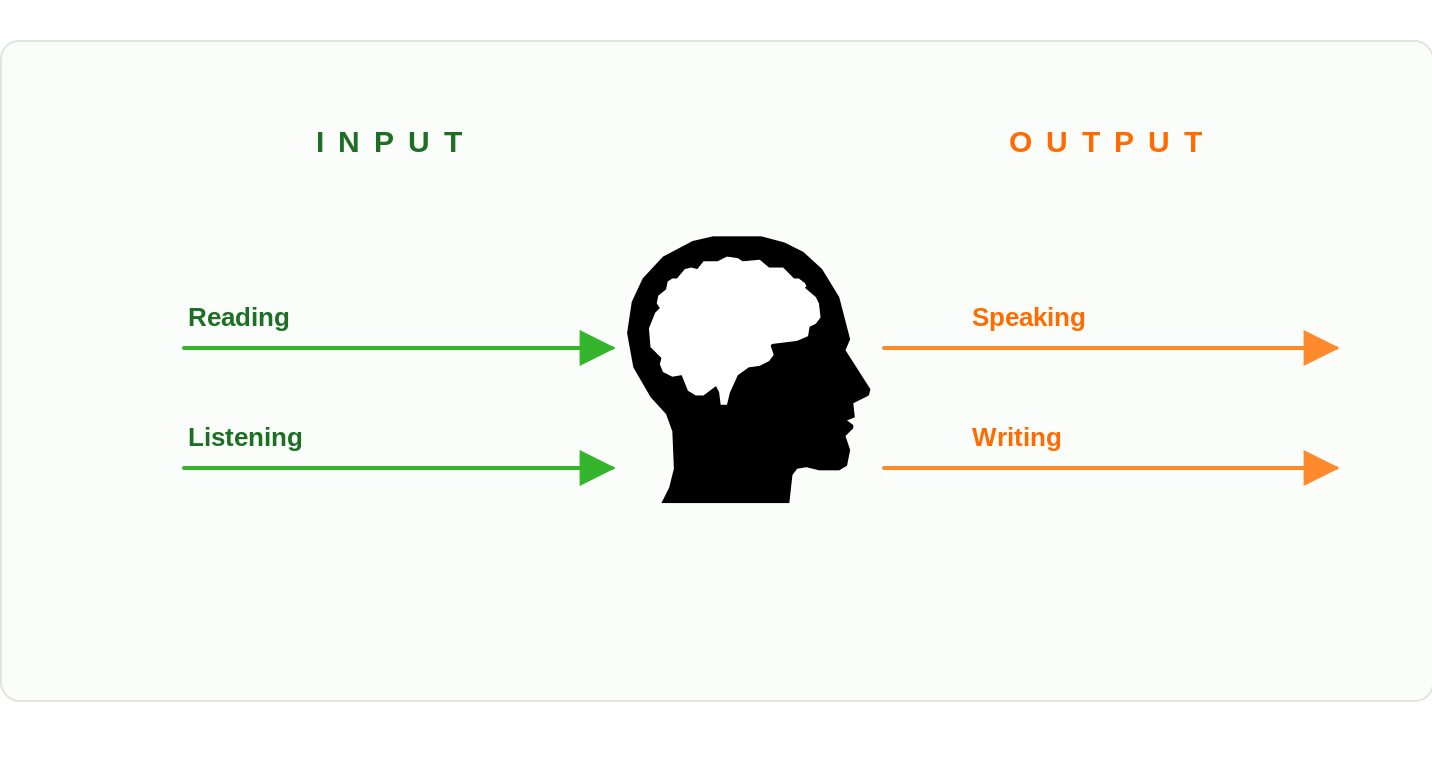
You learn language (your first language, your second language, your 10th language) one way and one way only: by getting lots and lots of comprehensible input.
The only way you can actually improve your language skills is by getting lots and lots of good comprehensible input.
But what’s “good input”?
Krashen says that input needs to contain something new for you to learn, but be familiar enough to you that you can still understand the message it communicates. This language that is just a bit above your current level (which he calls “i”) is referred to as “i + 1.”5
How do you know what your current level or “i” is?
It would require lots of testing to find that out for different parts of your language system, but the good thing is that if you focus on finding things you can mostly understand, you will probably be getting lots of “i + 1” input.
The real problem is that people often think they know more than they do!
This leads them to get frustrated at the fact that, for example, they can understand slow English but not fast English, or they can understand things but they can’t actually speak them.
The reason is explained by what linguists call the “receptive-productive gap.”
Why you can understand English but not speak it
If unconscious learning comes from input, you would expect adult learners to understand much more language than they can produce. That is exactly what we see.
Webb (2008) tested 83 Japanese university English as a Foreign Language learners on their receptive (“I know this when I see it”) and productive (“I can use this when I am asked to produce it”) knowledge of 180 words at three frequency levels. (Listening and reading, comprehending language, are receptive skills. Speaking and writing are productive skills.)6
Webb found that the more common a word is, the more likely the learner can both understand and speak it. The less common a word is, the wider the gap between recognition and use.
For very common words, the gap is small. For the words a learner needs to move from intermediate to advanced, the gap is much larger.
Roughly a third of the lower-frequency words a learner recognizes are not yet available for use.
Webb’s data show us, then, that you will usually understand more than you can speak.
A second study, Shin, Chon, and Kim (2011), tested 403 Korean high school learners across the first nine 1,000-word frequency bands of English.7 They found the same pattern Webb saw. Learners knew most of the very common words receptively, but their productive knowledge declined dramatically once they moved past the first 1,000 word families.
By the 5th 1,000 band, the average learner could recognize about 60% of the words but produce only about 16%. That is roughly a 4-to-1 gap. By the 9th 1,000 word band, the productive score was almost zero.
The conclusion here is that just because you know language enough to understand it does not mean you have completely learned it. In other words, your “i” or level of language may be lower than you think.
So when you say “I already know these words,” what is often the case is that “I know these words well enough to understand them when spoken slowly or by reading them, but I do not yet know them well enough to understand fast English or speak fluently.”
How much input is enough?
Researchers Waring and Takaki (2003) carried out a study, one that has been repeated many times, to show the importance of getting LOTS of input, especially for intermediates.
They had readers go through one short book and tested how many of the new words in the book they remembered after reading it. The answer: students could recognize, as receptive vocabulary, many words as long as they were repeated enough times in the text.
Most words required about 10 to 20 repetitions in the book before they were reliably “learned” well enough to understand them (“I know what that word means.”).8
But when it came time to produce the word, to recall it (productive vocabulary), 10 to 20 times was not enough.
In fact, students were unable to produce most of the words they saw (“recall” them).
We don’t have an exact estimate of the number of times you may need to see a word, but it may be two or three times the number needed to simply understand it.
Now, the wrong conclusion is that they just need to “study” more words!
Attempting to study the words one by one is, in fact, a very inefficient way of learning them. And we know from several studies that “memorizing” words doesn’t actually help even reading or listening comprehension (receptive tasks).9
The fastest, most effective way to learn words unconsciously is through hearing and reading them in context, in real English stories and conversations.
In other words, the fastest way to improve your vocabulary, to really learn the language, is by getting comprehensible input.
How to end the intermediate stall
You have heard enough English to understand a careful, clear speaker. But you have not heard enough English to:
- Understand a fast, native-paced speaker without effort.
- Pull words out of your own mouth in real time.
Both of those problems are the same problem in two different forms. They are an input problem.
Your brain does not yet have enough examples of the language used at speed. Your productive vocabulary, by Waring’s numbers, is roughly half your receptive vocabulary, which means most of the words you “know” are not yet automatic enough to use.
And research in the past 10 years tells us that this productive vocabulary is strongly correlated to your speaking fluency. Until you improve your productive vocabulary, your speaking will not get better.10
Most schools, apps, and tutors will tell you, at this point, that the answer is to speak more. Get a conversation partner. Force yourself to produce. Practice, practice, practice.
The research says this is backwards, the exact opposite of what you should be doing.
Remember, output (speaking) is a result of learning, not a cause of it.11
The intermediate plateau, then, is not a “speaking” problem or a “pronunciation” problem or a “practice” problem. It is an input problem.
Why Rich Comprehensible Input™ is the (only) way to get to fluency
This is the “gap” our method is designed to fill.
Rich Comprehensible Input™ is comprehensible input designed for adults who have “stalled” or slowed down in their progress in exactly the place I have just described.
Three principles run through every Unlimited English lesson Dr. Tse and I have created:
- The level is right. Lessons are pitched at i + 1. Slightly above where you are, but still understandable. It isn’t “authentic” content given to you with no help, which is often just noise. It’s also not beginner content, which is too low. In terms of vocabulary levels, we use primarily the first 3,000 to 4,000 of the most commonly used English word families, which are exactly the ones that are used in daily conversation. The reason this is important is that these are often the ones you “know” partially (you can understand many of them) but you have not yet fully learned well enough to understand them in fast English and in speaking.12
- The explanations stay in English. Hard words are explained with simpler English words (again, using those commonly spoken words), in context, in real sentences. There is no translation. This is what gets the new vocabulary into your brain unconsciously. The explanations are actually the most important part of the lesson, much more so than the “key terms” we discuss! You’re not expected to remember the key terms at the end of the lesson. The crucial thing is hearing and understanding the explanations themselves, which give you deeper exposure to the most commonly used word families.13
- The volume is high, and the repetition is built in. Words in that “conversation range” of up to 4,000 words come back across different lessons. By Waring and Takaki’s numbers, that is what “deep” learning for speaking and understanding fast English actually requires.14
This is also why our method does not ask you to speak before your brain is ready. It does not pretend that “drilling” output will somehow create input you never had.
The learners we see break through the intermediate plateau are not the ones who forced themselves to speak earlier. They are the ones who got hundreds of hours of language they could understand.
The speaking comes on its own. That is what forty years of research predicts, and it is what we see in our students.
Things that won’t help you
You should know enough about the science of language learning to understand why most of the things being sold as “language courses” are a complete waste of time.
They are not based on the scientific research at all, but on 19th century ideas (really!) of what learning a language requires.
You know now, for example, that you do not learn a language by speaking. Speaking is output, not input. It’s true that if you speak to someone, they might speak back to you and give you input. But it’s the input that matters, not the output.
Language tutors are not very helpful if you spend most of your time talking. You talking won’t directly improve your language. Again, that’s output, not input.
Studying grammar or morphology or pronunciation rules will not help you learn a language, either.
Why?
Because they are all examples of learning ABOUT a language, using conscious knowledge. And since conscious knowledge does not become unconscious learning, it won’t help you.
Also, there’s no time to use your conscious learning in real life, so “practicing” doesn’t help much. Conversations happen too quickly to stop and think about rules or memorized phrases.
Below is what you typically find in the language learning apps and courses on the internet, what each product is actually doing, and why each one fails to get you past the intermediate plateau.
| Popular method | What it really is | Why it fails |
|---|---|---|
| Duolingo, Babbel, and other “gamified” apps | Short, conscious drills on grammar and vocabulary, with points and “streaks.” | There is almost no real comprehensible input. You are studying about English, not learning it. |
| Rosetta Stone, Tell Me More, and similar software | Picture-to-word matching with a few short phrases. | There is very little real actual input. In one study, 99 per cent of users did not even reach the 10-hour mark of a 200-hour course of this type.15 |
| Pimsleur and other audio “repeat-after-me” courses | A small amount input, then a lot of “now you say it,” with over-use of concurrent translation. | Too much output is called for before the brain has heard enough input. The repetition drills are fake practice for your brain that is not yet ready to produce. |
| Conversation tutors (iTalki, Cambly, 1:1 language exchanges) | You speak. The tutor or partner corrects what comes out. | You cannot produce what you have not yet fully learned. The tutor becomes an audience for your gaps, not a source of input. |
| Vocabulary flashcards (Anki, Quizlet, paper cards) | Memorizing isolated word-translation pairs. | This is pure conscious study. The research shows this kind of memorization does not improve language comprehension.16 |
| Grammar workbooks and rule drills | Memorizing rules, then testing yourself on the rules. | This is learning about language, not learning a language. Conscious knowledge does not become unconscious learning. |
| Watching movies, news, or YouTube without help | Input that is usually not comprehensible. | If you understand less than 95 per cent of what is said, your brain has nothing to work with. The exposure is not input. It is noise. |
Each of these popular approaches ignores input entirely, supplies input you cannot understand, or asks you to produce language you have not yet acquired.
None of them is designed in the way the brain actually learns a language.
The reason Rich Comprehensible Input™ works is that it does the one thing the research says you must do: get understandable English, in volume, on topics you care about, with the harder words explained in simpler English so the message gets through. That is the only way to reach advanced fluency in a language.
Footnotes
- For the dropout figure across language study, see Dupuy, B., & Krashen, S. D. (1998). Survival of the fittest: ‘Surviving’ post-secondary foreign language programs. Mosaic, 5(2), 19–22; Furman, N., Goldberg, D., & Lusin, N. (2007). Enrollments in languages other than English in United States institutions of higher education, fall 2006. Modern Language Association; Draper, J. B., & Hicks, J. H. (2002). Foreign language enrollments in public secondary schools, fall 2000. American Council on the Teaching of Foreign Languages. For the commercial-software dropout figure cited in the table, see Nielson, K. B. (2011). Self-study with language learning software in the workplace: What happens? Language Learning & Technology, 15(3), 110–129; and McQuillan, J. (2019). And then there were none? Measuring the success of commercial language courses. International Journal of Foreign Language Teaching, 8(1), 2–5. See also Tse, L. (2000). Student perceptions of foreign language study: A qualitative analysis of foreign language autobiographies. Modern Language Journal, 84(1), 69–84. ↑ Back to text
- Krashen, S. D. (1982). Principles and practice in second language acquisition. Pergamon. See also Krashen, S. D. (2004). Applying the comprehension hypothesis: Some suggestions. Paper presented at the 13th International Symposium and Book Fair on Language Teaching, Taipei. ↑ Back to text
- Krashen, S. D. (1982). Principles and practice in second language acquisition. Pergamon. See also Krashen, S. D. (2004). Applying the comprehension hypothesis: Some suggestions. Paper presented at the 13th International Symposium and Book Fair on Language Teaching, Taipei. ↑ Back to text
- Krashen, S. D. (1982). Principles and practice in second language acquisition. Pergamon. See also Krashen, S. D. (2004). Applying the comprehension hypothesis: Some suggestions. Paper presented at the 13th International Symposium and Book Fair on Language Teaching, Taipei. ↑ Back to text
- Krashen, S. D. (1985). The input hypothesis: Issues and implications. Longman. ↑ Back to text
- Webb, S. (2008). Receptive and productive vocabulary sizes of L2 learners. Studies in Second Language Acquisition, 30(1), 79–95. ↑ Back to text
- Shin, D., Chon, Y. V., & Kim, H. (2011). Receptive and productive vocabulary sizes of high school learners: What next for the basic word list? English Teaching, 66(3), 123–148. ↑ Back to text
- Waring, R., & Takaki, M. (2003). At what rate do learners learn and retain new vocabulary from reading a graded reader? Reading in a Foreign Language, 15(2), 130–163. ↑ Back to text
- See Tuinman, J. J., & Brady, M. E. (1974). How does vocabulary account for variance on reading comprehension tests? A preliminary instructional analysis. In P. Nacke (Ed.), Interaction: Research and practice for college-adult reading (pp. 176–184). National Reading Conference; Pany, D., & Jenkins, J. R. (1978). Learning word meanings: A comparison of instructional procedures. Learning Disability Quarterly, 1(2), 21–32; Hudson, T. (1981). The effects of induced schemata on the “short circuit” in L2 reading: Non-decoding factors in L2 reading performance. Language Learning, 32(1), 1–31; Pany, D., Jenkins, J. R., & Schreck, J. (1982). Vocabulary instruction: Effects on word knowledge and reading comprehension. Learning Disability Quarterly, 5(3), 202–215; Jahangard, A., Moinzadeh, A., & Karimi, A. (2011). The effect of grouping and presenting selected TOEFL words on the vocabulary learning of EFL learners. Iranian EFL Journal, 7(2), 220–235. ↑ Back to text
- Uchihara, T., & Saito, K. (2019). Exploring the relationship between productive vocabulary knowledge and second language oral ability. The Language Learning Journal, 47(1), 64–75. See also Tong, Y., Hasim, Z., & Abdul Halim, H. (2022). The impact of L2 vocabulary knowledge on language fluency. Pertanika Journal of Social Sciences & Humanities, 30(4), 1723–1751. ↑ Back to text
- Krashen, S. D. (1998). Comprehensible output? System, 26(2), 175–182. See also McQuillan, J. (1997). The literacy crisis: False claims, real solutions. Heinemann; Tse, L. (2001). Why don’t they speak English? Separating fact from fallacy in the U.S. language debate. Teachers College Press; Krashen, S., Tse, L., & McQuillan, J. (Eds.). (1998). Heritage language development. Language Education Associates; Tse, L. (2001). Resisting and reversing language shift: Heritage language resilience among U.S. native biliterates. Harvard Educational Review, 71(4), 676–708. ↑ Back to text
- Krashen, S. D. (1985). The input hypothesis: Issues and implications. Longman. ↑ Back to text
- Krashen, S. D. (1982). Principles and practice in second language acquisition. Pergamon. See also Krashen, S. D. (2004). Applying the comprehension hypothesis: Some suggestions. Paper presented at the 13th International Symposium and Book Fair on Language Teaching, Taipei. ↑ Back to text
- Waring, R., & Takaki, M. (2003). At what rate do learners learn and retain new vocabulary from reading a graded reader? Reading in a Foreign Language, 15(2), 130–163. See also McQuillan, J. (2016). Time, texts, and teaching in vocabulary acquisition: A rebuttal to Cobb (2016). Reading in a Foreign Language, 28(2), 307–318; McQuillan, J. (2019a). Where do we get our academic vocabulary? Comparing the efficiency of direct instruction and free voluntary reading. The Reading Matrix: An International Online Journal, 19(1), 129–138. See also Tse, L. (1996). When an ESL adult becomes a reader. Reading Horizons, 31(1), 16–29. ↑ Back to text
- For the dropout figure across language study, see Dupuy, B., & Krashen, S. D. (1998). Survival of the fittest: ‘Surviving’ post-secondary foreign language programs. Mosaic, 5(2), 19–22; Furman, N., Goldberg, D., & Lusin, N. (2007). Enrollments in languages other than English in United States institutions of higher education, fall 2006. Modern Language Association; Draper, J. B., & Hicks, J. H. (2002). Foreign language enrollments in public secondary schools, fall 2000. American Council on the Teaching of Foreign Languages. For the commercial-software dropout figure cited in the table, see Nielson, K. B. (2011). Self-study with language learning software in the workplace: What happens? Language Learning & Technology, 15(3), 110–129; and McQuillan, J. (2019). And then there were none? Measuring the success of commercial language courses. International Journal of Foreign Language Teaching, 8(1), 2–5. ↑ Back to text
- See Tuinman, J. J., & Brady, M. E. (1974). How does vocabulary account for variance on reading comprehension tests? A preliminary instructional analysis. In P. Nacke (Ed.), Interaction: Research and practice for college-adult reading (pp. 176–184). National Reading Conference; Pany, D., & Jenkins, J. R. (1978). Learning word meanings: A comparison of instructional procedures. Learning Disability Quarterly, 1(2), 21–32; Hudson, T. (1981). The effects of induced schemata on the “short circuit” in L2 reading: Non-decoding factors in L2 reading performance. Language Learning, 32(1), 1–31; Pany, D., Jenkins, J. R., & Schreck, J. (1982). Vocabulary instruction: Effects on word knowledge and reading comprehension. Learning Disability Quarterly, 5(3), 202–215; Jahangard, A., Moinzadeh, A., & Karimi, A. (2011). The effect of grouping and presenting selected TOEFL words on the vocabulary learning of EFL learners. Iranian EFL Journal, 7(2), 220–235. ↑ Back to text
References
Draper, J. B., & Hicks, J. H. (2002). Foreign language enrollments in public secondary schools, fall 2000. American Council on the Teaching of Foreign Languages.
Dupuy, B., & Krashen, S. D. (1998). Survival of the fittest: ‘Surviving’ post-secondary foreign language programs. Mosaic, 5(2), 19–22.
Furman, N., Goldberg, D., & Lusin, N. (2007). Enrollments in languages other than English in United States institutions of higher education, fall 2006. Modern Language Association.
Hudson, T. (1981). The effects of induced schemata on the “short circuit” in L2 reading: Non-decoding factors in L2 reading performance. Language Learning, 32(1), 1–31.
Jahangard, A., Moinzadeh, A., & Karimi, A. (2011). The effect of grouping and presenting selected TOEFL words on the vocabulary learning of EFL learners. Iranian EFL Journal, 7(2), 220–235.
Krashen, S. D. (1982). Principles and practice in second language acquisition. Pergamon.
Krashen, S. D. (1985). The input hypothesis: Issues and implications. Longman.
Krashen, S. D. (1998). Comprehensible output? System, 26(2), 175–182.
Krashen, S. D. (2004). Applying the comprehension hypothesis: Some suggestions [Paper presentation]. 13th International Symposium and Book Fair on Language Teaching, Taipei, Taiwan.
Krashen, S., Tse, L., & McQuillan, J. (Eds.). (1998). Heritage language development. Language Education Associates.
McQuillan, J. (1997). The literacy crisis: False claims, real solutions. Heinemann.
McQuillan, J. (2016). Time, texts, and teaching in vocabulary acquisition: A rebuttal to Cobb (2016). Reading in a Foreign Language, 28(2), 307–318.
McQuillan, J. (2019). And then there were none? Measuring the success of commercial language courses. International Journal of Foreign Language Teaching, 8(1), 2–5.
McQuillan, J. (2019a). Where do we get our academic vocabulary? Comparing the efficiency of direct instruction and free voluntary reading. The Reading Matrix: An International Online Journal, 19(1), 129–138.
Nielson, K. B. (2011). Self-study with language learning software in the workplace: What happens? Language Learning & Technology, 15(3), 110–129.
Pany, D., & Jenkins, J. R. (1978). Learning word meanings: A comparison of instructional procedures. Learning Disability Quarterly, 1(2), 21–32.
Pany, D., Jenkins, J. R., & Schreck, J. (1982). Vocabulary instruction: Effects on word knowledge and reading comprehension. Learning Disability Quarterly, 5(3), 202–215.
Shin, D., Chon, Y. V., & Kim, H. (2011). Receptive and productive vocabulary sizes of high school learners: What next for the basic word list? English Teaching, 66(3), 123–148.
Tong, Y., Hasim, Z., & Abdul Halim, H. (2022). The impact of L2 vocabulary knowledge on language fluency. Pertanika Journal of Social Sciences & Humanities, 30(4), 1723–1751.
Tse, L. (1996). When an ESL adult becomes a reader. Reading Horizons, 31(1), 16–29.
Tse, L. (2000). Student perceptions of foreign language study: A qualitative analysis of foreign language autobiographies. Modern Language Journal, 84(1), 69–84.
Tse, L. (2001). Resisting and reversing language shift: Heritage language resilience among U.S. native biliterates. Harvard Educational Review, 71(4), 676–708.
Tse, L. (2001). Why don’t they speak English? Separating fact from fallacy in the U.S. language debate. Teachers College Press.
Tuinman, J. J., & Brady, M. E. (1974). How does vocabulary account for variance on reading comprehension tests? A preliminary instructional analysis. In P. Nacke (Ed.), Interaction: Research and practice for college-adult reading (pp. 176–184). National Reading Conference.
Uchihara, T., & Saito, K. (2019). Exploring the relationship between productive vocabulary knowledge and second language oral ability. The Language Learning Journal, 47(1), 64–75.
Waring, R., & Takaki, M. (2003). At what rate do learners learn and retain new vocabulary from reading a graded reader? Reading in a Foreign Language, 15(2), 130–163.
Webb, S. (2008). Receptive and productive vocabulary sizes of L2 learners. Studies in Second Language Acquisition, 30(1), 79–95.